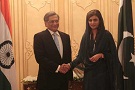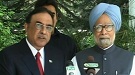
The prime minister, Manmohan Singh, while publicly expressing his
keenness to visit Pakistan, has also voiced his expectation several
times that the outcome would be substantial. It was earlier speculated
that by something “substantial” he had agreements on Siachen and Sir
Creek in mind. While he still thinks Sir Creek is doable, the hope for
an early resolution of the Siachen issue has receded. Although some
progress was made in past talks, the issue has become complicated
because of Kargil and the increased presence of China in Pakistan
occupied Kashmir. Now “substantial” means some credible progress by
Pakistan in bringing to justice those responsible for the Mumbai terror
attack. From the facts of the prime minister making his wishes known and
Pakistan ignoring them even as it continues to press for his visit, one
can infer that Singh is more keen on making the visit than Pakistan is
in facilitating it by giving him a minimum face-saving reason to do so.
At one level, there is nothing exceptional in heads of State and
government visiting one another. This is happening all the time in
international diplomacy. So why so much fuss about the opportuneness of
prime minister’s visit? In the case of India and Pakistan, though, the
decision whether to make a visit or not has an exceptional context.
India has long suffered from terrorism at Pakistan’s hands, without
this deterring it in the past to reach out to Pakistan at the prime
minister’s level as Atal Bihari Vajpayee did in 1999. Kargil followed.
In 2001, Vajpayee invited General Pervez Musharraf to Agra but the
initiative failed because Pakistan did not offer a clear-cut commitment
on terrorism. In 2004, Vajpayee went to Pakistan for the South Asian
Association for Regional Cooperation summit and obtained a carefully
worded commitment from Musharraf to prevent terrorism born on Pakistan’s
soil from being directed against India. A spate of terrorist attacks
nevertheless followed, but India did not interrupt the ongoing dialogue
in the hope that Pakistan would at some stage abjure such acts in its
own interest.
The dialogue collapsed, however, with the enormity of the 2008
terrorist attacks in Mumbai orchestrated by the Inter-Services
Intelligence-jihadi groups nexus. Again, after a gap, India
persuaded itself that the no-dialogue option was not sustainable and
that the compulsions of geography — which Pakistan disregards — dictated
that India begin talking to Pakistan again.
Four years have elapsed since the Mumbai attacks and two rounds of
dialogue have been held, but without any tangible move by Pakistan to
try those guilty of the Mumbai attack. Pakistan has used the excuse of
complex legal procedures and an independent judiciary to explain the
inordinate delay in doing so.
Meanwhile, to drive home to India the
futility of its demand, it allows Hafiz Saeed, the purported mastermind
of the Mumbai massacre, to engage freely in his anti-India jihadi
tirades. That it is unwilling to be put on the defensive on Mumbai is
indicated by its insistence on drawing a parallel between a meticulously
planned terrorist action by Pakistani nationals on Indian soil with
official Pakistani complicity and an isolated action by local Indian
terrorists on Indian soil without any official connivance.
Worse, Pakistan’s foreign minister insults reality and decency by
pretending that terrorism is no longer an issue between India and
Pakistan and advising us to be realistic and not emotional about the
Mumbai trial. Now, if the prime minister of India says that he will go
to Pakistan only if Pakistan demonstrates its sincerity by trying those
responsible for Mumbai and the foreign minister of Pakistan is
“appalled” that we raise the terrorism “mantra of the past”, this “old
time” stuff, as she calls it, where is the meeting ground between the
ways in which he and the Pakistani leadership see the issue? Our
concessions to Pakistan on terrorism, so that the bilateral dialogue can
continue, have unfortunately led to these scornful remarks by its
foreign minister. If the prime minister were still to go, Pakistan would
have diplomatically humiliated India finally on the terrorism issue.
To put the matter of the visit in perspective, our prime minister has
been meeting Pakistan’s president and prime minister quite regularly in
India or in third countries during international meetings, whether at
Ekaterinaberg, Sharm el-Sheikh, Thimphu, New York and, most recently,
Tehran. So, contact at the highest political levels is being maintained.
Our expectation has been that this willingness to engage with Pakistan
would encourage it to bring the pernicious and dangerous issue of
terrorism to a political closure bilaterally, as terrorism has the
potential to wreck the dialogue process if a Mumbai-like attack is
repeated. As it happens, Pakistan has succeeded in blunting India’s case
on terrorism even as the United States of America, ironically, has
increasingly exposed Pakistan’s duplicity on the issue. If the prime
minister were to go to Pakistan under these circumstances, we would have
allowed the latter to deny us the only deliverable we seek from it.
Apart from bilateral dimensions of the terrorism issue, there is the
international dimension. With religious extremism spreading in the Arab
world and organizations with a violent political past acceding to power
in hitherto “moderate Islamic states”, not to mention the current street
frenzy against the US unleashed by a film, India has to remain vigilant
about the impact of such developments on the popular spirit in the
region, linked transnationally through religion and ideology with
happenings beyond.
As a sign of the maturing of democracy in Pakistan and its polity
outgrowing its India obsession, Pakistani commentators had noted that
India had not figured as an electoral issue in the last general
elections there. If so, why should the prime minister’s visit at this
juncture play electorally in favour of the civilian government,
especially President Asif Ali Zardari’s, in any significant way? India,
in fact, has never been in a position to influence internal developments
in Pakistan to suit its interests. We should discard any illusions in
this regard.
While Zardari, no doubt, has relatively congenial views on India,
they do not get reflected sufficiently in policymaking. Pakistan’s
president, highly embattled politically, is hardly in a position to
deliver on substantive issues. In any case, the civilian government
cannot escape responsibility for the lack of progress on various issues
that bedevil our relations, apart from trade where different dynamics
are at play. Let us also not forget that it is not the military that
created Pakistan but civilian politicians. Civilian politicians were
fully complicit in Pakistan’s Afghanistan adventure, the unleashing of
terrorism in Kashmir, the country’s clandestine nuclear and missile
exchanges with North Korea and the anti-Indian thrust of the China
relationship. We should not entrap ourselves into the civilian good guys
versus the military bad guys equation.
Elections are due in Pakistan latest by February 2013. Before that, a
caretaker government will take over. For practical reasons, the timing
of a prime ministerial visit at this juncture would therefore be
ill-advised. For those who advocate that he visit Nankana Sahib on
November 28 and his village at Gah should remember that Guru Nanak’s jayanti
will be celebrated next year too and Gah will not be effaced from the
map in the years to come. So, let’s wait for Pakistan to deliver on
terrorism first.