Showing posts with label Lok Sabha. Show all posts

Wednesday, August 27, 2014

Article 331 Needs A Re-look: Open Lok Sabha Nominations to Parsis Also

Dr. A Surya Prakash, 
Distinguished Fellow, VIF

The House of the People (the Lok Sabha) has 543 elected members and two nominated seats. Article 331 of the Constitution stipulates that the nominated seats are exclusively for members of the Anglo-Indian community. This provision was made in 1950 in order to reassure the Anglo-Indians that their voice would continue to be heard in Parliament even after the departure of the British. Similarly, Article 333 of the Constitution provides for nomination of one member of this community to the assembly of a state, where such nomination is deemed necessary. Currently, Anglo-Indians enjoy this privilege in eight state assemblies.

There were around 800,000 Anglo-Indians in India in the 1940s. However, over the past six decades, a major section of the Anglo-Indians has migrated to many countries in the Commonwealth including the United Kingdom, Australia and Canada. The community has experienced demographic decline for other reasons as well. Current guesstimates put the number of Anglo-Indians in India at around 1,00,000. Because of the steady decline in population, successive governments at the Centre have found it difficult to find worthy candidates for nomination to the House of the People.

Meanwhile, another community – the Parsis – which has made an extraordinary contribution in various walks of life in the country faces the threat of extinction. The Parsis, who numbered just around 100,000 in 1971 dwindled to 69601 in 2001.1

Demographers estimate that their numbers would touch an abysmal 23,000 in a couple of decades.

It is therefore proposed that Article 331 and 333 of the Constitution be amended to throw open the nominated seats in the Lok Sabha and the state assemblies to both the Anglo-Indians and the Parsis. This will give much needed political strength to India’s smallest ethnic cum religious minority and re-inforce the country’s commitment to its secular ideals. Side by side, this move will preserve the country’s commitment to the Anglo-Indian community despite its depleting numbers.

It must be noted that although the Anglo-Indians were given this special privilege via Article 331, it is not a blanket assurance. Article 331 says “Notwithstanding anything in article 81, the President may, if he is of opinion that the Anglo-Indian community is not adequately represented in the House of the People, nominate not more than two members of that community to the House of the People”.2

When the Constitution came into being in 1950, there were around 8 lakh Anglo-Indians in India. Their number is now just around one lakh. Therefore, if our Constitution-makers felt that “not more than two members’ could be nominated to ensure “adequate representation” when their numbers were around eight lakhs, surely one nomination should be adequate now to meet the requirement of “adequate representation”?

Secondly, when every elected Member of the Lok Sabha today represents around 2.5 million people, how can the 100,000 strong Anglo-Indian community argue that they need two seats in that House to ensure their “adequate representation”?

Articles 331 and 333 should be amended to accommodate the Parsis, who are desperately in need of a political voice in India’s Parliament. For example, Article 331 could be amended to say: “Notwithstanding anything in article 81, the President may, if he is of opinion that the Anglo-Indian or the Parsi community is not adequately represented in the House of the People, nominate two members, drawn from either or both of these communities to the House of the People”. Article 331 too could be suitably amended.

Given their declining numbers and the vulnerability of yet another ethnic cum religious community, the Anglo-Indians need to accept the scaling down of this privilege. They cannot have this privilege for perpetuity because the Constitution, which is a dynamic document, has to respond to contemporary needs and reality. In any case, this is akin to the withdrawal of other privileges given to the Anglo-Indians in Articles 336 and 337. These articles provided guarantees to this community in regard to government jobs and educational grants. These privileges have since been withdrawn.3

Also, the Anglo-Indians, despite their dwindling numbers, are the only community in India to still enjoy the privilege of having a nominated seat in several state assemblies as well.

When the Constitution was adopted, the Governor of a state had the prerogative to nominate as many Anglo-Indians as he deemed necessary to ensure ‘adequate representation” of the community in the state assembly. However, this amendment changed the original Article 333 to limit the number of nominated Anglo-Indians to one per assembly.4

The state assemblies where the nominated seats are available to Anglo-Indians are: Andhra Pradesh, Karnataka, Kerala, Jharkhand, Tamil Nadu, Bihar, West Bengal and Uttarakhand.

Given the demographic reality and the full and complete integration of the community with the rest of the country, this privilege appears to be wholly anachronistic. The Anglo-Indians must certainly share this with communities that are even more disadvantaged than them like the Parsis or support the move to have these articles scrapped. Should Article 333 be amended on these lines, the Parsis could get nominated to the Maharashtra and Gujarat assemblies.

Such is the worry over the declining population of the Parsi community that the government has launched a special scheme called Jiyo Parsi to check their population decline. Now, a bigger political step must be taken to bolster the community’s spirits : nomination in the House of the People.5

Even President Pranab Mukherjee has expressed concern over the worrying demographic situation of the Parsis in December, 2013. Speaking at the 10 th World Zoroastrian Congress, the President described the Parsis as “the intangible cultural heritage of humanity”. He recalled the extraordinary contribution of members of this community to India, including Dadabhai Naoroji, the first Asian to be elected to the British House of Commons, Jamshetji Tata, Madam Bhikaji Cama, Homi Bhabha, J.R.D.Tata, Field Marshal Sam Manekshaw, Admiral Jal Cursetji, Air Chief Marshal Aspy Engineer and Air Chief Marshal Fali H Major and called for “sensible and pragmatic measures” to revive this community.6

Like the Parsis, the contribution of Anglo-Indians to our national life is far beyond their numbers. They have made pioneering contribution in the field of education and sports and laid the foundation for excellence in the railways, post and telegraph and many other government departments. Their contribution in the fields of art and literature is equally phenomenal. Some names that instantly come to mind are: George Orwell, Rudyard Kipling, Russel Peters, Engelbert Humperdinck, Cliff Richards and Frank Anthony and contemporary icons such as Ruskin Bond, Roger Binny etc.7

The Anglo-Indian community needs to realize that there were objections to these provisions when they were discussed in the Constituent Assembly. For example, Sardar Hukam Singh moved an amendment to ensure that these nominations were not the exclusive preserve of the Anglo-Indians. There were others who felt that the Anglo-Indians needed such nominations because they were few in number and scattered all over the country. Mr. M.Ananthasayanam Ayyangar said ‘You cannot point out any constituency where they (the Anglo-Indians) will be in a majority. Therefore, this exception has to be made, because they may not come in through the process of election”.8

Article 333 appeared to be based on this reasoning. If this be the basis for nominations to the Lok Sabha, the Parsis would eminently qualify.

Anglo-Indians are now fully integrated with the rest of the population and are also marrying out because of demographic compulsions. The time has come for them to face the reality and share the nominations with another community in distress. As stated earlier, the privileges accorded to the Anglo-Indians vis-à-vis jobs and educational grants in Articles 336 and 337 were completely withdrawn around half a century ago. Further, the number of nominated seats for Anglo-Indians in state assemblies was whittled down through the Constitution (Twenty-Third Amendment) in 1969. Therefore, given their receding numbers, the time is not far off when citizens will demand an end to this anachronism in India’s Constitution. One way in which they can avert this is to share this privilege with another community – the Parsis - which badly needs political empowerment. Will the Anglo-Indians see the writing on the wall?

Endnotes:
  1. Pp xxiv, The First report on Religion Data, Census of India 2001,
  2. Article 333, The Constitution of India
  3. Ibid, Articles 336 and 337
  4. See the Constitution (Twenty-Third Amendment) Act, 1969 http://indiacode.nic.in/coiweb/amend/amend23.htm
  5. http://timesofindia.indiatimes.com/city/delhi/Govt-scheme-to-boost-popul...
  6. http://www.business-standard.com/article/pti-stories/president-praises-p...
  7. http://en.wikipedia.org/wiki/List_of_Anglo-Indians
  8. Pages 660-662, Volume IX, Book 4, Constituent Assembly Debates

Published Date: 20th August 2014, Image source: http://www.indianetzone.com

Friday, May 3, 2013

Politics of The Rich, by The Rich and Supposedly for The Poor!


Dr. A Surya Prakash, 
Distinguished Fellow, VIF

An analyses of the affidavits filed by candidates contesting the Karnataka Assembly election on May 5 provides further evidence that politics is now completely out of the reach of the poor and the middle classes. These affidavits also offer irrefutable evidence that there is no business like the “business of politics” in the country. There are also indicators that politics may not be a good calling for law-abiding citizens because there is steady rise in the number of candidates with criminal records or pending criminal cases.

Ever since the high judiciary stepped in and directed that those contesting assembly and parliamentary elections must declare their educational qualifications, pending criminal cases and assets and liabilities, voters across the country, who were totally clueless about the antecedents of the candidates now have some information to go on while exercising their franchise in state assembly and Lok Sabha elections. Though the information available via the affidavits filed by contestants may be patchy, it provides valuable clues about how each candidate is placed in terms of his education, financial status and criminal record. Sometimes the contents of these affidavits may be useful, but they can be disturbing as well.

According to Karnataka Election Watch (KEW) and Association for Democratic Reforms (ADR), who analyzed the affidavits of 1052 candidates put up by six major political parties, 220 candidates (21 per cent) have pending criminal cases against them. Of them, about ten per cent of the candidates are facing serious criminal charges like murder and rape. The four major parties in the fray - Congress, BJP, Janata Dal (S) and Karnataka Janata Party – have given around 20 -25 per cent of their tickets to persons with criminal record.

KEW also analysed the affidavits of 347 candidates who had contested the assembly election in the state in 2008 and who are once again the fray in order to assess the financial standing of candidates. This analysis tells us a lot about how lucrative politics has become in the country. The increase in the value of assets owned by most of these candidates now as compared to what they possessed in 2008 is mind boggling. The value of assets possessed by these candidates has jumped by 79 per cent in just five years and on an average is Rs 6.25 crore per candidate. Also, the point to note is that not all of these candidates won the last election. This means that just being in politics is enough to ensure a steady rise in the net worth of a candidate.

Interestingly, the three candidates who have the highest declared assets are from the Congress Party. They are: Mr. Priyakrishna contesting from Govindarajanagar constituency in Bangalore City (Rs 910 crores); N.Nagaraju from Hoskote Constituency (Rs 470 crores) and Anil Lad of Bellary City (Rs 288 crores).

According to KEW analysts, the average assets held by 118 re-contesting candidates of the Congress Party today is Rs 24.85 crore while that of 93 BJP candidates in Rs 10.50 crore. Re-contesting candidates of the Janata Dal (S) have average assets of Rs 10.34 crore each while that of the re-contesting KJP candidates is Rs 3.15 crore. Among individual candidates, three Congress candidates stand out. Mr. D.K Shivkumar, a prominent Congress Leader contesting from Kanakapura Constituency heads the list. In 2008, his total assets amounted to Rs 75 crores. Today, after five years, he is worth Rs 251 crores – a jump of Rs 176 crores. Another Congress candidate from Bangalore - Priyakrishna of Govindrajnagar Constituency, was worth Rs 767 crores in 2008 and is now worth Rs 910 crores. Santosh Lad, also of the Congress Party, had assets worth Rs 61 crore in 2008. In 2013, this has jumped to Rs 186 crore.

Finally, a word about how candidates splurge money. Currently, in Karnataka, the buzz in many constituencies is that this election will cost every serious candidate at least Rs 5 crores. Political leaders say that candidates’ spending could even be between Rs 5-10 crores in many constituencies. Although this is way above the permitted ceiling by the Election Commission, all political parties are geared up for this kind of spending. In fact the major political parties are reportedly giving their candidates upwards of Rs one crore. But they expect the candidates to raise the rest. That is why political parties like the Congress, BKP, JD(s) and KJP look for wealthy candidates. They see a poor or middle class ticket aspirant as a liability and often reject him or her even though that person’s electoral prospects may be good. The commission is keeping a close watch on ostentatious spending and this has robbed the election of its usual noise and colour, but when it comes to bribing voters, politicians claim that they still have their way. They know where and when to pass on cash for bulk purchases among economically vulnerable voters. That is why the common man had become a rarity among candidates and terms like “social service” and “public service” have gone out of the window. Many politicians say elections are now a “Cash & Carry” business. It is not for the faint-hearted, nor is it for ordinary people with decent bank balances. No wonder, KEW reports that out of 1052 candidates from six major political parties, 681 (65 per cent) are crorepatis.

Reminds one of the 1970s hit by ABBA: “Money, Money, Money; Must be Funny; In the Rich man’s world!”

Monday, April 8, 2013

Need for A Collegium to Choose The Next CAG


A Surya Prakash 
(Distinguished Fellow, VIF)

Speaking on the role and functions of the Comptroller and Auditor General (CAG) of India in the Constituent Assembly on May 30, 1949, Dr. B.R. Ambedkar, Chairman of the Constitution Drafting Committee, said that this officer was “probably the most important officer in the Constitution of India” because he is the one man who is going to see that the expenses voted by Parliament are not exceeded or varied. “If this functionary is to carry out the duties- and his duties, I submit, are far more important than the duties even of the judiciary ………I personally feel that he ought to have far greater independence than the Judiciary itself”.

Without exception, every member of the Constituent Assembly who spoke on the articles relating to the CAG, including T.T. Krishnamachari (TTK), Pandit Hirday Nath Kunzru, K.T. Shah and R.K. Sidhva – fully endorsed Dr. Ambedkar’s sentiments. The primary objective of the assembly appeared to be to clothe the CAG with such powers that the executive would in no circumstances be able to weaken his independence and objectivity. As a result, the first amendment moved that day was to change the nomenclature of the Auditor General to Comptroller and Auditor General, because as TTK said, the function of the Auditor General is not merely to audit but to have a control over the expenses of government. The nomenclature, he said, should be in consonance with the duties that are entrusted to him by the constitution. The House also took some more decisions in this regard, including the decision to put the administrative expenses of the office of the CAG including salaries, allowances and pensions payable on the charged account (meaning that these expenses would not be voted upon by parliament); to have the President appoint the CAG by warrant under his hand and seal; to affirm that the CAG can only be removed from office in like manner and on the like grounds as a Judge of the Supreme Court; and to direct that the appointee shall, before entering office, make and subscribe before the President, an oath or affirmation as set out in the Third Schedule. The debate in the Constituent Assembly and the final wording of these Articles in the Constitution tells us a lot of the exalted perch that the founding fathers gave to the CAG.

This background is essential in order to understand the mischief that may be afoot at this juncture to undermine the independence of this institution while choosing a successor to Mr. Vinod Rai, the incumbent CAG, with whom the Congress Party- led United Progressive Alliance (UPA) government at the Centre has been having a running feud. The Union Government has repeatedly locked horns with the CAG over the last two years because its image has taken a beating over the scams exposed by the country’s supreme audit agency including the ones relating to the conduct of the Commonwealth Games and the scandalous and unfair manner in which 2G Spectrum and coal blocks were sold to private entities. Since they had no credible defence, several ministers in the Union Government and some leading members of the Congress Party have gone on the offensive and tried, without much success though, to accuse the CAG of having a political agenda.

Meanwhile, since the incumbent CAG, Mr. Rai is due to retire in May, 2013, there is a lurking fear that the government may see this as a god sent and try to have a “committed” CAG in place, just like the “committed judiciary” that the Congress Party wanted during the Emergency. This fear is not without basis. In fact, Mr. V. Narayansamy, the Minister of State in the Prime Minister’s Office let the cat out of the bag some months ago when he told PTI, the reputed news agency, that the government intended to make the office of CAG a multi- member body. In that interview the minister had claimed that the government was considering the recommendations made by the V.K. Shunglu Committee on broad-basing the CAG and making it a multi-member body. The minister’s statement, coming as it did in the wake of the financial scandals unearthed by the CAG, caused a political uproar forcing the minister to retract and even claim that he had been “misquoted”. But, this was enough for all to realize that the government’s intentions were to be doubted.

There is a history to these fears because the Congress Party, which enjoyed a two-thirds majority in Parliament in the 1970s, turned India’s democracy into a dictatorship, made drastic constitutional changes to weaken the judiciary and virtually wrecked the independence of many constitutional authorities, including the CAG. The mantra in those days, as stated earlier, was a “committed” judiciary – meaning a judiciary committed, not to the Constitution, but to the Prime Minister of the day Mrs. Indira Gandhi. Similarly, the government, which had imposed the Emergency in 1976, passed orders to weaken the office of the CAG. We have it on the authority of Mr. Y. Krishnan, former Deputy CAG, that until 1976, all papers and documents pertaining to the subject matter under audit scrutiny were made available to CAG and this included secret and confidential records. However, in 1976 the government decided that “only books and accounts need be made available to Audit and it was not obligatory for government to furnish records or papers containing discussions within government, leading to a particular decision or formulation of a particular policy”. Luckily the Janata Party which was voted to power in 1977 repaired much of the damage done to our democratic Constitution by restoring the original articles and deleting the obnoxious amendments introduced during the Emergency. Similarly, the orders passed to weaken the CAG in 1976 were withdrawn and the original authority of the CAG was restored by the Janata Party, which put democracy back on track.

However, it would be unwise to think that these undemocratic tendencies are now part of history, because the ruling dispensation has often laboured to remind us that the Emergency mindset is still alive and kicking. Two recent decisions of the government – the appointments of Mr. Navin Chawla as Election Commissioner and Mr. P.J. Thomas as Central Vigilance Commissioner – go to establish that the Congress Party’s discomfort with healthy democratic norms and independent constitutional authorities persists. The damage that these appointments did to the democratic environment will be discussed a little later.

Meanwhile, if we are to prevent the executive (politicians) from undermining the constitutional scheme, a collegium approach to the selection of the CAG becomes an urgent necessity. The CAG is fully empowered by Articles 148-151 to discharge his functions independently and fearlessly. But if the choice of the CAG is left to the government of day, especially in times such as these, there is every danger of the government choosing a person who is not strong enough morally and ethically to leverage the powers vested in him by the Constitution and act without fear or favour.

Some retired bureaucrats and Members of the Forum of Retired Officers of Indian Audit and Accounts Service have fired the first salvo in this regard by writing to the President Mr. Pranab Mukherjee and the Prime Minister demanding that the need of the hour is a “transparent, institutionalized selection mechanism” for choosing the next CAG.

They have suggested that a Committee headed by the Prime Minister and comprising the Finance Minister, the Lok Sabha Speaker, the Leader of the Opposition in the Lok Sabha, the Chairman of the Public Accounts Committee and the Chief Justice of India or a legal luminary should be constituted to select the CAG. The signatories to this memorandum have also referred to the precedents that now exist for adopting the collegium approach to appoint persons to high offices. They refer to the committees constituted to choose the Central Viligance Commissioner and the Chairman of the National Human Rights Commission Chairman. The same procedure should be adopted to select the CAG, they say. Does this not merit consideration in view of the past record of the UPA?

Wednesday, March 13, 2013

Turning India into An Aerospace Power House to end Defence Import Scams


Radhakrishna Rao 
(Research Fellow, VIF)

Frequent eruption of scams and scandals surrounding India’s high profile defence acquisition programme, besides delivering a severe blow to the defence preparedness of the country, has brought into sharp focus the abysmal failure of the country, boasting one of the largest pools of scientific and technical manpower in the world, to develop a strong and versatile indigenous base for defence and aerospace production. Against this backdrop, the exposure of the massive kickback involved in the Rs.36,000-million deal for the acquisition of 12 VVIP helicopters from Agusta Westland, a wholly owned subsidiary of the Italian firm Finmeccanica, in which the Italian Government holds 30% stake, has sent shock waves through the defence setup and political establishment of the country. Indeed, while replying to the searching queries of the agitated members in the upper house of the Indian Parliament (Lok Sabha) Indian Defence Minister A.K. Antony was at pains to explain that India is forced to import defence hardware to meet the immediate operational requirements of the Indian defence forces and that the defence self reliance would be stepped with a greater vigour to end Indian dependence on imported hardware and equipment.

Of course, Indian Defence Minister A.K. Antony, known for his clean image and impeccable personal integrity, has asserted that no mercy will be shown to the “guilty and wrong doers”. Rightly and appropriately, Antony gave a philosophical edge to this unsavoury episode by his observation that “there was no end to human greed and still greedy people were working around the world”. But then the moral of the story that had gone sour is that India’s continued dependence on overseas vendors for meeting much of its defence requirements is at the root of “impropriety and corruption” associated with the defence procurement programme. Indeed, as one defence analyst has put it, boosting domestic defence and aerospace production base holds the key to end the lurid saga of kickbacks that have became an integral part of the defence import. Indeed, Antony has been making use of every platform to urge the state owned Defence Research and Development Organisation (DRDO) to acquire the latest technological expertise to reduce Indian dependence on foreign vendors for defence and aerospace products.

Yet another disclosure by Antony in Lok Sabha has the potential to generate a debate on the need to undertake costly upgrades of old aircraft platforms instead of going in for new platforms. The crux of Antony’s statement in Indian Parliament was that the cost of upgraded and modernized French origin Mirage-2000 aircraft in service with the Indian Air Force (IAF) could be close to its shelf price if India wished to buy these aircrafts afresh now. As it is the cost of upgrading one Mirage-2000 fighter works out to Rs.1950-million. India had signed a Rs.109, 470-milliion contract with France for upgrading the Mirage-2000 fleet way back in 2011. Incidentally, India had purchased 51 Mirage-2000 fighters way back in 2000 with per piece price of Rs.1, 300-million. The whole episode is a tribute to the poor home work done by the Indian Defence Ministry which should be more circumspect while committing public money for defence acquisition and up-gradation programmes, some of which are really questionable. It is high time the Indian Defence Ministry fine tunes its strategy for “getting right type of equipment at right time in right place.” Of course, inordinate delay and cost escalation continues to remain the scourge of the Indian defence procurement programme right from the word go.

Unfortunately, India has notched up the dubious distinction of being the world’s largest importer of defence equipment constituting about 10% of the global arms import between 2007 and 2011. In its 2005 report on defence acquisition, the Vijay Kelkar Committee quoted that a just 25% reduction on foreign dependence will lessen foreign exchange outgo by around Rs. 85-billion. For long, the Indian defence production sector has been dominated by the state controlled defence public sector undertakings (DPSUs) including HAL and BEL (Bharat Electronics Limited), the Ordnance Factory Board (OFB) and various laboratories forming part of Defence Research and Development Organisation (DRDO) with very peripheral role for the private sector industry in the exercise of producing hardware and equipment for the Indian defence forces.

Of course following the opening up of the defence and aerospace sector for private participation, a greater role for India’s privately held entities in the defence production sector is being envisaged. For instance, in a major departure from the conventional approach to defence production and acquisition, Indian Defence Ministry would soon issue a Request for Proposal (RFP) to a number of private Indian enterprises including Reliance, Tata, Larsen and Toubro and Bharat Forge, for the production of 56 aircraft in six-to eight tonne class. This aircraft, which will replace the vintage Avro planes in service with the Indian defence forces, will have a cruise speed of 800 kmph and a range of 1500-km to 2700- km. As envisaged now, it will have far superior features in comparison to Avro. However, in the backdrop of the fact that the Indian industry has a very poor track record in the design and development of flying machines, they will be required to join hands with an established global aircraft major that will do the necessary hand holding in producing this aircraft which IAF badly needs as a replacement to Avro. The idea of IAF that Avro replacement project should be handled by the Indian private industry rather than HAL augurs well for giving a boost to the Indian aerospace capability in all its manifestations.

And in what can considered a shot in the arm for India’s defence indigenization programme, an Indian version of the Swedish 155-mm Bofors Howitzer, whose acquisition by India in 1980s, had created a big political storm in the country, is to be produced by OFB. As it is, during 1999 short lived Kargil skirmish, Bofors gun had proved its mettle through the lethal fire power. The Indian Defence Ministry has placed an order worth Rs.12, 600-million with OFB for the procurement of 114 of the artillery guns being developed based on the designs obtained under the transfer of technology provision as part of the Bofors contract signed in 1986. This exercise would give India a required level of confidence and expertise to design and develop futuristic, advanced howitzers required by the Indian army.

During his inaugural address at the Aero India-2013 show held in Bangalore in February this year, Antony was quick to point out that the country should harness all options including public-private participation(PPP), joint ventures, licensed production and technology transfer to attain self reliance in all the conceivable areas of aerospace and defence production.” Zero import is not possible but maximum equipment should be indigenous. We will have a second look about our defence production as well as procurement policy so that we can speed up indigenisation on time,” was the observation of Antony. The defence procurement policy was revised as early as 2011.

Air Marshal S. Sukumar, Deputy Chief of the Air Staff, Indian Air Force (IAF) while addressing the seminar “Rising with collaborative Opportunities” held as part of Aero India-2013 stated that the need of the hour is to boost the capability levels of IAF through an increased indigenous efforts in the defence and aerospace sectors of the country. Giving details, he said many Indian companies have successfully developed critical components and subsystems for many of the end products required by IAF. They include helmet mounted displays and transmit and receive modules. Home grown fourth generation supersonic fighter aircraft Tejas LCA(Light Combat Aircraft) and Indo-Russian supersonic cruise missile BrahMos stand out as classic examples of India’s growing prowess in aerospace and defence sectors.

According to Sukumar, a highly skilled, cost effective manpower pool and vibrant software and IT industry could be the major drivers of the indigenisation. There is no denying the fact that India’s prowess in Information Technology (IT) and software services industry is today recognised across the world. The striking feature of India’s IT and software success story was that, to a large extent, it was scripted by a smart group of visionary private sector entrepreneurs keen on entering the global market by exploiting the “low cost advantage” offered by India. Apparently, the Government stepped in subsequently as a facilitator to give a boost to the IT and software sector through a series of incentives and concession even as the initiative continued to be in the hands of the private sector entrepreneurs. Of course, it must be said to the credit of Government of India that it played a crucial role in introducing and popularizing the concept of Special Economic Zone (SEZ) and exclusive Technology Parks to give a” fresh thrust ” to the “human intensive” IT and software enterprise and take it to the “next level of growth”. What is more, this development implied that the scope of SEZ and technology parks was extended to embrace other nationally important sectors including aerospace and automobile industry.

Needless to mention, India’s aerospace industry is much older than its IT and software sector. The origins of the Indian aeronautical enterprise goes back to early 1940s when the visionary industrialist Walchand Hirachand established Hindustan Aircraft Company in Bangalore with a view to produce military aircraft for the then Royal Air Force. But despite such an impressive legacy, India’s state owned defence enterprise Hindustan Aeronautics Limited (HAL) could not achieve the kind of stature that country’s much younger IT and software industry could attain. That the Indian aerospace products and services account for less than 1% of the rapidly expanding multibillion dollar global aerospace market is in itself a telling commentary on the failure of the country to build up a “vibrant and versatile” aerospace industry base and position India as major aerospace hub of global standing.

Why HAL could not blossom into an enterprise on par with Brazilian Embrarer is a question that needs immediate and serious consideration. On another front, if the Indian Space Research Organisation (ISRO) could pull off a space spectacular in the form of Chandrayaan-1, India’s first mission to moon, what prevented HAL, which is much older to ISRO, from positioning India as a high profile aerospace nerve-centre is an issue that needs to be deliberated upon with all the seriousness it deserves.

Not surprisingly then Antony has chided HAL from various platforms for the “the delay and time slippages” in realizing many of the nationally important programmes. What is more, during Aero India-2013 held at Bangalore in February this year, IAF Chief Air Chief Marshal N A K Browne had stressed the point that the Intermediate Jet Trainer (IJT) being developed by HAL which is behind schedule by at least one decade, had serious problems with its engines and as such cannot be accepted in the current configuration. Further, Browne also made the point that HAL’s planned basic trainer would cost more than Swiss made Pilatus, 75 of which have been purchased by IAF. This implies that HAL would need to be serious about sprucing up its act and positioning itself as a dynamic, forward looking, aerospace entity capable of providing a serious competition to global aerospace majors.

There is no denying the fact that the virtual monopoly of HAL on India’s aerospace and defence sectors-- till a decade back when Government opened up the defence production for private participation-- was partly responsible for the sense of “complacency and smugness” permeating the vitals of this leading aerospace enterprise in South Asia. Indeed, lack of competition meant a slow and steady growth of “lethargy and incompetence” with serious consequences for nurturing the “creative talent” that HAL had in abundance. Similarly, bureaucratic interference, stranglehold of the defence establishment obsessed more with meeting its requirements than developing a home grown technology base as well as the denial of freedom for HAL to move ahead with new and innovative projects meant “creative thinking and spirit of innovation ”could no longer be sustained. Indeed, the poor performance of HAL over the years was the result of a variety of factors beyond its control. Though Government of India is planning to restructure HAL by diluting its own stake in the company, whether this move will lift this Indian aeronautical giant from its current state of mediocrity no one is sure as yet.

Further, the route of licensed production that HAL chose with a view to honour the contracts from the Indian defence forces in a timely and economically viable fashion proved to be its own undoing. For such a step resulted in the stifling of “talent and expertise” required to build up a home-grown design, development and manufacturing capability for producing a range of aircraft, helicopters and advanced aerial vehicles. Moreover, the sustained neglect of civil aviation and narrow focus on defence aerospace points out to the serious blunder committed by HAL. For civil aviation and defence aerospace have many common and shared technological elements from which HAL would have derived a synergy to build up a total aerospace eco system to position itself as a “globally competitive aerospace enterprise”.

The ground reality is that India would need to look beyond HAL to give a “new dimension and wider reach” to its aerospace sector. It is here that the SEZs could be developed as a “force multiplier” for the national aerospace enterprise which would need a global reach to survive and thrive. Through its integrated and state of the art facilities and human expertise and domain skill spanning a wide range of areas critical to defence and aerospace production, an aerospace SEZ can position itself a full-fledged high tech eco system capable of meeting the diverse requirements of a variety of customers from across the world.

India’s first aerospace SEZ at Hattargi near Belgaum in Karnataka promoted by QuEST Global is designed to serve as a well equipped eco system offering complete “design to build” services, right from the concept design to the final, finished product meeting the stringent international quality standards. The strategic advantage of having players across the value chain in the same location would be the amount of time saved in moving parts from one location to another as well as the associated cost of logistics.

Significantly, locations such as Wichita in USA and Toulose in France matured into widely patronised aerospace hubs through the dynamics of “cluster phenomenon”. Aerospace focussed SEZs with an eco system built around a full-fledged supply chain cluster could easily meet the diverse needs of a customer at one location, thus helping him save time, money and energy required to source his requirements from widely dispersed geographical locations. But then instances of SEZs falling by wayside after the real estate interests taking un upper hand are dime a dozen.

As things stand now, not even the sky seems to be the limit for the Indian aerospace sector. But then for the Indian aerospace sector to emerge as a major and serious player on a global scale, the country would need to bring about paradigm shift in the way the entire aerospace sector in run. A beginning towards this long journey could be made by accelerating the process of setting up a large number of aerospace SEZs with a deep domain knowledge and precision manufacturing capability.

Thursday, November 8, 2012

JPCs must have The Power to Summon Ministers


A.Surya Prakash 
(Senior Fellow, VIF)

Archaic rules and deep divisions along political lines within the Joint Parliamentary Committee (JPC) probing the controversial 2G Spectrum sale has affected the efficacy and sanctity of parliamentary investigations. While the controversy over the committee’s right to summon ministers has raised the question as to whether there is a need for a re-look at parliamentary practice and procedure, there can be no easy solutions to the problem posed by the political divide.

The rules that govern the working of the Lok Sabha and the Rajya Sabha, which were constituted 60 years ago, have largely been taken from the British Parliament. Over the years, some changes have been made keeping in mind the Indian ethos, the peculiarity of
representational politics and the demands that constituents make on their MPs in this country. However, these changes have been ad-hoc. There has never been a comprehensive review of parliamentary practices. As a result, many rules that came into the book decades ago, still dictate the way things are done, although much has changed in the world over these years.

For example, the rules governing the working of parliamentary committees do not permit them to summon the Prime Minister. Even the summoning of ministers is not permitted. Some committees however have managed to record the evidence of ministers after obtaining special permission from the Speaker of the Lok Sabha. Given the times we live in, one would think that these are unwanted hurdles placed before committees. Since transparency and accountability are the buzz words in democracies around the world today, rules that bar parliamentary committees from summoning and questioning the Prime Minister or a member of his Cabinet, do not make much sense at all.

It is this disjunction between archaic rules and contemporary democratic needs that is at the heart of the current conflict between ruling and opposition MPs within the JPC. Members belonging to the Bharatiya Janata Party (BJP), which is in opposition, want  ministers to be summoned, while MPs from the ruling Congress Party oppose the idea. The Congress view is articulated by the JPC’s Chairman Mr. P.C.Chacko, who belongs to that party. He is of the view that the Prime Minister cannot be summoned by the JPC because “there is no precedent”. But, would this not be a changeless world if we did nothing that had no precedent? The other problem is the political divide within the committee. The Congress Party’s blind assertion of its majority in the JPC has put a question mark on the standing of parliamentary committees and struck a blow against the semblance of non-partisanship that characterised the work of these committees in the past.

The argument against summoning ministers is also not well founded. Parliament has had several JPCs in the past and there have been two such joint committees which have summoned ministers. For example, in 1992, parliament constituted a JPC to probe irregularities in securities and banking transactions. This committee, which was headed by Mr.Ram Niwas Mirdha, summoned many ministers and ex-ministers. It investigated irregularities and fraudulent manipulations in transactions relating to securities, shares, bonds and other financial instruments and the role of banks, stock exchanges, financial institutions and public sector undertakings in this scam. The committee also had to fix responsibility and to recommend safeguards to prevent such manipulation of the market in future. This JPC asked as many as ten ministers and ex-ministers to send in their responses to issues before the committee and this included Mr. Manmohan Singh and Mr. B.Shankaranand, ministers at that time and Mr. V.P.Singh, former Prime Minister and several former ministers - Yashwant Sinha, S.P.Malaviya, Madhu Dandavate, Chinta Mohan, Madhavrao Scindia, N.D.Tewari and P.Chidambaram. The committee also asked then Finance Minister Manmohan Singh and Health Minister B.Shankaranand to appear before it.

Again, in April, 2001 Parliament appointed another JPC to probe yet another stock market scam. It was asked to investigate market manipulations in all its ramifications including insider trading and to examine the role of banks, stock exchanges, brokers and promoters and regulatory authorities. The committee was expected to fix responsibility on individuals (and institutions) who had manipulated the market. The committee was also asked to suggest deterrent measures to punish wrong doers. This committee, headed by Mr.Prakash Mani Tripathi,  submitted its report in December, 2002. This committee too decided to seek written information from Mr. Jaswant Singh and Mr. Yashwant Sinha, who were then ministers for finance and external affairs. Thereafter, it felt that
there were some points on which ‘further clarification” was needed and called both the ministers to tender evidence before it. This JPC also summoned two former Finance Ministers – Mr. Manmohan Singh and Mr. Chidambaram.

Interestingly, the terms of reference of both these JPCs said that they were to function within the ambit of the Lok Sabha’s Rules of Procedure relating to parliamentary committees, subject to the rider that “if the need arises” they could adopt a different procedure with the concurrence of the Speaker.  When it comes to summoning ministers,
an impediment that is often cited is Direction 99 of the Directions of the Speaker which is  applicable to Financial Committees. This prohibits committees from calling ministers either to give evidence or for consultation. However, these two JPCs overcame this hurdle by seeking the Speaker’s permission to record the evidence of ministers.

This brings us to the question as to why parliamentary rules impede the summoning of ministers. Obviously, these rules were written in another age and time when ideas like transparency and accountability were unheard of. Should we persist with them in this day and age? Secondly, when the Constitution requires the Prime Minister to be responsible to the House of the People, why should he not be summoned by a committee of parliament?

The argument advanced by Mr. P.C.Chacko, Chairman of the JPC probing the 2G Spectrum Scam, that decisions have to be taken in the committee on the basis of majority vote, is equally preposterous. Barring exceptions, parliamentary committees have always functioned in a non-partisan environment. If committees work on the majority-minority principle, independent parliamentary investigations will become impossible, because the ruling coalition or party always commands a majority in a committee of parliament.

Over the years, because of the deterioration in the internal security environment, the Prime Minister is encircled by the Special Protection Group and completely cut off from the people. What these archaic rules of parliament are doing is to cut him off from parliament as well. Similarly, one wonders why the Finance Minister or any other minister needs to be shielded from scrutiny. Do they lack the gumption or the intellectual wherewithal to face a parliamentary committee and explain the decisions that they take? If indeed they lack the confidence, why do they continue in office? And, why should parliamentary rules go to their rescue?

There is another good reason why the Prime Minister and other ministers must pick up courage to face parliamentary committees – the proceedings are in camera. In India,    since parliamentary committees work within closed doors, away from the glare of publicity, there is no fear of the Prime Minister being subjected to cross examination under the harsh glare of television cameras. Even if that be so, why run away from it if you are confident of the manner in which you run the government? When American presidential hopefuls have face-to-face debates on all issues affecting the people, why do we need rules and norms to shield our prime minister from our MPs?

The reluctance of Mr. Manmohan Singh and Mr. Chidambaram to face the JPC probing the 2G Spectrum Scam is inexplicable for yet another reason, namely that they are in a sense, JPC experts in this government, having tendered evidence before the JPCs constituted in 1992 and 2001. These two JPCs not only recorded the evidence of ex-ministers but also of ministers in the Union Government at that time. But, now both of
them have developed cold feet.

In the light of this evidence, both the Prime Minister and Finance Minister ought to have volunteered to appear before the present JPC, rather than hide behind some antiquated rules and even jeopardize the committee’s working. But, we should not acquiesce in their reticence. The time has come from Parliament to take a fresh look at its rules and weed out all those provisions that militate against the principle of accountability.

Wednesday, September 12, 2012

Genuflecting before Pakistan


Satish Chandra
Distinguished Fellow, VIF

The Indian external affairs minister’s visit to Pakistan from September 7-9 epitomised India’s composite re-engagement with Pakistan. It flies in the face of the assurances provided by the prime minister in his address to the Lok Sabha on July 29th that India “can have a meaningful dialogue with Pakistan only if they fulfil their commitment, in letter and spirit, not to allow their territory to be used in any manner for terrorist activities against India.”

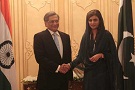
Krishna’s visit to Pakistan marks the culmination of two rounds of comprehensive talks between the two countries decided upon during the February 2011 foreign secretary-level talks in Thimphu. During his visit to Islamabad Krishna not only had discussions with his counterpart but also had meetings with the president, the prime minister, the interior minister and with leaders of political parties like the MQM, ANP and the PMLN. The visit was also marked by the signing of a liberalised visa agreement, a cultural agreement and a meeting of the India-Pakistan Joint Commission that was last held in 2007. The joint commission identified areas of cooperation in the fields of agriculture, education, environment, health, information, Information Technology and telecom, science and technology, and tourism. A series of measures were also agreed upon for easing travel and trade across the line of control. It was further decided that the next round of the secretary-level comprehensive dialogue process be launched that will come up for ministerial level review in New Delhi in 2013.

The lengthy 28 paragraph joint statement states that the talks were held in a ‘cordial, candid and constructive atmosphere’ and that there were ‘substantive discussions on the whole range of issues within the framework of the dialogue process’ with the ministers ‘expressing satisfaction over the progress achieved since their last review meeting in July 2011’. While there may have not been forward movement on many important issues like terrorism, Sir Creek and Siachen, the talks were cordial and wide ranging which is inexplicable in the light of the assurances given by PM in the Lok Sabha and given Pakistan’s continued hostility towards India.

Evidence of Pakistan’s inimical attitude towards India after the 26/11 attacks is borne out not only by its failure to make any serious efforts to bring to book the perpetrators but also by continued involvement in terrorist actions against India, like the Pune bombings of February 13, 2010 resulting in 17 deaths, the Mumbai serial blasts of July 13, 2011 resulting in 18 deaths and the Delhi High Court bombings of September 7, 2011 resulting in 11 deaths. Indeed, Abu Jindal’s debriefings confirm that Pakistan continues to plan similar terrorist actions against India. The resumption of cross-LoC firing by Pakistan, which had been stopped by Musharraf, continued terrorist infiltration from across the LoC, the relentless and massive pumping in of fake currency by Pakistan into India, the revival of its support to the Babbar Khalsa, its refusal to hand over to India any of the nearly 50 wanted terrorists, like Dawood Ibrahim, to whom its provides shelter, and its unwillingness to shut down the infrastructure of terror are proof that it means to continue to use terror against India in a ‘business as usual’ mode.

To add insult to injury the Pakistan foreign minister in an interview just before our external affairs minister’s visit urged that India should look at the 26/11 attacks “unemotionally”, drawing a parallel between them and the attacks on the Samjhauta Express and the 1971 conflict. This insensitivity was further reinforced in the joint press conference addressed by the two foreign ministers when she asserted that the two sides “should not be held hostage to history” but should look to the future.

Instead of challenging the Pakistan foreign minister at the joint press conference for the aforesaid comments and underlining the critical importance of addressing our terrorism-related concerns Krishna not only complimented the Pakistani leadership for bringing about “a positive change in the atmosphere” but echoed her thinking by stating “let us not look back, as you have very rightly said; let us not be held hostage to whatever has happened earlier…….Let us look to the future”. It is not surprising, therefore, that the Pakistani media has drawn the conclusion that India no longer attaches the importance it earlier did to bringing to book those involved in the Mumbai attacks.

It is logical to assume that it is only a matter of time before the PM who is “keen” to visit Pakistan will do so. Though prior to his departure in an interview to the Express Tribune the external affairs minister had stated that the “right atmosphere” would have to be created for it and that it should have a “substantive outcome” in Pakistan, in the joint press conference in Islamabad while not indicating any date for the visit he asserted that there was no question of progress on the 26/11 attacks being a condition for PM’s visit to Pakistan. Clearly, the government seems to have given up all pretence of pressurising Pakistan to give up the use of terror as an instrument of foreign policy against us.

PM’s visit to Pakistan irrespective of whether or not Pakistan addresses our concerns on terrorism is supported by some in India on the grounds that it would provide an impetus to the current upturn in ties and would strengthen the hands of the civilian set up in that country. In this context, it may be mentioned that the upturn in ties is an illusion based on sweet nothings mouthed by Pakistan and our failure to retaliate against its many provocations. It tactically suits Pakistan to maintain this illusion as it is isolated and as this illusion deflects the pressure on it to shut down the infrastructure of terror.

Forward movement on trade by Pakistan, which is acclaimed as a sign of its positivity, has been long delayed and tardy and is, primarily, in its own interests. To date it has not accorded us the MFN status, which we did in the mid 1990s. It still maintains a negative list of nearly 1,200 items, allows movement of only about 200 items through land, and does not permit us transit rights for overland exports to Afghanistan. As regards the civilian government in Pakistan, our investing in it is pointless since it does not exercise real power, it will have to demit office latest by March 2013, and, in the ultimate analysis, it is also imbued with an anti-Indian mindset.

Monday, August 13, 2012

Has the Political Class Failed Us?


A. Surya Prakash
Senior Fellow, VIF


The end of `Operation Jantar Mantar’ by Team Anna without any tangible gains vis-à-vis the fight against corruption and the indications from within government that the Lokpal and Lokayuktas Bill, 2011 may not come up for debate until the Winter Session of Parliament – should come as a major disappointment for all citizens who believe in the pursuit of peaceful and democratic solutions for major problems confronting the country.

With Anna Hazare virtually throwing his hands up and signalling the failure of the tried and tested Satyagraha route, every section of the political class, and this includes the ruling United Progressive Alliance (UPA), the National Democratic Alliance (NDA), the Third Front and the still nebulous Fourth Front, must be laughing all the way to their respective vote banks. This is a moment of triumph for politicians as a whole because they have successfully beaten back, at least for the moment, the biggest threat that was posed to their corrupt ways. The UPA of course is leading from the front and has been able to stop the anti-corruption movement dead in its tracks.

One year ago, as the Anna Hazare Movement picked up, the UPA government introduced the Lok Pal Bill in the Lok Sabha and repeatedly claimed that it was committed to the passage of this law. Other members of the political class made similar noises and swore that they too were keen on having an independent ombudsman to probe cases of corruption. However, within parliament there was an unwritten agreement among all parties that they should not go beyond rendering lip service to the anti-corruption movement. All parties also believed that by dragging the issue, they could tire out the crusaders. This plan appears to have worked. Twelve months hence, the anti-corruption crusade has become a victim of middle class ennui and the much-talked about bill has virtually gone into cold storage.

Caught in a maze of corruption, the UPA government was not keen on having an independent Lokpal. But it was not alone. It got some overt and covert backing from virtually the entire political class. The government introduced the Lokpal Bill on August 4, 2011 in the Lok Sabha and immediately referred it to a Standing Committee head by Mr.Abhishek Manu Singhvi. This gave the government a much-needed breather and also an excuse. It asked Team Anna and others to advance their arguments before the committee. The Singhvi Committee recommended that the Lokpal must have constitutional status and parliament must take a call on whether to bring the Prime Minister within the purview of the Lokpal. It said group A and group B employees must be brought within the purview of the Lokpal, but the Chief Vigilance Commissioner should have jurisdiction over group C and D staff. The committee wanted MPs to be kept out of the Lokpal’s purview in so far as their vote, speech and conduct in parliament was concerned. The judiciary was also to be outside the Lokpal’s jurisdiction. It suggested a single law for establishment of the Lokpal and the Lokayukras in the states. Once the committee’s report was tabled, the government withdrew the bill it had introduced in August and came up with a new bill – The Lokpal and Lokayuktas Bill, 2011.

After much debate, which drew nation-wide attention, this bill was passed by the Lok Sabha and the government raised the expectations of the people by pretending that it would see the legislation through in the Rajya Sabha as well. However, the government’s real intention – to stall the passage of this legislation – became clear when the bill came up for discussion in the Upper House on the last day of the Winter Session in December, 2011. The Congress Party’s floor managers cleverly ensured that MPs belonging to many small and regional parties raised objections and obstructed the debate. Thereafter, as the debate dragged on, the party took advantage of the commotion in the House and mischievously ensured the adjournment of the House sine die, even though MPs wanted the debate to be concluded. With the abrupt adjournment of the House, the curtain came down on the Winter Session of Parliament, thereby giving the government yet another breather.

However, when the Budget Session of Parliament opened in February this year, the UPA resumed its subterfuge. It promised to complete the legislative process in the Upper House but sprang a surprise on parliamentarians and the nation as a whole last May, when it announced the bill was being referred to yet another committee – a select committee of the Rajya Sabha. Sadly, the BJP became a party to the government’s dilatory tactics. This committee has been given time till the end of the Monsoon Session in September to submit its report. So, even as Anna Hazare and Co have ended yet another indefinite fast in order to live to fight another day, there are indications that the bill will not come up for discussion until the Winter Session of Parliament this year. Going by the prevailing mood in the political class, do not be surprised if this bill too suffers the fate of all previous Lokpal Bills and lapse when the present Lok Sabha is dissolved in May, 2014 or earlier.

In the year gone by, the UPA government has slipped further down on the credibility meter and strangely, it is taking the Bharatiya Janata Party (BJP) along with it. As the main opposition party, the BJP ought to have been the moral policeman and the standard-bearer for clean governance, but it is even more irrelevant today than it was a year ago. The Congress and the BJP are now seen as two sides of the same coin. The people feel that they are merely engaged in a mock fight and they are tired of listening to the same old rhetoric. Film maker Shekhar Kapur correctly summed it up when he said the debate is not about the failure of the UPA but about the failure of the political system itself.

“India does not need change of government but change in political system. 65 years of current system has created huge divide between the people and governance”, he said in one of his recent tweets.

Monday, August 6, 2012

India’s Political Class Lacks Ideology


Dr. M.N. Buch
Visiting Fellow, VIF


The Preamble to the Indian Constitution rules out any form of government of India other than democratic because it constitutes India into a sovereign socialist secular democratic republic. Part V of the Constitution trifurcates the State into three equal constituents, the Executive, Legislature and Judiciary. The composition of the Legislature, the Parliament of India, is of members elected by adult suffrage in the case of the House of the People, the Lok Sabha, and indirectly by the State Legislatures in the case of the Council of States or Rajya Sabha.

The whole of Parliament in the Lok Sabha is divided into territorial constituencies and each elected member becomes the representative of all the people residing in his constituency and registered in the electoral roll of that constituency. Each Member of Parliament then acts in the House on behalf of all his constituents and it is for this reason India is a representative democracy. The division of powers between the Executive, Legislature and the Judiciary closely follows the Westminster model and, therefore, India is considered to be a representative parliamentary democracy in contrast with the United States of America, which is a presidential form of democracy. In the Westminster model government power is exercised by the Prime Minister and the Council of Ministers who collectively enjoy the confidence of the House and who advise the President on how the executive powers of the Union will be exercised. The minute the House loses confidence in government the Prime Minister and the Council of Ministers must resign and the government would fall. In the presidential form of democracy the President is directly elected by the people and neither he nor his cabinet is responsible to the House of Representatives, the lower house in the American Congress or Parliament. In fact in the United States a cabinet member cannot be a member of either House of Congress. There the balance of power is established by the Legislature through its functions of legislation and approving the budget, but by itself Congress cannot either dismiss the cabinet nor remove the President except through the process of impeachment. In India, which follows the Westminster model, legislation itself is initiated by government and because the Council of Ministers is collectively responsible to Parliament the Executive and the Legislature come together in the matter of legislative business. Because government enjoys a majority in the House the Prime Minister can and does influence what goes on in Parliament, whether it be in the mater of the budget, legislation or debate. To that extent the Executive embodied by the Prime Minister can override the checks and balances between the Legislature and Executive, which are a feature of the American Constitution. It should be remembered that the infamous Nazi rule was initiated, facilitated and executed through the entirely democratic process of Hitler as Chancellor or Prime Minister, persuading Parliament to approve the Enabling Act and further succeeding in making President Hindenburg sign the Act into law. This enabled Hitler to rule Germany for a year by decree and one of his first decrees was to abolish Parliament itself and establish an absolute dictatorship.

I mention this because in a representative democracy a Nazi Germany scenario is not beyond the realm of possibility. For example, under Article 75 the President can appoint a person as Prime Minister who doe not enjoy the confidence of the House but is a potential Hitler. Under Article 85 of the Constitution it is for the President to summon each House of Parliament and the only restriction is that six months shall not intervene between one session and the previous session. In other words, after swearing in the Prime Minister the President need not summon Parliament for a period of five months and twenty-nine days. In this period the President would have the power to legislate by ordinance under Article 123, except in the matter of the Appropriation Act under Article 114 because under Article 113 (2) all estimates relating to expenditure from the Consolidated Fund of India must first be assented to by the Lok Sabha and only when a demand for a grant on any subject is approved by the Lok Sabha can it be included in the Appropriation Bill. This then is the principal check on the ability of the President and Prime Minister in conspiracy to convert India into a dictatorship because if there is no grant and no Appropriation Act no money can be withdrawn from the Consolidated Fund and, therefore, government would come to a halt. Another check, of course, is the Judiciary which in India would strike down any attempt to bypass the Constitution or convert India from a democracy to a dictatorship. The Indian Constitution, therefore, does keep India safe from conversion to a dictatorship, notwithstanding an attempt made by Indira Gandhi in 1975 to superimpose her absolute rule on India.

A representative democracy cannot function if, for example, the Lok Sabha consists exclusively of 543 members, each independent and not part of a group or party. To form a government these members would have to come together in a sufficiently large group to form a majority in the House so that collectively this group can constitute a government which will enjoy the confidence of the House. 543 persons can form a group or groups only if they subscribe to and enjoy a common ideology, a common programme, a common platform and common views so that they act cohesively. Such groups are what we call political parties. Section 29 A of the Representation of People Act 1951 provides for registration by the Election Commission of associations and bodies as political parties. Section 29 A (1) reads, “Any association or body of individual citizens of India calling itself a political party and intending to avail itself of the provisions of this Part shall make an application to the Election Commission for its registration as a political party for the purposes of this Act”. In other words, the Act governing elections recognises the existence of political parties and provides for their registration, regulation and superintendence. It is the political parties which approach the people to vote for their candidates on account of ideology and programmes of the party as enunciated in the party’s election manifesto and the people have the freedom to exercise their choice, not only on account of the suitability of the candidate proper but also because the candidate represents the party whose ideology appeals to the electorate.

In Britain there was a fair balance between the Tories (now Conservative Party) and the Whigs (now the Liberal Democratic Party). Disraeli epitomised the Tories just as did Gladstone the Whigs. In fundamentals these parties by and large agreed, though any functioning and nuances of approach the parties differed. Gradually the Whigs faded away to be replaced by the Labour Party as socialism began to take roots in Britain. Now the Conservatives and Labour are the two main parties in Britain and government alternates between them, but at present the Conservatives share power with the Liberal Democrats in a coalition. By and large the parties are fairly and evenly balanced and this results in a fairly stable democracy in which political parties and their members have to behave, especially in Parliament, because if they did not the opposition would pull them up and the people would not vote for them in the next election. This leads to a healthy democracy. In India for many years after independence the Congress, whose ideology was rooted in Gandhian principles, ruled the country both at the Centre and in the States. The opposition was weak but the prevailing parliamentary culture was such that it was heard with respect and the opinions expressed by it in Parliament on any issue were considered very seriously without the majority party steamrolling them. Men of the stature of Ram Manohar Lohia and Shyama Prasad Mukherjee carried a weight in our politics far in excess of the numbers they represented in Parliament. Because the party in power had an ideological base and a programme in which the nation came first our democracy was healthy, our politics relatively honest and our politicians definitely nationalistic in outlook. The nation came first and the self came later. The Gandhian principles of austerity governed our politicians, whose life style, needs and attitudes were simple and, therefore, their greed was nonexistent. Govind Ballabh Pant, Gopinath Bardaloi, B.C. Roy, B.G. Kher, C. Rajagopalachari, Jainarayan Vyas, U.N. Dhebar, Ravi Shankar Shukla, EMS Namboodiripad, Jyoti Basu, Gulzarilal Nanda, Morarji Desai, not to mention Jawaharlal Nehru, Sardar Vallabhbhai Patel and Maulana Azad are all remembered almost with reverence by our people, generation after generation, because of their sacrifices, their simple living and their deep commitment to the people and the nation of India. These were examples of the political class who represented an ideal which has not been paralleled anywhere in the world.

In politics and in the political class the most important thing is ideology. The Chambers Twenty-first Century Dictionary defines ideology in the following words, “The body of ideas and principles which form a basis for a social, economic or political system: the opinions, principles and way of thinking, characteristic of a particular person, group of people or nation”. We cannot have a political system in which there are neither ideas nor principles and if that happens we cannot have a social or economic system. A political party bereft of ideology is no party. Unfortunately as politics stands today there is no party which has an identifiable ideology and I state this in the context of the Communist Party of India or Communist Party of India (Marxist) also. Ultimately the programmes of a party have to be based on an ideology and the Preamble to the Constitution itself states that this ideology must take into account the fact that India is and will be a republic, its form of government will be democratic, it will be secular in nature and it will be socialist in that it will promote both equality and equity. Here one is not talking about dogmatic socialism but rather of a republic in which socialism means that there will be social, economic and political justice for all and there will be equality of status and of opportunity for all. The socialist ideal here would ensure that the right to equality before law enshrined in Article 14, prohibition of discrimination on grounds of religion, race, caste, sex or place of birth enshrined in Article 15 and the equality of opportunity in matters of public employment enshrined in Article 16 will be the guiding stars of every government, regardless of party affiliations. Socialism in the Indian context also means that the directive to the state enshrined in Article 38 to establish a social order for the promotion of the welfare of the people in which justice, social, economic and political, shall inform all the institutions of the national life will determine every policy of government. The question is whether any of these ideals forms part of the ideology of any political party in India and whether in fact any party has an ideology.

Ideology cannot be a matter of the moment. Ideology is the core of any political party and that core can evolve, but it cannot change like a weathervane responding to erratic air flows. Certainly ideology cannot be twisted and turned as a means of expediency. In this behalf I would like to mention Margaret Thatcher, the Conservative Prime Minister of Britain. She made an ideological statement when she came to power that she would dismantle the socialist state in Britain and in the process would destroy the instrumentalities of socialism. She then proceeded single-mindedly to fulfill her ideological objectives and whereas she faced enormous opposition in the manner in which she dealt with the Arthur Scargil led coal miners strike, the issue of poll tax, the reduction of milk in the school mid-day meal schemes, etc., she remained unperturbed by the personal unpopularity which visited her on some of her more controversial decisions. Regardless of momentary praise or opprobrium Margaret Thatcher went ahead with her programme to an extent where the political philosophy of the country changed. When ultimately Labour came to power under Tony Blair after a Conservative interregnum under John Major, that party had to repudiate many of its shibboleths and instead adopt many of the programmes of Margaret Thatcher. That is called an ideological approach to ruling the country. No Indian political party today has any ideology.

Up to1967 the Congress ruled India and by and large the old political class we inherited from the freedom movement continued to uphold Indian traditions. One could recognise the political class and identify oneself with it because it represented the best there was in this country. In 1967 everything changed. Starting from Haryana and rapidly coming to Madhya Pradesh we had the Ayaram--Gayaram phenomenon in which Members of the Legislature were bribed to defect from the ruling party and form a separate group which caused the ruling party to be ousted and new united front governments to be formed for the first time. In the history of independent India for the first time power was thus purchased. Suddenly our legislators found that they could command a price and if this price was paid the mandate of the electorate could be undone and new political combinations could be formed to constitute the government. Of course the new government itself would be unstable, based as it was on bribery and, therefore, having illegitimately won power it had to continue bribing in order to retain power. That was the end of any form of principled government in India and it brought into existence a new political class whose origin was corruption. In order to buy power one needed money and unless the State was subverted money could not be had. Therefore, the instrumentalities of the State had to be overawed and made totally pliant so that they would not stand in the way of illegal money making and to facilitate it the Civil Services had to be suborned. A systematic attack was launched on the Civil Services, they were made to surrender to threat and coercion, the honest officers who stood their ground were identified and isolated and the corrupt and the pliant brought to positions of power. The reason for the existence of the All India Services, independence, fearlessness in giving advice and impartiality, integrity and fairness in implementing the orders of government, was attacked at the very root and virtually destroyed. Thus a nexus was built up between the Services and the political class and the binding force was corruption.

Let me give one or two examples of how the political class has changed. Prior to 1967, in fact prior to 1975 when the Emergency destroyed whatever was left of principled government in India, one could differ from the ministers but one never questioned their motive or their integrity. Takhatmal Jain, who had been Chief Minister of Madhya Bharat, was the Minister for Industries and for Development in the new State of Madhya Pradesh. P.D. Chatterjee was Secretary of the Industries Department. Takhatmal Jain told Chatterjee that a case of one of his friends was pending in the department and that he wanted it to be examined urgently. Thinking that this would please the minister Chatterjee prepared a favourable note and recommended approval of the applicant’s proposal. Takhatmalji sent for him and said that he had expected the Secretary to Government to examine the case and not a courtier of the minister. He then sent the file back for proper examination on merit and in doing so he wrote on the file, “Please examine the case on merit. If sanction is justified please give the reasons for this. If, however, the case does not merit approval please advise accordingly. If I still want to favour the applicant I shall do it at my discretion, but your job as Secretary to Government is to render the correct advice”. By way of sharp contrast when I was head of the Delhi Development Authority my then minister Sikander Bakht, wanted me to sanction the building of a five star hotel at 15, Aurangazeb Road, New Delhi by Bhai Mohan Singh, the owner of Ranbaxy Laboratories. When I pointed out that our Regulations did not permit this Sikander Bakht did his best to pressurise me into violating my own regulations, including a written directive to change them. I had to tell him that he was free to change the Delhi Development Act through appropriate legislation but so long as the Act was in force government could not direct me either to change the Regulations or to violate them. Thereafter I remained the target of his anger, but I refused to give in and the hotel was not built. The cumulative result of this and other fights with his successor, Ram Kinker, resulted in my ouster from Delhi Development Authority and I spent a whole year without a posting. Most officers are not prepared to undergo such a fate and that is why the Services are today in shambles. The moral of the story remains that a principled minister would not accept the flattery of his Secretary and an unprincipled minister would not accept a stand taken by his officer based on law and rules. This is the change which has come about in our political class over the years.

No democracy can function on the basis of the bureaucracy alone, however efficient, honest and forward looking it might be. The power to legislate vests in the Legislature and the power to take policy decisions vests in the Council of Ministers which consists of elected members of the Legislature. At different levels of government, including urban and rural local government, the same position prevails and ultimately it is the elected representatives who, in a democracy, take policy decisions based on their party ideology, their declared programme and the mandate of the people. It is a Civil Servant’s job to advise, to point out precedents and the law and to bring to the notice of the decision makers the various courses of action available and the consequences of each. Once a decision is taken the Civil Servant must faithfully implement the decision, though in doing so he must be totally fair, evenhanded and impartial. In other words, the policy decision will be political but its implementation will be totally impartial. These respective roles become completely blurred when all decision making becomes a function of expediency and it is dictated by either the bribe which is received or the fear that is instilled by the possibility of losing power if a particular pressure group is not pleased. Such a political class no longer cares for the duties mandated to it by the Constitution because to it service of the nation, the welfare of the people, the development of the country are not issues of importance. What is important is how to remain in power, may be even for one extra day, so that everything that the system has to offer to oneself is squeezed out of it. The objective of the leaders of the past was to govern well, whereas the objective of the leaders of the present is not to govern at all and yet to enjoy power. The dictionary meaning of ‘govern’ is, “to control and direct the affairs of a country, state or organisation” Power, on the other hand, is defined as “control and influence exercised over others”. If power is used to govern it is desirable. If, however, power is used for self-aggrandisement, for pelf, for nepotism or for creating the means whereby power can be re-purchased, it is highly undesirable. In the case of the Indian political class as it exists today it is the latter use of power which governs all its actions. Such a political class cannot run a true democracy.

What the Indian political class has forgotten is that the reason for its existence is not self-perpetuation. If that were the case India could have opted for a hereditary absolute monarchy. If that were the case India could have opted for a Kuo-min-tang type of autocracy which afflicted China under Chiang Kai-shek before the Communist take over in 1949, or we could have opted for a Pakistan style theocracy in which the most powerful force is the Army. Instead we voluntarily opted for a secular republic which today has a second largest Muslim population in the world after Indonesia. We opted for a democracy in which the armed forces are clearly subordinated to civil authority. We opted for good government. Unfortunately we have gifted ourselves a government which is virtually non-existent in terms of the will to govern, manned by extremely corrupt and self-seeking politicians and their Civil Service supporters. As a result a country with enormous potential for growth is hamstrung by government itself. India does not deserve such a political class.

Is the situation irremediable? The fact that Indira Gandhi was voted out of power in 1977 means that the electorate will not accept a dictatorship. The fact that the Left Front was voted out of power means that the electorate will not accept single party rule. The fact that in election after election those who are known to be corrupt often lose the election means that the people of India want honest leaders. The fact that where there is good government, as is the case of Gujarat under Narendra Modi, Bihar under Nitish Kumar, Orissa under Navin Patnaik means people vote the party back to power. Where there is bad government, as occurred in Tamil Nadu under M. Karunanidhi and in Uttarakhand, the ruling party was ousted. The electorate wants a political class which will serve the people rather than themselves. That is the message of the common man loud and clear. Now the ball is in the court of the political parties.

It is time that political parties took stock of the situation and restored the trust of the people in ideology and programmes. That has to start by eschewing every form of caste and religion based politics. Today every political party calculates its chances of success according to the mathematics of caste and religion. That is why Rahul Gandhi, who is clean shaven in Delhi, has a two-day stubble when visiting the house of a scheduled caste person and sports a beard when he visits a constituency with a sizable Muslim population. Does he think that everyone in India is born an idiot and that such symbols will get him votes? Therefore, starting with the Congress it will have to break away from its dependence on the Nehru-Gandhi family, it will have to think in terms of developing a grass-root leadership in which Sonia Gandhi, Rahul Gandhi and Priyanka Vadra do not count on account of their marriage or their birth and there is genuine democracy and development of leadership based on support at local levels. Then Congress must also have a specific ideological base from which programmes should develop and these should be presented to the people for their judgment. The Left Front, where leadership questions are not based on heredity, must also now decide whether it wants to become only a clone of China, a country ruled by the Communist Party but somewhat to the right of United States in the matter of a capitalist economy, or it wants to function under Indian realities in which a State Government cannot dare to acquire 38,000 acres of fertile agricultural land as the Left Front tried to do in Nandigram for allotment to an industrialist. The BJP itself must decide whether it wants to develop in a secular environment in which RSS is no longer its principal mentor. I say this because the dilemma before the BJP is that unless it widens its base it cannot be accepted in the South and in the East and if it widens its base the RSS may break away. Even if BJP were to work according to Hindutva philosophy, which could further widen the religious divide and polarise minority votes, there is no guarantee that there would be a counter Hindu polarisation and more Hindu votes for the BJP because the Hindu vote is already divided on the lines of caste. BJP fails to win not because the Muslims vote against it. It fails to win because a large number of Hindus vote against it. It is for the party to decide whether it can garner more Hindu votes through an aggressive pursuit of a Hindutva programme or whether a more genuinely secular approach will get it more Hindu votes. One phenomenon in Gujarat where anti Modi journalists, social scientists and politicians have spared no effort to attack Modi, is that in that State without in any way appearing to reach out to the Muslims Modi has been able to get a percentage of Muslim votes and in the last local government elections he had given party tickets to Muslims and succeeded in having a large number of Muslims elected. This means that at least a section of Muslims in Gujarat feels that good government, even though appearing to be communal in outlook, is more beneficial to them than a government which promises secularism but delivers nothing. Introspection by the political parties will have to include coalescing of parties on ideological lines so that the blackmailing pressure of small groups representing either individual interests or regional interests do not take over and overwhelm any future coalition. In other words, the parties must try and absorb smaller groups so that eventually we have a centrist party, a right of centre party and a left of centre party in which the limits of extremes on both sides become circumscribed. It is this which will lead to more meaningful coalitions and, therefore, better government. Ultimately the political class has to draw itself back from the brink of corruption and go back to what the Constitution envisaged for them -- principled politics whose objective is to promote the welfare of the people and wealth of the nation.

Lastly, as things stand today by 2014 we may reach a stage where no party, including Congress and BJP, may get more than a hundred seats. This would lead to very fragmented coalitions and there would be virtually no government. Nothing can be worse than a fragmented polity for that opens the door to a future Hitler. For the sake of India the political class must reform itself and parties who can win the confidence of the electorate and in return deliver good government are strengthened.