Showing posts with label MQM. Show all posts

Friday, May 10, 2013

Test of democracy in Pakistan


Amb Satish Chandra, 
Dean, Centre for National Security and Strategic Studies

Apart from being the first elections to be conducted by a legitimately constituted civilian set-up on completion of a full term by a democratically elected government, Pakistan’s upcoming elections scheduled for May 11, 2013, are notable in more than one way.

Firstly, this will be the bloodiest election in Pakistan’s history. From April 21 to 28 alone, there were as many as 20 attacks on political parties, resulting in 40 deaths and 190 wounded.

Secondly, there is no single overwhelming factor to influence voting like the sympathy wave that brought the Pakistan People’s Party (PPP) to power in 1988 and 2008.

Thirdly, a relatively unknown factor will influence the outcome, in terms of the youth vote with 31 per cent of the voters aged between 18 and 29.

These elections, like the ones held earlier, will not be free and fair as the heavy hand of the Tehrik-i-Taliban Pakistan (TTP) has been evident right from the scrutiny of candidates to election rallies. Electoral officers have been influenced by it, with a wink and a nod from the army and the judiciary, to rigidly interpret Articles 62 and 63 of the Constitution to disqualify “undesirables” from the elections. For instance, doubts about the absence of anyone’s Islamic credentials have been invoked to disqualify many a candidate. Inevitably, this has most hurt left of centre parties like the PPP, Muttahida Quami Movement (MQM) and Awami National Party (ANP). These parties have also been specifically targeted by the TTP through physical intimidation because of their “secular” leanings and endeavours to take on militancy. As a result, they have not been able to campaign effectively and their election rallies have been few and far between. Thus, the election scene is skewed in favour of Islamist candidates and right of centre parties like Imran Khan’s Pakistan Tehreek-e-Insaf (PTI), Pakistan Muslim League (N) and a slew of Islamic parties like the Jamaat-i-Islami and the JUI (F).

This, coupled with the anti incumbency factor generated by years of massive misrule, will result in a sharp decline of seats won by the PPP and its allies, notably the MQM, ANP and PML (Q).

The PPP, hitherto was the largest party in Pakistan with 126 seats in a house of 342, is likely to get no more than 60-70 seats on account of the reasons cited above, extreme demoralisation and the absence of any star campaigner like Benazir or the sympathy factor. It will take massive losses in Khyber Pakhtunkhwa and Baluchistan where the increasingly radicalised electorate will be much more supportive of right of centre and Islamic parties. It is likely to get only five or six seats as against the 19 in the previous elections. In Punjab, too, from where it obtained 63 seats in the last elections, it will possibly witness major losses as it is clearly unpopular in urban Punjab and may be expected to obtain around 30 seats mainly from Southern Punjab. In Sind, it will retain its core support but as against the 40 seats it secured in the last elections it is likely to only get around 30.

Nawaz Sharif’s PML(N), the second largest party in the last elections with 91 seats, of which as many as 81 were from Punjab, is widely expected to emerge as the largest party with a projected 110 to 120 seats in the upcoming elections. This will, however, not enable it to form a government on its own even if it is able to win over many independents. The party’s somewhat improved showing will result from the absence of any anti-incumbency factor as its rule in Punjab had provided acceptable levels of governance and had certainly not been disastrous. The decimation of the PPP vote bank and that of the latter’s ally PML(Q), which in the last elections got as many as 35 seats in the Punjab, and PML(N)’s own conservative Islamic affiliations will naturally stand it in good stead in a steadily radicalising Pakistan. As in the previous elections, the bulk of PML(N)’s seats will come from Punjab, mainly at the cost of the PPP and PML(Q), and will most likely increase from 81 to little over 100. It may also be expected to get an additional 15 seats from the other three provinces as against only five in the last elections, giving it a total strength of 110 to 120 seats.

The third largest party is likely to be the PTI. Estimates about the seats likely to be secured by this party are the most variable, ranging from 10 to 100. The uncertainty of its showing stems from the fact that it is a new party with a fragile organisational structure which is, of course, compensated to an extent by Imran Khan’s name, recognition and popularity, particularly among the youth. Whether his popularity will translate into votes is a question mark. The bulk of the party’s support will come from Khyber Pakhtunkhwa and Punjab. In the former, it could get around 15-20 seats out of a total of 43 and in the latter it could get around 30 by eating into the PML (N), PML (Q), and PPP.
In Sindh the MQM, which has hitherto been the predominant party, will likely see some decline in strength with its seats falling from 25 to 15. Similarly, Khyber Pakhtunkhwa, which was the stronghold of the ANP, will see a dramatic decline in the fortunes of that party with its seats declining from 13 to three or four. Islamic parties like the Jamaat-i-Islami and JUI (F) will be the main beneficiaries of these developments in both provinces, apart from the PML (N) to a less extent.

An election outcome with a fractured mandate as projected above in which no party will be able to form a government on its own even with the support of independents will be unfortunate for Pakistan. More so, because none of the three largest parties notably — PML(N), PPP and PTI — will find it easy to link up with either of the other two due to their differing ethos and backgrounds, and as far as the PPP is concerned even ideology.

Should political expediency drive any two to form a coalition government, this is likely to be riven by dissent and an inability to effectively address the many pressing economic, security and foreign policy issues facing the country. Indeed, this could ultimately lead to a reversion to military rule.

As far as India is concerned, while all the three major parties profess to want good relations with the neighbour, each is also focused on Kashmir. The PTI refers to the resolution of the Kashmir “dispute” as a core issue, while the other two stress the need to take into account the UN resolutions for its closure. But above all, we should be concerned by the increasingly radicalised nature of Pakistani polity which does not bode well for us.

Friday, March 29, 2013

Pervez Musharraf Returns...From Exile into Oblivion?


Sushant Sareen 
(Senior Fellow, VIF)

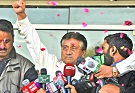
Pakistan’s former military dictator, Gen Pervez Musharraf, has ended his nearly five year long self-exile to return home to a tepid welcome by a handful of die-hard supporters and what was clearly a ‘rent-a-crowd’ bunch of people.
While his return did have some news value, the sort of excitement on display on Indian TV channels was completely missing on Pakistani airwaves. Musharraf might make for good TV but to imagine that he is a serious player in Pakistan's politics is to stretch the limits of incredulity.

In a sense, Musharraf’s return has illustrated two phenomenon, one in India and the other in Pakistan. The Indian interest in Musharraf is nothing if not a stark comment on the astounding ignorance about Pakistan's politics. On the other hand, Musharraf’s self-portrayal and self-belief that he remains popular in Pakistan, that he has a role to play in Pakistan's politics and its future, and that he will prove to be Pakistan's saviour, is reflective of the climate of denial that is pervading Pakistan's state and society. Apart from megalomania, which is primarily borne out of a delusionary state of mind, Musharraf also seems to be suffering from the ‘manifest destiny’ complex. He is quite clearly suffering from the withdrawal symptoms of a person who from being the toast of the international community has now been toasted by being consigned to the dustbin of history.

Politically, Musharraf is a complete non-entity. On his own, he is incapable of winning even a Resident Welfare Association election. Far from playing a pivotal role in Pakistani politics, which will be possible only if he can manage to win more than a handful of seats in the National Assembly, Musharraf will be extremely lucky if he can even win his own seat without the crutches of support from a party like the MQM. His own party, All Pakistan Muslim League, exists only on paper and has no presence on the ground. No surprises then that Musharraf, who points to hundreds of thousands of ‘friends’ on his Facebook page and ‘followers’ on Twitter as a measure of his popularity, is lampooned by his detractors who say that he might be a leader in the ‘Islamic Republic of Facebook’ but is a non-entity in the Islamic Republic of Pakistan.
What Musharraf doesn’t seem to understand or at least refuses to acknowledge because of his faux bravado is that deposed dictators are like expired medicine, or worse, used toiler paper: no one has any use for them and hence they are best discarded. Pakistani society, in spite of its obsession with Islam, is metaphorically at least, quite unabashed in its worship of the rising sun. Musharraf’s sun has set and the legions that were at his beck and call when he was at his zenith are nowhere to be found. If anything, associating with him is a huge political liability which no active politician can afford. In order to understand Musharraf’s prospects in Pakistan, all that needs to be done is study the fate of Field Marshal Ayub Khan and Gen. Yahya Khan after they were deposed. Also instructive is the pathetic state of Gen Aslam Beg after he retired. When he was at the helm of the army, Beg was pretty much the master of all he surveyed. After retirement he formed a political party which is so irrelevant that probably even Beg doesn’t remember its name.

Musharraf could well be harbouring the misconception that the terrible record of governance of the PPP-led coalition would have made the people of Pakistan hanker for his return at the helm of affairs. But what he has not taken into account is the fact that even though there is a lot of public anger against the PPP-led coalition, hardly anyone in Pakistan is remembers Musharraf fondly. His name is still mud, and he is still blamed for all the existential crises that Pakistan is facing. Given such a climate of hostility, even if he wins his own seat in National Assembly, he will be subjected to the sort of indignities by his fellow lawmakers which he will find difficult to digest. Remember, as President, he refused to address the Parliament (despite it being a constitutional requirement) because of the fear that the opposition would indulge in sloganeering against him.

While it is a no brainer that he is not a serious player in Pakistan's politics, the threats that he faces to his life and his liberty are quite serious. His old institution, the army, isn’t quite comfortable with his return and in fact is believed to have tried to dissuade him from returning. One reason for this is that if the cases against Musharraf were to be opened in the Courts, it could drag in the current top brass which was equally culpable for the actions of Musharraf. Another reason is that the Army will not like to see Musharraf being put behind bars, but will also find it difficult to stop the Courts from doing this. His return also confronts the Pakistani judiciary, which has been quick on the draw against politicians, with a dilemma. There are very serious charges against Musharraf including treason (the emergency he declared in 2007), murder (Akbar Bugti’s killing), conspiracy (Benazir Bhutto assassination) and mass murder (Lal Masjid operation). If in the face of these cases the judiciary doesn’t take action against Musharraf, it will open itself to the charge of having kowtowed to the Army; if they take action against him, it will incur the hostility of the military.

But more than the predicament of the military and the judiciary, it is the threat to his life from the Islamist terror groups that simply cannot be ignored. The Tehrik-e-Taliban Pakistan has already announced that it has prepared a special squad to kill Musharraf. Also baying for his blood are the heirs of Akbar Bugti, Baloch insurgents, sectarian groups like Lashkar-e-Jhangvi with links with the TTP and Al Qaeda, and the Lal Masjid affectees (also with links with TTP and Al Qaeda). Given that he will no longer enjoy the sort of security that he did when he was head of state and army chief means that Musharraf will be extremely vulnerable. He would therefore save many people a lot of trouble if he was to leave Pakistan once again. But if he has decided to make his final stand in Pakistan, then chances are that it won’t be long in coming. 

Wednesday, September 12, 2012

Genuflecting before Pakistan


Satish Chandra
Distinguished Fellow, VIF

The Indian external affairs minister’s visit to Pakistan from September 7-9 epitomised India’s composite re-engagement with Pakistan. It flies in the face of the assurances provided by the prime minister in his address to the Lok Sabha on July 29th that India “can have a meaningful dialogue with Pakistan only if they fulfil their commitment, in letter and spirit, not to allow their territory to be used in any manner for terrorist activities against India.”

Krishna’s visit to Pakistan marks the culmination of two rounds of comprehensive talks between the two countries decided upon during the February 2011 foreign secretary-level talks in Thimphu. During his visit to Islamabad Krishna not only had discussions with his counterpart but also had meetings with the president, the prime minister, the interior minister and with leaders of political parties like the MQM, ANP and the PMLN. The visit was also marked by the signing of a liberalised visa agreement, a cultural agreement and a meeting of the India-Pakistan Joint Commission that was last held in 2007. The joint commission identified areas of cooperation in the fields of agriculture, education, environment, health, information, Information Technology and telecom, science and technology, and tourism. A series of measures were also agreed upon for easing travel and trade across the line of control. It was further decided that the next round of the secretary-level comprehensive dialogue process be launched that will come up for ministerial level review in New Delhi in 2013.

The lengthy 28 paragraph joint statement states that the talks were held in a ‘cordial, candid and constructive atmosphere’ and that there were ‘substantive discussions on the whole range of issues within the framework of the dialogue process’ with the ministers ‘expressing satisfaction over the progress achieved since their last review meeting in July 2011’. While there may have not been forward movement on many important issues like terrorism, Sir Creek and Siachen, the talks were cordial and wide ranging which is inexplicable in the light of the assurances given by PM in the Lok Sabha and given Pakistan’s continued hostility towards India.

Evidence of Pakistan’s inimical attitude towards India after the 26/11 attacks is borne out not only by its failure to make any serious efforts to bring to book the perpetrators but also by continued involvement in terrorist actions against India, like the Pune bombings of February 13, 2010 resulting in 17 deaths, the Mumbai serial blasts of July 13, 2011 resulting in 18 deaths and the Delhi High Court bombings of September 7, 2011 resulting in 11 deaths. Indeed, Abu Jindal’s debriefings confirm that Pakistan continues to plan similar terrorist actions against India. The resumption of cross-LoC firing by Pakistan, which had been stopped by Musharraf, continued terrorist infiltration from across the LoC, the relentless and massive pumping in of fake currency by Pakistan into India, the revival of its support to the Babbar Khalsa, its refusal to hand over to India any of the nearly 50 wanted terrorists, like Dawood Ibrahim, to whom its provides shelter, and its unwillingness to shut down the infrastructure of terror are proof that it means to continue to use terror against India in a ‘business as usual’ mode.

To add insult to injury the Pakistan foreign minister in an interview just before our external affairs minister’s visit urged that India should look at the 26/11 attacks “unemotionally”, drawing a parallel between them and the attacks on the Samjhauta Express and the 1971 conflict. This insensitivity was further reinforced in the joint press conference addressed by the two foreign ministers when she asserted that the two sides “should not be held hostage to history” but should look to the future.

Instead of challenging the Pakistan foreign minister at the joint press conference for the aforesaid comments and underlining the critical importance of addressing our terrorism-related concerns Krishna not only complimented the Pakistani leadership for bringing about “a positive change in the atmosphere” but echoed her thinking by stating “let us not look back, as you have very rightly said; let us not be held hostage to whatever has happened earlier…….Let us look to the future”. It is not surprising, therefore, that the Pakistani media has drawn the conclusion that India no longer attaches the importance it earlier did to bringing to book those involved in the Mumbai attacks.

It is logical to assume that it is only a matter of time before the PM who is “keen” to visit Pakistan will do so. Though prior to his departure in an interview to the Express Tribune the external affairs minister had stated that the “right atmosphere” would have to be created for it and that it should have a “substantive outcome” in Pakistan, in the joint press conference in Islamabad while not indicating any date for the visit he asserted that there was no question of progress on the 26/11 attacks being a condition for PM’s visit to Pakistan. Clearly, the government seems to have given up all pretence of pressurising Pakistan to give up the use of terror as an instrument of foreign policy against us.

PM’s visit to Pakistan irrespective of whether or not Pakistan addresses our concerns on terrorism is supported by some in India on the grounds that it would provide an impetus to the current upturn in ties and would strengthen the hands of the civilian set up in that country. In this context, it may be mentioned that the upturn in ties is an illusion based on sweet nothings mouthed by Pakistan and our failure to retaliate against its many provocations. It tactically suits Pakistan to maintain this illusion as it is isolated and as this illusion deflects the pressure on it to shut down the infrastructure of terror.

Forward movement on trade by Pakistan, which is acclaimed as a sign of its positivity, has been long delayed and tardy and is, primarily, in its own interests. To date it has not accorded us the MFN status, which we did in the mid 1990s. It still maintains a negative list of nearly 1,200 items, allows movement of only about 200 items through land, and does not permit us transit rights for overland exports to Afghanistan. As regards the civilian government in Pakistan, our investing in it is pointless since it does not exercise real power, it will have to demit office latest by March 2013, and, in the ultimate analysis, it is also imbued with an anti-Indian mindset.