Showing posts with label National Assembly. Show all posts

Friday, March 29, 2013

Pervez Musharraf Returns...From Exile into Oblivion?


Sushant Sareen 
(Senior Fellow, VIF)

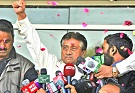
Pakistan’s former military dictator, Gen Pervez Musharraf, has ended his nearly five year long self-exile to return home to a tepid welcome by a handful of die-hard supporters and what was clearly a ‘rent-a-crowd’ bunch of people.
While his return did have some news value, the sort of excitement on display on Indian TV channels was completely missing on Pakistani airwaves. Musharraf might make for good TV but to imagine that he is a serious player in Pakistan's politics is to stretch the limits of incredulity.

In a sense, Musharraf’s return has illustrated two phenomenon, one in India and the other in Pakistan. The Indian interest in Musharraf is nothing if not a stark comment on the astounding ignorance about Pakistan's politics. On the other hand, Musharraf’s self-portrayal and self-belief that he remains popular in Pakistan, that he has a role to play in Pakistan's politics and its future, and that he will prove to be Pakistan's saviour, is reflective of the climate of denial that is pervading Pakistan's state and society. Apart from megalomania, which is primarily borne out of a delusionary state of mind, Musharraf also seems to be suffering from the ‘manifest destiny’ complex. He is quite clearly suffering from the withdrawal symptoms of a person who from being the toast of the international community has now been toasted by being consigned to the dustbin of history.

Politically, Musharraf is a complete non-entity. On his own, he is incapable of winning even a Resident Welfare Association election. Far from playing a pivotal role in Pakistani politics, which will be possible only if he can manage to win more than a handful of seats in the National Assembly, Musharraf will be extremely lucky if he can even win his own seat without the crutches of support from a party like the MQM. His own party, All Pakistan Muslim League, exists only on paper and has no presence on the ground. No surprises then that Musharraf, who points to hundreds of thousands of ‘friends’ on his Facebook page and ‘followers’ on Twitter as a measure of his popularity, is lampooned by his detractors who say that he might be a leader in the ‘Islamic Republic of Facebook’ but is a non-entity in the Islamic Republic of Pakistan.
What Musharraf doesn’t seem to understand or at least refuses to acknowledge because of his faux bravado is that deposed dictators are like expired medicine, or worse, used toiler paper: no one has any use for them and hence they are best discarded. Pakistani society, in spite of its obsession with Islam, is metaphorically at least, quite unabashed in its worship of the rising sun. Musharraf’s sun has set and the legions that were at his beck and call when he was at his zenith are nowhere to be found. If anything, associating with him is a huge political liability which no active politician can afford. In order to understand Musharraf’s prospects in Pakistan, all that needs to be done is study the fate of Field Marshal Ayub Khan and Gen. Yahya Khan after they were deposed. Also instructive is the pathetic state of Gen Aslam Beg after he retired. When he was at the helm of the army, Beg was pretty much the master of all he surveyed. After retirement he formed a political party which is so irrelevant that probably even Beg doesn’t remember its name.

Musharraf could well be harbouring the misconception that the terrible record of governance of the PPP-led coalition would have made the people of Pakistan hanker for his return at the helm of affairs. But what he has not taken into account is the fact that even though there is a lot of public anger against the PPP-led coalition, hardly anyone in Pakistan is remembers Musharraf fondly. His name is still mud, and he is still blamed for all the existential crises that Pakistan is facing. Given such a climate of hostility, even if he wins his own seat in National Assembly, he will be subjected to the sort of indignities by his fellow lawmakers which he will find difficult to digest. Remember, as President, he refused to address the Parliament (despite it being a constitutional requirement) because of the fear that the opposition would indulge in sloganeering against him.

While it is a no brainer that he is not a serious player in Pakistan's politics, the threats that he faces to his life and his liberty are quite serious. His old institution, the army, isn’t quite comfortable with his return and in fact is believed to have tried to dissuade him from returning. One reason for this is that if the cases against Musharraf were to be opened in the Courts, it could drag in the current top brass which was equally culpable for the actions of Musharraf. Another reason is that the Army will not like to see Musharraf being put behind bars, but will also find it difficult to stop the Courts from doing this. His return also confronts the Pakistani judiciary, which has been quick on the draw against politicians, with a dilemma. There are very serious charges against Musharraf including treason (the emergency he declared in 2007), murder (Akbar Bugti’s killing), conspiracy (Benazir Bhutto assassination) and mass murder (Lal Masjid operation). If in the face of these cases the judiciary doesn’t take action against Musharraf, it will open itself to the charge of having kowtowed to the Army; if they take action against him, it will incur the hostility of the military.

But more than the predicament of the military and the judiciary, it is the threat to his life from the Islamist terror groups that simply cannot be ignored. The Tehrik-e-Taliban Pakistan has already announced that it has prepared a special squad to kill Musharraf. Also baying for his blood are the heirs of Akbar Bugti, Baloch insurgents, sectarian groups like Lashkar-e-Jhangvi with links with the TTP and Al Qaeda, and the Lal Masjid affectees (also with links with TTP and Al Qaeda). Given that he will no longer enjoy the sort of security that he did when he was head of state and army chief means that Musharraf will be extremely vulnerable. He would therefore save many people a lot of trouble if he was to leave Pakistan once again. But if he has decided to make his final stand in Pakistan, then chances are that it won’t be long in coming. 

Saturday, March 16, 2013

Pakistan’s Lame Lawmakers’ Resolution on Kashmir a Challenge for India


Sushant Sareen 
(Senior Fellow, VIF)

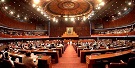
The highly provocative, extremely offensive, and utterly reprehensible resolution passed by the National Assembly of Pakistan condemning Indian ‘state sponsored brutalities’ and demanding the handing over the body of executed terrorist Afzal Guru to his family, allowing people to freely practise their religion (this coming from a state where an open season has been declared on Shias, Hindu girls are abducted and forcibly converted and Christians are subjected to the worst sort of Islamofascism), pulling out of security forces from Kashmir and repealing all ‘black laws’ in the Indian state, release of all ‘political prisoners’, implementation of the UN Security Council resolutions, and promising political, moral and diplomatic support to the Kashmiris, has predictably enough raised the hackles in India.

While on the one hand the resolution has given an indication of the direction in which things are likely to move as far as Pakistan's export of terrorism in Kashmir is concerned, on the other hand it has exposed all the manufactured bonhomie and double-talk being indulged by the Pakistani politicians who tried to beguile Indian policy makers into believing that there was a political consensus in Pakistan in favour of normalisation of relations with India. Since around 1997, India has been sold the nonsense that neither Kashmir nor India is any longer an issue in Pakistani elections. The real reason why India and Kashmir didn’t figure as an election issue was that there was a broad based political consensus in Pakistan in favour of exporting jihad and delivering a ‘death by a thousand cuts’ to India. Since no one opposed this policy there was no gain to be made by raking this issue at the hustings.

Over the last few years, however, an impression had gained ground that the political consensus inside Pakistan in favour of export of jihad was breaking down. Not surprisingly, some political players smelled an opportunity to agitate on this issue to increase their vote bank. But the moment one player tries to exploit this issue, all others start falling over each other to swear their commitment to snatching Kashmir from India. The unanimous passage of this resolution bears out that no one in Pakistan is willing to question, much less stand up against, the Jihadist policy of the State. What this does to the policy of appeasement towards Pakistan being followed by the Manmohan Singh government and to the expressed desire of the Indian Prime Minister who had declared that he would think he had done his job well if he managed to normalise relations with Pakistan can well be imagined.

Apologists for Pakistan in India will of course argue that too much should not be read into this resolution which has been made for purely political reasons by legislators who are about to go in for fresh elections. After all, notwithstanding all the hyperbole of this National Assembly having made the ‘historic achievement’ of completing it term, the fact remains that in many ways it was an effete and powerless collection of people whose resolutions were not worth the paper they were written on because these resolutions were observed more in their violation. What is more, these ‘elected representatives’ of the people of Pakistan are perhaps the meekest and weakest part of the Pakistani state and are treated with contempt by the overbearing judiciary, meddling military and self-righteous media. And yet, this is a resolution that cannot and should not be ignored, both because it reflects the unremitting hostility towards India of the political class in Pakistan, as well as for what this resolution portends in terms of another upsurge in export of jihadi terrorism to India.

To the extent that this resolution is a mea culpa on part of the Pakistani state for its involvement in the dastardly attack on the Indian Parliament, it needs to be welcomed. Pakistan, it seems, has finally officially taken ownership of Afzal Guru and his terrorist action and accepted that he was a Pakistani agent working at the behest of his Pakistani masters to attack the Indian Parliament. The resolution is a tacit acknowledgement of Guru’s links with the Jaish-e-Mohammed, one of the terrorist outfits involved in the Parliament attack. The mover of the resolution, Maulana Fazlur Rehman (better known as Maulana Diesel for his involvement in Diesel smuggling) is a Deobandi cleric who shares fraternal links with Deobandi terror groups like the JeM, Harkatul Mujahideen, Sipah-e-Sahaba, not to mention the Tehrik-e-Taliban Pakistan (TTP). Rehman also happens to be the Chairman of the Kashmir Committee of the Pakistani Parliament, which is basically an organisation for providing foreign junkets to Pakistani politicians at the expense of the bankrupt government of Pakistan.

The Maulana, who also happens to be leading an effort to effect a rapprochement between the Pakistani authorities and the TTP, probably intends to use this resolution not only to cement his credentials as a dyed-in-wool jihadist who stands firm on the so-called ‘Kashmir cause’, but also to appease terror groups like TTP which have been threatening retaliation against India for the hanging of Ajmal Kasab and Afzal Guru. The same Maulana had in 2001-02 issued a fatwa calling for the murder of Americans and the notoriety as well as popularity he gained catapulted him to the position of Leader of Opposition (he was actually more of a lap dog of the Pakistani military dictator Pervez Musharraf) in the National Assembly that came into existence after the 2002 elections. The Maulana’s party, Jamiat Ulema Islam (JUI-F) also formed governments in the province of Khyber Pakhtunkhwa and Balochistan, which were used to promote Talibanisation in both these provinces.

Perhaps, a similar game is once again being played by Maulana Fazlur Rehman, only this time it isn’t the US but India which is being targeted. In the process, the Maulana, who has been a frequent visitor to India where he has tried to convince his Indian interlocutors of his bonafides and his intense and sincere desire to play a role in improving Indo-Pak relations, has more or less burnt his bridges with India. He is unlikely to be welcome anymore in this country. He has only proved his detractors, who pointed to the undesirable company he kept and his links with extremist and terrorist groups, right. For the sake of playing to the gallery back home in the hope of winning some brownie points and perhaps a few extra votes, he has effectively become a persona non grata in India.

But if people like Fazlur Rehman are becoming an anathema for India, their acceptability is growing among the Americans. If anything, the Americans seem to have given a free hand to Pakistani Islamists as part of their plan to exit from the region. Just recently, the US Ambassador to Islamabad held a meeting with Maulana Fazlur Rehman. Subsequently, the US envoy told the Pakistani media that the situation in Terror Central (North Waziristan) was something that Pakistan had to sort out domestically, thereby indicating that the US was willing to turn a blind eye to a terrorist safe haven in return for Maulana Fazlur Rehman using his influence and contacts to push forward with the ‘reconciliation process’ in Afghanistan. Worse, with two utterly clueless apologists for Pakistan now at the helm of affairs at the State Department and Pentagon, the US policy on Islamist terrorism is likely to undergo a major transformation with appeasement of Pakistan and turning a blind eye to its use of terrorism as an instrument of state policy becoming the order of the day as a quid pro quo for safe passage out of Afghanistan for Western troops. The result is an emboldening of Pakistan, and its natural corollary is the political and military adventurism that is being seen on Kashmir and the recent acts of terrorism in other parts of India.

India cannot afford to let this challenge to go unanswered. Not only does India need to disabuse the Pakistanis and the Americans of the notion that they can trifle with India for their own ends, but more importantly, the political class in India, especially the Manmohanistas need to disabuse themselves of the notion that Pakistan is genuinely interested in normalisation of relations with India. Instead of formulating policy on the basis of the sweet-talk coming from Pakistani politicians who neither control any wing of the ISI nor command a single division of the Pakistan army (comprising of jihadis, some in uniform, others in mufti), India would be better served by seeing action on the ground by the Pakistanis to prove their bonafides. The unanimous resolution passed by the Lok Sabha is the first right step in this direction. This needs to be followed up by setting metrics on the basis of which Pakistan’s intentions will be judged. Equally important, India needs to stop giving the unnecessary and unwarranted importance to the mythical Pakistani civil society which is nothing more than a powerless, if also vocal, fringe group comprising around 500 (and if you want to be very charitable, 5000) people. Most of all, India needs to stop depending on the US for pulling its chestnuts out of the fire. The US will do what is in its interest and if this means sacrificing India’s interests, then so be it. India, therefore, needs to prepare itself for the coming wave of terrorism and develop capabilities to counter this scourge as well as pay back the adversary in more than equal measure.