Showing posts with label Islamabad. Show all posts

Monday, January 15, 2018

Commentary: Understanding the Recent Protests in Gilgit-Baltistan

15 Jan, 2018 | Prateek Joshi, Research Associate, VIF

A wave of strong protests swept across Gilgit-Baltistan recently, after the Gilgit-Baltistan Council, Islamabad, announced the imposition of direct taxes under the Income Tax (Adaption) Act, 2012. The protests were jointly led by Anjuman-e-Tajiran (which loosely translates into Traders’ committee, the word Tajir meaning Traders) and the Awami Action Committee (AAC). A few days ago, protestors even announced a “long march” from Skardu to Gilgit town (roughly 150 kilometer distance) to demonstrate their discomfort with tax imposition, defying the harsh winters the Karakoram region is known for.
Indian media was quick to react to these developments and news channels reported these protests as a pro-freedom movement directed against the state, citing the disputed status of the region. Although Islamabad withdrew the notification under pressure, the emerging developments leave a lot to be discussed on the prevalent mood in Gilgit-Baltistan. Therefore, it becomes important to grasp the underlying dynamic at play especially that of the protagonist AAC, along with the key actors driving it, if one is to understand the prevailing mood in Gilgit-Baltistan and the region’s relationship with Islamabad and the ‘establishment’.
The AAC, a collection of 20-22 religious and nationalist parties was formed roughly four years ago, and became widely popular in 2014, when it led protests after Islamabad withdrew wheat subsidies. Led by a charismatic advocate Ahsan Ali, the then convener, AAC’s outreach to the common people and its mobilization strategies made it highly popular among the masses. In one of its early protests, AAC even coined the slogan “Kargil Chalo” citing the subsidies entitled to Kargilis, the larger issue being the view of the neighboring Ladakh enjoying greater benefits and political representation vis-à-vis Gilgit-Baltistan.
Unfortunately, in 2014 itself, Ahsan Ali was forced to resign from the convener position, following which he founded the Action Tehreek, which lent support to the AAC. On the other hand, the AAC also got a new Chairman, Maulana Sultan Raees, who happens to be a Sunni cleric with close ties to the Ahle Sunnat Wal Jamaat (ASWJ), a Deobandi outfit which emerged from the notorious Sipah-e-Sahaba. The Maulana’s closeness with Qazi Nasir Ahmed, the head of Gilgit-Baltistan’s ASWJ wing, is not unknown, yet his oratory skills and the ability to convince the masses won him people’s goodwill.
The Pakistani establishment, by infiltrating Gilgit-Baltistan’s populist movements with pro-Pakistan leaders like Raees has managed to alter mass sentiments in favour of joining Pakistan. A deeper insight into these protests would help explain how the AAC under Raees’s leadership has become instrumental in gaining monopoly in managing the sentiment of masses, but also towing a line the establishment wants it to.
The AAC acknowledges the disputed nature of Gilgit-Baltistan and has time and again taken up issues which directly affect the people. “Gilgit-Baltistan was a disputed territory and imposition of taxes on its citizens was unlawful and unconstitutional. When the government wants to collect taxes from Gilgit-Baltistan people, they are declared citizens of the country, and when they demand equal rights it is said that the region is a disputed territory”, Maulana Raees said in one of his statements. Yet, it believes merger with Pakistan as the panacea to the problems faced by Gilgit-Baltistan.
Nature of Recent Protests: Interpreting “Tax do Huquq Lo”
Immediately after the order was made public, the AAC (along with the Anjuman-e-Tajiran) announced a shutter-down strike across Gilgit-Baltistan when protest marches witnessed an immense show of unity by the people who shunned their sectarian differences to rally for a common cause.
Slogans like “Tax do Huquq lo” and “No taxation without representation” became the rallying calls of the protestors. Here, the term ‘Huquq’ has two broad interpretations. The first one is the majoritarian view that Gilgit-Baltistan should be given representation (seats in the Senate, along with the right to vote in the national elections) and constitutional recognition as the fifth province. The other view, which is of the nationalists (who are in minority), also demands the same rights as described above, but tentatively. In the longer run, the nationalists aspire for independence from Pakistan through UN mandated referendum since they believe that people of Gilgit-Baltistan would opt for independence from Pakistan, provided a fair referendum takes place. According to the nationalists, GB’s Pro-Pakistan sentiment is a result of draconian measures like Section 4 of the Anti-Terrorism Act, 1997.
The Indian Angle
Given the widespread coverage by the Indian media, and the issue occurring in a disputed territory, the India factor loomed large as the protests grew. However, paradoxes also emerged.
Firstly, it was only because of the Indian media that the Pakistani media swung into action, as it had been ignoring the protests for the first couple days until reports began to trickle from the Indian side. Yet, the same AAC which got Islamabad’s attention due to the role of the Indian media, organised an anti-India rally in Gilgit city to protest against what they termed as India’s unnecessary attention.
On the one hand, the protestors were branded as Indian agents by Gilgit-Baltistan’s Chief Minister, but on the other hand, these were the same protestors who were mobilised by the AAC headed by a pro-establishment cleric. An alternative theory which could explain this is that the protests could have been organised at the behest of the agencies to test the unity of Gilgit-Baltistan’s residents for the cause of fifth province.
Even though the Pakistani establishment is mindful of the UN resolution mandating Pakistan to commence with Pakistan Occupied Kashmir’s (PoK) de-militarisation as the first step towards the resolution of Kashmir dispute, the message which Islamabad tries to convey to Gilgit-Baltistan’s residents is that their aspiration for provincehood and enjoying full rights is being throttled by India.
The next plausible step, currently being cogitated by Islamabad, is regarding some kind of constitutional arrangement where Gilgit-Baltistan could enjoy a marginal improvement over the 2009 constitutional order on devolution of powers and national representation. The possibility was discussed in the Pakistani Parliament last week, but not much progress was made. On the other hand, New Delhi has remained firm on its stand over PoK, and went as far as boycotting the Chinese Belt and Road Initiative (in protest against China’s routing of the Pakistan Economic Corridor through Gilgit-Baltistan), yet a coherent policy on how it plans to handle the Gilgit-Baltistan issue is yet to evolve.
(The Author is a Research Associate with Vivekananda International Foundation, New Delhi)
(Views expressed are of the author and do not necessarily reflect the views of the VIF)

Wednesday, September 12, 2012

Genuflecting before Pakistan


Satish Chandra
Distinguished Fellow, VIF

The Indian external affairs minister’s visit to Pakistan from September 7-9 epitomised India’s composite re-engagement with Pakistan. It flies in the face of the assurances provided by the prime minister in his address to the Lok Sabha on July 29th that India “can have a meaningful dialogue with Pakistan only if they fulfil their commitment, in letter and spirit, not to allow their territory to be used in any manner for terrorist activities against India.”

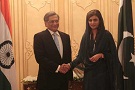
Krishna’s visit to Pakistan marks the culmination of two rounds of comprehensive talks between the two countries decided upon during the February 2011 foreign secretary-level talks in Thimphu. During his visit to Islamabad Krishna not only had discussions with his counterpart but also had meetings with the president, the prime minister, the interior minister and with leaders of political parties like the MQM, ANP and the PMLN. The visit was also marked by the signing of a liberalised visa agreement, a cultural agreement and a meeting of the India-Pakistan Joint Commission that was last held in 2007. The joint commission identified areas of cooperation in the fields of agriculture, education, environment, health, information, Information Technology and telecom, science and technology, and tourism. A series of measures were also agreed upon for easing travel and trade across the line of control. It was further decided that the next round of the secretary-level comprehensive dialogue process be launched that will come up for ministerial level review in New Delhi in 2013.

The lengthy 28 paragraph joint statement states that the talks were held in a ‘cordial, candid and constructive atmosphere’ and that there were ‘substantive discussions on the whole range of issues within the framework of the dialogue process’ with the ministers ‘expressing satisfaction over the progress achieved since their last review meeting in July 2011’. While there may have not been forward movement on many important issues like terrorism, Sir Creek and Siachen, the talks were cordial and wide ranging which is inexplicable in the light of the assurances given by PM in the Lok Sabha and given Pakistan’s continued hostility towards India.

Evidence of Pakistan’s inimical attitude towards India after the 26/11 attacks is borne out not only by its failure to make any serious efforts to bring to book the perpetrators but also by continued involvement in terrorist actions against India, like the Pune bombings of February 13, 2010 resulting in 17 deaths, the Mumbai serial blasts of July 13, 2011 resulting in 18 deaths and the Delhi High Court bombings of September 7, 2011 resulting in 11 deaths. Indeed, Abu Jindal’s debriefings confirm that Pakistan continues to plan similar terrorist actions against India. The resumption of cross-LoC firing by Pakistan, which had been stopped by Musharraf, continued terrorist infiltration from across the LoC, the relentless and massive pumping in of fake currency by Pakistan into India, the revival of its support to the Babbar Khalsa, its refusal to hand over to India any of the nearly 50 wanted terrorists, like Dawood Ibrahim, to whom its provides shelter, and its unwillingness to shut down the infrastructure of terror are proof that it means to continue to use terror against India in a ‘business as usual’ mode.

To add insult to injury the Pakistan foreign minister in an interview just before our external affairs minister’s visit urged that India should look at the 26/11 attacks “unemotionally”, drawing a parallel between them and the attacks on the Samjhauta Express and the 1971 conflict. This insensitivity was further reinforced in the joint press conference addressed by the two foreign ministers when she asserted that the two sides “should not be held hostage to history” but should look to the future.

Instead of challenging the Pakistan foreign minister at the joint press conference for the aforesaid comments and underlining the critical importance of addressing our terrorism-related concerns Krishna not only complimented the Pakistani leadership for bringing about “a positive change in the atmosphere” but echoed her thinking by stating “let us not look back, as you have very rightly said; let us not be held hostage to whatever has happened earlier…….Let us look to the future”. It is not surprising, therefore, that the Pakistani media has drawn the conclusion that India no longer attaches the importance it earlier did to bringing to book those involved in the Mumbai attacks.

It is logical to assume that it is only a matter of time before the PM who is “keen” to visit Pakistan will do so. Though prior to his departure in an interview to the Express Tribune the external affairs minister had stated that the “right atmosphere” would have to be created for it and that it should have a “substantive outcome” in Pakistan, in the joint press conference in Islamabad while not indicating any date for the visit he asserted that there was no question of progress on the 26/11 attacks being a condition for PM’s visit to Pakistan. Clearly, the government seems to have given up all pretence of pressurising Pakistan to give up the use of terror as an instrument of foreign policy against us.

PM’s visit to Pakistan irrespective of whether or not Pakistan addresses our concerns on terrorism is supported by some in India on the grounds that it would provide an impetus to the current upturn in ties and would strengthen the hands of the civilian set up in that country. In this context, it may be mentioned that the upturn in ties is an illusion based on sweet nothings mouthed by Pakistan and our failure to retaliate against its many provocations. It tactically suits Pakistan to maintain this illusion as it is isolated and as this illusion deflects the pressure on it to shut down the infrastructure of terror.

Forward movement on trade by Pakistan, which is acclaimed as a sign of its positivity, has been long delayed and tardy and is, primarily, in its own interests. To date it has not accorded us the MFN status, which we did in the mid 1990s. It still maintains a negative list of nearly 1,200 items, allows movement of only about 200 items through land, and does not permit us transit rights for overland exports to Afghanistan. As regards the civilian government in Pakistan, our investing in it is pointless since it does not exercise real power, it will have to demit office latest by March 2013, and, in the ultimate analysis, it is also imbued with an anti-Indian mindset.

Friday, April 6, 2012

Asif Zardari’s Visit: India Should Avoid The Old Mistakes

Sushant Sareen

Quite clearly, between two countries which share an adversarial relationship, there is nothing that can ever be called a ‘personal’ visit by one head of state to the other country. And between India and Pakistan, this is quite simply impossible because in this era of 24x7 TV, a media circus will inevitably surround such a visit giving it saturation coverage and analysing every turn of the head, every wink, nudge, shrug, nod and what have you. At the political level, such a ‘personal’ or even a ‘non-official’ visit (for instance a cricket match) serves as a convenient excuse for the leaderships of the two countries to touch base and use the occasion to confabulate with each other. Thus it is that the moment it became known that Pakistan's President Asif Zardari wanted to go on a pilgrimage to Ajmer, the Indian leadership not only extended all due protocol to him but also graciously invited the Pakistani president to stop over in New Delhi en route to Ajmer for a meeting followed by a lunch with the Indian Prime Minister.

The official line in both Islamabad and New Delhi is that Mr Zardari’s visit is purely personal and the Indian PM is hosting a lunch for him only to extend courtesy to a visiting head of state. There is really nothing on the ground to suggest that the officials are burning the midnight oil to prepare for some kind of intense dialogue. And yet, hardly anyone in the two countries is taking the official line on face value. Notwithstanding denials by officials who are going blue in the face trying to dispel any notion that the meeting between the Pakistani President and Indian PM has been elaborately choreographed, most analysts are convinced that the pilgrimage is actually a smokescreen for holding direct high level talks between Mr Zardari and Prime Minister Manmohan Singh.

Asides the fact that political leaders of India and Pakistan are notorious for entering into a dialogue without adequate preparations – Agra 2001 is a prime example – the speculation that the meeting between Zardari and Manmohan Singh will give some sort of a push to the dialogue process between the two countries is also fuelled by the recent breakthrough in trade relations with Pakistan moving to a negative list of trade items pending the grant of MFN status to India. This was a long standing demand of India and is being seen (quite wrongly, it must be said) as a concession made by Pakistan. What is more, ever since the obnoxious Shah Mehmood Qureshi was removed as foreign minister and was replaced by Hina Rabbani Khar, Pakistan has been making all the right noises towards India, sending signals that it is genuinely interested in normalising relations with its eastern neighbour. Although the Indian permanent establishment is rather sceptical about genuineness of Pakistan's professed intentions for good relations, at the political level the Indian leadership appears to be falling over itself in trying to reach out to Pakistan and clasp the extended hand. Not surprisingly then, observers are waiting to see what, if anything, comes out of the meeting between Zardari and Manmohan Singh. And it is precisely this expectation, rather anticipation, that India needs to guard against.

To some extent, there is recognition in India that Zardari probably doesn't have the political capital to effect any major breakthrough with India and therefore it would be unrealistic to expect him to deliver on anything substantial on issues of critical importance to India. Many in India would also argue that any assurances that Zardari gives to India on the issue of terrorism cannot be taken seriously because he just doesn't have the power to fulfil these assurances. After all, the terror machine in Pakistan is controlled by the military establishment of that country and given the frailty of the political system, and his own precarious position, it is unlikely that Zardari can or will take on the powerful Pakistan army in order to live up to any commitment he makes to India. As a result, no one should be surprised if the issue of terrorism is raised in only a very pro forma manner by the Indian side.

Paradoxically, it is this palpable weakness of successive Pakistani leaders that serves as a trump card for them in their dealings with India. Chances are that Zardari will play up on both his sincere desire for good relations with India as well as his weak position within his own country to try and extract some major concession from his Indian interlocutors, without of course conceding anything in return. In other words, what Zardari will do is that when pressed on the issue of terrorism, he will explain his difficulties and constraints in addressing this issue immediately. He will in all likelihood play the ‘Mullah-Military card’. His pitch will be: “help me by giving me something that I can take back with me to my country and marginalise the military-mullah alliance on the back foot; without such a grand gesture from India the mullahs and the military will destabilise my government, depose me and take over power and then India will have to contend with a radical or at least a very hard line government in Pakistan, dominated, if not run, by the military-mullah alliance”. He will wave the trade deal as a sign of his commitment and in turn seek concessions on what some ignorant analysts, commentators and other sundry peaceniks call ‘low hanging fruit’, namely Sir Creek and Siachen, on which there is a false propaganda that a deal is all set to be inked if only the Indian leadership summons the political courage and displays the political will to do so. This is exactly the tactic used by successive Pakistani leaders with their Indian counterparts and this has always been successful in extracting concessions from India – Ayub Khan used this after the 1965 war, Bhutto after 1971, Benazir Bhutto and Nawaz Sharif when they were at the helm of affairs.

Having fallen for the same beguiling Pakistani logic time and time again, India now needs to put a stop to this Pakistani version of ‘Apres moi le deluge’ and no better occasion to do this than Zardari’s forthcoming visit. While India should wish Zardari well – he is probably the most visionary leader Pakistan has got in a long, long time and his policies, domestic and external, hold the potential for making Pakistan a ‘normal’ state – his survival is neither India’s responsibility nor is it India’s primary interest vis-a-vis Pakistan, and most certainly not if this has to be achieved at the cost of surrendering India’s vital security interests or compromising on India’s sovereignty.

The big problem however is the obsessive quest of the current Indian dispensation to settle all the problems with Pakistan even if it means sacrificing India’s interests in the process. No one should therefore be surprised if India once again makes the same old mistake of trying to rescue a Pakistani leader by making concessions and ending up with the worst of both worlds – not only giving the Pakistanis what they wanted at India’s cost, but also failing to save the person for saving whom these concessions were made in the first place.

Author is Senior Fellow in Vivekananda International Foundation