Showing posts with label MEA. Show all posts

Thursday, May 21, 2015

Talking Candidly to China

Nitin A Gokhale, 
Editor & Senior Fellow, VIF

Prime Minister Narendra Modi appears to have gone beyond the cautious approach usually advocated by the tightly-knit ‘China group’, an informal team of Sinologists in the Ministry of External Affairs (MEA) in dealing with Beijing during his recently concluded China tour. In reminding the Chinese that there are “complex,” issues “holding back the relations,” Mr Modi was more than candid. He said in presence of Premier Li Keqiang: “I stressed the need for China to reconsider its approach on some of the issues that hold us back from realizing full potential of our partnership. I suggested that China should take a strategic and long term view of our relations.” Usually, Indian leaders do not speak with such frankness, largely preferring to be diplomatic, an approach preferred by the MEA mandarins.

The Prime Minister then reiterated his desire for a quick solution during his address at the Tsinghua University. There he said: “Yet, if we have to realise the extraordinary potential of our partnership, we must also address the issues that lead to hesitation and doubts, even distrust, in our relationship. First, we must try to settle the boundary question quickly."

Even the joint statement reflected a subtle shift in how New Delhi and Beijing look at the boundary issue now. Part of the statement said: “The two sides affirmed that an early settlement of the boundary question serves the basic interests of the two countries and should be pursued as a strategic objective by the two governments. Bearing in mind the overall bilateral relations and the long-term interests of the two peoples, the two sides are determined to actively seek a political settlement of the boundary question.” Premier Li, in his written interview to India Today just before Prime Minister Modi’s trip began, also spoke about the need to speedily settle the border. “The boundary question is left over from history, and is a difficult question in bilateral relations. To settle the question as early as possible is the historical responsibility that falls on both governments...” The earlier Chinese stand was 'let's leave the resolution of the border to future generations and concentrate on improving our relationship in other fields.'

Li's statement is also an important shift from what was said in Bejing in October 2013 when the Border Defence Cooperation Agreement (BDCA) was signed. That time, both sides were mostly talking about keeping the border quiet and finalising the framework for the boundary settlement. Part of the joint statement that time said: “Special Representatives, who have been charged with exploring a framework of settlement of the India-China boundary question, were encouraged by the two leaders to continue their efforts in that direction. Peace and tranquility on the India-China border was recognized as an important guarantor for the development and continued growth of bilateral relations.”

Another instance of the Prime Minister’s bold initiative was his decision to allow e-visas to Chinese citizens wishing to travel to India. Mr Modi appears to have taken a calculated risk in this matter although the security agencies and even the MEA appeared to have had reservations on this move. The Prime Minister has been criticised by hardliners for not linking the decision of e-visa to the resolution of ‘stapled visa’ that the Chinese occasionally issue to residents of J&K and Arunachal Pradesh. However the PMO looks to have decided to put greater emphasise on people-to-people contact between India and China. Pointing out that “Indians and Chinese don't know each other well, much less understand each other,” Mr Modi has taken a big step forward in correcting this shortcoming.

Moreover, by reaffirming the demand for clarification of the Line of Actual Control (LAC) India is adopting a similar tactic as the Chinese who stick to their stand irrespective of the response from the other side. Prime Minister Modi had made this suggestion for the first time last September when President Xi Jingping was in India. Beijing has not responded to the idea yet. By once again raising the point, New Delhi has now put the ball in China's court. If the Chinese don't respond then the border talks will continue to stagnate.

Similarly, for the first time both sides have acknowledged their role in the larger international context. "The leaders agreed that simultaneous re-emergence of India and China as two major powers in the region and the world offers a momentous opportunity for realisation of the Asian Century. They noted that India-China bilateral relations are poised to play a defining role in the 21st Century in Asia and indeed, globally."

In conclusion, a more confident New Delhi and an already assertive Beijing, currently led by two strong and nationalist leaders are willing to play a more proactive role in world affairs, their divergent views on some issues notwithstanding.

Published Date: 20th May 2015, Image Source: http://indiatoday.intoday.in

Thursday, March 27, 2014

Ukraine Crisis: The Chinese Stand and Lessons for India

Monish Gulati

Introduction

As the conflict in Ukraine refuses to abate, it continues to raise fears of triggering yet another confrontation between the Cold War era adversaries – the US and Russia - in a geopolitical tussle for dominance in Europe. There is also the possibility that Ukraine itself could descend into civil war; analysts ponder to which past moment of history will the country seek to repeat: the 1968 model, when Soviet troops invaded former Czechoslovakia to put an end to the Prague Spring; or the 2008 scenario, when Russia intervened in Georgia on the issue of Abkhazia and South Ossetia.

Ukraine with its 45 million residents has deep geopolitical, ethnic and economic fautlines.1 While the economically weak regions in the west are bastions of nationalists, Ukraine’s major companies, like its steel mills, ship and turbine building are located in the east and are dependent on the Russian market. One narrative on the protests in the independence square in Kiev states that far-right nationalists and fascists have been at the heart of the protests and attacks on government buildings. The most active of the groups has been reported to be the rightwing Svoboda or “Freedom” Party which in the 2012 election took 10.45 percent of the vote and over 40 percent in parts of the western Ukraine. It currently has 36 deputies in the 450-member Ukrainian parliament. The latest source of tension in the region is the autonomous Crimean peninsula, which was first transferred to Ukraine in 1954, and now its parliament has just voted to be independent from Ukraine.
The Ukrainian crisis has turned out to be a severe test for global governance norms and institutions on the issues of democracy, public will and territorial sovereignty. India would draw several pointers for its foreign policy as the US, EU, Russia play out the geopolitical chess. As the situation unfolds in Ukraine, it is the Chinese position and the dynamics of China-Russia relationship that would be keenly watched by India to derive implications for its bilateral standoffs.

India’s Position

For months into the Ukraine crisis, India had remained noncommittal and no statements were forthcoming from the government. The only indication of India’s position came from a ‘tweet’ by the External Affairs Ministry (MEA) spokesperson, which read “We are closely watching fast evolving situation and hope for a peaceful resolution.” The silence was broken on 6th March after statements from both the MEA and the National Security Advisor (NSA).

The statement by MEA expressed India’s concern at the escalation of tension in Ukraine and called "for a legitimate democratic process to find full expression through free and fair elections that provide for an inclusive society."2 It added that India stood for sincere and sustained diplomatic efforts to ensure that issues between Ukraine and its neighbouring countries are resolved through constructive dialogue. However, the response of the NSA, who said, "There are legitimate Russian and other interests involved and we hope they are discussed and resolved,” was more indicative of India’s tightrope walk between deep historic ties with Russia and the Indian commitment to the inviolability of national sovereignty.

Chinese Reaction

The Chinese position on Ukraine has been gleaned by China watchers from two telephone calls, a newspaper editorial, and two foreign ministry briefings. It has left the analysts divided and China’s position declared as being of “studied ambiguity”.

Chinese President Xi Jinping was quoted on 4th March by the official Chinese media as telling Putin during a telephone call that the present situation in Ukraine was highly complicated and sensitive and that China supports proposals and mediation efforts of the international community that are conducive to reduction of tension. Russia should work towards a political settlement of the issue so as to safeguard regional and world peace and stability.3 Earlier on 3rd March, Russian Foreign Minister Sergei Lavrov had discussed Ukraine on telephone with his Chinese counterpart, Wang Yi and claimed they had “broadly coinciding points of view” on the situation in Ukraine.

Chinese foreign ministry spokesman Qin Gang said on 3rd March that "China upholds its own diplomatic principles and the basic codes for international relations, which have also been implied on the Ukraine issue," Qin said China has taken the historical and contemporary factors of the Ukraine issue into consideration and that there were reasons for the situation in Ukraine.

China’s ‘fine balancing’ has been justified on the grounds that denouncing Putin’s decision to send troops to Crimea would impact the partnership between Beijing and Moscow. Worse, standing against Moscow would mean China was supporting the position taken by the West—which could be taken as implicit support for the Ukrainian protestors. China is distrustful of “colour revolutions,” including Ukraine’s own “Orange Revolution” of 2004 as it considers the “colour revolutions/springs” as instigated by Western nations to oust unfriendly regimes. Given the circumstances, China seems to have gone as far as it can, when it abstained during the UN Security council resolution on Crimea; which not surprisingly was vetoed by Russia. However, Chinese tacit support for Russia has not come easy.

Principle of Non-Interference

The non-interference principle has served China well in diplomacy to justify its inaction in many international crisis situations from Sudan to Syria to North Korea and at the same time allowed it to take an anti-West position. China expects that the principle in turn would apply to its internal affairs, particularly the provinces and autonomous regions with restive minorities along its periphery which associate more ethnically/ culturally with China’s neighbours.4 However, support to Russia would violate China’s principle of non-interference and possibly set a precedent of China’s support for military intervention outside a country’s recognised borders—which goes against all China’s instincts, given its own issues with Tibet and Xinjiang provinces. 5

China’s relationship with Russia also has an underlying sense of competition, particularly for leadership in Central Asia, and a historical lack of trust among many within the broader citizenry of each country. Moreover, in 2008, during the Russo–Georgia conflict, Moscow failed to obtain support from the Shanghai Cooperation Organization (SCO), which includes most of the Central Asian republics. China then had remained silent, not expressing support for either side.6 Letting Russia have its way appears to undermine China’s interests in Ukraine.

Chinese Interests in Ukraine

There is another narrative on China’s balancing act on Ukraine; its commercial and non-traditional security interest. As Voice of America reports, China has strong business interests in Ukraine which would be compromised by overt Chinese support for Russia.7 Ukraine is a major source of arms and armament technology for China and a growing partner in China’s global quest for resources. China recently inked a deal to farm three million hectares of arable Ukrainian land over the span of half a century. Under the initial agreement, worth $1.7 billion, with KSG Agro, Ukraine's leading agricultural company, 100,000 hectares will be leased to Xinjiang Production and Construction Corp (XPCC), a Chinese quasi-military organization, also known as Bingtuan. The leased farmland in the eastern Dnipropetrovsk region would be cultivated principally for crops and raising pigs and the produce will be sold to two Chinese state-owned grain conglomerates at preferential prices. The project will eventually expand to three million hectares.

As part of the same deal, China’s Export-Import bank has given Ukraine a $3 billion loan for agricultural development. XPCC also intends to help build a highway in Ukraine’s Autonomous Republic of Crimea as well as a bridge across the Strait of Kerch. Ukraine is one of the world’s leading exporters of grain, and is hoping to increase production in coming years. Ukraine’s plans for its agricultural industry, coupled with China’s need to increase grain imports, will make Kiev an attractive target for increased economic cooperation with Beijing.8

Assessment

Alyssa Ayres at the US-based Council of Foreign Relations (CFR) has drawn out some lessons from the Ukraine crisis. First, she highlights the importance of establishing strong “rules of the road” which are effected through functional regional institutions to resolve differences between countries. Referring to the North Atlantic Treaty Organization (NATO), she says Russia’s approach on similar issues/ differences with NATO member countries in the region has been more appropriate and balanced unlike in the case of Ukraine, possibly because it is not a member of the NATO. Yet the concept has its limitation as the thought of the likely NATO reaction did not deter Russia from moving into Crimea. Nor did fear of possible alienation from the G8, or condemnation from the Organization for Security and Co-operation in Europe (OSCE) appear to have any restraining effect either.

Second, the Ukrainian events accentuate the shortcomings of the UN Security Council (UNSC) and its vulnerability to use of veto power by the permanent members. Consequently EU and US have been compelled to explore other persuasive and punitive responses centred on national visa policies, economic and trade sanctions etc.9

China, a permanent member of the UNSC, over the last few months has increasingly pushed to test established global norms with regard to resolving territorial disputes as well as demonstrated an inclination to challenge the regional order. US in its pivot to Asia finds itself balancing stable US-China relations on the one hand, and the imperative to uphold the credibility of US deterrence in the face of rising concern amongst its allies on China’s ‘creeping expansionism’, on the other. Analysts warn that US will struggle to maintain this precarious balance and Chinese interests may dominate Asia in the future.10

China would be mindful of the fact that it too at some point in future could be the target of Western sanctions. Therefore, it would watch closely the drama over Ukraine and Crimea and the West-Russia confrontation to expand its portfolio of strategic options. China in this regard would also value its strategic collaboration with Russia to jointly counter Western interference.11
On 8th March on the sidelines of the National People's Congress (NPC) session, Chinese Foreign Minister Wang Yi told media persons, on the issue of territorial disputes that ”We will not take anything that is not ours, but we will defend every inch of territory that belongs to us".12 Referring to the strained Sino-Japanese relations over the islands in the East China Sea, Wang said, "On the two issues of principle, history and territory, there is no room for compromise." This was the second time within few days (the other being in case of Ukraine) that China had used “history and territory” together to justify aggressive measures to resolve long standing territorial disputes. It is this kind of posturing that would give strategic analysts in India goose bumps, especially after the recent stand-off on territorial issues.

While the Indian approach on China has been to engage, compete and cooperate in the shared periphery and in the world, India would take certain pointers from the Ukraine crisis with respect to its prospective interactions with China. India would be conscious of the degree of consensus and cooperation Russia and China have shared on ticklish issues concerning Syria, Libya, Iran and now Ukraine. Also the fact that this understanding has included deliberations at the UNSC and that Russia may feel obliged to reciprocate Chinese support in the future. This may compromise Russian support to India during a Sino-Indian standoff. Also defence purchases which have been the mainstay of Indo-Russian partnership has been on the decline while India’s purchase of US weapons and equipment has seen a significant upswing.
India would watch the effectiveness of non-military coercive measures being deployed by EU and the US against Russia and at the same time being aware that similar measures if ever used against China would be appreciably less effective, given China’s economic staying power. Also despite the fact that Russia’s economic clout is relatively diminished compared to that of China, US is struggling to find support for its economic sanctions outside the EU. Even within the EU, dependence on energy imports from Russia, is making the implementation of non-military coercive measures that much more difficult.

India would also the seek greater and stronger partnerships on China’s periphery and in regional cooperation frameworks such as the ASEAN, BIMSTEC etc. Strategic partnerships with countries like Japan which may walk the extra mile during a crisis assume importance.

The crisis in Ukraine is not likely to go away in a hurry. Its impact on global security structures, the dynamics of US, EU, Russia and China relations and the growing Russia-China strategic partnership are the issues that India would be keenly watching.

Endnotes

  1. Prabhat P Shukla. The Stakes in Ukraine, VIF, March 06, 2014. http://www.vifindia.org/article/2014/march/06/the-stakes-in-ukraine
  2. Russian interests in Crimea ‘legitimate’: India, The Times of India, March 07, 2014 http://timesofindia.indiatimes.com/india/Russian-interests-in-Crimea-leg...
  3. Ibid.
  4. Shannon Van Sant. China Attempts to Strike Delicate Balance on Ukraine, VOA, March 04, 2014. http://www.voanews.com/content/china-offers-support-for-ukraine-without-...
  5. Shannon Tiezzi. China Backs Russia on Ukraine, The Diplomat, March 04, 2014. http://thediplomat.com/2014/03/china-backs-russia-on-ukraine/
  6. Elizabeth C. Economy. China’s Soft “Nyet” to Russia’s Ukraine Intervention, CFR, March 05, 2014. http://blogs.cfr.org/asia/2014/03/05/chinas-soft-nyet-to-russias-ukraine...
  7. Shannon Van Sant. China Attempts to Strike Delicate Balance on Ukraine, VOA, March 04, 2014. http://www.voanews.com/content/china-offers-support-for-ukraine-without-...
  8. Shannon Tiezzi. China's Agricultural Deals with Ukraine in Jeopardy, The diplomat, February 28, 2014 http://thediplomat.com/2014/02/chinas-agricultural-deals-with-ukraine-in...
  9. Alyssa Ayres. Ukraine’s Lessons for Asia, CFR, March 05, 2014.
  10. Benjamin Schreer. China’s rise: the strategic climate is getting colder, The Strategist, March 2014. http://www.aspistrategist.org.au/chinas-rise-the-strategic-climate-is-ge...
  11. Chen Xiangyang, Researcher & Deputy Director, Institute of World Political Studies, CICIR. http://www.chinausfocus.com/peace-security/tug-of-war-in-ukraine-reflect...
  12. Will defend every inch of territory, China warns neighbours, PTI , March 08, 2014. http://timesofindia.indiatimes.com/world/china/Will-defend-every-inch-of...

(The author is an independent analyst based in New Delhi)

Thursday, August 1, 2013

India-Bhutan Ties: New Delhi Got it Right

Kanwal Sibal, 
Dean, Centre for International Relations and Diplomacy, VIF

Many in India believe that we have failed in our policy towards our neighbours. For them the hall mark of any successful foreign policy is good relations with neighbours. Because we are so big, many think that we must make an extra effort to win the trust of our neighbours, deal with them generously, without seeking reciprocity, and show greater sensitivity to their concerns, however misplaced. They should be given a stake in our growing economy through unilateral concessions, with any shorter term loss being traded for longer term gains that economic dependence brings.

Such thinking overlooks the objectives of third countries in our neighbourhood who get more space by playing upon the insecurities of small countries living under the shadow of a behemoth. It also ignores the political thinking, perceptions of national interest, personal preferences and even prejudices of ruling elites in our neigbourhood that too determine the quality of their relationship with India.

Relationships

India cannot unilaterally mould ties with neighbours who may, in fact, not want to be embraced too tightly and may want to court other powers both to balance India and extract more concessions from us.

They may believe that because of our internal problems, our high tolerance levels, lack of an internal consensus on treatment of neighbours, existence of sympathetic local lobbies and sensitivity to accusations of hegemony, they have scope to disregard our interests and concerns with some impunity.

Critics should ask themselves whether other big countries surrounded by smaller neighbours, whether China, Russia or the US, have smooth, conflict free relations with them. It is not axiomatic for smaller countries to be always right and the bigger to be always wrong in any conflict of interest.

All this is pertinent to the controversy generated by our ‘mis-step’ to cut subsidies on cooking gas and kerosene in the midst of parliamentary elections in Bhutan, putting the Ministry of External Affairs (MEA) in the eye of the media storm.

Actually, the best managed relationship with any of our neigbours is with Bhutan, in which the extremely sensible policies of the Bhutanese monarchy towards India is a key factor. Unlike Pakistan, Nepal, Bangaldesh, Sri Lanka and lately Maldives, the monarchy has not played the Chinese card against us. Bhutan is also monetising its water assets for mutual benefit, which Nepal has failed to do with India.

Criticism of the government for wanting to put foreign policy constraints on Bhutan and pursuing the British imperial tradition of treating it as a “protectorate” is misplaced. India has in fact promoted Bhutan’s international personality; it has revised in 2007 the 1949 treaty that required Bhutanese foreign policy to be guided by India. Bhutan is often voting differently from India as in the case of the Arms Trade Treaty, Iran, Syria and North Korea, without Indian objections.

Buffer

India has more reason to create buffers to protect its sovereign territory from the Chinese threat than the British had to protect their colonial fiefdom. Bhutan adjoins Arunachal Pradesh which China claims. Any Chinese penetration into Bhutan outflanks us politically. The Chumbi valley’s strategic sensitivity for our defences requires that India and Bhutan cooperate with each other to prevent a deeper Chinese encroachment southwards. The Chinese are keen to have a diplomatic presence in Thimphu. So far the monarchy, in rejecting the establishment of any P-5 embassy in Thimphu, has been sensitive to India’s security interests.

Outgoing Premier Thinley injected an element of suspicion about Bhutanese dealings with China by meeting his Chinese counterpart in Rio last year, with China tweaking us by announcing that diplomatic ties were discussed, a fact suppressed by the Bhutanese government. Given Bhutan’s delicate position, it must calculate carefully the pluses and minuses of its overtures to China that make India nervous.

Our media commentary on the subsidy issue has been disproportionately critical of the government, overlooking the generous record of India’s assistance to Bhutan. In the 10th Plan period- July 2008 to June 2013- we have provided Rs 6055 crores of assistance, which included Rs 1500 crores for Refunds and Subsidies, of which the kerosene and the LPG subsidy (jumping up from Rs 33 crores in 2011 to Rs 52 crores in 2012 ) is a minor part.

Assistance

Some concerns about transparency in the utilization of Indian assistance to Bhutan have persisted, with calls within MEA for corrective action, which is not abnormal. Following MEA’s request to the Ministry of Petroleum to examine ways to make the supply of all POL products to Bhutan commercially viable, the Indian Oil Corporation (IOC) apparently conveyed to Bhutan, without further consultations with the MEA, that prices would be increased from July 1, causing wide speculation in the Bhutanese media whether this was a political move.

To suggest that the MEA suddenly lost its diplomatic sense by initiating this move amidst Bhutanese elections would be unjustified. In reality, after the February visit of Premier Thinley, the MEA released a further standby credit of Rs 400 crores to tide over Bhutan’s rupee crunch and in May the last tranche of the Excise Duty Refunds of Rs 300 crores was released, which refutes any intention to apply a politically calculated squeeze. MEA’s already announced in-principle decision to restore the LPG and kerosene subsidy next month closes the unfortunate episode.


Despite an unpleasant hiccup, all’s well that ends well. The PDP, which campaigned on developing stronger ties with India has won, even as the losing DPT has emphasized the importance of maintaining good relations with us. The monarchy, which has always given paramount importance to ties with India, should welcome the election results as it is unlikely that the PDP will gratuitously create during its tenure undercurrents of suspicion in India-Bhutan ties. 

Wednesday, November 21, 2012

India’s Role in the Current Century


Kanwal Sibal
(Advisory Board, VIF)


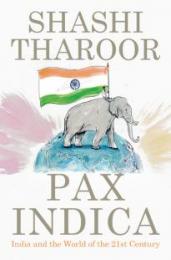
The title of Shashi Tharoor’s new book, Pax Indica: India and the World of the 21st Century, can mislead an unwary reader. The book does not offer a blueprint for India’s rise to imperial status in the current century. A more modest role is envisaged for India, that of helping to define the norms of tomorrow’s new networked world, write the rules and have a voice in their application. But the book is not really about this either. It is more an overview of India’s relations with its neighbours, South- East Asia, China, the US, the Arab countries, Africa, Europe, and Latin America, with separate chapters on India and the UN and Soft Power and Public Diplomacy, and a final chapter on Multi-Alignment as a “Grand Strategy” for India in the decades ahead.

The new norms and rules that India would work on, how they would be different from the ones that the West considers universal, and the means India will deploy to achieve success are not spelt out in the book. In actual fact, the author believes that the world having been made “safe of democracy”, India’s vocation should be the promotion of democracy and human rights worldwide along with “major allies” like the US. This suggests adjusting to Western norms more than redefining them, which is in fact what the West expects of others.

The reader would have greater than usual interest in Tharoor’s latest book because he would be writing from a double perspective – that of his long experience in international diplomacy as a UN civil servant and a brief exposure at the political level to India’s foreign-policymaking as a junior Minister in the Ministry of External Affairs (MEA). However, rather than this double experience combining to give more cohesion to his analysis of India’s foreign policy in the current century, it produces some inconsistencies.

An instance of this is the disproportionate attention given to groups such as BIMSTEC (Bay of Bengal Initiative for Multi-Sectoral Technical and Economic Cooperation) and the IOC-ARC (the Indian Ocean Rim Association for Regional Cooperation) and the exaggerated enthusiasm with which their potential is described. The eight pages devoted to BIMSTEC contrast with one paragraph each that Japan and South Korea merit, and the less than three pages of superficial treatment of Russia. While Europe gets the same space as BIMSTEC, the author considers the continent irrelevant to India’s strategic interests. He claims that “there’s nothing like the IOC-ARC in the annals of global diplomacy” and rhapsodizes thus in UN-speak:

When the IOC-ARC meets, new windows are opened between countries separated by distance as well as politics. Malaysians talk with Mauritians, Arabs with Australians, South Africans with Sri Lankans, Iranians with Indonesians. The India Ocean serves as both a sea separating them and a bridge binding them together.
Doesn’t the UN at New York do all this too?

Some other inconsistencies in the book probably derive from the author’s reluctance as a former Minister and Congress Member of Parliament to criticize the government’s policies. Tharoor’s analysis of the roots of Pakistan’s deep-seated hostility towards India is most perspicacious and hard-headed, but even as the reader is being convinced that Pakistan cannot be trusted and dialoguing with it would not be productive, the author dutifully purveys all the contestable arguments of the government to justify resuming the dialogue, adding some jejune ones of his own, such as “what we say when we talk that will make the difference” and that a dialogue allows India to make clear to Pakistan “its bottom lines and minimum standards of civilized conduct”. He is very dismissive about the India-Pakistan Track-2 dialogues, but slips into candlelight phraseology in advocating a show of “magnanimity and generosity of spirit that in itself stands an outside chance of persuading Pakistanis to rethink their attitude to us”. Homilies such as “To acknowledge that trust does not exist right now, however, is not to suggest that trust can never be built” and that “The time has come ... for the victims of geography to make history” cannot be the basis of serious policy. He does not explain how but wants “New Delhi to do its best to ensure that the Islamabad establishment abandons the conviction that terrorism is the only effective instrument that obliges India to sit up and pay attention to Pakistan and engage with its interests”. Rather surprisingly for a UN hand, he believes India can have sanctions imposed on Pakistan under UN Chapter VII resolutions on terrorism, overlooking that the US, despite serious Pakistani provocations, has not used this instrument against Pakistan and any action in the UN Security Council will need US and Chinese assent.

The author is right to affirm that India is no longer in the same league as China economically, but some of his other views on India-China relations are debatable. He seems to believe, without any apparent basis, that India has a genuine strategic partnership with China and that this relationship has broadened to include “the wider civil society in both nations”. His view that Chinese and Indian economies are complementary will be contested by those who argue that the relationship has become colonial-like in structure – export of raw materials versus import of manufactured goods. He visualizes India- China cooperation on nuclear disarmament when China refuses to hold nuclear parleys with India because it does not consider the latter a nuclear power. His repeated assertions that China and India have a common interest in keeping sea lanes open overlook India’s strategic concerns about China’s increased presence in the Indian Ocean and the South China Sea imbroglio. The author is absolutely right about enhancing relations between India and Taiwan.

The chapter on the US is a mixture of several sharp insights and questionable assumptions. At one point the author notes Obama’s “substantive assurance” of support for India’s permanent membership of the Security Council and at another he characterizes it as “largely symbolic” and a “rhetorical flourish”. (In the chapter on the UN and global commons he gives an excellent analysis of the issues involved in expanding the Security Council in both permanent and non-permanent categories.) How the two countries can cooperate to counter nuclear proliferation is not explained. To say that there is no real clash between India and the US on “geopolitical fundamentals” is exaggerating the degree of convergence. It is debatable whether the relationship with India is going to be as important to American security as that with Europe once was. India and the US, the author says, “share a responsibility for preserving a rule-based open and democratic order” and the global commons, without clarifying the nature of this responsibility and who would define it because India itself has not done it so far. His belief that India and the US as the two principal democracies have special interests and responsibilities exaggerates India’s willingness to assume such a global role and overlooks the United States’ historical and continuing courting of authoritarian states in its larger national interest.

Tharoor rightly underlines the importance of India’s relations with the Arab world because of critical energy, trade, human resources and remittance links. But to say that the centuries-old India-Arab links have given the peoples on the two sides “a similarity of perceptions and cultural mores” is an obvious exaggeration, as is the assertion that “our geopolitical aspirations are entirely compatible”. On Iran, the Shia-Sunni issue, and the role of Saudi Arabia and Qatar in Libya and Syria this is not true. That Iran has been a “kindred spirit of India” on Pakistan, that it is a “friend at Court” in the Islamic world and that it considers India a useful source of “high technology” is not supported by facts.

Africa and Latin America get the requisite attention in the book. While the overview is informative, India’s sentiments towards Africa are expressed in extraordinarily mushy language:

India and Africa have been close to each other for so many centuries that our relationship is not one of immediate give and take but has been that of a family where each one provides the best advice, the best support and the best sharing of experience, so that when we walk the same path, we learn from each other and do not make the same mistakes.

Tharoor exaggerates the impact of India’s soft power on the current century, using mellifluous prose to make his point. While India’s democracy and pluralism, its composite culture, management of diversity, Bollywood et al. earn it respect, how can India be the “land of the better story” globally with its dysfunctional democracy, poor governance, abysmal levels of poverty, low human welfare indices, urban decay, lack of sanitation, etc.? On page 410 he himself lists India’s dramatic underperformance in many areas. Tharoor ignores the hard-power foundation of soft power acknowledged by Robert Nye, the originator of the concept of “soft power”.

The author’s views on the MEA, which he mockingly calls the Ministry of Eternal Affairs, are unflattering. The well-known shortcomings of the Ministry which he lists – to which international attention has been drawn by a US researcher – cannot be denied. While the Ministry is manifestly understaffed, mid-level lateral entry on a large scale is not an answer. Where will competent mid-level recruits come from? A successful remodelling of the MEA has to be part of an overall administrative services reform. The author explains well the ineffectual role of Parliament in foreign affairs and he is right about the centralization of foreign policy decisions on important issues in the PMO.

Not surprisingly, Tharoor deplores the non-aligned phase of India’s foreign policy. In his view, Indian diplomacy is concerned more with principles than interests, privileging intellect over interest and process over outcome, but he does not give any example to sustain this sweeping generalization. He wants India to adopt a gentler and more accommodative tone on the multilateral high table, an advice that would not appeal to those who recall the hectoring of India during the CTBT negotiations and have heard the rantings of some Ambassadors in the Security Council on Libya, Iran and Syria.

Tharoor’s version of India’s “grand strategy” would see us in the US-led camp of liberal democracies besieged by Islamist terrorism and Chinese authoritarianism, forgetting that it is the US that has propped Islamism and China in the first place. He wants India to “be true to its soul in the multilateral arena” and espouse vigorously the “Community of Democracies”, though this would require reconciliation with the rationale of India’s adherence to political groups like RIC (Russia-India-China) and BRICS. Tharoor is wary of multipolarity; but multi-alignment, which he strongly recommends as the axis of India’s future foreign policy, presupposes a diffusion of power within the international system and recognition that in the absence of an international consensus on the promotion of the Western agenda of democracy and human rights, which many countries see as selective and geopolitically driven, India has to maintain a balance between different approaches to such fundamental issues as respect for sovereignty, non-interference in internal affairs, regime change policies and concepts like the right to intervene and protect.

Tharoor decries the fact that India’s “old obsession with strategic autonomy remains”. In his view, “strategic autonomy is all very well, but it cannot be the be-all and end-all of India’s attitude to the world”. While he cautions against antagonizing the US for maintaining energy supplies from Iran, he affirms somewhat inconsistently that “no power on earth can presume to dictate to India on any international issue”. India has “more in common with the countries of the North than the global South”, he says, contradicting his own paeans to BIMSTEC, IOR-ARC, IBSA and relations with Africa, the Arab world, Latin America, India’s neighbours, and, to boot, East Timor.

In virtually every chapter Tharoor quotes extensively David Malone (seventeen times), a former Canadian envoy to India, to buttress his views. His “internationalism” probably explains the need for such external endorsement of his thinking on key facets of India’s foreign policy.

Thursday, July 26, 2012

Political - Civil - Military Participation in National Security


Vice Admiral (Retd.) Barry Barathan
Distinguished Fellow, VIF

Opener

Analysis of India's approach towards it's national security reveals an unacceptable hiatus between the Political -Civil- Military systems. We perhaps were lucky enough to get away thus far even despite the 1962 China debacle. New security realities, an assertive China, a highly probable Sino-Pak collusion, the emergence of non state actors, possible implosion in Pakistan, the Af-Pak mess all call for India to review and revamp its management of national security. Our bureaucracy has the sagacity, expertise and eclectic experience to optimise civil control mechanisms under political guidance. Our military and security forces have the commitment and wisdom to perpetuate democracy and secularism. Ours is a democracy wherein civil control of the military is absolute. We have mechanisms in place to optimally approach “national security and military readiness". This of course has to be politically understood, accepted, absorbed and be top down with sense of ownership, accountability and authority. This paper looks at the quantum and quality of civil- military participation, the higher defence decision making, the structures within the military and the way ahead.

Current Status of Political – Civil - Military Participation

Indian political -civil- military relationship needs to be seen in the context of the critical dichotomy between "Authority and Responsibility" resulting in the absence of ownership for military and security. The whole discussion often misses the forest for the trees. In the fog of this debate, the political leadership virtually goes unnoticed and hence never answers for this grave omission. Should our political leadership not take onus of ownership or at least assign responsibility for military and security readiness to an accountable entity. Six decades post independence has not seen any effective viable change.

Civil and military martnership needs to be seen in wider contours of nation’s Management, national security, foreign policy, technology self reliance, budgeting: in the frame work of sovereignty, sustainability and survivability as a nation state. It should also include internal security concerns. Intelligence and policing are inherent in this.

Who is Responsible for Readiness?

The Government of India rules of business are distinctly vague on responsibility, accountability of military preparation and readiness. Extracts from the rules of business and MOD website reproduced below, clearly highlight this:

‘Defence of India and every part thereof including preparation for defence and all such acts as may be conducive in times of war to its prosecution and after its termination to effective demobilisation’.

MoD Website also Reads

“The Defence Secretary functions as head of the Department of Defence and is additionally responsible for co-coordinating the activities of the four Departments in the Ministry.”

The above extract does not mention "preparedness or readiness" even in passing not to speak about the much needed deliberation. It is silent on "Accountability and Answerability"

Responsibility of Military Readiness

Security, Sovereignty, Stability of a Nation is clearly a leadership mandate- how it chooses to exercise and execute this, is, its prerogative. Why it remains passive has not been questioned either by the establishment or by the people.

The Army, Navy, Air Force are engaged individually in terms of turf protection. There is neither integration nor coordination between the Ministries of Defence, Home, Finance, External affairs with the army, paramilitary and intelligence forces, even as a concept, let alone in practice. Guarding the turf is a solemn obsession. What started as a practice became a habit and is now an addiction. The divide on the concept and role of the Chief of Defense Staff within the three services is sharp enough for the polity to justify its passivity. The IDS Headquarters under the CISC- Chief of Integrated Staff committee is gamely trying to pull the services together and over the last 7 years or so has been proved to be useful. This vindicates the need for a CDS. However, the Naresh Chandra Task Force has recently recommended a permanent Chairman, Joint Chiefs of Staff which is a climb down from the CDS. It is also not very clear as to what powers would CJCS have to enforce/enable integration and jointness.

Higher Defense Decision Making

The collateral, attendant impact on the Military and Security scenario is dependent upon the quality, quantity of ownership by the Political- Civil- Military combine in Higher Defense Decision Making. This has direct correlation with India's security calculus, effective military preparation, and readiness. Internal security strategies too, are contingent on the construct of Civilian - Military- Security equations and equity. Our bad neighbourhood is slipping into a vortex of visceral anarchy beyond reason and control. In the North East, China makes us nervous by its rapid and robust build up. Sino- Pak collusion is on the cards. Both may decide to make a play together, to stir the already simmering South Asian Security pot. The Afghan-Pakistan region is also fraught with various probabilities of dysfunctional anarchy. A Taliban take over is most likely, no sooner than the withdrawal of the American led NATO military. The fall out has serious implications in the region. Civil and Military participation in synergy must come into play sooner than later.

"Power relationships between Nations are constantly changing, and unless a country understands and adjusts itself to the changes that are taking place around it, its own Security will be seriously endangered" An extract from Sardar K M Panikkar’s Annual Day address to the Indian School of International Studies on 13 February 1961

Status Quo Syndrome

Examination of our Higher Defense Decision Making Organisation, readily reveals a witting "Six decade status quo syndrome" perpetuated by the way we are as Indians; fatalistic about our Indian-ness and independence. The implications of this on our sovereignty, security, stability, status as a secular Democracy can be understood, absorbed and be acted upon only if the top leadership grasps this with firmness and dynamism.


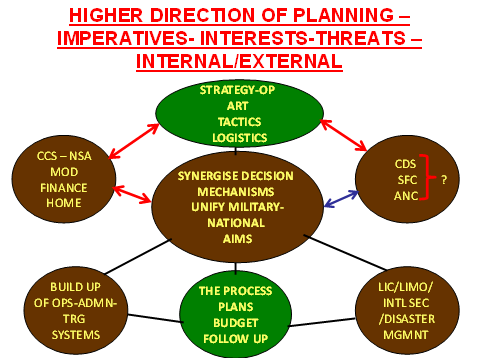
Key CCS -cabinet committee on Security
NSA- National Security Advisor
MOD - Ministry of Defense
CDS - Chief of Defense Staff
SFC - Strategic Forces Command
ANC- Andaman and Nicobar Command
LIC- Low Intensity Conflict
LIMO- Low Intensity Maritime Operations
INTL SEC- Internal Security
TRG - Training

Higher Direction Schematic and Actuality

The above schematic is the writer’s imagination. In practice the circles exist but are mostly in separate orbit. At best there are some committees of secretaries and the CCS who deliberate upon important issues on a need based continuum. The military may or may not be called in all deliberations.
The origin lies squarely in the Nehruvian mind set at the time of Independence. The Political leadership felt uncomfortable with the British model of command and control. The Bureaucracy too perceived that its primacy was sacrosanct in a democracy. Hence in the euphoria of independence, the Commander in Chief of the military was sectioned into the three chiefs of the three services. The promise of concurrent reorganisation of the Ministry of Defence is yet to be realised.

Military Obtuseness or Obedience

The naiveté of the British cloned, Army dominated Indian military leadership was perhaps an unwitting factor.

Ensconced in the cantonment and surrounded by the splendour of fife and drum beat, it did not understand the obvious, apparent difference between being "apolitical and politically obtuse"

The senior Indian Army hierarchy understandably behaved more like proper soldiers than statesmen. They believed in their leadership to do the right thing. What the former laid down then, continues even today.

It's approach to civil relations is always confined to a very narrow swathe of the defence ministry. Personnel of the armed forces are conditioned to be indifferent and sometimes with apathy towards the political class. Somehow, that they are people and citizens too, and not a class apart is overlooked in their education. In turn, the polity is comfortable with managing military affairs through the proxy of bureaucracy. Who should educate who, and on what, of the mutual, political & military education remains ignored.

Leadership & Civilian Bureaucracy Sans Military

Our leadership and bureaucracy adopted the whole works of the erstwhile English Raj through the aegis of the civil services without any consultation with the military. Both believed that the British model was suitable with minor modifications, excepting the military aspect. The euphoria of independence, the challenges of ruling a geo politically united India, infatuation with an English way of life, and dealing with the real politick of governance ensured that the rules of business on national management precepts were not properly thought through. Great Britain left behind a robust system that made lot of sense gave order and form with a strong legal base. Yet it was designed to take away wealth from us and hence in principle not compatible to our culture, tradition and age old valid systems. This has been adequately proved time and again in the way the land has been sub optimally governed. The system is "INDIA" dyslexic, people unfriendly and not result oriented. Government profligacy and inefficiency are in tandem in the maze of complicated red tape.

Lack of political direction and a loose limbed hands off approach, queers the pitch of military readiness. Consequently civil military bureaucratic relations exist under best conditions of polite detached, " Us versus Them” and diffused accountability.

The first warning that all was not well in this arrangement, was during the ill fated 1962 Sino-India conflict. Despite the lasting trauma of that battle, The Indian establishment continues in the same ilk. Despite all the conflicts with Pakistan and the imposing Chinese posture , the whole Political- Bureaucratic-Diplomatic- Military- Intelligence- Technology-Industrial community has not been able to get its act together! Working in watertight silos is both style and form today.

The quality and value of our Civil- Military bureaucratic relationship reflects; our inability to internalise India in terms of national perspectives. Consequently our externalisation tends to be tentative and confusing to us and outsiders. Drifting along with events as they occur seems to be our preferred option"

Paradox of The Pen & Sword

Both the Civilian Decision maker and the Military executor of the Country are committed to Sovereignty, Security, of a Democratic India. Hence there is neither a threatening crisis, nor even an impasse in the Civil- Military construct. This is the good news. The bad news however is: it is muddled, disjointed, indecisive, frustrating, and cost prohibitive, by default and design. Trust deficit and misperceptions militate against working together. The absence of mandated directives from the political leadership is the root cause of this avoidable morass. The Pen and the Sword can and have to join forces to ensure that files create capable combat effectiveness.

Go Between Bureaucracies

Both bureaucracies are pseudo go betweens with each other. All dialogue is on a dated filing system with a conundrum of file processing. In the Services, the file follows a hierarchical path from downwards to upwards and reaches Ministry of Defence at the level of Defence Secretary/ Additional Secretary. From that level it plunges straight down to the desk officer and is processed upwards through every layer. Unless this is changed inordinate delays in decision making would continue. In effect the silent strangler of the system is the file.

Our File Process The System Strangler

India, compelled to adopt the White Hall filing system as part of its legacy of freedom, continues with this archaic practice of file based decisions. The Civil and Military bureaucracy grew with this paper trail. Today despite the obvious advantages of the information highway, presence of useful decision supporting Management Information Systems; files still do the rounds at snail's pace. In practice, the whole process precludes collegiate decision making. The underlying working principle is to ensure that the file notes do not ever implicate any decision makers or subordinates on both sides. File Noting hence is defensive, tentative and tend to be open ended. It is no exaggeration to state that diffused accountability through obfuscation is the norm; fear of CVC/CAG (Central Vigilance Commission and Comptroller Auditor General) too is another catalyst for playing safe. This file process is the silent strangler, impervious to other dynamic changes brought in force through revised procurement policies.

File work must be minimal and supported by IT based decision processes. Information archiving, retrieval is the need of the day. Collegiate decision making is the answer in a networked set up. Secure LAN/WAN arrangements and software processes must become policy sooner than later.

Absence of Direct Communication Flow

Direct, institutionalised, formalised communication between National Leadership, Parliament and the executors of the country's Defence and Security policies and processes is more in absentia. The Parliamentary Standing Committee on DefenCe is notional, ineffective and powerless by design and organisation. Even in this, the armed forces only tag along with their civilian counterparts. The time, attention and energy devoted to the whole exercise is adhoc, cursory and a mere formality.

Culture of Working in Compartments

It is the norm for the MEA to take foreign policy decisions without any institutionalised consultation with MOD. The Latter has no formalised relationship with MEA

Similarly the MOH and MOD have no mandated Rules of Business on Internal security supervision.

One important facet of bureaucratic relationships is the complete impersonal imprint and a mindset to only dialogue on file and keep records. Time delay is a given, devoid of any emotional involvement.

Military Uniform to Uniform

Pride of service, in uniform is a primal facet of the military. This is needed, understandable and acceptable. Modern warfare however requires a mindset acceptance that, unified operations are a mandate. A mandate that needs doctrine, policy, procedures, training, debrief, remediation, re training and operational practice. The paradoxes of the military profession need to be part of the war fighter's DNA. Senior military leadership must undergo continuing education on involuntary conundrums, intrinsic in a fighting force, those are:

Preparing for an exam while hoping that it never takes place Maintaining a Combat ready entity in a 95% plus peace time continuum? This calls for an "Us with Us" approach.

Dealing with Internal security Issues on the concept of an " an iron fist in a velvet glove"

Managing; the promotion pyramid, the career construct, the significant superseded strata and rising expectations of a better educated, evolving military society!

Handling technology obsolescence in the face of ever present imminent combat and security threats in incipient conditions of uncertainty.
Living with bereavement and dealing with rehabilitation of families and the large number of retirees.

Learning to meld and blend combat culture with corporate practices to optimally organise the entire establishment needs, through serious, deliberate planning, money, in terms of intention, effort and determination.
Funding determination as part of the military budget for resettling families and transitioning veterans into civilian careers.

Crucial Strategic Asks

Can India live on its ancient glory, and its recent success of sorts? Is there room for complacency in a rapidly changing and deteriorating security scenario in the neighbourhood. Radical Islam, rapidity of information spread, increasing awareness on rights, rising expectations, inequitable economic weaknesses, poverty spread, malnutrition; all cause social unrest and desperation.

The crucial asks are:

Who is responsible, accountable for combat and security readiness?

Is the present civil -military arrangement able and workable across the span of governance, administration, nation’s management, diplomacy, defence, security and poverty alleviation?

Does India have overall national capability to handle both the neighbourhood as well as internal security issues and complexities?

Does defence budgeting require a different dynamism to make military management and acquisition cost effective?

What are fault lines within the Military that need speedy remediation?
Why has India not set up a defence Industrial base to strategically reduce Import costs?

How Should India Go About This

Ownership of readiness

The military will always fight with what it has- (COAS, Gen VP Malik during OP Vijay in Kargill) . Lack of " Ownership of Readiness" is behind this soldierly lament. Fixing Ownership of Readiness is the first step. It should be the Defence Minister who should be made answerable for military readiness and sovereign security. Similarly the Home Minister should be responsible for Internal security.

Once ownership is defined with authority, the whole chain would be galvanised into a channelised process of achieving stated objectives.

Able and Workable Systems

Process and authority in capability based capital acquisition is paramount. It has to rest and vest on a single point authority along with an empowered Organism. A pre audited collegiate decision matrix with autonomy and assurance that "Ghosts of Inquiry" do not unwittingly haunt the decision makers. Only then can the system become Nationally able and capable to handle Combat and Security management.

Military Fault Lines Repair

Concept of unified operations is an operational imperative. Training and learning to fight together should become part of our blood stream. This can and must be done with retention of individual service identity. From unified operations will stem Joint Operations and Individual service missions. This will strengthen our combat capability in synergy.

Creation of a Chief of Defence Staff with attendant revision of roles in Chiefs of Staff has to be through an act of Parliament. Creation of theatre commands must be also mandated. Cost benefits and operational effectiveness study of the American example shows significant salutary effects on combined combat readiness.

Integration of Military with MOD, DRDO, DPSUS and institutionalized relations with Intelligence agencies, private industry will go a long way towards self reliance

Personnel management, selection of Commanders in Chief and Heads of Services must be done on an informed, participative basis that includes the politico- bureaucratic setup.

Serving Military- Bureaucratic- Diplomatic, Intelligence, senior leadership from joint secretary upwards must attend regular participative workshops of short durations. It hasto be formalised, structured on the determinants of national management and consequent military matrices. The CCS Ministers and National Defence Council members must address these gatherings and gain critical inputs. It must become a regular feature that would bring synergy in civil- military participation.

Appointing Joint/Additional Secretaries from MEA/MHA to all critical commands that contend with sensitive issues must become policy. Similarly having service officers and MOD representatives in MEA/MHA must be mandated.
Creation of a common information highway should be taken up as the first dynamic. Informed collegiate decision processes must follow suit.

Defence Budgeting Revamp

This revamp is a top priority. The New management strategy introduced in the late nineties has to be further revised. Budget roll over, getting rid of the year ending frenzy of deadlines, assured funding of money and no return of unspent money have to be considered by a council of military expenditure appointed by the CCS. Only then can the acquisition become cost and operationally effective

Military Industrial Complex

We are no where near becoming “Indian” in terms of becoming reasonably self reliant across the spectrum of Indian battle order needs. Civilian and military participation has to enable creation of a Military Industrial Commission. This could be set up from existing entities like CII, FICCI, DRDO, DPSUs, Armed forces, Private and Public sector companies. Oversight could be by the Defence Acquisition Council.

The Military Industrial Commission charter could be created from the findings and recommendations of the various committees set up by the Government within the last two decades. The Political-Civil-Military combine also needs to institutionally focus on the critical aspect of self reliance and reduce rising import costs.

Imperative Next Steps

Higher Defence and Security Decision Making Robustness can be achieved by the Cabinet Committee on Security (CCS). It must mandate institutionalised mechanisms between the National Security Advisor (NSA), the Ministries of Defence, Home, External affairs. Civil control of the military is a given. Integrated, inclusiveness of the armed forces through proactive participation will optimise combat and security preparedness.

Creation of a Chief of Defence Staff and defining Unified Commands like SFC, ANC should be carried out immediately by legislation. Unified Areas of operations, defining, national interests, military & security threats, have to be on priority in the reporting and preparation mechanisms.

The Standing Parliamentary Committee on Defence needs to be elevated to A National Defense Council (NDC). It should have leaders of the ruling and opposition. It must be empowered and organised to monitor military readiness formally, in camera. Joint review by CCS to validate this must be mandated. The CDS/the Chiefs of Services must annually report the state of military readiness to NDC regularly.

Summation

Civil control over the military in a democracy is a sanctified given in India. Ownership of military, its preparedness, readiness are integral, inherent and sacrosanct to national Interests. They are intrinsic in nation’s management. Our 5000 years DNA in many ways is a genetic gift of being flexible and yet forged to withstand tsunamis, and tectonic shifts of global geo- political movement and collateral combat, and security situations.

India has all organisations and systems in place. Our political leadership has to be given the comfort of the changes proposed in this paper. Their acceptance would germinate a renewed, refreshed political civil military relationship in the national interest of security in sovereignty. This would enable the political leadership to take well informed sound decisions in an inclusive manner

India is poised at the tipping point on the international ledge of global geo politics- It can be a model to the world as a successful stable democracy. The centre of gravity is the silos of the political-civil and military becoming a sacred granary of security in synergy for our lasting sovereignty. Optimal civil and military participation will make India reach its ordained destiny.