Showing posts with label Strategic Forces Command. Show all posts

Wednesday, January 31, 2018

Commentary: India’s Missile Arsenal - An Overview

31 Jan, 2018 | Brig Gurmeet Kanwal, Visiting Fellow, VIF

On January 18, 2018, the personnel of the Indian armed forces test-fired the 5,000-km-plus Agni-5 Interim Range Ballistic Missile (IRBM). The test, conducted from Kalam Island in the Bay of Bengal, achieved all the mission parameters that had been stipulated. The last test of Agni-5 had been conducted on December 26, 2016. After additional user trials over the next twelve to eighteen months, the nuclear-capable Agni-5 missile will be inducted into India’s Strategic Forces Command (SFC). Normally, five to seven tests are carried out, including technical trials and user trials, before a missile is inducted into the arsenal. On the operationalisation of Agni-5, all targets in China will come within range from India. The Chinese are reported to be concerned at this development.
The 4,000-km Agni-4 IRBM was successfully test-fired by personnel of the SFC from the same launch facility on January 2, 2017. After these two tests, the credibility of India’s nuclear deterrence received a good boost.
Under the aegis of its Integrated Guided Missile Development Programme (IGMDP), which was approved by the Government on 26 July 1983, India has achieved considerable success in ballistic missile development. The Prithvi Short Range Ballistic Missile (SRBM) (1-metre diameter, 150 km to 350 km range, liquid-fuelled) and the multiple models of Agni IRBM (800 km to 5,000 km range, solid-fuelled) have provided India with an assured retaliation capability. Though exact details are not known in the public domain, DRDO spokespersons have shared sufficient information to allow for an assessment of the missiles’ capabilities. While the Agni-5 is still under development, the Agni- 4 is reported to be ready for deployment. According to a Ministry of Defence press release, ‘Agni-3 was inducted to strengthen India’s strategic might and joined Agni-1, Agni-2, Prithvi-2 and Dhanush (the naval version of Prithvi capable of being launched from ships even under rough sea conditions).’
Agni IRBMs are the mainstay of the surface-to-surface leg of India’s strategic forces. With the exception of the Agni-1, all Agni missiles are fully solid-fuelled with carbon composite heat shields for re-entry protection. All of the Agni variants are known to be extremely accurate and use navigation systems based on a combination of ring laser gyros and inertial navigation. Presently, at least two Agni missile groups are reported to be in service.
India’s successful experience in space research, particularly the launch of multiple satellites on a single rocket, has endowed the scientists with the capability to master MIRV (multiple independently targetable re-entry vehicles) technology. In view of the R&D developments in China, it was considered expedient to commence a research programme on MIRV systems as a technology demonstrator. Costing Rs. 100 crore per missile, the Agni-5, with a range of 5,000 km-plus, is known to be capable of carrying MIRV warheads. At its maximum range, the Agni-5 can reach even Harbin, China’s northernmost city (according to Chinese officials, the maximum range of Agni-5 is 8,000 km). A canisterised version of the Agni-5 was first test-fired on January 15, 2015. The process of canisterisation means the warhead will be mated with the missile for storage, not stored separately and mounted on the missile shortly before launch.
Dr V K Saraswat, a former DRDO chief, said the Agni-5 had ‘ushered in fantastic opportunities in…building Anti-Satellite (ASAT) weapons and launching mini/micro satellites on demand’. The Agni-5, like Dongfeng 31A, is a canisterised, road mobile missile. According to Avinash Chander, director, Advanced Systems Laboratory, Hyderabad, ‘With the canister having been successfully developed, all India’s future land-based strategic missiles will be canisterised as well.’ The DRDO is also reported to have plans to develop the Agni-6 Inter-Continental Ballistic Missile (ICBM), which will be capable of carrying a 3-ton payload of MIRVs and manoeuvrable re-entry vehicles (MaRVs). The range of this missile, made of light weight composite materials, is expected to be over 5,500 km. However, the existence of such a programme has been officially denied.
Prithvi-1 (150 km-range), Prithvi-2 (250 km, IAF version) and Prithvi-3 (350 km) Surface to Surface Missiles (SSM) are all nuclear-capable. Prithvi missiles are liquid fuelled with strap-down inertial guidance and a manoeuvrable trajectory; accuracies are claimed to be in single digits and the circular error probability (CEP) is likely to be less than 100 metre. These dual-use missiles are capable of carrying 500 kg to 1,000 kg warheads. It is now being increasingly believed that the Prithvi-1 missile was never intended to carry nuclear warheads. Six Prithvi missile groups are reported to be in service.
As soon as the Agni-1 regiments are fully operational and the missiles have been produced in the required numbers, it should be possible to retire the Prithvi missiles from service with the SFC. However, these missiles are likely to continue to be used for conventional conflict and as part of the ballistic missile defence (BMD) technology development programme till these become obsolete. A modified Prithvi missile is the interceptor in the Prithvi Air Defence (PAD) system for exo-atmospheric interception. It is also used as a target for an incoming missile.
India has a few other missiles in its arsenal. The Dhanush SSM is a ship-to-surface variant of Prithvi-3 with a maximum range of 350 km, while Nirbhay is a subsonic (Mach 0.7) cruise missile with a maximum range of 1,000 km. Of the Tomahawk and Kh-57 class, it carries a 450 kg high-explosive warhead and was successfully tested in November 2017. Prahar is a highly manoeuvrable, precision-strike tactical SSM with a range of 150 km and is armed with a conventional warhead. Comparable to the US Army Tactical Missile System (ATACMS), it has been conceived as a quick-reaction battlefield support weapon system that fills the range gap between multi-barrel rocket launchers (MBRLs) and SRBMs. All of these missiles have been indigenously developed by the Aeronautical Development Establishment (ADE), Bengaluru, and have been produced by Bharat Dynamics Limited (BDL), Secunderabad. The rate of production of Agni missiles is reported to be twelve to eighteen per annum.
India does not maintain its missile launchers on hair-trigger alerts as India’s ‘no first use’ posture does not require launch-on-warning (LoW) and launch-through-attack (LTA) capabilities. Alert levels are planned to be progressively raised based on intelligence inputs or for the purpose of signalling. As India shares its western boundary with Pakistan, the time of flight of ballistic missiles ranges from eight to thirteen minutes for a target between 600 km and 2,000 km away. Deployment sites – hides and firing positions – are selected keeping this in mind, besides other tactical parameters. Depending on the level of alert being maintained, preparation time for launch can vary from one to four hours. When deployed, missile batteries would be provided logistics support by the nearest field formation of the Army and helped with their local defence where feasible.
(The writer is Visiting Fellow, VIF and Distinguished Fellow, Institute for Defence Studies and Analyses (IDSA), New Delhi)
(Views expressed are of the author and do not necessarily reflect the views of the VIF)

Thursday, July 4, 2013

India’s National Security Management needs Urgent Reform

Brig (Retd) Gurmeet Kanwal, 
Visiting Fellow, VIF 

The Ministry of Defence (MoD) appears to have rejected the proposal of the Naresh Chandra Committee on Defence Reforms to appoint a permanent Chairman of the Chiefs of Staff Committee (CoSC). This is a retrograde step as the proposal itself is a watered down version of the original recommendation of the Group of Ministers (GoM) of 2001 to appoint a Chief of Defence Staff (CDS). 

For many decades, defence planning in India has been marked by knee jerk reactions to emerging situations and haphazard single-Service growth. The absence of a clearly enunciated national security strategy, poor civil-military relations, the lack of firm commitment of funds for modernisation beyond the current financial year and sub-optimal inter-service prioritisation, have handicapped defence planning. Consequently, the defence planning process has failed to produce the most effective force structure and force mix based on carefully drawn up long-term priorities. With projected expenditure of US$ 100 billion on military modernisation over the next 10 years, it is now being realised that force structures must be configured on a tri-Service, long-term basis to meet future threats and challenges. 

In 1999, the Kargil Review Committee headed by the late Mr. K Subrahmanyam had been asked to “…review the events leading up to the Pakistani aggression in the Kargil District of Ladakh in Jammu & Kashmir; and, to recommend such measures as are considered necessary to safeguard national security against such armed intrusions." Though it had been given a very narrow and limited charter, the committee looked holistically at the threats and challenges and examined the loopholes in the management of national security. The committee was of the view that the “political, bureaucratic, military and intelligence establishments appear to have developed a vested interest in the status quo.'' It made far reaching recommendations on the development of India’s nuclear deterrence, higher defence organisations, intelligence reforms, border management, the defence budget, the use of air power, counter-insurgency operations, integrated manpower policy, defence research and development, and media relations. The committee’s report was tabled in Parliament on February 23, 2000.

The Cabinet Committee on Security appointed a GoM to study the Kargil Review Committee report and recommend measures for implementation. The GoM was headed by the then Home Minister L K Advani and, in turn, set up four task forces on intelligence reforms, internal security, border management and defence management to undertake in-depth analysis of various facets of the management of national security. 

The GoM recommended sweeping reforms to the existing national security management system. On May 11, 2001, the CCS accepted all its recommendations, including one for the establishment of the post of the Chief of Defence Staff (CDS) – which has still not been implemented. The CCS approved the following key measures: 
  • Headquarters Integrated Defence Staff (IDS) was established with representation from all the Services. The DG DPS was merged in it. 
  • The post of Chief of Defence Staff (CDS), whose tasks include inter-Services prioritisation of defence plans and improvement in jointmanship among the three Services, was approved. However, a CDS is yet to be appointed. 
  • A tri-Service Andaman and Nicobar Command and a Strategic Forces Command were established. 
  • The tri-Service Defence Intelligence Agency (DIA) was established under the COSC for strategic threat assessments. 
  • Speedy decision making, enhanced transparency and accountability were sought to be brought into defence acquisitions. Approval of the Defence Procurement Procedure (DPP 2002) was formally announced. 
  • The DPP constituted the Defence Acquisition Council (DAC) and the Defence Technology Board, both headed by the Defence Minister. 
  • Implementation of the decisions of the DAC was assigned to the Defence Procurement Board (DPB).
  • The National Technical Research Organisation (NTRO) was set up. 
  • The CCS also issued a directive that India’s borders with different countries be managed by a single agency – “one border, one force” and nominated the CRPF as India’s primary force for counter-insurgency operations.
Decision making is gradually becoming more streamlined. The new Defence Planning Guidelines have laid down three inter-linked stages in the planning process:
  • 15 years Long Term Integrated Perspective Plan (LTIPP), to be drawn up by HQ IDS in consultation with the Services HQ and approved by the DAC. 
  • Five Years Defence Plans for the Services (current plan: 2007-12), including 5-years Services Capital Acquisition Plan (SCAP), to be drawn up by HQ IDS in consultation with the Services HQ and approved by the DAC.
  • Annual Acquisition Plan (AAP), to be drawn up by HQ IDS approved by the DPB. Budgetary allocations for ensuing the financial year (ending March) are made on the basis of the AAP. 


Ten years later, many lacunae still remain in the management of national security. The lack of inter-ministerial and inter-departmental coordination on issues like border management and centre-state disagreements over the handling of internal security are particularly alarming. In order to review the progress of implementation of the proposals approved by the CCS in 2001, the government appointed a Task Force on National Security led by Mr. Naresh Chandra, former Cabinet Secretary. The task force has submitted its report, which has been sent for inter-ministerial consultations.

Conclusion

A fluid strategic environment, rapid advances in defence technology, the need for judicious allocation of scarce budgetary resources, long lead times required for creating futuristic forces and the requirement of synergising plans for defence and development, make long-term defence planning a demanding exercise. The lack of a cohesive national security strategy and defence policy has resulted in inadequate political direction regarding politico-military objectives and military strategy. Consequently, defence planning in India had till recently been marked by ad hoc decision making to tide over immediate national security challenges and long-term planning was neglected. This is now being gradually corrected and new measures have been instituted to improve long-term planning.

It is now being increasingly realised that a Defence Plan must be prepared on the basis of a 15-year perspective plan. The first five years of the plan should be very firm (Definitive Plan), the second five years may be relatively less firm but should be clear in direction (Indicative Plan), and the last five years should be tentative (Vision Plan). A reasonably firm allocation of financial resources for the first five years and an indicative allocation for the subsequent period is a pre-requisite. 

Perspective planning is gradually becoming tri-Service in approach. It is now undertaken in HQ IDS, where military, technical and R&D experts take an integrated view of future threats and challenges based on a forecast of the future battlefield milieu, evaluation of strategic options and analysis of potential technological and industrial capabilities. Issues like intelligence, surveillance and reconnaissance, air defence, electronic warfare and amphibious operations, which are common to all the Services, are now getting adequate attention. However, unless a CDS is appointed to guide integrated operational planning, it will continue to be mostly single-Service oriented in its conceptual framework.

Thursday, November 8, 2012

India’s Nuclear Deterrence Must be Professionally Managed

Brig (retd) Gurmeet Kanwal 
(Visiting Fellow, VIF)

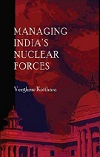
Forces by Verghese Koithara
(New Delhi: Routledge, 2012), 294 p, Rs. 795.
Review of Managing India’s Nuclear

India declared itself a state armed with nuclear weapons in May 1998 after the Pokhran tests. Despite the fact that almost 15 years have passed since then, the number of good books on the subject of managing India’s nuclear deterrence can be counted on the finger tips of one hand. This is partly because academics and strategic analysts find deterrence theory and the complexities of nuclear command and control too esoteric and partly because the Government of India has made no attempt to encourage such research. None of the government funded think tanks have thought it fit to conduct research on this issue. It is to the credit of Vice Admiral Verghese Koithara (Retd) that he has dared to enter what may be loosely termed as forbidden territory. In his book Managing India’s Nuclear Forces Admiral Koithara takes stock of the system in place for managing nuclear deterrence, carefully evaluates its efficacy and makes substantive recommendations to enhance its functionality.

India’s nuclear doctrine is built around a ‘no first use’ policy with ‘credible minimum deterrence’. In the interest of strategic stability, India is willing to absorb a ‘first strike’ and will launching punitive nuclear strikes in retaliation to cause unacceptable damage to the adversary if it is attacked with nuclear weapons. India’s nuclear weapons are political weapons meant only to deter the use and threat of use of nuclear weapons against India. It is clearly accepted in India that nuclear weapons are not weapons of warfighting. Hence, India has firmly rejected the use of tactical or theatre nuclear weapons – despite provocation from across its western border. However, India has not publicly demonstrated that it has done what it takes to ‘operationalise’ its nuclear deterrence. This is the essence of Admiral Koithara’s excellent book. In fact, he goes one step further to state that by keeping the armed forces out of the nuclear decision making loop, the authorities have actually undermined the credibility of India’s nuclear deterrence.

Both the NDA and UPA governments have tended to play down discussion of nuclear issues in the public domain. According to the strategic community grapevine, the late Brajesh Mishra, India’s first National Security Advisor (NSA), had issued an informal whip to the effect that no one in government will speak to the media about nuclear deterrence. No discussions or seminars have been held by the three Services to study issues like ‘targeting’ and deterrence breakdown that are in the military domain. Through various acts of commission and omission, successive governments have created the perception that acquiring nuclear weapons was an end in itself for power and prestige and that since nuclear weapons are political weapons and not weapons of warfighting, the barest minimum needs to be done to create nuclear forces that are robust and usable.

India’s nuclear signalling has been marked primarily by the routine flaunting of various models of Agni and Prithvi missiles at the Republic Day parade. No nuclear drills are known to have been held to ensure that the missile groups can deploy in a realistic time frame and that the warheads can be mated with the launchers in real time for early retaliation in the eventuality of a nuclear strike, even though some of these measures may have been practised in secret. Nuclear signalling is an extremely sophisticated art and India appears to have ignored this aspect completely. In view of these major shortcomings, India’s nuclear deterrence tends to lack credibility and is not taken seriously by either military adversaries or by the international community. India must demonstrate its resolve to use nuclear weapons if it ever becomes necessary through a carefully formulated process of signalling and must enhance the quality of its warhead and missile technology. The steps necessary to fully operationalise India’s nuclear deterrence must not only be taken early, but must also be publicly seen to have been taken – within the bounds of security of information and materials.

The author identifies and challenges the four tacit assumptions behind the lack of seriousness in operationalising India’s nuclear forces: that deterrence credibility can be established through technological demonstration; that nuclear force operations are largely a technical matter; that transition from general to immediate deterrence through alerting is not a very demanding exercise; and that force survivability is not a critical issue. He also mentions a fifth one: in a crunch situation the US will be there to call upon. He goes on to successfully demolish all of them through the force of logic.

Admiral Koithara focuses a sharp lens on the systemic weaknesses plaguing the management of India’s nuclear deterrence. He has stated that inadequacies in the management of nuclear forces have degraded India’s deterrence, “Not just by the inability to conduct operations in a safe and reliable manner, but also by revealing a lack of seriousness of purpose.” He bemoans the fact that the armed forces have been kept away from functional involvement in managing deterrence and asserts that, “Nuclear forces of every NWS are... closely controlled by the national leadership. But in every one of those countries, except India, these forces are managed by the armed forces under the supervision of the political leadership.” He points out that the command and control structure is patently flawed where even the Defence Minister is a peripheral figure in nuclear decision making. He recommends a return to the erstwhile Defence Committee of the Cabinet with the three Chiefs as permanent invitees.

India still does not have a Chief of Defence Staff to provide ‘single point military advice’ to the Prime Minister. The three Services Chiefs are members of the Executive Council of the Nuclear Command Authority (NCA) headed by the NSA and not of the Political Council of the NCA headed by the Prime Minister. As such, their inputs would reach the PM only indirectly in a moment of crisis. This system of isolation of the three Chiefs is unsuitable for long term nuclear planning. Though India has a Strategic Forces Command (SFC) for managing its nuclear forces, the C-in-C SFC reports directly to the NSA in practice and keeps the Chairman CoSC informed. Also, India does not have full fledged nuclear planning staff like Pakistan’s Strategic Plans Division and nuclear planning is not seamlessly integrated across the ministries and the departments. The author writes, “Using inadequately prepared nuclear forces to generate deterrence will be similar to the inadequately-supported forward policy that India had adopted along the Tibet border in 1959.

This remarkable book would have been much richer if the author had taken stock of Pakistan’s unbridled for additional fissile material beyond its legitimate needs and its quest to acquire tactical nuclear weapons like the 60-kilometres range Hatf 9 (Nasr) missile, which is inherently destabilising, and its efforts to tip its cruise missile Babur with nuclear warheads. The lack of serious confidence building and risk reduction measures between the two countries has also not been covered, nor has India’s long standing support for total disarmament been addressed. However, no book can cover the entire nuclear landscape.

This book must be read by all personnel of the armed forces, particularly the senior officers. It must be prescribed reading for the Higher Command courses of the three Services. It must also be read by the political leaders, scientists and bureaucrats or technocrats who are involved in national security decision making and managing India’s nuclear forces.

Thursday, July 26, 2012

Political - Civil - Military Participation in National Security


Vice Admiral (Retd.) Barry Barathan
Distinguished Fellow, VIF

Opener

Analysis of India's approach towards it's national security reveals an unacceptable hiatus between the Political -Civil- Military systems. We perhaps were lucky enough to get away thus far even despite the 1962 China debacle. New security realities, an assertive China, a highly probable Sino-Pak collusion, the emergence of non state actors, possible implosion in Pakistan, the Af-Pak mess all call for India to review and revamp its management of national security. Our bureaucracy has the sagacity, expertise and eclectic experience to optimise civil control mechanisms under political guidance. Our military and security forces have the commitment and wisdom to perpetuate democracy and secularism. Ours is a democracy wherein civil control of the military is absolute. We have mechanisms in place to optimally approach “national security and military readiness". This of course has to be politically understood, accepted, absorbed and be top down with sense of ownership, accountability and authority. This paper looks at the quantum and quality of civil- military participation, the higher defence decision making, the structures within the military and the way ahead.

Current Status of Political – Civil - Military Participation

Indian political -civil- military relationship needs to be seen in the context of the critical dichotomy between "Authority and Responsibility" resulting in the absence of ownership for military and security. The whole discussion often misses the forest for the trees. In the fog of this debate, the political leadership virtually goes unnoticed and hence never answers for this grave omission. Should our political leadership not take onus of ownership or at least assign responsibility for military and security readiness to an accountable entity. Six decades post independence has not seen any effective viable change.

Civil and military martnership needs to be seen in wider contours of nation’s Management, national security, foreign policy, technology self reliance, budgeting: in the frame work of sovereignty, sustainability and survivability as a nation state. It should also include internal security concerns. Intelligence and policing are inherent in this.

Who is Responsible for Readiness?

The Government of India rules of business are distinctly vague on responsibility, accountability of military preparation and readiness. Extracts from the rules of business and MOD website reproduced below, clearly highlight this:

‘Defence of India and every part thereof including preparation for defence and all such acts as may be conducive in times of war to its prosecution and after its termination to effective demobilisation’.

MoD Website also Reads

“The Defence Secretary functions as head of the Department of Defence and is additionally responsible for co-coordinating the activities of the four Departments in the Ministry.”

The above extract does not mention "preparedness or readiness" even in passing not to speak about the much needed deliberation. It is silent on "Accountability and Answerability"

Responsibility of Military Readiness

Security, Sovereignty, Stability of a Nation is clearly a leadership mandate- how it chooses to exercise and execute this, is, its prerogative. Why it remains passive has not been questioned either by the establishment or by the people.

The Army, Navy, Air Force are engaged individually in terms of turf protection. There is neither integration nor coordination between the Ministries of Defence, Home, Finance, External affairs with the army, paramilitary and intelligence forces, even as a concept, let alone in practice. Guarding the turf is a solemn obsession. What started as a practice became a habit and is now an addiction. The divide on the concept and role of the Chief of Defense Staff within the three services is sharp enough for the polity to justify its passivity. The IDS Headquarters under the CISC- Chief of Integrated Staff committee is gamely trying to pull the services together and over the last 7 years or so has been proved to be useful. This vindicates the need for a CDS. However, the Naresh Chandra Task Force has recently recommended a permanent Chairman, Joint Chiefs of Staff which is a climb down from the CDS. It is also not very clear as to what powers would CJCS have to enforce/enable integration and jointness.

Higher Defense Decision Making

The collateral, attendant impact on the Military and Security scenario is dependent upon the quality, quantity of ownership by the Political- Civil- Military combine in Higher Defense Decision Making. This has direct correlation with India's security calculus, effective military preparation, and readiness. Internal security strategies too, are contingent on the construct of Civilian - Military- Security equations and equity. Our bad neighbourhood is slipping into a vortex of visceral anarchy beyond reason and control. In the North East, China makes us nervous by its rapid and robust build up. Sino- Pak collusion is on the cards. Both may decide to make a play together, to stir the already simmering South Asian Security pot. The Afghan-Pakistan region is also fraught with various probabilities of dysfunctional anarchy. A Taliban take over is most likely, no sooner than the withdrawal of the American led NATO military. The fall out has serious implications in the region. Civil and Military participation in synergy must come into play sooner than later.

"Power relationships between Nations are constantly changing, and unless a country understands and adjusts itself to the changes that are taking place around it, its own Security will be seriously endangered" An extract from Sardar K M Panikkar’s Annual Day address to the Indian School of International Studies on 13 February 1961

Status Quo Syndrome

Examination of our Higher Defense Decision Making Organisation, readily reveals a witting "Six decade status quo syndrome" perpetuated by the way we are as Indians; fatalistic about our Indian-ness and independence. The implications of this on our sovereignty, security, stability, status as a secular Democracy can be understood, absorbed and be acted upon only if the top leadership grasps this with firmness and dynamism.


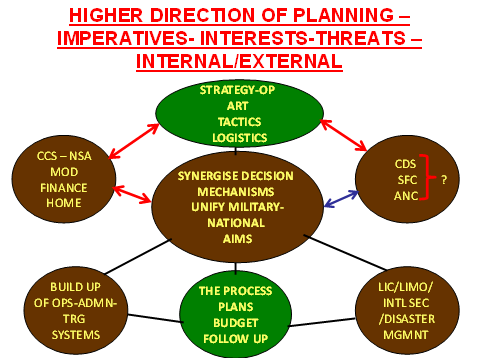
Key CCS -cabinet committee on Security
NSA- National Security Advisor
MOD - Ministry of Defense
CDS - Chief of Defense Staff
SFC - Strategic Forces Command
ANC- Andaman and Nicobar Command
LIC- Low Intensity Conflict
LIMO- Low Intensity Maritime Operations
INTL SEC- Internal Security
TRG - Training

Higher Direction Schematic and Actuality

The above schematic is the writer’s imagination. In practice the circles exist but are mostly in separate orbit. At best there are some committees of secretaries and the CCS who deliberate upon important issues on a need based continuum. The military may or may not be called in all deliberations.
The origin lies squarely in the Nehruvian mind set at the time of Independence. The Political leadership felt uncomfortable with the British model of command and control. The Bureaucracy too perceived that its primacy was sacrosanct in a democracy. Hence in the euphoria of independence, the Commander in Chief of the military was sectioned into the three chiefs of the three services. The promise of concurrent reorganisation of the Ministry of Defence is yet to be realised.

Military Obtuseness or Obedience

The naiveté of the British cloned, Army dominated Indian military leadership was perhaps an unwitting factor.

Ensconced in the cantonment and surrounded by the splendour of fife and drum beat, it did not understand the obvious, apparent difference between being "apolitical and politically obtuse"

The senior Indian Army hierarchy understandably behaved more like proper soldiers than statesmen. They believed in their leadership to do the right thing. What the former laid down then, continues even today.

It's approach to civil relations is always confined to a very narrow swathe of the defence ministry. Personnel of the armed forces are conditioned to be indifferent and sometimes with apathy towards the political class. Somehow, that they are people and citizens too, and not a class apart is overlooked in their education. In turn, the polity is comfortable with managing military affairs through the proxy of bureaucracy. Who should educate who, and on what, of the mutual, political & military education remains ignored.

Leadership & Civilian Bureaucracy Sans Military

Our leadership and bureaucracy adopted the whole works of the erstwhile English Raj through the aegis of the civil services without any consultation with the military. Both believed that the British model was suitable with minor modifications, excepting the military aspect. The euphoria of independence, the challenges of ruling a geo politically united India, infatuation with an English way of life, and dealing with the real politick of governance ensured that the rules of business on national management precepts were not properly thought through. Great Britain left behind a robust system that made lot of sense gave order and form with a strong legal base. Yet it was designed to take away wealth from us and hence in principle not compatible to our culture, tradition and age old valid systems. This has been adequately proved time and again in the way the land has been sub optimally governed. The system is "INDIA" dyslexic, people unfriendly and not result oriented. Government profligacy and inefficiency are in tandem in the maze of complicated red tape.

Lack of political direction and a loose limbed hands off approach, queers the pitch of military readiness. Consequently civil military bureaucratic relations exist under best conditions of polite detached, " Us versus Them” and diffused accountability.

The first warning that all was not well in this arrangement, was during the ill fated 1962 Sino-India conflict. Despite the lasting trauma of that battle, The Indian establishment continues in the same ilk. Despite all the conflicts with Pakistan and the imposing Chinese posture , the whole Political- Bureaucratic-Diplomatic- Military- Intelligence- Technology-Industrial community has not been able to get its act together! Working in watertight silos is both style and form today.

The quality and value of our Civil- Military bureaucratic relationship reflects; our inability to internalise India in terms of national perspectives. Consequently our externalisation tends to be tentative and confusing to us and outsiders. Drifting along with events as they occur seems to be our preferred option"

Paradox of The Pen & Sword

Both the Civilian Decision maker and the Military executor of the Country are committed to Sovereignty, Security, of a Democratic India. Hence there is neither a threatening crisis, nor even an impasse in the Civil- Military construct. This is the good news. The bad news however is: it is muddled, disjointed, indecisive, frustrating, and cost prohibitive, by default and design. Trust deficit and misperceptions militate against working together. The absence of mandated directives from the political leadership is the root cause of this avoidable morass. The Pen and the Sword can and have to join forces to ensure that files create capable combat effectiveness.

Go Between Bureaucracies

Both bureaucracies are pseudo go betweens with each other. All dialogue is on a dated filing system with a conundrum of file processing. In the Services, the file follows a hierarchical path from downwards to upwards and reaches Ministry of Defence at the level of Defence Secretary/ Additional Secretary. From that level it plunges straight down to the desk officer and is processed upwards through every layer. Unless this is changed inordinate delays in decision making would continue. In effect the silent strangler of the system is the file.

Our File Process The System Strangler

India, compelled to adopt the White Hall filing system as part of its legacy of freedom, continues with this archaic practice of file based decisions. The Civil and Military bureaucracy grew with this paper trail. Today despite the obvious advantages of the information highway, presence of useful decision supporting Management Information Systems; files still do the rounds at snail's pace. In practice, the whole process precludes collegiate decision making. The underlying working principle is to ensure that the file notes do not ever implicate any decision makers or subordinates on both sides. File Noting hence is defensive, tentative and tend to be open ended. It is no exaggeration to state that diffused accountability through obfuscation is the norm; fear of CVC/CAG (Central Vigilance Commission and Comptroller Auditor General) too is another catalyst for playing safe. This file process is the silent strangler, impervious to other dynamic changes brought in force through revised procurement policies.

File work must be minimal and supported by IT based decision processes. Information archiving, retrieval is the need of the day. Collegiate decision making is the answer in a networked set up. Secure LAN/WAN arrangements and software processes must become policy sooner than later.

Absence of Direct Communication Flow

Direct, institutionalised, formalised communication between National Leadership, Parliament and the executors of the country's Defence and Security policies and processes is more in absentia. The Parliamentary Standing Committee on DefenCe is notional, ineffective and powerless by design and organisation. Even in this, the armed forces only tag along with their civilian counterparts. The time, attention and energy devoted to the whole exercise is adhoc, cursory and a mere formality.

Culture of Working in Compartments

It is the norm for the MEA to take foreign policy decisions without any institutionalised consultation with MOD. The Latter has no formalised relationship with MEA

Similarly the MOH and MOD have no mandated Rules of Business on Internal security supervision.

One important facet of bureaucratic relationships is the complete impersonal imprint and a mindset to only dialogue on file and keep records. Time delay is a given, devoid of any emotional involvement.

Military Uniform to Uniform

Pride of service, in uniform is a primal facet of the military. This is needed, understandable and acceptable. Modern warfare however requires a mindset acceptance that, unified operations are a mandate. A mandate that needs doctrine, policy, procedures, training, debrief, remediation, re training and operational practice. The paradoxes of the military profession need to be part of the war fighter's DNA. Senior military leadership must undergo continuing education on involuntary conundrums, intrinsic in a fighting force, those are:

Preparing for an exam while hoping that it never takes place Maintaining a Combat ready entity in a 95% plus peace time continuum? This calls for an "Us with Us" approach.

Dealing with Internal security Issues on the concept of an " an iron fist in a velvet glove"

Managing; the promotion pyramid, the career construct, the significant superseded strata and rising expectations of a better educated, evolving military society!

Handling technology obsolescence in the face of ever present imminent combat and security threats in incipient conditions of uncertainty.
Living with bereavement and dealing with rehabilitation of families and the large number of retirees.

Learning to meld and blend combat culture with corporate practices to optimally organise the entire establishment needs, through serious, deliberate planning, money, in terms of intention, effort and determination.
Funding determination as part of the military budget for resettling families and transitioning veterans into civilian careers.

Crucial Strategic Asks

Can India live on its ancient glory, and its recent success of sorts? Is there room for complacency in a rapidly changing and deteriorating security scenario in the neighbourhood. Radical Islam, rapidity of information spread, increasing awareness on rights, rising expectations, inequitable economic weaknesses, poverty spread, malnutrition; all cause social unrest and desperation.

The crucial asks are:

Who is responsible, accountable for combat and security readiness?

Is the present civil -military arrangement able and workable across the span of governance, administration, nation’s management, diplomacy, defence, security and poverty alleviation?

Does India have overall national capability to handle both the neighbourhood as well as internal security issues and complexities?

Does defence budgeting require a different dynamism to make military management and acquisition cost effective?

What are fault lines within the Military that need speedy remediation?
Why has India not set up a defence Industrial base to strategically reduce Import costs?

How Should India Go About This

Ownership of readiness

The military will always fight with what it has- (COAS, Gen VP Malik during OP Vijay in Kargill) . Lack of " Ownership of Readiness" is behind this soldierly lament. Fixing Ownership of Readiness is the first step. It should be the Defence Minister who should be made answerable for military readiness and sovereign security. Similarly the Home Minister should be responsible for Internal security.

Once ownership is defined with authority, the whole chain would be galvanised into a channelised process of achieving stated objectives.

Able and Workable Systems

Process and authority in capability based capital acquisition is paramount. It has to rest and vest on a single point authority along with an empowered Organism. A pre audited collegiate decision matrix with autonomy and assurance that "Ghosts of Inquiry" do not unwittingly haunt the decision makers. Only then can the system become Nationally able and capable to handle Combat and Security management.

Military Fault Lines Repair

Concept of unified operations is an operational imperative. Training and learning to fight together should become part of our blood stream. This can and must be done with retention of individual service identity. From unified operations will stem Joint Operations and Individual service missions. This will strengthen our combat capability in synergy.

Creation of a Chief of Defence Staff with attendant revision of roles in Chiefs of Staff has to be through an act of Parliament. Creation of theatre commands must be also mandated. Cost benefits and operational effectiveness study of the American example shows significant salutary effects on combined combat readiness.

Integration of Military with MOD, DRDO, DPSUS and institutionalized relations with Intelligence agencies, private industry will go a long way towards self reliance

Personnel management, selection of Commanders in Chief and Heads of Services must be done on an informed, participative basis that includes the politico- bureaucratic setup.

Serving Military- Bureaucratic- Diplomatic, Intelligence, senior leadership from joint secretary upwards must attend regular participative workshops of short durations. It hasto be formalised, structured on the determinants of national management and consequent military matrices. The CCS Ministers and National Defence Council members must address these gatherings and gain critical inputs. It must become a regular feature that would bring synergy in civil- military participation.

Appointing Joint/Additional Secretaries from MEA/MHA to all critical commands that contend with sensitive issues must become policy. Similarly having service officers and MOD representatives in MEA/MHA must be mandated.
Creation of a common information highway should be taken up as the first dynamic. Informed collegiate decision processes must follow suit.

Defence Budgeting Revamp

This revamp is a top priority. The New management strategy introduced in the late nineties has to be further revised. Budget roll over, getting rid of the year ending frenzy of deadlines, assured funding of money and no return of unspent money have to be considered by a council of military expenditure appointed by the CCS. Only then can the acquisition become cost and operationally effective

Military Industrial Complex

We are no where near becoming “Indian” in terms of becoming reasonably self reliant across the spectrum of Indian battle order needs. Civilian and military participation has to enable creation of a Military Industrial Commission. This could be set up from existing entities like CII, FICCI, DRDO, DPSUs, Armed forces, Private and Public sector companies. Oversight could be by the Defence Acquisition Council.

The Military Industrial Commission charter could be created from the findings and recommendations of the various committees set up by the Government within the last two decades. The Political-Civil-Military combine also needs to institutionally focus on the critical aspect of self reliance and reduce rising import costs.

Imperative Next Steps

Higher Defence and Security Decision Making Robustness can be achieved by the Cabinet Committee on Security (CCS). It must mandate institutionalised mechanisms between the National Security Advisor (NSA), the Ministries of Defence, Home, External affairs. Civil control of the military is a given. Integrated, inclusiveness of the armed forces through proactive participation will optimise combat and security preparedness.

Creation of a Chief of Defence Staff and defining Unified Commands like SFC, ANC should be carried out immediately by legislation. Unified Areas of operations, defining, national interests, military & security threats, have to be on priority in the reporting and preparation mechanisms.

The Standing Parliamentary Committee on Defence needs to be elevated to A National Defense Council (NDC). It should have leaders of the ruling and opposition. It must be empowered and organised to monitor military readiness formally, in camera. Joint review by CCS to validate this must be mandated. The CDS/the Chiefs of Services must annually report the state of military readiness to NDC regularly.

Summation

Civil control over the military in a democracy is a sanctified given in India. Ownership of military, its preparedness, readiness are integral, inherent and sacrosanct to national Interests. They are intrinsic in nation’s management. Our 5000 years DNA in many ways is a genetic gift of being flexible and yet forged to withstand tsunamis, and tectonic shifts of global geo- political movement and collateral combat, and security situations.

India has all organisations and systems in place. Our political leadership has to be given the comfort of the changes proposed in this paper. Their acceptance would germinate a renewed, refreshed political civil military relationship in the national interest of security in sovereignty. This would enable the political leadership to take well informed sound decisions in an inclusive manner

India is poised at the tipping point on the international ledge of global geo politics- It can be a model to the world as a successful stable democracy. The centre of gravity is the silos of the political-civil and military becoming a sacred granary of security in synergy for our lasting sovereignty. Optimal civil and military participation will make India reach its ordained destiny.

Thursday, May 17, 2012

But Deterrence Means Possession with Political Will


Lt. Col. (retd.) Anil Bhat

Five months after India’s successful test launch of the 3,500 km range Agni-IV ballistic missile, the well over 5000 kms range Agni-V was successfully test fired at 08:07 hours on 19 April 2012 from the Wheeler’s Island , Odisha.

Planned for a night launch on the evening of 18 April, but postponed owing to bad weather, the missile, according to Defence Research and Development Organisation (DRDO) was flawlessly auto-launched the next morning, rising exactly the way it was designed for. It followed the entire trajectory in DRDO’s favourite phrase “in textbook fashion” with the three stages of propulsion dropping and falling at appropriate times into Bay of Bengal. The three propulsion stages, developed completely indigenously by DRDO, performed exactly the way they were intended to and the indigenously developed Composite Rocket Motors have performed well. All the radars and electro-optical systems along the path monitored all the parameters of the missile and displayed in real time. Ships located in midrange and at the target point tracked the missile’s flight.

Lot of new technologies developed indigenously were successfully tested in this Agni-V Mission. The redundant navigation systems, very high accuracy Ring Laser Gyro based Inertial Navigation System (RINS) and the most modern and accurate Micro Navigation System (MINS) ensured the missile reach the target point within few meters of accuracy. The high speed onboard computer and fault tolerant software along with robust and reliable bus guided the missile flawlessly.

“DRDO Scientists have made the country proud” said Prime Minister Dr. Manmohan Singh while speaking to Dr V.K. Saraswat, the Scientific Advisor to the Defence Minister and Programme Director Avinash Chander and congratulated all the Scientists of DRDO. Defence Minister A.K. Antony was monitoring the launch activities and immediately after successful flight, congratulated all the Scientists on this much awaited event. National Security Advisor Shiv Shankar Menon congratulated DRDO Scientists and said that the event is a milestone in the long range Missile era of India. Air Marshal K.J. Mathews, C-in-C Strategic Forces Command, who witnessed the launch, said that the success of AGNI-V is historical event for India.
Agni-V is a solid fuelled long range ballistic missile developed by DRDO and will greatly extend India’s reach to strike targets well beyond 5,500 km. It will be quite easy to store and swiftly transport the missile by road since it's a canister-launch missile system, unlike the earlier Agni missiles. Agni-V would also carry MIRV (multiple independently targetable re-entry vehicles) payloads being concurrently developed. A single MIRV equipped missile can deliver multiple warheads at different targets. With a ‘launch mass’ of around 50 tonnes and a development cost of over Rs 2,500 crore, Agni-V will incorporate advanced technologies involving ring laser gyroscope and accelerometer for navigation and guidance. It takes its first stage from Agni-III, with a modified second stage and a miniaturised third stage to ensure it can fly to distances of 5,000 km. With a canister-launch system to impart higher road mobility, the missile will give the armed forces much greater operational flexibility than the earlier-generation of Agni missiles. According to a source, the accuracy levels of Agni-V and the 3,500-km Agni-IV (first tested in November 2011), with their better guidance and navigation systems, are far higher than Agni-I (700-km), Agni-II (2,000-km) and Agni-III (3,000-km).

Chinese media controlled by the Communist Party of China was full of this news. While a section of it did not consider it significant, the Global Times, a one of the prominent Chinese newspaper cites Agni-V launch just as an addition to promote the arm race in Asia and warned India not to compete with China. Global Times is the Chinese newspaper that publishes views on the behalf of Communist Party of China. Chinese diplomats, however, did not give any such sharp reaction to the test. Chinese Foreign Ministry spokesman Liu Weimin, stated that India and China are both emerging countries and expressed hopes that both the countries work together to maintain a peaceful environment. However, nestled within the response, Liu included a subtle reference to the conflict, saying ‘we should both cherish the fact that our current good relations were hard to come by.’ However, the fact remains that China’s periodic outbursts, claims, incursions, activities, postures etc on the ground in Arunachal Pradesh and other parts of the Line of Actual Control and most importantly, its very substantial nuclear arsenal, its strong military ties with Pakistan in conventional and nuclear fields and its deployment of a division strength of troops in Pakistan Occupied Kashmir is far from reassuring.

By this successful test of Agni-V, now India has joined the elite club of countries with the United States, Russia, and China. While it is a commendable achievement in for India in developing the technology, it will amount to strategic deterrence only after production and deployment.

On countries pontificating about India’s nuclear tests leading to or adding to an arms race in the subcontinent, it needs to be clarified that India as one of the greatest votaries of non-nuclearisation was left with no choice but to nuclearise in view of Pakistan’s and China’s nuclear programmes. And in any case, who are the original proliferators of nuclear weapons creating conditions for mutually assured destruction? Which is the country that actually started this race and which is the country to have actually launched a nuclear attack?

Although unconfirmed, most Western analysts believe China has deployed anywhere from 18 to 36 Dongfeng 5 (East Wind) intercontinental ballistic missiles (ICBM) since the 1980s. The Dongfeng 5A is a single-warhead, three-stage, liquid-fueled missile with a range of over 13,000 km. In 2000, General Eugene Habiger of the U.S. Air Force, then commander of the U.S. Strategic Command, testified before Congress that China has 18 silo-based DF-5s. Since the early 21st century, the Chinese People’s Liberation Army’s Second Artillery Corps also deployed up to 10 solid-fueled mobile DF-31 ICBMs, with a range of 7,200+ km and possibly up to 3 MIRVs. China has also developed the DF-31A, an intercontinental ballistic missile with a range of 11,200+ km with possibly 3-6 multiple independently targetable reentry vehicle (MIRV) capability. China reportedly stores many of its missiles in huge underground tunnel complexes. US Representative Michael Turner referring to 2009 Chinese media reports said “This network of tunnels could be in excess of 5,000 kilometers (3,110 miles), and is used to transport nuclear weapons and forces.” he Chinese Army newsletter calls this tunnel system an underground Great Wall of China. Approximately 55 percent of China’s missiles are in the medium range category, targeted at regional theater targets. The Chinese categorize long range ballistic missiles as ones with a range between 3000 to 8000 km.

The use of rockets and missiles by Indians dates back to 18th century, i.e. during the period of ruler Hyder Ali and Tipu Sultan. They used rocket artillery brigades against infantry formations for mass attacks. The rocket men were trained to launch the rockets at a launch angle which was calculated from the diameter of the cylinder and the distance of the target. The launchers were having the capability to launch 5-10 rockets in salvo firing mode. Tipu Sultan had 27 brigades and each brigade had a company of rocket men. With such a huge force, he defended the Mysore kingdom against the British until his death at Srirangapatnam in 1799. Even, Marathas used the rockets at the Battle of Panipat in 1761. With the death of Tipu Sultan, Indian rocketry also met its demise, only to be revived in the 1970s by Drs. Vikram Sarabhai, APJ Abdul Kalam, and others. Two of the rockets, captured by the British at Srirangapatnam, are displayed in the Royal Artillery Museum in London.

Defence Science Organization, formed in 1956 for initiating studies & development of work on futuristic weapon systems was headed by Dr. B. N. Singh who formed the Special Weapon Development Team (SWDT) study and development of guided missiles. At Metcalfe House, Delhi the Team worked on a 1st generation Anti-Tank Missile (ATM) for gaining developmental experience. SWDT became Defence Research & Development Laboratory (DRDL) at old Ahmed Manzil, Hyderabad, in June 1962 under Gp. Capt. V Ganesan its Director. A project formulated at DRDL in 1964 got support of Army after the 1965 Indo-Pak war and got converted to a “Staff Project”, which tested an indigenously developed anti – tank missile in 1970, considered as a major achievement by DRDL, which later moved to the Defence Research Complex at Kanchanbagh, on the periphery of Hyderabad's Old City. Some scientists and Army, Navy and Air Force officers developed the DEVIL missile.

All the preliminary understanding and development of Electronics sub-systems of DEVIL missile including Airframe and Aerodynamics were carried out at Ahmed Manzil. Leading scientists like Mr.Burman, Mr. JC Bhattacharya, Admiral Mohan and Mr. Surya Kantha Rao gave thrust to Electronics, Navigation, Guidance & Control and Telemetry & Instrumentation areas. Dr. Ranga Rao, Dr. Rama Rao, Dr. Bala Krishnan, Mr. Krishnan, and Dr.Achyuthan gave priority to Airframe, structures, Aerodynamic and system related areas. This was further strengthened by the techno-managerial leadership of Lt.Gen.(Retd) Dr. VJ Sundaram, Lt.Gen.R.Swaminathan and Squadron Leader Shah in the area of airframe controls and integration.
Rocket Test House (RTH, Presently near Kanchanbagh) was identified for carrying out propulsion related design and tests. The liquid and solid propulsion areas were continuing with vibrant leadership of Dr. Gopal Swamy and Wg. Cdr. Sen. Re-entry technology and ballistic missile programmes were spearheaded by Shri R.N. Agarwal. The state-of-the-gyro test facility was initiated by Mr. P. Banerjee within the campus. However, the whole facility of Ahmed Manzil was shifted near Kanchanbagh in 1975. Full scale missile laboratory (DRDL) was built up from then onwards.

The Integrated Guided Missile Development Program (IGMDP) under India’s Defence Ministry, began since early 1980s for the development of a comprehensive range of missiles, including the intermediate range Agni missile (Surface to Surface), and short range missiles such as the Prithvi ballistic missile (Surface to Surface), Sagarika, the naval version of the Prithvi, Akash missile (Surface to Air), Astra missile (Air to Air), Trishul missile (Surface to Air), Nag Missile (Anti Tank) and also an inter-continental-ballistic-missile (codenamed Surya missile) with a range of 8,000-12,000 km. Managed by DRDO in partnership with other Indian government labs and research centres, one of the most prominent chief engineers on the project, Dr. Abdul Kalam went on to become the President of India.

In 1998, the Government of India, signed an agreement with Russia to design, develop, manufacture and market BrahMos (Brahmaputra –Moscow rivers), a Supersonic Cruise Missile System that can be launched from submarines, ships, aircraft or land, which was successfully accomplished by 2006. At speeds of Mach 2.5 to 2.8, it is the world's fastest cruise missile, about three and a half times faster than the American subsonic Harpoon cruise missile. BrahMos is reportedly attempting a hypersonic Mach 8 version of the missile, BrahMos II, the first ever hypersonic cruise missile, expected to be ready by 2012-13.
While India must forge ahead with production of its missiles, it must not neglect regaining and maintaining its edge in conventional weapons, on which it is at an all time low. Further, India must also shake out of its known mode of a soft state and strive to develop the political will to acquire the requisite level of force and send the message that it will effectively be used.