Showing posts with label Central Vigilance Commission. Show all posts

Thursday, October 10, 2013

Corruption: Ten Ways to Deal with the Malaise

Dean, Centre for Governance and Political Studies, VIF

From a society of hope, India has suddenly gained notoriety as one of the most corrupt countries in the world. Whether it be in trade, industry, the election process, government, in all its branches, even education and health, domestically the belief is that nothing is done in India without a bribe having to be paid. This has created an enormous crisis of confidence in which we as Indians trust no one because every one of our institutions has lost credibility. Internationally the reputation that we have earned for being a corrupt society has shaken the confidence of the world market in India’s viability as a good place to do business and this has seriously and adversely affected our economy. For every Indian, this is a situation which is not only fraught with danger, it is a situation which threatens to damage the very fabric of India beyond repair.

Corruption takes many forms and is facilitated and promoted by various factors. Our general approach to tackling corruption is to enact a law to prevent corruption, create an organisation for investigating cases of corruption and then leaving it to the courts to punish the corrupt. The Delhi Special Police Establishment, the various States Lokayuktas and the Central Vigilance Commission and the investigating agencies functioning in the States have not so far inspired confidence either by their professional competence, impartiality, integrity or their intention to actually book the corrupt. Consequently, there are allegations of investigating agencies functioning according to political diktats, themselves becoming a part of the system of corruption by being corrupt during investigation and by failing to produce convincing evidence in the courts, have a conviction record which is miserable. The penal approach to tackling corruption can succeed only if government has a firm political commitment to eradicating corruption, the investigating agencies are competent, unbiased and immunised from political or other interference and the functioning of these agencies is so efficient that investigation is prompt, prosecution is relentless and the conviction rate is high. Otherwise, the penal approach has no deterrent effect.

One could classify corruption on the following lines:-

(a) Political corruption which arises from the need to make money to meet the high cost of election. It also arises from a practice which has now become fairly common whereby politicians are purchased through actual cash payment and by such purchase governments are formed and power snatched. Once power is a purchasable commodity, it no longer remains a means of serving the people and promoting their welfare. It becomes a means of acquiring ill gotten personal wealth. The need for money to buy power ultimately corrupts the whole system of government and this is the phenomenon which we are witnessing in India. Therefore, the first set of remedies for corruption must begin by attacking the problem of political corruption head on.

(b) Corruption which has traditionally been described as ‘Jabarana’ or extortion, ‘Nazarana’, or tribute and ‘Shukrana’, that is gratitude. This is the most rampant form of corruption prevalent at bureaucratic level. In fact, it is generally believed that nothing moves in India without money being paid on one or the other of these counts and it is this which is hurting the common man. Political corruption also hurts the common man, but more than that it derails the economy at national level. Both types of corruption need to be tackled.

Can we remedy the situation? We have to begin with tackling political corruption, which means that we have to restore a situation in which corruption carries a heavy price, power is no longer a purchasable commodity and power is to be enjoyed only for the promotion of the welfare of the people. In a democracy, the holders of power must periodically change so that dynastic or coterie based politics is eliminated from the system. Let us make a start by looking at how we can make the process of elections open, subject to scrutiny, not very expensive but with an equal opportunity being available to persons who are otherwise desirable but cannot afford even the normal cost of campaigning in our very large and populous constituencies. Let us recognise, therefore, that we have to pare the cost of elections down to the bare bones so that the need to spend money to be elected is substantially reduced and elections become affordable.

The first step in this behalf, therefore, would be that we should have a system of State funding of a prescribed minimum amount of expenditure by candidates for State Legislature and Parliamentary elections. This would include funding of every aspect of canvassing for a period of one month, including cost of transport, miscellaneous expenditure and incidental expenditure. It is suggested that:
  1. Every nominee be given vehicles, drivers, P/D/OL and incidentals at the rate of one vehicle per assembly segment, one for the election agent of the candidate, one vehicle for the candidate and one spare vehicle for a Parliamentary election; and one vehicle for the candidate, one for his election agent and two other vehicles for an Assembly election at State cost.
  2. Prescribed incidental expenses be reimbursed on the day of the poll and the counting day at the rate of two polling agents per booth per candidate.
  3. Miscellaneous and incidental expenses for covering other costs, including a prescribed quantum of publicity material, for each candidate.
  4. Because once there is State spending, all other expenditure by the candidate must be barred, therefore, the District and Sessions Judge of the District in which the constituency is located should have the authority to summarily hear and dispose of complaints of excess expenditure by candidates or their supporters on their behalf, with the Judge having the power to debar the candidate from seeking election from that constituency if the charges are proved. This process would be from the date of announcement of the poll schedule and continue up to the date of actual voting.
The second step would aim at ensuring that the elections result in the possibility of forming a stable government, free from undue pressure from small or regional parties which have an agenda of self promotion rather than good government. For this the major political parties have to be strengthened and, therefore, the importance of small groups has to be reduced. It is suggested that in order to do this, we have to:-

(a) Prohibit an independent from standing for a State Assembly election until he has successfully contested a local government election at panchayat or municipal level.

(b) Prohibit an independent from contesting a parliamentary election unless he has successfully contested both a local government and a State Assembly election. That would leave only serious independent contenders in the fray.

(c) Prohibit any political party from contesting parliamentary election unless it holds at least five seats each in the State Legislatures of at least three States. Regional parties would then either have to merge with larger parties, increasing their viability, or would have to expand their horizon beyond just one State, or would be kept out of Parliament, thus preventing them from exerting disproportionate pressure in a situation where the major parties are delicately balanced in Parliament.

The third point is that we have to eliminate the monster created by the politics of defection. In 1967 politicians such as Devi Lal and Bhajan Lal in Haryana and Govind Narain Singh in Madhya Pradesh discovered that it is possible to purchase legislators and thus induce them to defect from the party on whose ticket they were elected. In Madhya Pradesh, 38 MLAs were thus made to defect from the Congress and the government headed by Pt. D.P, Mishra was reduced to a minority. Because D.P. Mishra was not liked by Indira Gandhi, she told the Governor of Madhya Pradesh not to accept the Chief Minister’s advice to dissolve the House and hold fresh elections. Had that been done, this malpractice of defection would have been nipped in the bud. Instead, to satisfy her own likes and dislikes, Indira Gandhi chose to make defections a premium activity and since then India has neither had honest politicians nor stable government. The blame for our present unstable coalitions rests fairly and squarely on Indira Gandhi’s decision in 1967. Therefore, to curb political corruption we have to eliminate defection. In order to do this, the following measures are recommended:-

(a) If there is a total prohibition on switch of loyalty from the ticket on which one is elected, with a change of loyalty automatically inviting removal from the Legislature and being debarred for six years from contesting an election, then power cannot be purchased by defection and governments would tend to be stable.

(b) If defections jeopardise the government by reducing the government to a minority, then the President or the Governor, as the case may be, should be constitutionally bound to dissolve the House and order fresh elections. Every member who defected would stand barred from contesting elections for six years.

Jabarana, Nazarana and Shukrana forms of corruption arise out of administrative factors, in which arbitrary executive decisions, excessive discretion, deliberate delay and procrastination are causal factors, especially if they deny justice to those who have a genuine case and benefit those who take advantage of arbitrariness in decision making. To the extent that a system is governed by a set of rules and norms which apply equally to all, thus reducing the power of officials to extort money from applicants, Jabarana can be curbed or even eliminated. To the extent that a person’s office does not give him the authority to make people fear him, Nazarana or tribute can be eliminated.

The fourth point is that if corruption by officials is to be curbed or eliminated, we should attempt to reduce personal interaction between the citizens and officials to a bare minimum, so that citizen does not have to run to government office to get even his routine work done. Rules, then become a benchmark against which a citizen can himself judge the merit of his own case, with a guarantee that if the case fits within the rules it will be approved and if it does not then no one can approve it. It is suggested that we review all rules and regulations, as also procedures, which bring the citizen in contact with officials, simplify them as far as possible, widely publicise the procedure and then put in place the mechanism by which the citizen can obtain remedy for anything in which he requires government intervention and that, too, through a system which, because of the way in which it is constructed, brooks no delay. Two examples of how this would work are

(a) In 1978, the Delhi Development Authority reviewed the system of obtaining completion certificates after construction of a building. The citizen had the option of either approaching the City Planning Department for such a certificate, or he could go to an architect who could issue a certificate in accordance with a prescribed checklist. The DDA officials extorted sums for issuing a completion certificate, without which the owner could not use the building. The architects were in no position to extort money as they had no official post. What is more, they were in competition with each other and, therefore, they could only charge a reasonable fee. In two years not a single complaint was received on account of delay or non-issuance of completion certificate, though the illegal earnings of DDA planners plummeted. The minute the officer who headed the DDA and had introduced this reform was moved out, the old system was restored and corruption came flooding back.

(b) The Rajkot Municipal Corporation some years ago made all building permission applications on line. If a plan confirmed to the permissible norms, building permission was issued on line the same day. As this covered more than 90 percent of applications, the process become largely corruption free.

The fifth issue is that though there is separation between the Executive and the Legislature, at individual level legislators hanker for executive power or at least for the authority to interfere with executive decision making and implementation. The legislators then neglect their legislative duties and because of their constant interference, the efficiency and impartiality of the administration erodes. This also leads to a great deal of corruption as the citizen runs from politicians to officer and back in order to have even his legitimate work done. Therefore, we have to strengthen the separation of functions between the Executive and Legislature and to keep the legislators away from executive administration, whilst calling the Executive to account through the Legislature. For this purpose, we have to insist that executive officers should function strictly in accordance with the law and mandate given to them and to do this without fear or favour, bias or personal prejudice, with a guarantee of support for all bona fide actions. Once the legislators know that they cannot influence the Executive to function according to their whims, corruption by politicians to force officers to take the wrong decisions in favour of their clients will cease.

The sixth issue relates to the use of discretionary powers by officers and ministers. When I took over as the Head of the Delhi Development Authority in early 1978, I found that in the allotment of houses built by D.D.A. ninety-two percent of all allotment was done on discretionary or preferential decisions and that only eight per cent of those who applied for a D.D.A. house were served on a first-come-first-served basis. I went to the then Prime Minister, Shri Morarji Desai and he agreed that all such discretionary powers should be withdrawn. Though my minister, Sikandar Bakht, was supremely unhappy because now he no longer had any discretion to make out of turn allotments, this single step dramatically reduced corruption in the allotment of houses.

If the rules are unambiguous, if the policy of government is properly pronounced and publicised, if the citizen has confidence that the decisions of government will be rational and issued within the confines of the rules and the pronounced policy, then no one can expect preferential treatment and corruption will sharply decline. The problem with allocation of coal blocks or of 2G spectrum is not that government had used discretion and that, too, unwisely; the problem was that the rules and policies kept changing and the excessive discretion available at the decision making level had either been exercised correctly or there was a public perception that it has been done corruptly. Therefore, in every matter there must be a policy framework, prescribed criteria and universally applicable rules and regulations so that no one from the Prime Minister downward can exercise a discretion which is obviously whimsical or based on corruption.

The seventh issue is that the Executive seems to have lost sight of the fact that it exists only in order to ensure that the right to justice, liberty and equality enshrined in the Preamble to the Constitution is actually secured to all citizens and that the State endeavours to secure a social order for the promotion of welfare of the people as enshrined in Article 38 of the Constitution. To end corruption, therefore, every action of every officer must be judged by his superiors in the light of whether this promotes welfare and whether the matter has been dealt with judiciously. If the amswer is in the negative, there should be a presumption of corruption on the part of the officer concerned and he must be immediately brought under disciplinary action.

The eighth issue is one of delay in dealing with a matter which almost inevitably leads to the asking of a bribe and, secondly, the giving of a bribe just to expedite matters. Therefore, in every single matter in which there is interaction between the citizen and the officials, a time limit should be prescribed on the application or proposal itself, responsibility for dealing with that case should be assigned to a particular officer and if the matter has not been disposed of within the time limit, there should be a presumption of corruption by the officer concerned, who should be immediately call to account and punished where he is found wanting.

The ninth issue is one of accountability. Whether it be the Police Manual, the General Book Circulars or the Revenue Book Circulars, in a State such as Madhya Pradesh there is a regular system of inspections prescribed, whereby superior officers constantly supervise the work of their subordinates, who were thereby forced to attend to their duties diligently. The system is virtually abandoned. What we need to do, therefore, is to create a system of interlocking accountability whereby at every level of government from the Prime Minister down officials of the executive government are assigned specific duties and areas of operation and are held accountable for lapses, failures, mischief or downright corrupt practices. Interlocking accountability means that the immediate superior would be held as liable for the actions of his immediate subordinate as that subordinate himself. Under the British Police Act, a superior police officer is liable for the action of his subordinate in the same way as an employer is liable for torts and malfeasance committed by his subordinates. If the interlocking accountability, a strong system of inspection, monitoring and evaluation and immediate action against errant officials is set in place, the citizen will certainly benefit and corruption will be reduced.

A tenth area of concern is that in India we have virtually given up on the concept of ‘paap’ and ‘prayaschit’ or sin and atonement. This means that if wrong doing is not punished then wrongdoing is at a premium and this encourages others also to indulge in wrongdoing. Therefore, the system of interlocking accountability also demands a parallel system whereby good work as adjudged by a performance index is immediately rewarded and lack of performance, delay, harassment of citizens and bribery are immediately punished. In order to do this, we shall have to tighten discipline, allow superior officers to take swift departmental action against errant officials, speed up the process of investigation and prosecution of criminal offences pertaining to corruption, simplify processes so that justice is swift and quickly eliminate by a process of weeding out those officials who fail to perform or are corrupt.

We can certainly eliminate ‘Nazarana’ if we give up our darbari style of sycophancy towards superiors and instead establish a relationship of equality in which it is not misinterpreted as familiarity and what goes with but discipline is not impaired. If officials and ministers are viewed as ordinary mortals, there would be no question of paying them tribute and would thus end the practice of ‘Nazarana’. As for ‘Shukrana’, which means gratitude, one cannot eliminate it nor should try to do so. However, a gift given by way of gratitude has to be of very nominal value and not more than a token. If its value exceeds a prescribed amount, it should be treated as a bribe and the officer concerned called to account.

Thursday, July 26, 2012

Political - Civil - Military Participation in National Security


Vice Admiral (Retd.) Barry Barathan
Distinguished Fellow, VIF

Opener

Analysis of India's approach towards it's national security reveals an unacceptable hiatus between the Political -Civil- Military systems. We perhaps were lucky enough to get away thus far even despite the 1962 China debacle. New security realities, an assertive China, a highly probable Sino-Pak collusion, the emergence of non state actors, possible implosion in Pakistan, the Af-Pak mess all call for India to review and revamp its management of national security. Our bureaucracy has the sagacity, expertise and eclectic experience to optimise civil control mechanisms under political guidance. Our military and security forces have the commitment and wisdom to perpetuate democracy and secularism. Ours is a democracy wherein civil control of the military is absolute. We have mechanisms in place to optimally approach “national security and military readiness". This of course has to be politically understood, accepted, absorbed and be top down with sense of ownership, accountability and authority. This paper looks at the quantum and quality of civil- military participation, the higher defence decision making, the structures within the military and the way ahead.

Current Status of Political – Civil - Military Participation

Indian political -civil- military relationship needs to be seen in the context of the critical dichotomy between "Authority and Responsibility" resulting in the absence of ownership for military and security. The whole discussion often misses the forest for the trees. In the fog of this debate, the political leadership virtually goes unnoticed and hence never answers for this grave omission. Should our political leadership not take onus of ownership or at least assign responsibility for military and security readiness to an accountable entity. Six decades post independence has not seen any effective viable change.

Civil and military martnership needs to be seen in wider contours of nation’s Management, national security, foreign policy, technology self reliance, budgeting: in the frame work of sovereignty, sustainability and survivability as a nation state. It should also include internal security concerns. Intelligence and policing are inherent in this.

Who is Responsible for Readiness?

The Government of India rules of business are distinctly vague on responsibility, accountability of military preparation and readiness. Extracts from the rules of business and MOD website reproduced below, clearly highlight this:

‘Defence of India and every part thereof including preparation for defence and all such acts as may be conducive in times of war to its prosecution and after its termination to effective demobilisation’.

MoD Website also Reads

“The Defence Secretary functions as head of the Department of Defence and is additionally responsible for co-coordinating the activities of the four Departments in the Ministry.”

The above extract does not mention "preparedness or readiness" even in passing not to speak about the much needed deliberation. It is silent on "Accountability and Answerability"

Responsibility of Military Readiness

Security, Sovereignty, Stability of a Nation is clearly a leadership mandate- how it chooses to exercise and execute this, is, its prerogative. Why it remains passive has not been questioned either by the establishment or by the people.

The Army, Navy, Air Force are engaged individually in terms of turf protection. There is neither integration nor coordination between the Ministries of Defence, Home, Finance, External affairs with the army, paramilitary and intelligence forces, even as a concept, let alone in practice. Guarding the turf is a solemn obsession. What started as a practice became a habit and is now an addiction. The divide on the concept and role of the Chief of Defense Staff within the three services is sharp enough for the polity to justify its passivity. The IDS Headquarters under the CISC- Chief of Integrated Staff committee is gamely trying to pull the services together and over the last 7 years or so has been proved to be useful. This vindicates the need for a CDS. However, the Naresh Chandra Task Force has recently recommended a permanent Chairman, Joint Chiefs of Staff which is a climb down from the CDS. It is also not very clear as to what powers would CJCS have to enforce/enable integration and jointness.

Higher Defense Decision Making

The collateral, attendant impact on the Military and Security scenario is dependent upon the quality, quantity of ownership by the Political- Civil- Military combine in Higher Defense Decision Making. This has direct correlation with India's security calculus, effective military preparation, and readiness. Internal security strategies too, are contingent on the construct of Civilian - Military- Security equations and equity. Our bad neighbourhood is slipping into a vortex of visceral anarchy beyond reason and control. In the North East, China makes us nervous by its rapid and robust build up. Sino- Pak collusion is on the cards. Both may decide to make a play together, to stir the already simmering South Asian Security pot. The Afghan-Pakistan region is also fraught with various probabilities of dysfunctional anarchy. A Taliban take over is most likely, no sooner than the withdrawal of the American led NATO military. The fall out has serious implications in the region. Civil and Military participation in synergy must come into play sooner than later.

"Power relationships between Nations are constantly changing, and unless a country understands and adjusts itself to the changes that are taking place around it, its own Security will be seriously endangered" An extract from Sardar K M Panikkar’s Annual Day address to the Indian School of International Studies on 13 February 1961

Status Quo Syndrome

Examination of our Higher Defense Decision Making Organisation, readily reveals a witting "Six decade status quo syndrome" perpetuated by the way we are as Indians; fatalistic about our Indian-ness and independence. The implications of this on our sovereignty, security, stability, status as a secular Democracy can be understood, absorbed and be acted upon only if the top leadership grasps this with firmness and dynamism.


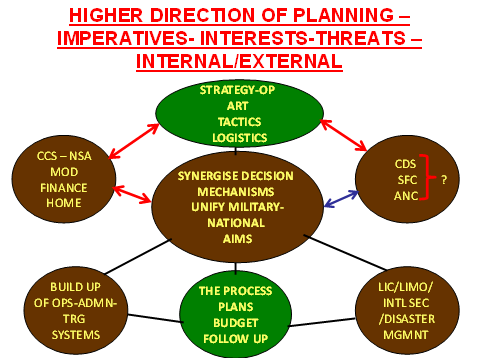
Key CCS -cabinet committee on Security
NSA- National Security Advisor
MOD - Ministry of Defense
CDS - Chief of Defense Staff
SFC - Strategic Forces Command
ANC- Andaman and Nicobar Command
LIC- Low Intensity Conflict
LIMO- Low Intensity Maritime Operations
INTL SEC- Internal Security
TRG - Training

Higher Direction Schematic and Actuality

The above schematic is the writer’s imagination. In practice the circles exist but are mostly in separate orbit. At best there are some committees of secretaries and the CCS who deliberate upon important issues on a need based continuum. The military may or may not be called in all deliberations.
The origin lies squarely in the Nehruvian mind set at the time of Independence. The Political leadership felt uncomfortable with the British model of command and control. The Bureaucracy too perceived that its primacy was sacrosanct in a democracy. Hence in the euphoria of independence, the Commander in Chief of the military was sectioned into the three chiefs of the three services. The promise of concurrent reorganisation of the Ministry of Defence is yet to be realised.

Military Obtuseness or Obedience

The naiveté of the British cloned, Army dominated Indian military leadership was perhaps an unwitting factor.

Ensconced in the cantonment and surrounded by the splendour of fife and drum beat, it did not understand the obvious, apparent difference between being "apolitical and politically obtuse"

The senior Indian Army hierarchy understandably behaved more like proper soldiers than statesmen. They believed in their leadership to do the right thing. What the former laid down then, continues even today.

It's approach to civil relations is always confined to a very narrow swathe of the defence ministry. Personnel of the armed forces are conditioned to be indifferent and sometimes with apathy towards the political class. Somehow, that they are people and citizens too, and not a class apart is overlooked in their education. In turn, the polity is comfortable with managing military affairs through the proxy of bureaucracy. Who should educate who, and on what, of the mutual, political & military education remains ignored.

Leadership & Civilian Bureaucracy Sans Military

Our leadership and bureaucracy adopted the whole works of the erstwhile English Raj through the aegis of the civil services without any consultation with the military. Both believed that the British model was suitable with minor modifications, excepting the military aspect. The euphoria of independence, the challenges of ruling a geo politically united India, infatuation with an English way of life, and dealing with the real politick of governance ensured that the rules of business on national management precepts were not properly thought through. Great Britain left behind a robust system that made lot of sense gave order and form with a strong legal base. Yet it was designed to take away wealth from us and hence in principle not compatible to our culture, tradition and age old valid systems. This has been adequately proved time and again in the way the land has been sub optimally governed. The system is "INDIA" dyslexic, people unfriendly and not result oriented. Government profligacy and inefficiency are in tandem in the maze of complicated red tape.

Lack of political direction and a loose limbed hands off approach, queers the pitch of military readiness. Consequently civil military bureaucratic relations exist under best conditions of polite detached, " Us versus Them” and diffused accountability.

The first warning that all was not well in this arrangement, was during the ill fated 1962 Sino-India conflict. Despite the lasting trauma of that battle, The Indian establishment continues in the same ilk. Despite all the conflicts with Pakistan and the imposing Chinese posture , the whole Political- Bureaucratic-Diplomatic- Military- Intelligence- Technology-Industrial community has not been able to get its act together! Working in watertight silos is both style and form today.

The quality and value of our Civil- Military bureaucratic relationship reflects; our inability to internalise India in terms of national perspectives. Consequently our externalisation tends to be tentative and confusing to us and outsiders. Drifting along with events as they occur seems to be our preferred option"

Paradox of The Pen & Sword

Both the Civilian Decision maker and the Military executor of the Country are committed to Sovereignty, Security, of a Democratic India. Hence there is neither a threatening crisis, nor even an impasse in the Civil- Military construct. This is the good news. The bad news however is: it is muddled, disjointed, indecisive, frustrating, and cost prohibitive, by default and design. Trust deficit and misperceptions militate against working together. The absence of mandated directives from the political leadership is the root cause of this avoidable morass. The Pen and the Sword can and have to join forces to ensure that files create capable combat effectiveness.

Go Between Bureaucracies

Both bureaucracies are pseudo go betweens with each other. All dialogue is on a dated filing system with a conundrum of file processing. In the Services, the file follows a hierarchical path from downwards to upwards and reaches Ministry of Defence at the level of Defence Secretary/ Additional Secretary. From that level it plunges straight down to the desk officer and is processed upwards through every layer. Unless this is changed inordinate delays in decision making would continue. In effect the silent strangler of the system is the file.

Our File Process The System Strangler

India, compelled to adopt the White Hall filing system as part of its legacy of freedom, continues with this archaic practice of file based decisions. The Civil and Military bureaucracy grew with this paper trail. Today despite the obvious advantages of the information highway, presence of useful decision supporting Management Information Systems; files still do the rounds at snail's pace. In practice, the whole process precludes collegiate decision making. The underlying working principle is to ensure that the file notes do not ever implicate any decision makers or subordinates on both sides. File Noting hence is defensive, tentative and tend to be open ended. It is no exaggeration to state that diffused accountability through obfuscation is the norm; fear of CVC/CAG (Central Vigilance Commission and Comptroller Auditor General) too is another catalyst for playing safe. This file process is the silent strangler, impervious to other dynamic changes brought in force through revised procurement policies.

File work must be minimal and supported by IT based decision processes. Information archiving, retrieval is the need of the day. Collegiate decision making is the answer in a networked set up. Secure LAN/WAN arrangements and software processes must become policy sooner than later.

Absence of Direct Communication Flow

Direct, institutionalised, formalised communication between National Leadership, Parliament and the executors of the country's Defence and Security policies and processes is more in absentia. The Parliamentary Standing Committee on DefenCe is notional, ineffective and powerless by design and organisation. Even in this, the armed forces only tag along with their civilian counterparts. The time, attention and energy devoted to the whole exercise is adhoc, cursory and a mere formality.

Culture of Working in Compartments

It is the norm for the MEA to take foreign policy decisions without any institutionalised consultation with MOD. The Latter has no formalised relationship with MEA

Similarly the MOH and MOD have no mandated Rules of Business on Internal security supervision.

One important facet of bureaucratic relationships is the complete impersonal imprint and a mindset to only dialogue on file and keep records. Time delay is a given, devoid of any emotional involvement.

Military Uniform to Uniform

Pride of service, in uniform is a primal facet of the military. This is needed, understandable and acceptable. Modern warfare however requires a mindset acceptance that, unified operations are a mandate. A mandate that needs doctrine, policy, procedures, training, debrief, remediation, re training and operational practice. The paradoxes of the military profession need to be part of the war fighter's DNA. Senior military leadership must undergo continuing education on involuntary conundrums, intrinsic in a fighting force, those are:

Preparing for an exam while hoping that it never takes place Maintaining a Combat ready entity in a 95% plus peace time continuum? This calls for an "Us with Us" approach.

Dealing with Internal security Issues on the concept of an " an iron fist in a velvet glove"

Managing; the promotion pyramid, the career construct, the significant superseded strata and rising expectations of a better educated, evolving military society!

Handling technology obsolescence in the face of ever present imminent combat and security threats in incipient conditions of uncertainty.
Living with bereavement and dealing with rehabilitation of families and the large number of retirees.

Learning to meld and blend combat culture with corporate practices to optimally organise the entire establishment needs, through serious, deliberate planning, money, in terms of intention, effort and determination.
Funding determination as part of the military budget for resettling families and transitioning veterans into civilian careers.

Crucial Strategic Asks

Can India live on its ancient glory, and its recent success of sorts? Is there room for complacency in a rapidly changing and deteriorating security scenario in the neighbourhood. Radical Islam, rapidity of information spread, increasing awareness on rights, rising expectations, inequitable economic weaknesses, poverty spread, malnutrition; all cause social unrest and desperation.

The crucial asks are:

Who is responsible, accountable for combat and security readiness?

Is the present civil -military arrangement able and workable across the span of governance, administration, nation’s management, diplomacy, defence, security and poverty alleviation?

Does India have overall national capability to handle both the neighbourhood as well as internal security issues and complexities?

Does defence budgeting require a different dynamism to make military management and acquisition cost effective?

What are fault lines within the Military that need speedy remediation?
Why has India not set up a defence Industrial base to strategically reduce Import costs?

How Should India Go About This

Ownership of readiness

The military will always fight with what it has- (COAS, Gen VP Malik during OP Vijay in Kargill) . Lack of " Ownership of Readiness" is behind this soldierly lament. Fixing Ownership of Readiness is the first step. It should be the Defence Minister who should be made answerable for military readiness and sovereign security. Similarly the Home Minister should be responsible for Internal security.

Once ownership is defined with authority, the whole chain would be galvanised into a channelised process of achieving stated objectives.

Able and Workable Systems

Process and authority in capability based capital acquisition is paramount. It has to rest and vest on a single point authority along with an empowered Organism. A pre audited collegiate decision matrix with autonomy and assurance that "Ghosts of Inquiry" do not unwittingly haunt the decision makers. Only then can the system become Nationally able and capable to handle Combat and Security management.

Military Fault Lines Repair

Concept of unified operations is an operational imperative. Training and learning to fight together should become part of our blood stream. This can and must be done with retention of individual service identity. From unified operations will stem Joint Operations and Individual service missions. This will strengthen our combat capability in synergy.

Creation of a Chief of Defence Staff with attendant revision of roles in Chiefs of Staff has to be through an act of Parliament. Creation of theatre commands must be also mandated. Cost benefits and operational effectiveness study of the American example shows significant salutary effects on combined combat readiness.

Integration of Military with MOD, DRDO, DPSUS and institutionalized relations with Intelligence agencies, private industry will go a long way towards self reliance

Personnel management, selection of Commanders in Chief and Heads of Services must be done on an informed, participative basis that includes the politico- bureaucratic setup.

Serving Military- Bureaucratic- Diplomatic, Intelligence, senior leadership from joint secretary upwards must attend regular participative workshops of short durations. It hasto be formalised, structured on the determinants of national management and consequent military matrices. The CCS Ministers and National Defence Council members must address these gatherings and gain critical inputs. It must become a regular feature that would bring synergy in civil- military participation.

Appointing Joint/Additional Secretaries from MEA/MHA to all critical commands that contend with sensitive issues must become policy. Similarly having service officers and MOD representatives in MEA/MHA must be mandated.
Creation of a common information highway should be taken up as the first dynamic. Informed collegiate decision processes must follow suit.

Defence Budgeting Revamp

This revamp is a top priority. The New management strategy introduced in the late nineties has to be further revised. Budget roll over, getting rid of the year ending frenzy of deadlines, assured funding of money and no return of unspent money have to be considered by a council of military expenditure appointed by the CCS. Only then can the acquisition become cost and operationally effective

Military Industrial Complex

We are no where near becoming “Indian” in terms of becoming reasonably self reliant across the spectrum of Indian battle order needs. Civilian and military participation has to enable creation of a Military Industrial Commission. This could be set up from existing entities like CII, FICCI, DRDO, DPSUs, Armed forces, Private and Public sector companies. Oversight could be by the Defence Acquisition Council.

The Military Industrial Commission charter could be created from the findings and recommendations of the various committees set up by the Government within the last two decades. The Political-Civil-Military combine also needs to institutionally focus on the critical aspect of self reliance and reduce rising import costs.

Imperative Next Steps

Higher Defence and Security Decision Making Robustness can be achieved by the Cabinet Committee on Security (CCS). It must mandate institutionalised mechanisms between the National Security Advisor (NSA), the Ministries of Defence, Home, External affairs. Civil control of the military is a given. Integrated, inclusiveness of the armed forces through proactive participation will optimise combat and security preparedness.

Creation of a Chief of Defence Staff and defining Unified Commands like SFC, ANC should be carried out immediately by legislation. Unified Areas of operations, defining, national interests, military & security threats, have to be on priority in the reporting and preparation mechanisms.

The Standing Parliamentary Committee on Defence needs to be elevated to A National Defense Council (NDC). It should have leaders of the ruling and opposition. It must be empowered and organised to monitor military readiness formally, in camera. Joint review by CCS to validate this must be mandated. The CDS/the Chiefs of Services must annually report the state of military readiness to NDC regularly.

Summation

Civil control over the military in a democracy is a sanctified given in India. Ownership of military, its preparedness, readiness are integral, inherent and sacrosanct to national Interests. They are intrinsic in nation’s management. Our 5000 years DNA in many ways is a genetic gift of being flexible and yet forged to withstand tsunamis, and tectonic shifts of global geo- political movement and collateral combat, and security situations.

India has all organisations and systems in place. Our political leadership has to be given the comfort of the changes proposed in this paper. Their acceptance would germinate a renewed, refreshed political civil military relationship in the national interest of security in sovereignty. This would enable the political leadership to take well informed sound decisions in an inclusive manner

India is poised at the tipping point on the international ledge of global geo politics- It can be a model to the world as a successful stable democracy. The centre of gravity is the silos of the political-civil and military becoming a sacred granary of security in synergy for our lasting sovereignty. Optimal civil and military participation will make India reach its ordained destiny.