Vice
Admiral (Retd.) Barry Barathan
Distinguished Fellow, VIF
Opener
Analysis of India's
approach towards it's national security reveals an unacceptable hiatus between
the Political -Civil- Military systems. We perhaps were lucky enough to get
away thus far even despite the 1962 China debacle. New security realities, an assertive
China, a highly probable Sino-Pak collusion, the emergence of non state actors,
possible implosion in Pakistan, the Af-Pak mess all call for India to review
and revamp its management of national security. Our bureaucracy has the
sagacity, expertise and eclectic experience to optimise civil control
mechanisms under political guidance. Our military and security forces have the
commitment and wisdom to perpetuate democracy and secularism. Ours is a
democracy wherein civil control of the military is absolute. We have mechanisms
in place to optimally approach “national security and military readiness".
This of course has to be politically understood, accepted, absorbed and be top
down with sense of ownership, accountability and authority. This paper looks at
the quantum and quality of civil- military participation, the higher defence
decision making, the structures within the military and the way ahead.
Current
Status of Political – Civil - Military Participation
Indian political -civil-
military relationship needs to be seen in the context of the critical dichotomy
between "Authority and Responsibility" resulting in the absence of
ownership for military and security. The whole discussion often misses the
forest for the trees. In the fog of this debate, the political leadership
virtually goes unnoticed and hence never answers for this grave omission.
Should our political leadership not take onus of ownership or at least assign
responsibility for military and security readiness to an accountable entity.
Six decades post independence has not seen any effective viable change.
Civil and military
martnership needs to be seen in wider contours of nation’s Management, national
security, foreign policy, technology self reliance, budgeting: in the frame
work of sovereignty, sustainability and survivability as a nation state. It
should also include internal security concerns. Intelligence and policing are
inherent in this.
Who is
Responsible for Readiness?
The Government of India
rules of business are distinctly vague on responsibility, accountability of
military preparation and readiness. Extracts from the rules of business and MOD
website reproduced below, clearly highlight this:
‘Defence of India and
every part thereof including preparation for defence and all such acts as may
be conducive in times of war to its prosecution and after its termination to
effective demobilisation’.
MoD
Website also Reads
“The Defence Secretary
functions as head of the Department of Defence and is additionally responsible
for co-coordinating the activities of the four Departments in the Ministry.”
The above extract does
not mention "preparedness or readiness" even in passing not to speak
about the much needed deliberation. It is silent on "Accountability and
Answerability"
Responsibility
of Military Readiness
Security, Sovereignty,
Stability of a Nation is clearly a leadership mandate- how it chooses to
exercise and execute this, is, its prerogative. Why it remains passive has not
been questioned either by the establishment or by the people.
The Army, Navy, Air Force
are engaged individually in terms of turf protection. There is neither
integration nor coordination between the Ministries of Defence, Home, Finance,
External affairs with the army, paramilitary and intelligence forces, even as a
concept, let alone in practice. Guarding the turf is a solemn obsession. What
started as a practice became a habit and is now an addiction. The divide on the
concept and role of the Chief of Defense Staff within the three services is
sharp enough for the polity to justify its passivity. The IDS Headquarters
under the CISC- Chief of Integrated Staff committee is gamely trying to pull
the services together and over the last 7 years or so has been proved to be
useful. This vindicates the need for a CDS. However, the Naresh Chandra Task
Force has recently recommended a permanent Chairman, Joint Chiefs of Staff
which is a climb down from the CDS. It is also not very clear as to what powers
would CJCS have to enforce/enable integration and jointness.
Higher
Defense Decision Making
The collateral, attendant
impact on the Military and Security scenario is dependent upon the quality,
quantity of ownership by the Political- Civil- Military combine in Higher
Defense Decision Making. This has direct correlation with India's security
calculus, effective military preparation, and readiness. Internal security
strategies too, are contingent on the construct of Civilian - Military-
Security equations and equity. Our bad neighbourhood is slipping into a vortex
of visceral anarchy beyond reason and control. In the North East, China makes
us nervous by its rapid and robust build up. Sino- Pak collusion is on the
cards. Both may decide to make a play together, to stir the already simmering
South Asian Security pot. The Afghan-Pakistan region is also fraught with
various probabilities of dysfunctional anarchy. A Taliban take over is most
likely, no sooner than the withdrawal of the American led NATO military. The
fall out has serious implications in the region. Civil and Military participation
in synergy must come into play sooner than later.
"Power relationships
between Nations are constantly changing, and unless a country understands and
adjusts itself to the changes that are taking place around it, its own Security
will be seriously endangered" An extract from Sardar K M Panikkar’s Annual
Day address to the Indian School of International Studies on 13 February 1961
Status
Quo Syndrome
Examination of our Higher
Defense Decision Making Organisation, readily reveals a witting "Six decade
status quo syndrome" perpetuated by the way we are as Indians; fatalistic
about our Indian-ness and independence. The implications of this on our
sovereignty, security, stability, status as a secular Democracy can be
understood, absorbed and be acted upon only if the top leadership grasps this
with firmness and dynamism.
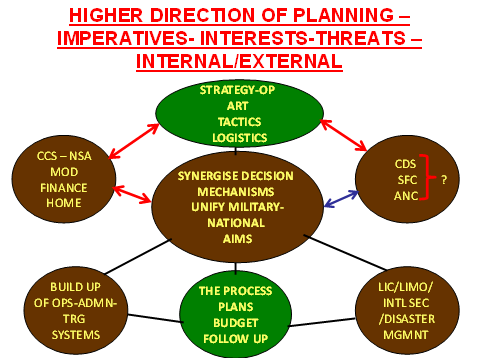
Key CCS -cabinet
committee on Security
NSA- National Security Advisor
MOD - Ministry of Defense
CDS - Chief of Defense Staff
SFC - Strategic Forces Command
ANC- Andaman and Nicobar Command
LIC- Low Intensity Conflict
LIMO- Low Intensity Maritime Operations
INTL SEC- Internal Security
TRG - Training
Higher
Direction Schematic and Actuality
The above schematic is
the writer’s imagination. In practice the circles exist but are mostly in
separate orbit. At best there are some committees of secretaries and the CCS
who deliberate upon important issues on a need based continuum. The military
may or may not be called in all deliberations.
The origin lies squarely
in the Nehruvian mind set at the time of Independence. The Political leadership
felt uncomfortable with the British model of command and control. The
Bureaucracy too perceived that its primacy was sacrosanct in a democracy. Hence
in the euphoria of independence, the Commander in Chief of the military was
sectioned into the three chiefs of the three services. The promise of
concurrent reorganisation of the Ministry of Defence is yet to be realised.
Military
Obtuseness or Obedience
The naiveté of the
British cloned, Army dominated Indian military leadership was perhaps an
unwitting factor.
Ensconced in the
cantonment and surrounded by the splendour of fife and drum beat, it did not
understand the obvious, apparent difference between being "apolitical and
politically obtuse"
The senior Indian Army
hierarchy understandably behaved more like proper soldiers than statesmen. They
believed in their leadership to do the right thing. What the former laid down
then, continues even today.
It's approach to civil
relations is always confined to a very narrow swathe of the defence ministry.
Personnel of the armed forces are conditioned to be indifferent and sometimes
with apathy towards the political class. Somehow, that they are people and
citizens too, and not a class apart is overlooked in their education. In turn,
the polity is comfortable with managing military affairs through the proxy of
bureaucracy. Who should educate who, and on what, of the mutual, political
& military education remains ignored.
Leadership
& Civilian Bureaucracy Sans Military
Our leadership and
bureaucracy adopted the whole works of the erstwhile English Raj through the
aegis of the civil services without any consultation with the military. Both
believed that the British model was suitable with minor modifications,
excepting the military aspect. The euphoria of independence, the challenges of
ruling a geo politically united India, infatuation with an English way of life,
and dealing with the real politick of governance ensured that the rules of
business on national management precepts were not properly thought through.
Great Britain left behind a robust system that made lot of sense gave order and
form with a strong legal base. Yet it was designed to take away wealth from us and
hence in principle not compatible to our culture, tradition and age old valid
systems. This has been adequately proved time and again in the way the land has
been sub optimally governed. The system is "INDIA" dyslexic, people
unfriendly and not result oriented. Government profligacy and inefficiency are
in tandem in the maze of complicated red tape.
Lack of political
direction and a loose limbed hands off approach, queers the pitch of military
readiness. Consequently civil military bureaucratic relations exist under best
conditions of polite detached, " Us versus Them” and diffused
accountability.
The first warning that
all was not well in this arrangement, was during the ill fated 1962 Sino-India
conflict. Despite the lasting trauma of that battle, The Indian establishment
continues in the same ilk. Despite all the conflicts with Pakistan and the
imposing Chinese posture , the whole Political- Bureaucratic-Diplomatic-
Military- Intelligence- Technology-Industrial community has not been able to
get its act together! Working in watertight silos is both style and form today.
The quality and value of
our Civil- Military bureaucratic relationship reflects; our inability to
internalise India in terms of national perspectives. Consequently our
externalisation tends to be tentative and confusing to us and outsiders.
Drifting along with events as they occur seems to be our preferred option"
Paradox
of The Pen & Sword
Both the Civilian
Decision maker and the Military executor of the Country are committed to
Sovereignty, Security, of a Democratic India. Hence there is neither a
threatening crisis, nor even an impasse in the Civil- Military construct. This
is the good news. The bad news however is: it is muddled, disjointed,
indecisive, frustrating, and cost prohibitive, by default and design. Trust
deficit and misperceptions militate against working together. The absence of
mandated directives from the political leadership is the root cause of this
avoidable morass. The Pen and the Sword can and have to join forces to ensure
that files create capable combat effectiveness.
Go
Between Bureaucracies
Both bureaucracies are
pseudo go betweens with each other. All dialogue is on a dated filing system
with a conundrum of file processing. In the Services, the file follows a hierarchical
path from downwards to upwards and reaches Ministry of Defence at the level of
Defence Secretary/ Additional Secretary. From that level it plunges straight
down to the desk officer and is processed upwards through every layer. Unless
this is changed inordinate delays in decision making would continue. In effect
the silent strangler of the system is the file.
Our
File Process The System Strangler
India, compelled to adopt
the White Hall filing system as part of its legacy of freedom, continues with
this archaic practice of file based decisions. The Civil and Military
bureaucracy grew with this paper trail. Today despite the obvious advantages of
the information highway, presence of useful decision supporting Management
Information Systems; files still do the rounds at snail's pace. In practice,
the whole process precludes collegiate decision making. The underlying working
principle is to ensure that the file notes do not ever implicate any decision
makers or subordinates on both sides. File Noting hence is defensive, tentative
and tend to be open ended. It is no exaggeration to state that diffused
accountability through obfuscation is the norm; fear of CVC/CAG (Central
Vigilance Commission and Comptroller Auditor General) too is another catalyst
for playing safe. This file process is the silent strangler, impervious to
other dynamic changes brought in force through revised procurement policies.
File work must be minimal
and supported by IT based decision processes. Information archiving, retrieval
is the need of the day. Collegiate decision making is the answer in a networked
set up. Secure LAN/WAN arrangements and software processes must become policy
sooner than later.
Absence
of Direct Communication Flow
Direct,
institutionalised, formalised communication between National Leadership,
Parliament and the executors of the country's Defence and Security policies and
processes is more in absentia. The Parliamentary Standing Committee on DefenCe
is notional, ineffective and powerless by design and organisation. Even in
this, the armed forces only tag along with their civilian counterparts. The
time, attention and energy devoted to the whole exercise is adhoc, cursory and
a mere formality.
Culture
of Working in Compartments
It is the norm for the
MEA to take foreign policy decisions without any institutionalised consultation
with MOD. The Latter has no formalised relationship with MEA
Similarly the MOH and MOD
have no mandated Rules of Business on Internal security supervision.
One important facet of
bureaucratic relationships is the complete impersonal imprint and a mindset to
only dialogue on file and keep records. Time delay is a given, devoid of any
emotional involvement.
Military
Uniform to Uniform
Pride of service, in
uniform is a primal facet of the military. This is needed, understandable and
acceptable. Modern warfare however requires a mindset acceptance that, unified
operations are a mandate. A mandate that needs doctrine, policy, procedures,
training, debrief, remediation, re training and operational practice. The
paradoxes of the military profession need to be part of the war fighter's DNA.
Senior military leadership must undergo continuing education on involuntary
conundrums, intrinsic in a fighting force, those are:
Preparing for an exam
while hoping that it never takes place Maintaining a Combat ready entity in a
95% plus peace time continuum? This calls for an "Us with Us"
approach.
Dealing with Internal
security Issues on the concept of an " an iron fist in a velvet
glove"
Managing; the promotion
pyramid, the career construct, the significant superseded strata and rising
expectations of a better educated, evolving military society!
Handling technology
obsolescence in the face of ever present imminent combat and security threats
in incipient conditions of uncertainty.
Living with bereavement
and dealing with rehabilitation of families and the large number of retirees.
Learning to meld and blend combat culture with corporate practices to optimally
organise the entire establishment needs, through serious, deliberate planning,
money, in terms of intention, effort and determination.
Funding determination as
part of the military budget for resettling families and transitioning veterans
into civilian careers.
Crucial
Strategic Asks
Can India live on its
ancient glory, and its recent success of sorts? Is there room for complacency
in a rapidly changing and deteriorating security scenario in the neighbourhood.
Radical Islam, rapidity of information spread, increasing awareness on rights,
rising expectations, inequitable economic weaknesses, poverty spread,
malnutrition; all cause social unrest and desperation.
The
crucial asks are:
Who is responsible,
accountable for combat and security readiness?
Is the present civil
-military arrangement able and workable across the span of governance,
administration, nation’s management, diplomacy, defence, security and poverty
alleviation?
Does India have overall
national capability to handle both the neighbourhood as well as internal
security issues and complexities?
Does defence budgeting
require a different dynamism to make military management and acquisition cost
effective?
What are fault lines
within the Military that need speedy remediation?
Why has India not set up
a defence Industrial base to strategically reduce Import costs?
How Should India Go About
This
Ownership
of readiness
The military will always
fight with what it has- (COAS, Gen VP Malik during OP Vijay in Kargill) . Lack
of " Ownership of Readiness" is behind this soldierly lament. Fixing
Ownership of Readiness is the first step. It should be the Defence Minister who
should be made answerable for military readiness and sovereign security. Similarly
the Home Minister should be responsible for Internal security.
Once ownership is defined
with authority, the whole chain would be galvanised into a channelised process
of achieving stated objectives.
Able
and Workable Systems
Process and authority in
capability based capital acquisition is paramount. It has to rest and vest on a
single point authority along with an empowered Organism. A pre audited
collegiate decision matrix with autonomy and assurance that "Ghosts of
Inquiry" do not unwittingly haunt the decision makers. Only then can the
system become Nationally able and capable to handle Combat and Security
management.
Military
Fault Lines Repair
Concept of unified
operations is an operational imperative. Training and learning to fight
together should become part of our blood stream. This can and must be done with
retention of individual service identity. From unified operations will stem
Joint Operations and Individual service missions. This will strengthen our
combat capability in synergy.
Creation of a Chief of
Defence Staff with attendant revision of roles in Chiefs of Staff has to be
through an act of Parliament. Creation of theatre commands must be also
mandated. Cost benefits and operational effectiveness study of the American
example shows significant salutary effects on combined combat readiness.
Integration of Military
with MOD, DRDO, DPSUS and institutionalized relations with Intelligence
agencies, private industry will go a long way towards self reliance
Personnel management,
selection of Commanders in Chief and Heads of Services must be done on an
informed, participative basis that includes the politico- bureaucratic setup.
Serving Military-
Bureaucratic- Diplomatic, Intelligence, senior leadership from joint secretary
upwards must attend regular participative workshops of short durations. It
hasto be formalised, structured on the determinants of national management and
consequent military matrices. The CCS Ministers and National Defence Council
members must address these gatherings and gain critical inputs. It must become
a regular feature that would bring synergy in civil- military participation.
Appointing
Joint/Additional Secretaries from MEA/MHA to all critical commands that contend
with sensitive issues must become policy. Similarly having service officers and
MOD representatives in MEA/MHA must be mandated.
Creation of a common
information highway should be taken up as the first dynamic. Informed
collegiate decision processes must follow suit.
Defence
Budgeting Revamp
This revamp is a top
priority. The New management strategy introduced in the late nineties has to be
further revised. Budget roll over, getting rid of the year ending frenzy of
deadlines, assured funding of money and no return of unspent money have to be considered
by a council of military expenditure appointed by the CCS. Only then can the
acquisition become cost and operationally effective
Military
Industrial Complex
We are no where near
becoming “Indian” in terms of becoming reasonably self reliant across the
spectrum of Indian battle order needs. Civilian and military participation has
to enable creation of a Military Industrial Commission. This could be set up
from existing entities like CII, FICCI, DRDO, DPSUs, Armed forces, Private and
Public sector companies. Oversight could be by the Defence Acquisition Council.
The Military Industrial
Commission charter could be created from the findings and recommendations of
the various committees set up by the Government within the last two decades.
The Political-Civil-Military combine also needs to institutionally focus on the
critical aspect of self reliance and reduce rising import costs.
Imperative
Next Steps
Higher Defence and
Security Decision Making Robustness can be achieved by the Cabinet Committee on
Security (CCS). It must mandate institutionalised mechanisms between the
National Security Advisor (NSA), the Ministries of Defence, Home, External
affairs. Civil control of the military is a given. Integrated, inclusiveness of
the armed forces through proactive participation will optimise combat and
security preparedness.
Creation of a Chief of
Defence Staff and defining Unified Commands like SFC, ANC should be carried out
immediately by legislation. Unified Areas of operations, defining, national
interests, military & security threats, have to be on priority in the
reporting and preparation mechanisms.
The Standing
Parliamentary Committee on Defence needs to be elevated to A National Defense
Council (NDC). It should have leaders of the ruling and opposition. It must be
empowered and organised to monitor military readiness formally, in camera.
Joint review by CCS to validate this must be mandated. The CDS/the Chiefs of
Services must annually report the state of military readiness to NDC regularly.
Summation
Civil control over the
military in a democracy is a sanctified given in India. Ownership of military,
its preparedness, readiness are integral, inherent and sacrosanct to national
Interests. They are intrinsic in nation’s management. Our 5000 years DNA in many
ways is a genetic gift of being flexible and yet forged to withstand tsunamis,
and tectonic shifts of global geo- political movement and collateral combat,
and security situations.
India has all
organisations and systems in place. Our political leadership has to be given
the comfort of the changes proposed in this paper. Their acceptance would
germinate a renewed, refreshed political civil military relationship in the
national interest of security in sovereignty. This would enable the political
leadership to take well informed sound decisions in an inclusive manner
India is poised at the
tipping point on the international ledge of global geo politics- It can be a
model to the world as a successful stable democracy. The centre of gravity is
the silos of the political-civil and military becoming a sacred granary of
security in synergy for our lasting sovereignty. Optimal civil and military
participation will make India reach its ordained destiny.