(Visiting Fellow, VIF)
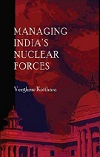
Forces by Verghese Koithara
(New Delhi: Routledge, 2012), 294 p, Rs. 795.
Review of Managing India’s Nuclear
India declared itself a state armed with nuclear weapons in May 1998 after the Pokhran tests. Despite the fact that almost 15 years have passed since then, the number of good books on the subject of managing India’s nuclear deterrence can be counted on the finger tips of one hand. This is partly because academics and strategic analysts find deterrence theory and the complexities of nuclear command and control too esoteric and partly because the Government of India has made no attempt to encourage such research. None of the government funded think tanks have thought it fit to conduct research on this issue. It is to the credit of Vice Admiral Verghese Koithara (Retd) that he has dared to enter what may be loosely termed as forbidden territory. In his book Managing India’s Nuclear Forces Admiral Koithara takes stock of the system in place for managing nuclear deterrence, carefully evaluates its efficacy and makes substantive recommendations to enhance its functionality.
India’s nuclear doctrine is built around a ‘no first use’ policy with ‘credible minimum deterrence’. In the interest of strategic stability, India is willing to absorb a ‘first strike’ and will launching punitive nuclear strikes in retaliation to cause unacceptable damage to the adversary if it is attacked with nuclear weapons. India’s nuclear weapons are political weapons meant only to deter the use and threat of use of nuclear weapons against India. It is clearly accepted in India that nuclear weapons are not weapons of warfighting. Hence, India has firmly rejected the use of tactical or theatre nuclear weapons – despite provocation from across its western border. However, India has not publicly demonstrated that it has done what it takes to ‘operationalise’ its nuclear deterrence. This is the essence of Admiral Koithara’s excellent book. In fact, he goes one step further to state that by keeping the armed forces out of the nuclear decision making loop, the authorities have actually undermined the credibility of India’s nuclear deterrence.
Both the NDA and UPA governments have tended to play down discussion of nuclear issues in the public domain. According to the strategic community grapevine, the late Brajesh Mishra, India’s first National Security Advisor (NSA), had issued an informal whip to the effect that no one in government will speak to the media about nuclear deterrence. No discussions or seminars have been held by the three Services to study issues like ‘targeting’ and deterrence breakdown that are in the military domain. Through various acts of commission and omission, successive governments have created the perception that acquiring nuclear weapons was an end in itself for power and prestige and that since nuclear weapons are political weapons and not weapons of warfighting, the barest minimum needs to be done to create nuclear forces that are robust and usable.
India’s nuclear signalling has been marked primarily by the routine flaunting of various models of Agni and Prithvi missiles at the Republic Day parade. No nuclear drills are known to have been held to ensure that the missile groups can deploy in a realistic time frame and that the warheads can be mated with the launchers in real time for early retaliation in the eventuality of a nuclear strike, even though some of these measures may have been practised in secret. Nuclear signalling is an extremely sophisticated art and India appears to have ignored this aspect completely. In view of these major shortcomings, India’s nuclear deterrence tends to lack credibility and is not taken seriously by either military adversaries or by the international community. India must demonstrate its resolve to use nuclear weapons if it ever becomes necessary through a carefully formulated process of signalling and must enhance the quality of its warhead and missile technology. The steps necessary to fully operationalise India’s nuclear deterrence must not only be taken early, but must also be publicly seen to have been taken – within the bounds of security of information and materials.
The author identifies and challenges the four tacit assumptions behind the lack of seriousness in operationalising India’s nuclear forces: that deterrence credibility can be established through technological demonstration; that nuclear force operations are largely a technical matter; that transition from general to immediate deterrence through alerting is not a very demanding exercise; and that force survivability is not a critical issue. He also mentions a fifth one: in a crunch situation the US will be there to call upon. He goes on to successfully demolish all of them through the force of logic.
Admiral Koithara focuses a sharp lens on the systemic weaknesses plaguing the management of India’s nuclear deterrence. He has stated that inadequacies in the management of nuclear forces have degraded India’s deterrence, “Not just by the inability to conduct operations in a safe and reliable manner, but also by revealing a lack of seriousness of purpose.” He bemoans the fact that the armed forces have been kept away from functional involvement in managing deterrence and asserts that, “Nuclear forces of every NWS are... closely controlled by the national leadership. But in every one of those countries, except India, these forces are managed by the armed forces under the supervision of the political leadership.” He points out that the command and control structure is patently flawed where even the Defence Minister is a peripheral figure in nuclear decision making. He recommends a return to the erstwhile Defence Committee of the Cabinet with the three Chiefs as permanent invitees.
India still does not have a Chief of Defence Staff to provide ‘single point military advice’ to the Prime Minister. The three Services Chiefs are members of the Executive Council of the Nuclear Command Authority (NCA) headed by the NSA and not of the Political Council of the NCA headed by the Prime Minister. As such, their inputs would reach the PM only indirectly in a moment of crisis. This system of isolation of the three Chiefs is unsuitable for long term nuclear planning. Though India has a Strategic Forces Command (SFC) for managing its nuclear forces, the C-in-C SFC reports directly to the NSA in practice and keeps the Chairman CoSC informed. Also, India does not have full fledged nuclear planning staff like Pakistan’s Strategic Plans Division and nuclear planning is not seamlessly integrated across the ministries and the departments. The author writes, “Using inadequately prepared nuclear forces to generate deterrence will be similar to the inadequately-supported forward policy that India had adopted along the Tibet border in 1959.
This remarkable book would have been much richer if the author had taken stock of Pakistan’s unbridled for additional fissile material beyond its legitimate needs and its quest to acquire tactical nuclear weapons like the 60-kilometres range Hatf 9 (Nasr) missile, which is inherently destabilising, and its efforts to tip its cruise missile Babur with nuclear warheads. The lack of serious confidence building and risk reduction measures between the two countries has also not been covered, nor has India’s long standing support for total disarmament been addressed. However, no book can cover the entire nuclear landscape.
This book must be read by all personnel of the armed forces, particularly the senior officers. It must be prescribed reading for the Higher Command courses of the three Services. It must also be read by the political leaders, scientists and bureaucrats or technocrats who are involved in national security decision making and managing India’s nuclear forces.