Showing posts with label PLAAF. Show all posts

Friday, August 22, 2014

Geopolitical Developments and India-China Relations

Jayadeva Ranade

The world is in a state of continuing flux. The economies of the major powers are still fragile and vulnerabilities exist in those of the bigger emerging powers in the Asia-Pacific like China and India. The balance of power is concurrently undergoing a shift with competing focal points of power surfacing in the East. The fragile nature has been accentuated in the past few years with Beijing’s accelerated push for recognition as the dominant power in the Asia-Pacific. This is resisted by the US, Japan and India and has made South East Asian countries nervous.

China’s sudden assertiveness since the end of 2007 was prompted by a combination of factors, but mainly by: the global economic downturn; China’s considerably enhanced economic and military strength; and Beijing’s perception that the US as a global power is on the decline and this is now the opportune moment for China to regain its self-perceived rightful position on the world stage and alter the status quo in Asia. The Chinese Communist Party (CCP) leadership is divided on the issue of whether to write off the US as the sole world power. One view is that the US is a power irreparably on the decline while the other, which seems to be gaining ground, argues that the intrinsic strength and resilience of the US will ensure its return on to the world stage as a stronger, more effective power. There is consensus, however, that the US ability to project power simultaneously in different theatres is presently constrained, thus offering China a window of opportunity that would last at most between 5-10 years.

China’s impetuousness and decision to ‘take on’ the US anticipatedly triggered a response signalling quite clearly that the US is not about to cede either power or influence in the Asia-Pacific. The US encouraged particularly Japan and the Philippines, to react to China’s aggressiveness. It additionally unveiled the seemingly short-lived ‘Asian Pivot’ with its definite military content. The US has now shifted emphasis though, to the Trans-Pacific Partnership (TPP) and Trans-Pacific Intellectual Property Rights (TPIP), which are economic equivalents of the ‘Asian Pivot’. China is now leaning towards joining the TPP/TPIP.

China, however, has not been deterred and continues to press ahead with achieving its global and regional ambitions. The continuing tense stand-off with US ally and East Asia’s strongest power, namely Japan, amidst steady escalation in tensions in the South China Sea, underlines Beijing’s willingness to push the envelope in the apparent confidence that the US will stop shy of confronting it and so will Japan and Vietnam. China reasserted the role it desires in the Asia-Pacific in a statement in Washington DC by its Ambassador to the US, Cui Tiankai, in February 2014. There is little doubt that US credibility as a reliable ally willing to back its partners in the region has been dented in the past 5-odd years.

In the South China Sea, after a series of confrontations with Vietnam and the Philippines where China seized some maritime territories, Beijing has begun to assert its claims over a larger area. It has revived its claims on St. James’ Shoal off Thailand and South Korea’s Ieodo Rock and recently began building airports on some islands and extending others. On May 24, 2014, China’s largest US $ 1 billion oil rig the ‘Haiyang Shi You 981’ sailed into Vietnamese-claimed waters escorted by 86 armed ships and Beijing has now sent four more rigs. Simultaneously, tension with Japan over the Senkaku Islands (called Diaoyu in Chinese) rose in recent weeks with the increased frequency of patrols by Chinese Navy ships and People’s Liberation Army Air Force (PLAAF) aircraft flying very close to Japanese Self Defence Force (SDF) aircraft and at times coming near collision range.

Meanwhile, modernisation of the 2.3 million-strong People’s Liberation Army (PLA), which coincides with China’s continuing assertiveness that has unsettled its neighbours, has entered the final stage of its current phase. The Chinese Communist Party (CCP)’s Third Plenum, which was held in November 2013, provided it a substantive push. On January 18, 2014, the Party Secretary of Liaoning province disclosed that the second domestically-produced aircraft carrier being built at Dalian would be ready in six years. China also allocated US$ 1.6 billion for the first phase of indigenous design, development and production of jet engines.

The Third Plenum approved organisational reforms in the PLA’s command structure and the PLA Navy (PLAN), PLAAF and China’s strategic missile strike force, namely the Second Artillery, have been allotted enhanced operational roles and will receive priority in allocation of budgets and manpower. The PLA is to be downsized by 800,000 personnel including a large number of non-combatants. Reports filtering out of Beijing disclose that plans have been finalised to merge the seven military regions into five “combat zones”. This reorganisation will give the PLA a definite “outward orientation” and implies that “recovery” of territories claimed by Beijing will be a central feature of China’s strategic agenda and the PLA will reinforce diplomacy aimed at realising “China’s Dream”.

All this is relevant to India-China relations as is Beijing’s stance on ‘core national issues’ in bilateral relations. Beijing has made it explicitly clear in two despatches of China’s official news agency ‘Xinhua’ in August 2011, addressed to Japan and the Philippines, that ‘burgeoning economic ties do not mean good bilateral relations’ which depend entirely on the recognition and acceptance of China’s ‘core national interests’. The despatches are important because ‘Xinhua’ is China’s authoritative official news agency and even the CCP Central Committee (CC)’s powerful Propaganda Department instructs all Chinese journalists reporting on sensitive topics to adhere strictly to the text of ‘Xinhua’ reports.

To digress slightly, Chinese Premier Li Keqiang’s 2-day visit (June 17-18, 2014) to UK is pertinent. Apart from the fact that Beijing was particular about the minutiae of protocol, the 30-Article Joint Statement issued after the visit revealed UK’s capitulation to China. Article 23 stated that Britain recognises Tibet as an integral part of China and does not recognise Tibetan independence. The English-language ‘Global Times’, a subsidiary of the CCP’s official newspaper ‘People’s Daily’, gloated that Britain was finding it difficult to accept that it was now a “poor power compared to China”. A major inducement were the over US$ 40 billion trade deals signed during the visit and establishment last year of a Yuan swap centre in London.

While assessing a country’s foreign and strategic policies, and particularly in the context of India- China relations where there are major stakes and we are directly affected, it is important to understand the nature of the State and its internal leadership dynamics.

There has been a major change in China’s politics and leadership style since 2011 and particularly with the ouster of former Politburo (PB) member Bo Xilai in 2012. That was a major event in China’s politics, perhaps the first major political upheaval since the Tiananmen Event of 1989, and has seen a visible ‘hardening’ of the Chinese State. Details revealed during the events leading to Bo Xilai’s ouster reinforced the conviction of the CCP’s nomenklatura that the US remains intent on its strategy of ‘peaceful evolution’ -- China’s short-hand for US efforts to dismantle the CCP; deprive the CCP of its monopoly rule and introduce multi-Party democracy; and replace the ‘socialist economy’ with a ‘free-market capitalist economy’. Factional differences were subordinated to protecting the Party Centre and ensuring the CCP’s monopoly on power. All senior veteran cadres backed Xi Jinping and supported him as ‘leader’ of the Politburo Standing Committee (PBSC). As a consequence, in addition to the three all important posts of CCP CC General Secretary, Chairman of the CMC and President of China, Xi Jinping now additionally heads seven of the Party’s Central Leading Small Groups, which are the most important and highest decision making bodies. The Party has, in effect, asserted itself and further tightened its grip over key levers of the State.

Doctrinaire policies have also gained ascendance in the Party in the past few years with renewed emphasis on Marxist and Maoist ideology and Party discipline. The Party’s guiding narrative is being enforced by the CCP CC’s powerful Propaganda Department which has been steadily tightening restrictions on the media, social media and journalists (including most recently last week), since Xi Jinping took over. The elevation of Liu Yunshan, former Director of the CCP CC Propaganda Department, as Member of the PBSC and the country’s Propaganda and Ideology Czar is demonstration that the ‘hardening’ of the State is the decision of the Party Centre.

Particularly relevant in this context is Xi Jinping’s ‘China Dream’ which envisages: making the Chinese people wealthy; making China a strong nation; and the rejuvenation of China. This muscular aspiration for China spelt out by Xi Jinping at the 18th Party Congress has been adopted by the entire Party and has already entered the lexicon of the CCP. It is particularly pertinent to India-China relations as ‘rejuvenation’ implies the restoration of China to its self-perceived rightful international status and recovery of all its territories. The new passports published by China depict its claimed territories, as do its actions in the South China Sea and East China Sea and the increased assertiveness and expanding claims over Arunachal Pradesh and Jammu and Kashmir.

The Party has concretised Xi Jinping’s status in the CCP hierarchy, thus legitimising his status in China. The Party theoretical fortnightly journal ‘Qiu Shi’ in its latest issue (June 2014) described Xi Jinping as “one of China’s greatest Communist leaders”. Xi Jinping is today China’s most powerful leader since Mao Zedong.

In India too, there has been a radical change with a new leader emerging after a resounding democratic electoral victory. New Prime Minister Narendra Modi has a reputation as a strong, decisive leader and the BJP as a ‘right wing’ Party and they have a majority in Parliament unprecedented for thirty years. Modi very quickly used his swearing-in ceremony as an opportunity to outline India’s view of its strategic neighbourhood and where Indian interest will focus. The visit to Bhutan and planned visit to Japan reinforces this. The current government can shape and implement medium to long-term policies. In other words, India and China both have strong leaders and this itself offers an opportunity for engagement on fresh and revised terms.

Chinese Foreign Minister Wang Yi’s visit was intended to show China’s eagerness in engaging with India’s new right-wing Government and is part of its strategy of ‘Peripheral Diplomacy’. It sought to project that China desires good relations with India and prevent India from moving close to Japan or towards a US-led anti-China grouping. A Chinese-language official ‘Xinhua’ despatch of May 29, 2014, is, however, pertinent. Its tone differed noticeably from that of other Chinese media reports which assessed that India’s policies towards China would not change and that economic relations would receive a boost. This Xinhua despatch asserted that Modi has no option other than economic cooperation with China as India perforce has to recognise China’s economic and military superiority in Asia. It stressed that Modi would have to accommodate China, not out of choice or inclination, but out of necessity. While this is arguable, but the Xinhua despatch exhibits China’s self-confidence and at the same time implies there is potential for cooperation.

China’s focus is on economic cooperation with India: Xi Jinping and PM Modi’s meeting on the sidelines of BRICS Summit also pointed towards the same though differences on some of the strategic issues remained. Chinese President Xi Jinping’s forthcoming visit to India has the economy as its focus and he is reportedly being accompanied by 350 Chinese Chief Executives (CEOs) amidst much talk of investing in India’s infrastructure, high-speed railways and the Bullet Train. Chinese diplomatic missions in India have already begun selecting locations for the ‘Special Industrial Parks’ and, at least in Maharashtra, Rajasthan and Bengal, have identified middle-men for ‘benami’ purchases of land. China is anxious to find a new market for its huge reserves of surplus cash and as another avenue for investment, and India is an attractive vast market. Undoubtedly it will benefit if China invests in India’s infrastructure, but India will need to carefully decide the direction in which to steer Chinese business as otherwise, in a democratic set up such as India’s, China will soon acquire a powerful business lobby capable of adversely influencing national strategic decisions. Roads, flyovers, railways, hydro-electric projects, multi-storey office and residential buildings, are sectors that can benefit from Chinese investment. In order to ensure strategic flexibility and increased investment, however, these must be balanced by offering similar competitive opportunities to other countries like Japan, Taiwan and Singapore. India can particularly benefit in the hi-tech, advanced electronics and defence sectors by encouraging investments from Japan and Taiwan on very preferential terms.

Nevertheless, two events are worthy of note in this context. First is the protracted 20-day incursion by Chinese troops in Apr/May 2013 in the Depsang Plains of Ladakh that cast a cloud over the bilateral relationship and Chinese Premier Li Keqiang’s visit. The intrusion was apparently planned and deliberate. It was proposed by the PLA and approved by the Politburo which, after discussions, assessed that India would not cancel Li Keqiang’s visit for fear of offending China. It was certainly not, as sought to be made out, a local action by a local PLA Commander. On May 14, 2013, the influential, official ‘Zhongguo Qingnian Bao’ (China Youth Daily) published an article implicitly laying claim to Ladakh and describing it as part of Tibet.

Second is the visit (June 8 -9, 2014) of Chinese Foreign Minister Wang Yi to New Delhi. In keeping with past practice, just two days before Wang Yi’s arrival China alluded to the outstanding border issue and the Dalai Lama’s presence by officially protesting the presence of Lobsang Sangay, head of the Central Tibetan Administration, at Prime Minister Modi’s swearing-in ceremony. Wang Yi too, at his press conference in New Delhi, asserted China’s territorial claims by brushing aside questions on border intrusions and made a carefully worded remark that the issue of stapled visas by China were a “unilateral” “flexible” “goodwill gesture” or, in other words, that the status of Arunachal Pradesh and Jammu and Kashmir remain disputed.

On the vexed border issue, little progress can be anticipated unless both leaders and, especially Xi Jinping, decide to use their strength and push for a mutually acceptable settlement. China’s recent utterances on issues of sovereignty and territorial integrity, however, make this a distant possibility. China can, in fact, be expected to be insistent and expand its claims on Arunachal Pradesh and J&K and may test the resolve of the BJP government on the territorial issue. The status quo in negotiations will not change till India acquires the capability, through asymmetrical power, to impose unacceptable costs on China’s ‘Han heartland’, including Beijing and Shanghai. This will take a couple of years as the Agni V series of missiles become operational and are deployed.

China will continue to deepen relations with Pakistan, Nepal and Sri Lanka and exert to establish a formal diplomatic presence in Thimpu, which is only a matter of time. A new and worrying feature is China’s focus on Lumbini in Nepal. Not only will construction of a modern airport in Lumbini built by the PLA pose a proximate military threat to India, but more insidious is Beijing’s effort to undermine the influence and the authority of the Dalai Lama amongst Tibetan Buddhist monks and lay the ground work for potentially triggering instability and secessionism across the vulnerable Indo-Tibetan Himalayan border belt. Plans of China’s so-called NGOs to build and operate a monastery-cum-seminary points to this.

Finally, it is pertinent to briefly mention China’s strategy of ‘Peripheral Diplomacy’ formulated in October last year. The ‘Peripheral Diplomacy’ strategy for the first time in the history of communist China designates neighbouring countries as ‘friend’ and ‘enemy’ and promises huge benefits and economic largesse for countries that accept and assist China’s regional ambitions. These three initiatives aim at obtaining new sources of natural resources and new markets for China and will be secured by China’s expanding military might and strategic reach including in the Indian Ocean.

(The author is Member of the National Security Advisory Board and President of the Centre for China Analysis and Strategy, New Delhi. He is a former Additional Secretary, Cabinet Secretariat, Government of India)

(The article is a revised version of the paper presented by the author at the seminar on ‘Engaging China: Opportunities and Challenges’ organised by Vivekananda International Foundation on June 26, 2014)

Published Date: 31st July 2014, Image source: http://www.icec-council.org
(Disclaimer: The views and opinions expressed in this article are those of the author and do not necessarily reflect the official policy or position of the Vivekananda International Foundation)


Thursday, July 26, 2012

The Evolving Threat from PLA along Indo-Tibetan Border: Implications


Vinod Anand
Senior Fellow, VIF

Early this month the Research and Analysis Wing in its threat assessment conveyed to the government that "there was a possibility of a skirmish or an incident triggered by China on the Line of Actual Control (LAC). ...Beijing was contemplating such an action to divert attention from its own domestic trouble."The above RAW report is not much different from its assessment of September 2009 when it ruled out any ‘major military adventure’ (but was silent on the possibility of a minor or limited conflict) by China against India in immediate future as this could derail its own economy. The report of 2009 also detailed the efforts being made by China in India’s neighbourhood aimed at isolating India. However, dwelling on PLA’s activity on Indo-Tibetan border R & AW’s assessment of 2009 had emphasized that China’s ‘recent incursions into India were part of the well-planned design to keep India on the tenterhooks and force it to divert attention from its primary development objectives’. “As such we feel that the pinpricks of incursion would continue”. And incursions or in some quarters ‘transgressions’ by PLA across the Line of Actual continue till today with impunity. Any of these incursions could become a prelude for limited conflict with India whether intended (by China) or unintended.

Whatever be the basis or inputs for coming to R&AW’s conclusions it cannot be denied that there would continue to be a near term threat from China as long as the border dispute remains unsolved.
In last three years the PLA has created capacities in Tibetan plateau which have distinctly enhanced the quality of threat being posed by China’s military posture in Tibet. With ever increasing defence budgets, increase in frequency of PLA training exercises in Tibet since 2010, improvements in military infrastructure as well as improvements in the weapons and equipment for high altitude and mountain warfare, the operational readiness of PLA to undertake agile and well-coordinated joint operations has been tremendously enhanced.

PLA Trains for India-Specific Operations

In 2010 an exercise to transport ‘strategic logistic equipment’ from Qinghai plateau to Tibet plateau by rail was carried out; this equipment was meant for the Air Force and missile units; therefore it was deduced that these were the ballistic missiles and some other missiles. There were also reports that this was being done for the first time. It is believed that the exercise was designed to test whether the missiles could withstand pressure differences during the transportation and as well as at the destination due to rarified atmosphere of Tibet. In another military exercise of October 2010 PLA conducted (said to be for the first time) a live-fire joint training drill involving Air Force, armour, artillery and Electronic Warfare units on the Tibetan plateau. The aim of exercise was to test the endurance of the soldiers at an altitude of 4700 meters with its harsh climate and lack of oxygen.

The momentum for training the PLA for India-specific operations was continued in the next year when two joint exercises in Chengdu and Lanzhou Military Regions were conducted. One was held at Army Group level to practice a division size force in joint and integrated operations including Special Forces and another was conducted in October, 2011 to practice a live-fire drill comprising air force and armour and artillery units.

Further, in March this year a ground attack training drill with the PLA Air Force’s (PLAAF) J-10 fighters was conducted. The J-10 used Laser Guided Bombs to hit the pre-designated targets. In May, an engineering unit of the PLAAF announced it had “modified” aircraft to make them more suited to the harsh environment of the Tibetan plateau and pledged that it would improve aircraft maintenance work. This year was also for the first time that PLAAF positioned their fighter aircraft in Gongga airfield near Lhasa for the first time during the winter months. Activation of new surveillance and tracking radars in the Lanzhou Military Region which is responsible for looking after border with India in the western and central sectors was also resorted to for monitoring Indian activity during the PLA exercise conducted last month. In addition an exercise was carried out to practice anti-tank units in live fire practice with the aim to “test their precision strike capability”.

In fact 2012 has already become a year when maximum amount of training activity has been carried out by the Chengdu Military Region and the military formations under it. In addition to training events mentioned above a war game described as ‘command and confrontation’ drill of command-and-staff organs based on information systems was organized by Chengdu MR in June. Over 100 high-ranking officers from the leading organs and troop units above regiment level of the Chengdu were said to have attended the exercise and studied the ways of command and confrontation training of the command-and-staff organs under information-based conditions. Apparently, this was the highest level war-game that involved both the 13thand 14th Group Armies with possibly representation from Lanzhou MR. The battlefield situation and awareness picture was depicted on a large screen where the moves of Red and Blue forces were plotted and discussions carried out. No prizes for guessing as to who could have been painted as the adversary in this war-game.

The above training efforts indicate the direction and focus of PLA’s manoeuvers therefore R&AW’s assessment on likelihood of China-initiated conflict cannot be easily discounted. Another factor which lends a certain degree of validity is the furious pace at which China has created infrastructure facilities, both military and civilian, on Tibetan plateau.

Synthesis of Civilian and Military Infrastructure

While the current politico-military leadership of China has paid great attention to develop military and civilian infrastructure as part of Western Area Development plans the President in waiting Mr. Xi Jinping is also a great proponent of Mao’s strategic concept of the 'unity between soldiers and civilians'. Sometime back Mr. Xi had remarked that both the army and regional civilian authorities should assiduously pool resources in the preparation for military struggle (against China's enemies). Thus the civilian infrastructure created in the frontier provinces of Tibet and Xinjiang has been also designed to strengthen national defence capabilities. And looking at Xi Jinping’s proclivities a larger share of national resources is likely to be allotted for PLA in the coming years.

It is also well known that the robust and extensive rail and road network built on Tibet plateau is meant for economic exploitation of natural resources and for speedy induction and deployment of military forces for both internal and external contingencies. In its current Five Year Plan (2011-2015) for Tibet China would be extending rail line from Lhasa to Shigatse (opposite Sikkim) and to Nyingchi town (closer to Arunachal Pradesh border). Extension of rail to Kathmandu is also on the anvil. Further, PLA is developing Bayi base of PLA next to Nyingchi. Bayi would be a key central base for launching operations across border with Arunachal Pradesh. While the infrastructure development activities in and around Bayi (including an airport nearby) are being done under the garb of developing tourism infrastructure they would also benefit PLA’s operational plans tremendously.

Upgrading of airports, especially the lengthening of the runways to more than 4500 meters at Nyingchi, Ngar Gunsi in Gar County in Western Tibet opposite Ladakh in addition to Gongga airfield near Lhasa and at Chamdo, are specifically designed to cater for both defence and civil requirements.

Further, over the years there have been reports based on the inputs provided by the local Tibetans that PLA has developed underground missile and weapons storage sights where the tunnels and other underground infrastructure has been developed in secrecy largely using the Chinese workers. Large trucks and missile shaped objects have been seen entering the underground storage complexes especially at Bayi town near Nyingchi. These missile sights are expected to house DF-21 intermediate range missile which could cover most of the cities in India and short range missiles with range varying between 200 to 600 kilometers to hit targets closer to the possible areas of operations.

Alarmed with the accelerated development of infrastructure in Tibet the Indian Army had made a presentation in May 2011 to the Defence Minister, Defence Secretary and the NSA that PLA could move 34 Divisions to Tibet in a maximum threat scenario. The military brass was particularly concerned with the widening asymmetry between our infrastructure in the border areas and that of the Chinese.

In another development this year the repaving work on the Xinjiang section of the Xinjiang-Tibet National Road, (which was a graveled road) would be completed by August this year. This would enable switching of forces between Xinjiang and Tibet thus giving more flexibility in deployment of PLA.

Improving the Quality of PLA

For over a decade the PLA has been concentrating on giving a practical shape to its doctrine of fighting ‘Local Wars under the Conditions of Informalisation’. Towards realizing the objectives of this concept it has improved its C4ISR capabilities in Tibet tremendously. It has laid out a vast network of underground fiber optic communication lines which provide redundancy and secure means of communications and enhance its information warfare capabilities. Placing of several types of military satellites in space has enabled the PLA to provide force multiplication to its ground assets. For instance 58 Very Small Aperture Terminal (VSAT) satellite stations are part of the robust command and control structure in Tibet whereas Indian forces have limited capacities in this field. There are reports that PLAAF units and sub-units have been linked through satellite links.

Further, there is abroad-band connectivity and secure means of communications between successive higher HQs including Lanzhou and Chengdu Military Region back to Beijing.

Recent reports suggest that PLA has constructed fifth generation barracks for the troops in the high altitude areas of Lanzhou and Chengdu Military regions. PLA has also constructed hyperbaric chambers which would enable accelerated acclimatization of troops being inducted from lower altitudes. All these preparations point towards acquiring the capacities for a quick mobilization and induction of forces for a surprise strike.

India’s Response

As a result of mounting threat from China India had gone in for raising of two mountain divisions in the North-East besides deployment of additional fighter squadrons along with a fresh push for development of rail, road and military infrastructure in the border areas. Last year in August, as part of upgrading its defensive posture from dissuasion to deterrence the government had accepted a proposal for raising of a Mountain Strike Corps at Pannagarh in West Bengal, positioning of two armoured regiments at Nathu La in Sikkim and Fukche in Ladakh respectively, and deployment of an additional infantry brigade in Barahoti plains of Uttarakhand. The proposal had been approved by the Ministry of Defence and Cabinet Committee on Security. But this month, in a classical example of politico-bureaucratic red-tapism the proposal has been sent to the Chiefs of Staff Committee (COSC) in order to bring the navy and air force on board and broad base military capability against China. Such a move would result in nothing but more delay as COSC is merely a talking shop where each service chief is supposed to defend its own turf. Evidently the government is not seized with urgency to mitigate the gap in military capabilities along the Indo-Tibetan borders that is becoming wider with the passage of time.

As far as border roads infrastructure is concerned elaborate plans in the shape of Long Term Perspective Plan I and II have been made. But as usual, the implementation of the plans has been very tardy. The slow pace of execution has been attributed to delay in obtaining clearances from multiple authorities, resistance shown by concerned state PWDs in handing over of roads and shortage of staff and restricted fund flows. The Parliament’s Standing Committee on Defence had carried out a detailed review of the BRO’s projects in March last year pointing out the inordinate delays and reasons for the same. However even after more than a year there has been hardly any reassessment of the BRO’s projects. Plans that should have been executed on war-footing lack suitable and robust oversight, monitoring and coordination mechanisms.

What Needs to be Done

While upgrading the dissuasive posture to a deterrence posture would take some time it is the filling in of gaps in our dissuasive forces that needs to be undertaken urgently. A number of measures to strengthen our defence preparedness have been suggested by the outgoing Army Chief and the current incumbent. Some of the priority actions that need to be taken are outlined below:-

The R & AW Report is a timely warning which needs to be taken seriously by our politico-bureaucratic combine otherwise we may be in for another Kargil like surprise. No opportunity should be given to China to teach us a lesson again. In fact we should be prepared to teach a lesson if any conflict is initiated by the PLA. And finally, one should remember the dictum that weakness invites aggression.

  • The HUMINT cover along the borders needs to be augmented; the density of intelligence posts should also be increased.
  • The quality of the ELINT and COMINT capabilities along the borders needs to be improved and the depth and breadth of such a cover should be enhanced.
  • Similarly satellite cover for ISR and target acquisition needs to be supplemented on an urgent basis.
  • Above all basic wherewithal like ammunition deficiencies and improvement of ammunition dumps as brought out by the current and outgoing Army Chiefs, need to be made up speedily. There are large scale voids which has also been described as ‘critical hollowness’ in the army that includes tanks running out of ammunition, obsolete air defence systems and lack of essential weaponry, and lack of critical surveillance and night-fighting capabilities for infantry and special forces.
  • Acquisition of ground attack helicopters, speeding up the acquisition of artillery especially the ultra-light howitzers ex-USA that can be deployed in the mountains and are transportable by helicopters should be resorted to at the earliest. Acquisition of UAV’s and Drones would add to our surveillance, reconnaissance and precision strike capabilities.


Friday, July 6, 2012

PLA Sharpening its Claws in Tibet


Vinod Anand
Senior Fellow, VIF

In the second week of June PLA conducted an exercise with live fire practice for their anti-tank units in Tibet to test their precision strike capabilities. This training exercise was a sequel to a major live-fire air attack drill conducted in March, by a brigade under the Tibet Military District which in turn is part of the Chengdu Military Region.Evidently the training exercise was aimed at encouraging the PLA troops to have confidence in their weapon systems and their own skills. It also needs to be noted that in recent times the frequency of PLA’s training exercises in Tibet have increased. Further, there is an emphasis on jointness and integration among the PLA Air Force and various arms and services of the PLA.

Earlier in October 2011 two other joint exercises were carried out in Chengdu Military Region and Lanzhou Military Region. The Chengdu Military Region and PLAAF air bases in Tibet are earmarked for operations against Indian targets. The level of the joint exercises was at the Group Army level with the objective of practicing a Division sized force in an integrated and joint environment that involved armour, artillery and PLAAF units of Tibetan plateau. Network centric operations in intense electromagnetic environment i.e. in conditions of ‘informationalisation’ were practiced.
Later, in March this year PLAAF practiced ground attacks in conjunction with army and artillery units. It has also been revealed that PLAAF has modified its J-10 fighter aircrafts to operate in the higher altitudes of Tibet which severely restricts its performance in many operational parameters. Tibetan plateau in winters is freezing cold when it becomes difficult for the PLAAF jet fighters to fly therefore usually it had been exercising in favourable weather conditions of summer. This exercise was also aimed at testing out the new improvements and modifications made to their jet fighters and associated equipment to operate in sub-zero temperatures. The degree of advantage enjoyed by India because the PLA jets have to take off from 10,000 to 12,000 feet high airfield (thus with less payload) would be narrowed. Further, PLAAF is modernising rapidly and the air fleet size is almost triple of our Air Force fleet.

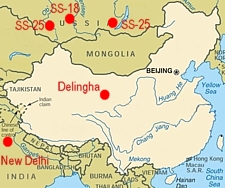
There are also reports that Second Artillery Corps has upgraded its missiles in the Western region by replacing old Dong Feng -3 missiles with intermediate range Dong Feng-21 ballistic missiles. Further with its centrally located missile base at Delingha it can target the Indian capital. And with its new improved logistics infrastructure, especially the railway network in place, the DF-21 missiles from Delingha and elsewhere can be inducted into the central and southern Tibet in a shorter span of time.

It has also been reported that underground missile silos/sites have been constructed in the Tibetan plateau that can strike targets further afield in India or for that matter even into the Indian Ocean. Reports suggest that a modified DF-21 has been converted into an Anti-Ship Ballistic Missile and it has reached an advanced stage of operationalisation. The short range missiles of 200-600 Kms could also be easily moved by road and deployed near the Indian borders to target India’s military and civil installations and other vital areas and vital points.

Added to the above is PLA’s stress on its doctrine of fighting Local Wars under informationalised’ Conditions; this concept was first articulated in China’s National Defence White Paper of 2004. Thereafter, PLA has laid solid foundations for fighting information and cyber wars. Thus, before any physical operations take place it would be the information and cyber domains which would be used to cripple the adversary’s capabilities. PLA’s expanding capabilities in the use of space for military purposes provides it with the means to enhance its command and control, intelligence, surveillance, reconnaissance, information and cyber warfare capabilities.

The PLA formations in Tibet have been provided with additional fire power, precision and long range capabilities. Their organisational structures have also been streamlined.

Further, the PLA has understood that their strategy of active defence depends largely upon achieving a high level of joint capabilities. Their concept of War Zone Campaign aims at the use of “elite and sharp arms” (special operations troops and their wherewithal) to be inserted behind enemy lines and seizing important ground to make a political statement (gaining initiative by striking first remains the essential lynchpin of its active defence strategy). If political objectives are achieved, then the forces are withdrawn, otherwise a quick battle is to be fought to force a quick resolution.

WZC is likely to be conducted at an intermediate level between the theatre and operational levels. It would be a joint and integrated campaign conducted under joint HQs with support from the Military Regions. At some level, WZC which involves the use of rapid reaction forces (RRF) can be compared with our “cold start doctrine” which aims at achieving allotted mission in a short span of time with Integrated Battle Groups. Both concepts are greatly dependent upon ushering in elements of the RMA and the practice of a high level of jointmanship.

What needs to be noticed is that PLA is sharpening its claws in Tibet in concert with increasing number of incursions or so called ‘transgressions’ of PLA across the Line of Actual Control. This stance of assertive PLA in Tibet has been made possible by the massive build up of logistic structure in Tibet to include extensive railway network and over 58,000 kilometres of roads. The roads have been built up to Indian borders and have also penetrated Nepal. This would ensure smooth induction of the PLA troops in any contingency. Not only that, China has initiated diplomatic talks with Bhutan to come understanding with the tiny kingdom on the border issue. If the influence of China on Bhutan increases then it would open another avenue of approach to India in certain contingencies.
PLA’s rising capabilities combined with enhanced levels of jointness and integration in the PLA need to be looked at seriously by India’s politico-military decision-makers.

No doubt India has recently embarked on activating its old airfields along Sino-Indian border and the MOD has chalked out a plan for building extensive road net work and other infrastructure facilities but our record in implementing plans and projects has so far been very tardy.

Further, standards of integration and jointness in our armed forces leave much to be desired. Even though Naresh Chandra’s Task Force in their recent report has recommended the institution of the post of a Chairman Joint Chiefs of Staff, it nevertheless is a climb down from the Chief of Defence Staff recommended earlier by a Group of Ministers in 2001. HQ Integrated Defence Staff created for enhancing jointness and integration does not have adequate powers or wherewithal to enforce jointness or integration.

We also need to pay attention to increasing military assets in the space for enhancing our C4ISR capabilities. Surveillance and radar cover on our Northern borders is weak and needs augmentation at the earliest. And lastly, RMA in our armed forces has been proceeding at a glacial pace given the prevailing politico-bureaucratic environment. All this is leading to widening of the capability gap between the PLA and our armed forces. One thing which needs to be remembered is that weakness invites aggression.