Showing posts with label Muslims. Show all posts

Tuesday, September 4, 2012

The Justice System and the Secular State


Dr. M.N. Buch
Visiting Fellow, VIF


Gujarat has been touted around as a State steeped in communalism, with a government which is right wing, extremist Hindu, anti Muslim and totally communal in outlook. The Congress, on the other hand, projects itself as the party which is secular, pro-minority and, in particular, totally protective of the Muslims. The pro-Muslim secular stance of the Congress formed the main plank of its election campaign in the recent elections in Uttar Pradesh, the end result of which was that the Congress got only twenty-six seats in the State Legislative Assembly and trailed behind BJP to emerge as number four in the electoral race. By contrast in the allegedly communalised State of Gujarat the Mephistopheles of Indian politics, Narendra Modi gave tickets to and was able to have elected over a hundred Muslim candidates in local government elections. Anti Sikh riots took place all over the country in 1984 and at that time the Congress ruled at the Centre and in many other States in India. Not a single conviction has been obtained for these horrendous riots in which in Delhi alone three times more Sikhs were killed than the Muslims in Gujarat in 2002. The entire Hindu Pandit population of the Kashmir Valley was driven out and they became refugees in their own country. Not even one of the culprits of this ethnic cleansing has even been prosecuted, leave alone been convicted. The Pandits even today are either living in refugee camps or are scattered throughout the country. Neither the activists who claim secular credentials nor government has raised a finger to help these refugees.

In 1992-93 the worst rioting post Babri Masjid demolition occurred in Maharashtra, notably in Bombay city. The State was then under Congress rule. No one has been convicted for these riots and the Commission headed by Justice Shri B.N. Srikrishna gave a very categorical report, in which officers who failed in their duty were identified and named, but has been completely ignored by government. Both the Congress and NCP in their election manifestos promised to implement the recommendations of the Srikrishna Commission, but nothing has happened in this behalf despite the fact that it is a coalition of the Congress and NCP which is in power in Maharashtra.

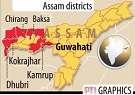
The latest in the series is the complete break-down of law and order in four districts of Assam, with Bodo tribals being in direct conflict with Muslims. Allegedly these Muslims are illegal migrants from Bangladesh whose presence is resented by the Bodos, which has resulted in direct ethnic conflict. Several hundred villages have been burnt down and lakhs of people displaced. There have been Bodo casualties also but, as happens in many communal conflicts, it is the Muslims who had suffered the most. Even the international community has taken note of what has happened in Assam, with unfavourable comments about how we have handled the situation. The Chief Minister of Assam, who is a Congress man, had at an early stage reacted to press reports that Assam was burning by stating that the media had exaggerated as usual and that only three districts were aflame. Considering the size and population of an Indian district the Chief Minister virtually confessed that an area containing a population of five to six million people was seriously affected and that he considered this as a fairly minor event. This could only be expected of a Chief Minister who, in order to win the election, had played the contrary communal card by ignoring the Muslims to win the Hindu votes which might otherwise have gone to the BJP. Can such a government be considered secular?

What about our friends from the Left? Undoubtedly the Left Front Government in West Bengal had a popular image of secularism, so much so that in 1984-85 the Sikhs as a community publicly honoured the then Chief Minister, Jyoti Basu, for ensuring security for the Sikhs and maintaining communal harmony. It is also a fact that West Bengal remained relatively free of Hindu-Muslim conflict during the Left Front rule. Towards the end this image had begun to change and that is because massive land acquisition in Nandigram largely affected Muslim cultivators and the Trinamool Congress was able to project this, at least partially, as the anti Muslim policy of the Left Front. The fact that this was not true is not really relevant in the electoral politics of the India of today. However, in Kerala the Left Front had no inhibition whatsoever in playing the communal card and when it suited LDF it allied itself with the Indian Union Muslim League. Surprisingly in a State in which the BJP has a poor political presence RSS is quite strong, partly because of communal Muslim politics¸ which is why there have been a number of communal clashes in Kerala, especially in the old Madras Presidency Malabar District (now divided into several districts). LDF did little to oppose such communalism, which does not speak well for its secular credentials.

Let us revert to Gujarat. No one can be an apologist for what happened in 2002 and in one letter to the Prime Minister I have said that had I been Governor of the State I would have strongly advised the Chief Minister and actually ordered the Chief Secretary and the Director General of Police to restore order immediately. I would have also gone around the State and if I saw any rioting I would have ordered my escort to fire on the mobs and disperse them. This would not have gone down well with the Government of India and would have probably resulted in my immediate removal, but nevertheless this is how I would have interpreted Article 154 of the Constitution which vests the executive power of the State in the Governor and also acted according to the oath sworn by me under Article 159 which required me to preserve, protect and defend the Constitution and the law. I would have seen it as my duty to remind the Chief Minister that the law required him to maintain law and order and I would certainly consider it a breakdown of the Constitution if the State itself became a party to lawlessness. At the same time it is equally a fact that neither in Delhi, nor in Maharashtra, nor in Assam, nor in Rajasthan during the recent conflict between Jats and Meos has any worthwhile judicial action been initiated and large-scale conviction of wrongdoers obtained. No doubt Nitish Kumar in Bihar, who is truly secular, has been able to take effective legal action. Otherwise Gujarat is the only State in India where six successful cases have been fought against the perpetrators of the 2002 riots and a large number of people have been convicted. This is as true of the Best Bakery case as it is of the Naroda Patiya case in which thirty-two persons, including an ex-minister, have been convicted. A great deal of credit must go the Supreme Court which has forced the Gujarat Government to act, has activated the Gujarat Police which bore the brunt of the investigation and set up an impartial Special Investigation Team (SIT) which has spearheaded the investigation. Everyone is considering the convictions as a set back to Narendra Modi. I disagree with this because the Gujarat Government has, however reluctantly, gone along with investigations, has not obstructed them, nor interfered with the course of justice. Even in the Sohrabuddin case, where the ex-Minister of State for Home, a DIG and other police officers are facing murder trials, the Gujarat Police has not destroyed the evidence and, therefore, the relevant SIT has been able to proceed with the investigation. The encouraging thing about Gujarat is that a largely Hindu Supreme Court, an overwhelmingly Hindu Gujarat Police and the SIT set up by the Supreme Court, Hindu judges such as Jyostna Yagnik have brought justice of the victims of the 2002 riots and convicted a large number of persons involved in these riots. So long as we have this example we can be assured that India has institutions which are secular, though unfortunately none of these are political. Real secularism requires the political class to also be on board.

How communal is Narendra Modi? To his opponents he is the communal devil incarnate, who is unrepentant about what happened in 2002, who refuses to apologise to the Muslims and whose ministers interfered with the maintenance of law and order during that crucial period. But is there another side to Modi? In the State of Gujarat in 2002 the whole of Saurashtra remained largely peaceful and the district administration and the police intervened strongly and effectively to keep the area peaceful. This was true of Kutch also. North Gujarat, mainly Sabarkantha and Banaskantha Districts, remained peaceful despite the substantial Muslim population there. The Central and Southern Districts of Gujarat, in particular Ahmedabad, Kheda, Baroda, Panchmahals, Bharuch and to some extent, Bulsar and Surat were the focus of rioting. This region has had communal conflict even during British days and the worst communal riots in the history of Gujarat occurred in 1969 in Ahmedabad when Hitendra Desai was the Chief Minister. I had written to Dr. Manmohan Singh when he became Prime Minister that the history of this part of Gujarat is such that regardless of which party in power, this region will remain prone to communal tension. I suggested that a person of the calibre of P.S. Appu, IAS should be asked to hold a free ranging administrative enquiry into the causes of communal unrest in these districts and to look into why the district administration and the police did not react strongly and positively to a communal situation. If the root cause of Hindu-Muslim animosity could be identified and then removed Gujarat would be peaceful. Narendra Modi was a phenomenon but he was not the cause of communal strife in these districts of Gujarat. The underlying cause is much older and deeper. The Prime Minister responded favourably but did nothing and, therefore, we still do not know why this region of Gujarat has Hindu-Muslim animosity.

Narendra Modi has not reached out to the Muslims as such, but he has kept RSS, VHP, BKS and the Bajrang Dal under strict control since 2002, which is one reason why rabble rousers such as Pravin Togadia dare not open their mouths in Gujarat. Since 2002 there have been no communal riots in Gujarat and whatever his detractors might say, Gujarat is a relatively corruption-free State with a service oriented, efficient government which has accelerated the pace of development. Whereas there is no special effort to bring the Muslims on board, Muslims have not been denied the fruits of development and many of them have prospered. Whereas the Muslims are hardly ever likely to forgive Narendra Modi for the 2002 riots there are many of them who believe that one must not remain in a period mourning for the past and must move forward to a new future. That is why paradoxically Gujarat is the one State with a BJP Government where at least some Muslims have participated in local government elections and a small section has even voted for Narendra Modi’s party. They certainly did not do so for Sonia Gandhi’s allegedly secular Congress in Uttar Pradesh.
Amongst so-called secular parties there is a mistaken notion that any secularism which is not pro Muslim loses votes. The vast majority of the people of India are Hindu and if a polarisation of their votes takes place in which the present fragmented Hindu votes become concentrated, can we ever keep extremist Hindu parties out of power? Therefore, India’s best bet is the politics of genuine secularism in which government follows policies which give equal opportunities to all communities, without singling out one for opprobrium and another for appeasement. Narendra Modi says that he does not speak for any community but is concerned only about the ‘asmita’ of five and a half crores Gujaratis. Is it not about time that political parties begin talking about the ‘asmita’ of 110 crores Indians without dividing them into religion, caste, class, or region?

The Bharat Ratna is an individual award given to individuals who have achieved high distinction and merit in the service of the country. The George Cross is the highest gallantry award during peace time for defence personnel and for civilians during war and peace, which the British can give. It is an individual award and is equivalent to the Ashok Chakra in India. However, because the people of the Island of Malta stood collectively with the British against the Germans in the Second World War and exhibited the highest degree of gallantry under massive bombardment, the Island of Malta was collectively given the George Cross. On this analogy the Supreme Court of India deserves the Bharat Ratna for the manner in which it has upheld, protected and enhanced the status of the Constitution of India and in particular the secular nature of this republic. My respectful submission to the President and to the Government of India would be that in the Republic Day awards to be announced on 26th January 2013 they may collectively award to the Supreme Court the Bharat Ratma as a token of gratitude of this nation for being the one pillar of the Constitution which has remained true to its salt. No greater tribute could be paid to what I consider the best Supreme Court in the whole world.

Monday, September 3, 2012

Violence in Bodo Areas: Issues and Options


Dr. N. Manoharan
Senior Fellow, VIF


Violence in Bodo areas is not a simple story of communal conflict between Bodos and non-Bodos, but is a complex issue with socio-cultural, economic, political and security dimensions.Clashes have erupted from time-to-time1 in the area, but the situation this time has reached a state where the number of killings has crossed 90. There is a displacement of about 400,000 people and its echo has been felt in other parts of India in terms of reverse flow of Northeasterners, triggered by rumours of reprisals. What factors were responsible for the present situation? Who were the actors involved? What were the major points of friction? What is the way ahead?

Land, language and livelihood have been the major elements of Bodos’ grievances that caused the community to agitate. Desire for political power came later, although the aspiration was basically to realise their core socio-economic demands. The Bodo movement in its long history “has had several forms moving gradually towards the demand for a separate state” and even a sovereign “Bodoland”. The entire movement can be broadly divided into six phases: Colonial, 1947-67, 1967-87, 1987-1993, 1993-2003 and post-2003. In each phase, the Bodos gradually advanced their socio-economic and political aspirations, but not without facing proportionate challenges in the form of resistance from other competing groups in the area, or lethargy of the state or even division within its own community. From the mid-1980s armed component to the movement took shape. Militant groups like Bodo Liberation Tigers (BLT) and National Democratic Front of Bodoland (NDFB) came to the fore. Since the 1993 signing of BAC Accord and later 2003 BTC Accord, there were concerted efforts made by the Bodos to “prove right of the autochthonous over the land” what they called “Bodoland”. They first turned to “illegal Bangladeshi immigrants” and then to Adivasis. The resultant violence and counter-violence led to large-scale killings and displacement.

To take a snapshot of present cycle of violence, the events leading to July riots was triggered by a 24-hour bandh called by All Bodoland Minority Students’ Union (ABMSU) on 29 May 2012 to protest against the alleged removal of a signboard by cadres of the ex-Bodo Liberation Tigers (BLT) from a piece of land in the Badlangmari area that had been allocated for a mosque. The bandh turned violent injuring 13 persons. The momentum of violence, however, started with the killing of two members of All Bodoland Minority Students Union (ABMSU) allegedly by Bodo gunmen at Anthihara in Kokrajhar on 06 July 2012 and on 19 July, two more people were killed in Magurmari in Kokrajhar. In retaliation, on 20 July, four former BLT cadres were killed. Violence intensified since then and went out of proportion for the local police to be able to control. It subsided only when the Army was called in.

The challenge to crafting a way ahead is can the grievances of Bodos – safeguarding their culture and improving their economic conditions – be met without a separate state of Bodoland and without compromising the interests of other ethno-religious groups living in the so called Bodo areas? The answer lies in looking at the issue in a comprehensive, rather than segmented manner. The following six broad measures can be considered:

Timely Action: Analyzing all previous incidents of violence in the Bodo areas, it is clear that as and when the security apparatus missed taking note of symptoms of unrest and failed to take appropriate proactive action, the situation got out of control. The state police and Intelligence should have woken up by March 2012 itself when Bodos started commemorating 25 years of their “struggle”. Similar symbolisms and assertions were bound to be displayed by non-Bodo groups, especially Muslims and Adivasis. The manifestation of such assertions by competing groups was always through violence. This should be understood. Signs of imminent clashes were simmering since May, but were not taken seriously by the government. Nipping the problem at the bud would have averted indiscriminate violence and resulting killings and displacement.

Political Settlement: There is no point in going for a fresh accord. The failure of Bodo Autonomous Council (BAC) of 1993 and Bodo Territorial Council (BTC) of 2003 clearly shows the problem was more with the implementation and less with the provisions per se. It is vital, therefore, to fix the present BTC accord without any ambiguities and implement it in full. It was the ambiguities in the previous two Accords that led to lot of misunderstandings, opportunistic interpretations and confusions. Yet full and timely implementation would have averted many issues. The future amendment and implementation of the Accord is such that the provisions should satisfy both Bodos and non-Bodos in unequivocal terms. It should be realised that any success of the Accord lies also in cooperation between Bodos and non-Bodos.

Armed Groups: Armed groups representing Bodos and non-Bodos have to be tackled through appropriate means, either through political or military means or a mix of both. As long as they remain armed and active, insecurity and the consequent trust deficit would linger on. It would not suffice to prevail only on those groups that have not entered into ceasefire, but on all groups that have access to weapons and are motivated to kill.

Reconciliation: There is a significant gap between the present ground reality in the Bodo areas and the romance of Bodoland. It is important to bridge this gap. The political leadership should rise to the occasion in convincing the respective communities to see the things as they are and look ahead, instead of exploiting the situation to gain electoral mileage. Appropriate confidence-building measures and reconciliation among the concerned communities – Bodos, Mulsims, and Adivasis – are crucial.


Illegal Migration: It is also important to find a lasting solution to the issue of illegal immigration from Bangladesh. Despite the enormity of the issue, the response in stemming the flow of migrants from neighbouring Bangladesh has been grossly inadequate. The entire stretch of 4,096-km India-Bangladesh border is heavily populated, making monitoring extremely difficult. Fencing has to a large extent been acting as an obstacle, but only 2,760.12 km have been fenced so far.2 The remaining stretch should be fenced at the earliest, complimented with floodlights and hi-tech surveillance devices. Most importantly, existing border has to be demarcated at the earliest to make them free of ‘enclaves’ and ‘adverse positions’; much of the activities take place in these undemarcated areas. Although the Border Security Force (BSF), in charge of policing the border, has been doing its job creditably, the force levels are not sufficient to monitor the long and difficult border. Apart from raising new battalions, it is important not to divert the BSF for duties other than border management. They also have to be equipped legally to handle situations at borders that include not only illegal migration, but also smuggling, drug-trafficking, counterfeit currency, and militant movements. Apart from creating physical hurdles, it is also important to discourage illegal migrants through suitable deterrent legislation. Till recently, illegal migrants in Assam were handled by Illegal Migration (Determination by Tribunals) Act, 1983, that was held as unconstitutional by the Supreme Court in 2005 as it was “coming to the advantage of such illegal migrants as any proceedings initiated against them almost entirely ends in their favour, enables them to have a document having official sanctity to the effect that they are not illegal migrants.”3 An exclusive refugee/migration law is long pending. It is also vital to hasten the present plan of issuing multi-purpose identity cards, at least to curb further illegal migration. At some pockets, issue of temporary work permits can be considered so that Bangladeshis can come, work and go back. At the macro level, India should help in the overall economic development and prosperity of Bangladesh so that its citizens need not to go elsewhere for their livelihood.

Refugee Camps: Relief camps housing internally displaced requires due attention. All three broad categories of communities – Bodos, Muslims, Adivasis – are housed in various camps. Some of the camps have been in existence since 1993, as inmates could not return to their homes fearing violence. Because of overcrowding there is persistent lack of food, water, accommodation, medical attention, and sanitation. These concerns should be addressed urgently. Apart from making the living conditions of the internally displaced in relief camps better, the government should make sure that the displaced are rehabilitated at the earliest. Else relief camps would turn into breeding grounds for new militants.

Thursday, July 26, 2012

Religion Based Reservation is Anti-Constitution - II


Prof. Makkhan Lal
Senior Fellow, VIF

Among the political parties, who treat Muslims as a vote-bank, the clamour for the reservations for Muslims is increasing every day. Every time elections, be it of a State Assembly or the Parliament, approach the pitch for reservation for Muslims increases. Recently held Assembly election in Uttar Pradesh which has sizable presence of Muslims population, is an example. Various political parties promised from 9% reservations 18% reservations for the Muslims in Government jobs and educational institutions. It is ironical that Prime Minister of India should declare from the Rampart of the Lal Qila on 15th August 2007 that “Muslims have the first right on the resources of the country.” This is the mental makeup of the Prime Minister and the largest political party which claims the legacy of the Freedom movement, then what can be said about smaller leaders and the parties. The Congress leaders, freedom fighters, the Constituent Assembly and Jawaharlal Nehru had given enough thought on the issue and felt that reservation of any kind will be detrimental for the development of the nation and a cohesive society.

These leaders often quote Justice Ranganath Mishra Commission and Justice Sachar Committee Reports for such reservations for Muslims. This is despite the fact that Muslims are enjoying the benefits of reservation having been included in various states lists for the OBC/BC/SC and ST; despite the fact that Islam or Christianity denies existence of caste system within its fold.

Several times in the past separate reservations enacted in the name of religious denominations have been struck down by courts and the latest is the judgement delivered by Andhra Pradesh High Court declaring 4.5% sub-quota for the Muslims within 27% quota for the OBCs as unconstitutional. Predictably, the Central Government appealed for a stay of Andhra Pradesh High Court’s judgement. After hearing the matter argued by the Attorney General of India the Hon’ble Supreme Court declined to stay Andhra Pradesh High Court’s judgement and indeed made indicting comments on the Government that there is no rationale and justification for 4.5% sub-reservation for the Muslims within the 27% quota for the OBCs. . The Supreme Court criticized the government for the way it had handled the "complex" and "sensitive" issue. The apex court had also expressed its "unhappiness" that the Centre was blaming the High Court when it had itself failed to produce documents to support its case.

Justice Ranganath Mishra Commission

A ‘National Commission for Religious and Linguistic Minorities’ was set up by the Government of India in October 2004 under the Chairmanship of Justice Ranganath Mishra t. Other members were Prof. Tahir Mahmood (Muslim), Dr. Anil Wilson (Christian), Dr. Mohinder Singh (Sikh) and Mrs. Asha Das (SC and a former IAS officer) as Member Secretary. The Commission submitted its report in May 2007.

The terms of reference of the Commission were:

1. To suggest criteria for identification of socially and economically backward sections among religious and linguistic minorities;

2. To recommend measures for welfare of socially and economically backward sections and among religious and linguistic minorities, including reservation in education and government employment; and

3.  To suggest necessary constitutional, legal and administrative modalities required for the implementation of its recommendations.
However, subsequently following point was also added to the above terms of reference:

“To give its recommendations on the issues raised in writ petitions 189/04 and 94/05 filed in Supreme Court and in certain High Courts, relating to para 3 of the Constitution (Scheduled Castes) Order 1950 in the context of ceiling of 50 per cent on reservations as also the modalities of inclusion in the list of scheduled Castes.”

The Commission lists following communities as recognized minorities: Muslims, Christians, Sikhs, Buddhists, Jains and Parsi. Accepting the Hon’ble Supreme Court Judgement in TMA Pai Foundations and others Vs State of Karnataka and others the Commission says that “for the purpose of Article 30 a minority, whether linguistic or religious, is determinable with reference to a state and not by taking into consideration the population of the country as a whole.”

The Commission took the trouble of going through the economic, education and employment opportunities for all the people of India on the basis of religious denominations and to its dismay it found that by-and-large no substantial gaps exists among the various communities/religious groups – be it Hindus, Muslims or Christians. They are all suffering same level of disadvantages or having almost the same level of opportunities. In fact, in many aspects minorities and especially Muslims and Christians are doing much better. After discussing various issues like education, poverty, employment opportunities, caste and social status, and the various measures undertaken for the upliftment of disadvantaged groups, the Commission expresses it complete disillusionment with the existing system of reservation. It concluded as follows:

1. The inclusion of an entire caste, tribe or class in the list, is contrary to the principle of social justice. No 'caste’, or class or tribe suffer from social, economic and educational deprivations as a whole. Class or caste or tribe as a criterion identifying the socio-economic backward has become totally irrelevant. The only option is to identify families that are socially and economically backward and devise criteria that are implementable. (Chapter 6, para 40),

2.  The lack of a system to regularly assess the impact on castes, tribes or classes enlisted of schemes and programme under implementation, to exclude categories either wrongly included in the list or no longer being eligible, has further complicated the situation. Non-exclusion of the ineligible has marginalised the poorest and most backward amongst various categories including the minorities. (Chapter 6, Para 41)

3. Religion or castes do not determine 'socio-economic backwardness. Poverty is not religion or caste based and the socially, economically backward should be identified on uniformity applicable criterion throughout the country irrespective of caste, creed / religion affirmatives’. (Chapter 6, Para 42)

4. The poorest of the poor families should get opportunities for advancement. Those falling in the creamy layer category should be excluded from the lists of backwards. Family-wise data should be collected and treated as valid for at least ten years and renewed periodically. Benefits of reservations should be made time-bound and for one generation only. (Chapter 6, Para 45 to 49)

5. All lists (SC/ST/OBC) have been prepared without any scientific basis (no data base as no surveys were undertaken). (Chapter 6, para 65)

6. Since BPL (below poverty line) lists are prepared on the basis of social/educational and economic criteria, they are more scientific. They are also revised periodically. BPL lists should, therefore, be made eligible for grant of reservation without distinction on caste, class, groups or religion basis.” (Chapter 10, Para13)

However, all good intension end here. When it came for suggesting concrete steps for a fair reservation system Commission not only failed in recommending any such measure but also to make the matter worse it jumped into the same rotten system, for the inclusion of Minorities also in the categories of OBC/BC/SC/ST. The recommendations read like a charter of demands on behalf of Muslims rather than a Commission’s report on all religious and linguistic minorities of India which also include Christians, Buddhists, Sikhs, and Zoroastrians and so on. It says:

“We recommend that in the matter of criteria for identifying backward classes there should be absolutely no discrimination whatsoever between the majority community and the minorities; and, therefore, the criteria now applied for this purpose to the majority community whatever that criteria may be - must be unreservedly applied also to all the minorities…. “To be more specific we recommend that all those social and vocational groups among the minorities who but for their religious identity would have been covered by the present net of Scheduled Castes should be unquestionably treated as socially backward, irrespective of whether the religion of those other communities recognises the caste system or not…. that the caste system should be recognised as a general social characteristic of the Indian society as a whole, without questioning whether the philosophy and teachings of any particular religion recognise it or not… (Chapter 10, Paras 5-16)

Unbelievable, as it may sound, the Commission Members totally forgot that reservations for SC/ST come into force because of the peculiar social-system and religious practices of Hindu society. They forget that it is this cast system for which Hindu society is constantly berated at political, intellectual, social, religious and academic platforms. Can the Islam and Christianity accept that in their social and religious practices they are same as their fellow Hindus? Are they willing to accept that caste system exists in the Islam and Christianity as a part of religious and social tenets?

The Member-Secretary very rightly questioned the wisdom of the Commission regarding the existence of caste system in the Islam and Christianity and submitted a 13 pages Note of Dissent. The Commission had no cogent reply to this note of dissent.

Sachar Committee Report

Justice Ranganath Mishra Commission report perhaps fell short of Government’s expectations, at least from the point of view of enhancing Muslims’ tilt toward the Congress. The Government of the day started looking for some other avenues for catering to the Muslims alone. Justice Rajinder Sachar Committee, appointed on 9th March 2005, filled this space. What was missing in the report of Mishra Commision, Sachar Committee compensated that in ample – reservation in the legislature and elected/political bodies.

Sachar Committee was ostensibly appointed by the UPA Government to look into the matters concerning “Social, Economic and Educational Status of the Muslim Community”. The subject matter itself shows as if the social, economic and educational problems in the other communities and among the followers of other religions in India do not exist. If that is not the case, then it can be safely said that even if the social, economic and educational problems do exist in other communities and amongst the followers of other religions in India, they do not merit any attention because they do not form a vote-bank or they do not form a “very strong, well knit and well-organized minority… that could force the partition of the country.”1 Be it as it may.

However, while going through Sachar Committee report, one can see that it is not only full of inaccurate data but also in many areas it dwells in the realm of fantasy. A large number of problems and deprivations that are being faced by most of the Indians, irrespective of caste, creed and religion, have been presented as those of Muslims’ alone. Many of the problems discussed in the report have nothing to do with the polity, government and the economic condition. They emanate directly from the social customs and the religious beliefs. It is impossible to believe that Justice Sachar and his learned colleagues are unaware of this aspect of the problem. They have simply ignored it. The entire report reads like compilation of reasonable and unreasonable complaints, grievances and demands of Muslims since independence.

One can reasonably expect that many people will continue to discuss various aspects of this report for sometimes to come. Our purpose is limited; only to discuss the insinuating statement concerning the ‘political participation of the Muslims’ and the recommendations that the report has made in the matter. The notification of the Government of India certainly had not mandated the Committee to go into political matters. But it still has gone into it. What is most shocking is that it has suggested the very same remedy which was based on two-nation theory that finally led to the unprecedented human miseries, both for the Hindus and Muslims, and partition of the country. The Committee has recommended reservations in the legislature and in the other elected bodies besides having reservations in the services, educational institutions and public and private sectors.

These recommendations though discussed and contained in just two paragraphs of the report, become significant in the light of explanations given by Abusaleh Shariff, Member Secretary in the Sachar Committee. Mr. Shariff writes:

“It is a cruel irony that the development process by passed in particular Muslims who stayed back in India after the partition – those from Uttar Pradesh, Bihar and West Bengal.

The root cause of this neglect is lack of political empowerment. While the Constitution and the democratic framework allowed Muslims to maintain their identity and profess their faith, their representation in political system has suffered. This impacted their participation in governance.”

After this the Mr. Shariff talks about the population ratio in terms of Muslims belonging to the OBC, SC and ST categories. This is nothing less than a revelation that among the Muslims there exists caste system which discriminated them socially within the realm of Islam. Mr. Shariff now gives the solution of the problem:

“However, problems of Muslim deprivation cannot be addressed adequately through extension and implementation of reservations alone. OBC reservations apply only to public employment and now at higher levels of education. With the report detailing the nature of discrimination against Muslim, the challenge before Government, political class, private sector and civil society is to create institutional mechanism t ensure the delivery of essential public goods.

“To begin with, Muslims should be represented in political bodies, policy-making agencies, administration and law-enforcement agencies in relation to their share in the population.”

Reservation and the Constituent Assembly

The question of reservation in the services and in the elected bodies for the religious minorities was considered and discussed in detail by the Constituent Assembly. It constituted an Advisory Committee of 43 eminent political and religious leaders and social workers. The Committee was headed by was Shri S.C. Mookerjee, a Christian. Some of the Members were Maulana Abul Kalam Azad, Khan Abdul Samad Khan, Hifzur Rehman, Syed Ali Zaheer, Abdul Quiyum Ansari, Chaudhari Khaliquzzam, Saiyid Jafar Imam, Haji Abdul Sathar, Haji Isaq Seth. Jawaharlal Nehru, and Sardar Patel, Rajendra Prasad and B.R. Ambedakar (for the speeches of some of the leaders see earlier article on reservation on VIF web site - Reservation Based on Religion is Anti-Constitution).

However, the recommendations of the Advisory Committee were taken up for the discussion in the Constituent Assembly on 27 and 28 August 1948 and then again for two days, 25 and 26 May 1949. While submitting its recommendations to the Constituent Assembly the Committee reported:

“The Committee considering the whole situation came to the conclusion that the time has come, when the vast majority of the minority communities have themselves realised after great reflection the evil effects in the past of such reservation on the minorities themselves, that the reservations should be dropped.”

The recommendations as adopted by the Assembly were included in the Draft Constitution. In nutshell the committee recommended that:

“It was no longer appropriate in the context of free India and of present conditions that there should be reservation of seats for Muslims, Christians, Sikhs or any other religious minority. Although the abolition of separate electorates had removed much of the poison from the body politic, the reservation of seats for religious communities, it was felt, did lead to a certain degree of separatism and was to that extent contrary to the conception of secular democratic State."

On the issue of reservation in public services it was recommended that there shall be no reservation in the public services and competitive services except for the Scheduled Castes and Scheduled Tribes.

The Constituent Assembly debates (Vol. V) on the issue of religion based reservation is an eye opener. Most of the Muslim leaders like Z.H. Lari, Naziruddin Ahmad, Begum Aizaz Rasul, Muhammad Ismail Khan, Tajmul Hussain, Maulan Hasrat Mohani, and Col. B.H. Zaidi, who spoke on the occasion said in one voice that reservation on the basis of religion has been responsible for the division of country and is certainly an evil. They opposed any kind of reservation for Muslims just because they happen to be Muslims and have been enjoying reservation since 1906.

Jawaharlal Nehru speaking on 26th May 1949 in the Constituent Assembly on the issue of reservation based on religion said:

“Where you are up against a full- blooded democracy, if you seek to give safeguards to minority, and a relatively small minority, you isolate it. May be you protect it to a slight extent, but at what cost? At the cost of isolating it and keeping it away from the main current in which the majority is going, – I am talking on the political plane of course – at the cost of forfeiting that inner sympathy and fellow-feeling with the majority. … It is a bad thing for any small group or minority to make it appear to the world and to the majority that "we wish to keep apart from you, that we do not trust you, that we look to ourselves and that therefore we want safeguards and other things". The result is that they may get one anna in the rupee of protection at the cost of the remaining fifteen annas.”

Later, on the issue of any kind of reservations in general Jawaharlal Nehru wrote to all the Chief Ministers on 27 June 1961:

“I have referred above to efficiency and to our getting out of our traditional ruts. This necessitates our getting out of the old habits of reservations and particular privileges being given to this caste or that group. The recent meeting we held here, at which the Chief Ministers were present, to consider national integration, laid down that help should be given on economic considerations and not on caste. It is true that we are tied up with certain rules and conventions about helping the scheduled castes and tribes. They deserve help but, even so I dislike any kind of reservation, more particularly in Services. I react strongly against anything which leads to inefficiency and second-rate standards. I want my country to be a first class country in everything. The moment we encourage the second-rate, we are lost.

“The only real way to help a backward group is to give opportunities of good education; this includes technical education which is becoming more and more important. Everything else is provision of some kind of crutches which do not add to the strength or health of the body. We have made recently two decisions which are very important: one is, universal free elementary education, that is the base; and the second is scholarships on a very wide scale at every grade of education to the bright boys and girls, and this applies not merely to the literary education, but, much more so, to technical, scientific and medical training. I lay stress on the bright and able boys and girls because it is only they who will raise our standards. I have no doubt that there is a vast reservoir of potential talent in this country if only we can give it opportunity.

“But if we go in for reservations on communal and caste basis, we swamp the bright and able people and remain second-rate or third-rate. I am grieved to learn how far this business of reservation has gone based on communal considerations. It has amazed me to learn that even promotions are based some times on communal or caste considerations. This way lays not only folly, but disaster. Let us help the backward groups by all means, but never at the cost of efficiency. How are we going to build the public sector or indeed any sector with second rate-people?”


Thursday, July 12, 2012

Religion, Caste, Regionalism and Politics in India


Dr. M.N. Buch
Visiting Fellow, VIF

When Guru Govind Singh, the Tenth Guru, ruled that he would be the last human guru and the Guru Granth Sahib itself would be the eternal Living Guru, he said that in case of any doubt search within the Shabad, or the Guru Granth Sahib and all doubts would be resolved. To me the Constitution of India is the Shabad and when I have any doubt I go back to the Constitution and it speaks loud and clear to me. The whole Constitution is designed to make India a secular republic in which there is justice, liberty, equality and fraternity for all, in which there is total equality before law and in which the dignity of the individual is of paramount importance. The Constitution, in order to promote equality, abolishes untouchability through Article 17 and through Article 18 it abolishes titles. Regardless of birth and circumstance all Indians are equal and in this there is no room for differentiation on account of religion, caste, class, region or any other factor which divides man from man.

How are we governed? India is a Union of States and the bounds between the Union, or the Centre and the States are prescribed by the Seventh Schedule of the Constitution which gives the exclusive jurisdiction of Parliament and of the State Legislatures within their respective domains and the concurrent jurisdiction for both regarding those items which fall within the Concurrent List. Within the framework of the States by the 73rd and 74th Amendments of the Constitution have been constituted rural and urban local bodies, which form the third tier of government. The Preamble makes India a democratic republic and government at all levels is to be conducted by democratically elected people who will then elect the Council of Ministers in the Centre and the States and will constitute the village or town council, as the case may be. The execution and implementation of decisions of the elected representatives of the people would be done by officers appointed by the President or the Governor, as the case may be and they, too, will function independently as per the Rules of Business under Article 77 in the case of the Government of India and Article 166 framed for the Government of a State. Every Indian above the age of eighteen is entitled to be included in the electoral roll and cannot be excluded on grounds of religion, race, caste, sex or any of them under Article 325. There will be a single electoral roll and the Constitution specifically prohibits the preparation of a special electoral roll. Under Article 326 election to the House of the People of Parliament and the Legislative Assemblies of States is to be on the basis of adult franchise, which is universal. The Constitution specifically prohibits any discrimination on any grounds whatsoever in the matter of elections, which are the very basis for the formation of government. From this one can infer that the theme of the Constitution is that we move towards a casteless, classless, secular society in which neither religion, nor sex, nor domicile will in any way influence or determine the course of elections.

Having said this one would also have to look at the ground reality. The State of Karnataka has two dominant castes, the lingayats and the vokkaligars. Deve Gowda, former Prime Minister and Sadanand Gowda, the outgoing Chief Minister of Karnataka are vokkaligars, BSR Yeddiyurappa, on the other hand, is a lingayat. Yeddiyurappa had to resign as Chief Minister because he was arrested in a case of corruption and is even now facing investigation on charges of corruption framed by the Supreme Court of India. When he was removed from office, virtually kicking and screaming, he insisted that Sadanand Gowda be made Chief Minister. The BJP national leadership conceded this demand. Thereafter Yeddiyurappa wanted to return to office and when this was not allowed he sulked and instigated a revolt in BJP. Instead of expelling him BJP once again succumbed to his demand that Sadanad Gowda should be removed and Jagadish Shettar, a lingayat be made Chief Minster. The top leadership of BJP again gave in and Gowda is out and Shettar is in. Neither the merit of Gowda nor of Shettar has been the determinant of who should be Chief Minister. What has triumphed is caste equations. One can now look forward to a vokkaligar revolt. What happens to good government in Karnataka is one one’s concern.

Let us move to Uttar Pradesh and the elections held earlier this year. This is one State, in population India’s largest State, where caste has been the determinant of electoral politics and equations. The Samajwadi Party has Yadavs, Gujjars and Ahirs as its solid vote base. The BJP and the Congress are considered upper caste parties, though Mayawati and BSP did play the spoiler by deliberately giving seats in substantial numbers to the Brahmins and Rajputs. The fairly sizable population of Muslims in Uttar Pradesh was wooed by the Congress and the Samajwadi Party. The Congress has always looked upon the Muslims as creatures of its own backyard, whose votes could be taken for granted. However, there is such total disillusionment with the Congress among the Muslims that in Uttar Pradesh they have substantially drifted towards the Samajwadi Party and in Bihar towards the Janata Dal (United). The Congress has been left high and dry. That the Congress is quite happy to play the religious card is proved by the fact that during the entire election campaign Rahul Gandhi was paraded in the Muslim dominated areas sporting an emerging beard of a fortnight’s growth which gradually thickened as the days passed. If a beard makes one a Muslim, then many of the Syrian Orthodox priests of Kerala and people such as Acharya Giriraj Kishore would win hands down because their beards compete with the best that a Mullah can sport. Crocodile tears over the Batala House encounter, false promises about what Congress will do for the Muslims failed because the Muslim refuses to be considered part of a homogenous group whose only desire is to be appealed to as a Muslim. He refuses to be a vote bank which can be taken for granted. He is an Indian, a human being and an individual and wants to be treated as such.

The Indian Muslim of 2012 is not the same person as the Muslim of 1947. Because India is secular and because its leadership, by and large, is committed to secularism, the majority of Indian Muslims has voted with their feet to be Indians and have refused to migrate to Pakistan. In population India is the second largest Islamic country in the world after Indonesia. The Muslim population is so large that it cannot really be called a minority and the Muslim is asserting his rights in the same manner as any other citizen of India. He wants security, justice, equality of opportunity, he wants his children to be educated, he wants his cut of the development pie and he wants a share of power. These are the legitimate aspirations of every Indian and any party which fails to recognise this has no business to be in the game of politics in India. This lesson the Congress has not learnt and it will never learn. Even Gujarat, whose name is anathema of all our neoliberals, has reached the stage where many Muslims are prepared to move forward from the horrors of 2002, because the results of purposive government has been that the Muslims are now beginning to feel physically secure and certainly they are not left untouched by the economic development of that State. Paradoxically, the very State which conjures up vision of the horrors of 2002 is also the State where about 150 Muslims were elected on a BJP ticket in the local government elections. In Gujarat the Muslim community is moving forward in the matter of education and economic development. A secular party such as the Congress can surely do much more than this. It can prove that it no longer thinks of the Muslims as a collective vote bank and instead desires to move forward to treat the Muslims as individual citizens whose support it seeks.

What is preventing this? It is Congress which set up the Sachar Committee, whose mandate was to look at the position of the minorities in India. But the said committee ended up with only looking at the position of Muslims. The committee has remarked that in the matter of education, employment, holding of political office and economic development the Muslim is far behind the Hindu and that he needs special assistance to be able to catch up. The tenor of the report is that government and the majority community have both discriminated against Muslims, denied them equal opportunity in the matter of education and employment and, therefore, the Muslim is virtually a second class citizen in India. Justice Rajinder Sachar never really asked the question, “Why are the Muslims backward?” The Committee’s report itself states that compared to the majority community the level of education amongst Muslims is low. In every State of India the female literacy rate of Muslims is lower than the average of female literacy in that State. Fewer Muslim girls go to school than, for example, Hindu or Christian girls. Even when we were in the throes of the horrors of partition, no one in India had said that Muslim children, especially girls, should not be educated. Because there was no legal compulsion to educate, because India had no Truancy Act whereby absence from school could invite a penalty for the parents, school enrolment of Muslims, especially girls, definitely lagged behind the admission rate for other communities. Naturally Muslims lag behind other communities in the matter of higher and technical education also and this directly affects their employment profile because so many of them are unemployable. This has to be corrected very fast if Muslims are to keep on par with other communities. Certainly reservation in jobs will not give the desired results because the few Muslims who are already educated would monopolise jobs, leaving the needy in the community high and dry.
The parties which call themselves secular, the Congress, Samajwadi Party, Trinamool Congress, etc., should have launched a campaign for bringing Muslim children to school and ensuring that they completed their education. An educated person cannot be denied employment because if India cannot employ him or her, jobs would be found somewhere else in the world. From 1923 the Madras Presidency, which included Tamil Nadu, Andhra Pradesh minus Telangana and Hyderabad, Malabar District in Kerala and Mangalore in Karnataka, had a reservation policy which virtually denied Brahmins an entry into higher education and government jobs. There was no Sachar Committee to look at the plight of the Brahmins, but the community collectively decided that regardless of what happened to the then current generation, the children would be educated. Denied admission in Tamil Nadu they migrated in large numbers to wherever they could be admitted in India. Universities in Madhya Pradesh, Maharashtra, Uttar Pradesh were flooded with Tamil students and today children of the community virtually rule Silicon Valley in the United States of America. The way to eliminate religion as a determinant of politics is to make the Muslims take the educational path to progress and instead of appealing to narrow religious sentiments the parties which seek power should persuade backward communities like the Muslims take advantage of what the education system has to offer. In the long run this would pay rich dividends to the community, the country and our political parties.
The use of religion, caste and class as a political weapon is potentially fraught with danger. When differences are highlighted base passions are ignited and caste wars in India are endemic. The result of the caste divide in Bihar was utter lawlessness in the State and this has pushed Bihar’s progress back by half a century. Nitish Kumar’s greatest achievement is that he is able to cut through caste barriers and has launched Bihar on a development path which unites rather than divides. The significant improvement in law and order in Bihar is not necessarily because of better policing but because of more impartial policing and the Chief Minister’s efforts to put development above caste considerations.

The most dangerous form of divisiveness is religion. The post Godhra riots in Gujarat in 2002 were by no means the worst in that State’s history. The 1969 riots lasted longer and took a larger toll of life. Maharashtra, especially the city of Bombay, has experienced some of the bloodiest communal riots in India, almost all of them under a Congress regime. What set the Gujarat riots apart is the allegation of State patronage of the riots. This has not been proved and at least in North Gujarat and Saurashtra either there were no riots or the district administration acted firmly and promptly to nip the trouble in the bud. In Central and South Gujarat, on the other hand, there was a real communal divide and there the riots were more prolonged. The fact that since 2002 there have been no major riots in Gujarat shows that the Chief Minister has since encouraged effective law enforcement and that the 2002 riots were an unfortunate episode which is being blown out of proportion. However, the fact remains that in Central and South Gujarat there is a Hindu-Muslim divide and that is the principal cause of riots in that part of the State. The lesson to us is that if the divide continues it is inevitable that violence will occur. Why blame the Muslim League and Jinnah for partition of the country when right from Gram Panchayat up to Parliament all our politicians are busy playing the game of setting caste against caste, religion against religion, all for the sake of a few votes. The Indian State is capable of containing and eliminating separatist movements, terrorism, militancy and even violent Naxalism. It is not these factors which will destroy India. It is the politics of divisiveness, religion, caste, class, regionalism which is posing the real danger to the integrity of our nation. If the political parties decide to fight elections on the basis of ideology, programmes and plans instead of flaunting the caste and religious factors, most of the problems of India will disappear and certainly the country will no longer be split apart by religion, caste, class, or region.

How deeply is caste entrenched? In the upcoming presidential election one candidate, P.A. Sangma, is projecting himself as a tribal, a Christian and a North Easterner. The BJP is doing the same for Sangma. There is not a word about how as Chief Minister of Meghalaya, as an Union Minister and Speaker of the Lok Sabha Sangma put in a sterling performance which is no less than that of Pranab Mukherji. Ethnicity in this case rather than caste, minority status as a Christian and the regional appeal of the North East are the dominant factors in the election campaign. Does this promote equality, secularism and rational politics? The whole campaign for reservation for other backward classes, which is a thinly disguised cover for intermediate castes, is directly aimed at further entrenching the caste system in our psyche. When we take a highly competitive examination like the Civil Services Examination, ultimately the selection is of fifty percent of those who are neither SC, nor ST, nor OBC. The general category, therefore, becomes another caste. The OBCs are resented by SC and ST people because reservation for OBCs cuts into their own employment opportunities. To this witch’s brew we now want to add reservation for Muslims. There is already a demand from Christian groups that members of the SC who lost their status on conversion to Christianity should be recognised as Christian dalits and given all the concessions available to a scheduled caste, notwithstanding the fact that caste is a function of the Hindu religion and does not apply to any other religion.

They say that a house divided cannot stand. Our politicians are using a sledge hammer, a battering ram to cause our house to splinter so that the whole nation gets divided and sub-divided between religion, caste and region. Let us not discount regionalism because it is this which has led the movements such as those for Vidarbha, Telangana, Bodoland, Gurkhaland, separatism as in Kashmir and other forms of violent militancy in different parts of the country. Such fissiparous tendencies can only be combated if we pull ourselves back from the brink of fragmentation caused by religion, caste, class and regionalism.