Showing posts with label NDFB. Show all posts

Tuesday, December 4, 2012

Violence in Bodo Areas: Address the Armed Component


Dr N Manoharan 
(Senior Fellow, VIF)

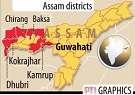
After a three-month lull, violence has once again erupted in the Bodo areas of Assam. It was in July-August this year the areas witnessed major violence between Bodos and Muslims resulting in over 100 deaths and about 400,000 displaced. If the issue remains unaddressed, violence will continue to haunt the state again, and again. High on the priority, therefore, should be on toning down and finally eliminating the armed component of the issue. The armed component of the Bodo issue remains in the form of militant groups representing two broad categories of communities in the area – Bodos and non-Bodos – and the availability of illegal arms. ‘Non-Bodos’ are put here in one category for the convenience of analysis of the issue, but they rather comprise of three different groups: Adivasis, Muslims and Koch-Rajbongshis.

In the case of Bodos, different groups carried the mantle of radicalism in different time periods. In the 1980s it was the All Bodo Students Union; in the 1990s it was Bodo Liberation Tigers (BLT). After the 2003 Bodo Territorial Council (BTC) Accord, BLT laid down arms, but the National Democratic Front of Bodoland (NDFB) came to prominence. The NDFB has now been split as pro- and anti-talk factions headed respectively by Dhiren Boro and Ranjan Daimary. While the Dhiren Boro faction continues to talk with the Government of India, the Daimary faction has been involved in attacks on state targets and on non-Bodos like Adivasis and Muslims in Bodo areas. Although the NDFB chairman, Ranjan Daimary, is in custody, the group’s activities continue. Either of the militant groups has had hand in ethnic clashes that have erupted in the past two decades: 1993, 1994, 1996, 1998, 2008 and 2012. Fratricidal killings between NDFB and former BLT cadres over leadership of the Bodos are yet another troubling dimension of violence in Bodo areas. The NDFB opposed the BTC Accord and did not want to settle for anything less than “sovereign Boroland”. This was yet another motivation for the NDFB to attack BLT, which actually signed the Accord with the governments of India and Assam. There is also disagreement over the script for Bodo language. While BLT wants to stick to present Devnagri script, NDFB insists on adoption of Roman script.

As far non-Bodos are concerned, there are Adivasis, Muslims and Koch-Rajbongshis. There are about five militant groups that represent the Adivasi community: Adivashi People’s Army (APA), Adivashi National Liberation Army (ANLA), Santhal Tiger Force (STF), Birsa Commando Force (BCF), and Adivashi Cobra Military of Assam (ACMA). They stand for creation of Adivasi land to be carved out of the BTC area and Schedule Tribe (ST) status for the Adivasi community.1 They have indeed formally surrendered before the Home Minister of India on 24 January 2012, yet stick to their demands.2

The Government of Assam has identified 14 radical Muslim groups operating in Assam: Muslim Security Council of Assam, United Liberation Militia of Assam, Islamic Liberation Army of Assam, Muslim Volunteer Force, Muslim Liberation Army, Muslim Security Force, Islamic Sevak Sangh, Islamic United Reformation Protest of India, Revolutionary Muslim Commandos, Muslim Tiger Force, Muslim Liberation Front, Muslim Liberation Tigers of Assam, Muslim United Liberation Front of Assam United Muslim National Army (UMNA), and Muslim United Liberation Tigers of Assam.3 Of these, some groups like United Muslim National Army (UMNA), Muslim United Liberation Tigers of Assam (MULTA) and Muslim United Liberation Front of Assam (MULFA) are operating in Bodo areas.4 A recent report on Bodo clashes by the National Commission on Minorities observed that “The danger of Muslims in the BTC becoming militants in the future, in case their security was not ensured.”5 This was echoed by Asaduddin Owaisi in his remark at Lok Sabha on 08 August 2012. He observed, “If proper rehabilitation does not take place, you be ready for a third wave of radicalization among Muslim youth. …”6 If these observations are taken into consideration, the future trend of violence is likely to be on an upward trajectory.

Then there is Kamtapur Liberation Organisation (KLO) of Koch-Rajbongshis that has been demanding, among other things, the formation of a separate sovereign State of Kamatapur by combining six northernmost districts of West Bengal and the four westernmost districts of Assam. The vital “Chicken Neck” – the narrow corridor linking the Northeast with the rest of India – forms part of this area. Although not very strong in terms of arms and cadre strength, KLO enjoys considerable support among Koch-Rajbongshis, and has been involved in sporadic attacks. KLO’s links with ULFA, Nepali Maoists and the ISI has given a disturbing orientation to the threat profile.7

The latest concern is attempts by the CPI (Maoist) to push the boundaries of the ‘Red Corridor’ and set up support bases in upper Assam and some of the tribal areas in the hilly interiors. They cannot do this without establishing linkage with some of the militant groups of the Bodo areas like NDFB, KLO, ANLA, and APA. Presently, the linkage ranges from getting arms, ammunitions, communication devices to training. Maoists, in turn, are said to be providing explosives (ammonium nitrate) and funds to the northeast groups. Chinese small arms find their way to the ‘Red Corridor’ mainly through these groups. It is through the northeast groups the Maoists have good access to militant groups of Myanmar. Therefore, apart from military utility of training, arms procurement and sanctuary, the Maoists also found parts of the northeast of India as a new zone of “revolution” to establish what they call as “base areas”.

Armed groups representing all communities have to be tackled through appropriate means, either that be military, political or a mix of both. As long as they remain armed and active, insecurity and the consequent trust deficit would linger on. Negotiations with those groups that have ceased fire and entered into talks should be taken to a logical conclusion without much delay. Continuing with status quo without substantive breakthrough would cause uncertainty and frustration among the surrendered cadres. It is important to suitably rehabilitate them through innovative rehabilitation packages that also include gainful employment in the long run. Else, they would return to militancy sooner or later.

Easy availability of illegal arms in Assam that has encouraged killings, kidnappings and extortions is yet another dimension of the armed component. It is reported that “extremist groups like the Bodo Liberation Tigers and National Democratic Front of Bodoland have as many as 350-400 automatic weapons in their arsenal in the four districts comprising BTAD—Kokrajhar, Chirang, Udalguri and Baksa.”8 It is appreciable that the some arms could be seized in the BTC area by a military operation this September. But, this is not enough. Apart from taking control of all illegal weapons, it is also important to control their flow from across the borders, especially from China, Myanmar and Bangladesh.

Analysing all previous incidents of violence in Bodo areas, it is clear that as and when the security apparatus missed taking note of symptoms of unrest and as and when it failed to take appropriate proactive action, the situation got out of control. The issue is that the BTAD region has become a tinderbox that needs only a spark to explode. The state police and the Intelligence should have taken appropriate action in early March 2012 itself when Bodos started commemorating 25 years of their “struggle”. Similar symbolisms and assertions were bound to be displayed by non-Bodo groups, especially Muslims and Adivasis. The manifestation of such assertions by competing groups was always through violence. This should be understood. Signs of imminent clashes were simmering since May, but were not taken seriously by the government. Even during 2008 clashes between Bodos and Muslims, the state security apparatus was caught unawares. Justice Phuken Commission Report blamed, apart from Muslim Students Union of Assam (MUSA) for initiating the violence, the state intelligence for the gross negligence.9

It is also important to find a lasting solution to the issue of illegal immigration from Bangladesh. The entire stretch of 4,096-km India-Bangladesh border is heavily populated, making monitoring extremely difficult. Fencing has to a large extent been acting as an obstacle, but only 2,760.12 km have been fenced so far. 10The remaining stretch should be fenced at the earliest, complimented with floodlights and hi-tech surveillance devices. Most importantly, existing border has to be demarcated at the earliest to make them free of ‘enclaves’ and ‘adverse possessions’. Although the Border Security Force (BSF), in charge of policing the border, has been doing its job creditably, the force levels are not sufficient to monitor the long and difficult border. Apart from raising new battalions, it is important not to divert the BSF for duties other than border management. They also have to be equipped legally to handle situations at borders that include not only illegal migration, but also smuggling, drug-trafficking, counterfeits, and militant movements. Apart from creating physical hurdles, it is also important to discourage illegal migrants through suitable deterrent legislation. Till recently, illegal migrants in Assam were handled by Illegal Migration (Determination by Tribunals) Act, 1983, that was held as unconstitutional by the Supreme Court in 2005 as it was “coming to the advantage of such illegal migrants as any proceedings initiated against them almost entirely ends in their favour, enables them to have a document having official sanctity to the effect that they are not illegal migrants.”11 An exclusive refugee/migration law is long pending. At some pockets, issue of temporary work permits can be considered so that Bangladeshis can come, work and go back. At the diplomatic level, India should not hesitate to raise the issue of illegal migration with Bangladesh so that the problem is addressed at its source.

Endnotes
  1. “Demand to carve out Adivasi land from BTC,” The Assam Tribune, 11 July 2012.
  2. “North East militants surrender before Chidambaram,” The Hindu, 24 January 2012.
  3. “Government of Assam to thwart 14 radical Islamic groups,” The Northeast Today, 21 August 2012.
  4. “Centre eye on rise of Muslim rebel groups,” The Times of India, 22 August 2012.
  5. National Commission on Minorities, “Report on Visit to Bodoland Territorial Autonomous Districts (BTAD) and Dhubri District in Assam,” July 2012, p. 6.
  6. Lok Sabha, Proceedings with Questions and Answers, Part I, Asaduddin Owaisi, 08 August 2012, p. 95.
  7. Subodh Ghildiyal, “ULFA, KLO foot soldiers of ISI, The Times of India, 25 November 2006.
  8. S.N.M. Abdi, “The 50-50-shot,” Outlook, 03 September 2012.
  9. “2008 riots: probe panel blames MUSA, Assam police intelligence wing,” The Hindu, 21 July 2010.
  10. Ministry of Home Affairs, Government of India, Annual Report 2011-12, pp. 46-47.
  11. “IMDT Act is the biggest barrier to deportation, says Supreme Court,” The Hindu, 14 July 2005.

Monday, September 3, 2012

Violence in Bodo Areas: Issues and Options


Dr. N. Manoharan
Senior Fellow, VIF


Violence in Bodo areas is not a simple story of communal conflict between Bodos and non-Bodos, but is a complex issue with socio-cultural, economic, political and security dimensions.Clashes have erupted from time-to-time1 in the area, but the situation this time has reached a state where the number of killings has crossed 90. There is a displacement of about 400,000 people and its echo has been felt in other parts of India in terms of reverse flow of Northeasterners, triggered by rumours of reprisals. What factors were responsible for the present situation? Who were the actors involved? What were the major points of friction? What is the way ahead?

Land, language and livelihood have been the major elements of Bodos’ grievances that caused the community to agitate. Desire for political power came later, although the aspiration was basically to realise their core socio-economic demands. The Bodo movement in its long history “has had several forms moving gradually towards the demand for a separate state” and even a sovereign “Bodoland”. The entire movement can be broadly divided into six phases: Colonial, 1947-67, 1967-87, 1987-1993, 1993-2003 and post-2003. In each phase, the Bodos gradually advanced their socio-economic and political aspirations, but not without facing proportionate challenges in the form of resistance from other competing groups in the area, or lethargy of the state or even division within its own community. From the mid-1980s armed component to the movement took shape. Militant groups like Bodo Liberation Tigers (BLT) and National Democratic Front of Bodoland (NDFB) came to the fore. Since the 1993 signing of BAC Accord and later 2003 BTC Accord, there were concerted efforts made by the Bodos to “prove right of the autochthonous over the land” what they called “Bodoland”. They first turned to “illegal Bangladeshi immigrants” and then to Adivasis. The resultant violence and counter-violence led to large-scale killings and displacement.

To take a snapshot of present cycle of violence, the events leading to July riots was triggered by a 24-hour bandh called by All Bodoland Minority Students’ Union (ABMSU) on 29 May 2012 to protest against the alleged removal of a signboard by cadres of the ex-Bodo Liberation Tigers (BLT) from a piece of land in the Badlangmari area that had been allocated for a mosque. The bandh turned violent injuring 13 persons. The momentum of violence, however, started with the killing of two members of All Bodoland Minority Students Union (ABMSU) allegedly by Bodo gunmen at Anthihara in Kokrajhar on 06 July 2012 and on 19 July, two more people were killed in Magurmari in Kokrajhar. In retaliation, on 20 July, four former BLT cadres were killed. Violence intensified since then and went out of proportion for the local police to be able to control. It subsided only when the Army was called in.

The challenge to crafting a way ahead is can the grievances of Bodos – safeguarding their culture and improving their economic conditions – be met without a separate state of Bodoland and without compromising the interests of other ethno-religious groups living in the so called Bodo areas? The answer lies in looking at the issue in a comprehensive, rather than segmented manner. The following six broad measures can be considered:

Timely Action: Analyzing all previous incidents of violence in the Bodo areas, it is clear that as and when the security apparatus missed taking note of symptoms of unrest and failed to take appropriate proactive action, the situation got out of control. The state police and Intelligence should have woken up by March 2012 itself when Bodos started commemorating 25 years of their “struggle”. Similar symbolisms and assertions were bound to be displayed by non-Bodo groups, especially Muslims and Adivasis. The manifestation of such assertions by competing groups was always through violence. This should be understood. Signs of imminent clashes were simmering since May, but were not taken seriously by the government. Nipping the problem at the bud would have averted indiscriminate violence and resulting killings and displacement.

Political Settlement: There is no point in going for a fresh accord. The failure of Bodo Autonomous Council (BAC) of 1993 and Bodo Territorial Council (BTC) of 2003 clearly shows the problem was more with the implementation and less with the provisions per se. It is vital, therefore, to fix the present BTC accord without any ambiguities and implement it in full. It was the ambiguities in the previous two Accords that led to lot of misunderstandings, opportunistic interpretations and confusions. Yet full and timely implementation would have averted many issues. The future amendment and implementation of the Accord is such that the provisions should satisfy both Bodos and non-Bodos in unequivocal terms. It should be realised that any success of the Accord lies also in cooperation between Bodos and non-Bodos.

Armed Groups: Armed groups representing Bodos and non-Bodos have to be tackled through appropriate means, either through political or military means or a mix of both. As long as they remain armed and active, insecurity and the consequent trust deficit would linger on. It would not suffice to prevail only on those groups that have not entered into ceasefire, but on all groups that have access to weapons and are motivated to kill.

Reconciliation: There is a significant gap between the present ground reality in the Bodo areas and the romance of Bodoland. It is important to bridge this gap. The political leadership should rise to the occasion in convincing the respective communities to see the things as they are and look ahead, instead of exploiting the situation to gain electoral mileage. Appropriate confidence-building measures and reconciliation among the concerned communities – Bodos, Mulsims, and Adivasis – are crucial.


Illegal Migration: It is also important to find a lasting solution to the issue of illegal immigration from Bangladesh. Despite the enormity of the issue, the response in stemming the flow of migrants from neighbouring Bangladesh has been grossly inadequate. The entire stretch of 4,096-km India-Bangladesh border is heavily populated, making monitoring extremely difficult. Fencing has to a large extent been acting as an obstacle, but only 2,760.12 km have been fenced so far.2 The remaining stretch should be fenced at the earliest, complimented with floodlights and hi-tech surveillance devices. Most importantly, existing border has to be demarcated at the earliest to make them free of ‘enclaves’ and ‘adverse positions’; much of the activities take place in these undemarcated areas. Although the Border Security Force (BSF), in charge of policing the border, has been doing its job creditably, the force levels are not sufficient to monitor the long and difficult border. Apart from raising new battalions, it is important not to divert the BSF for duties other than border management. They also have to be equipped legally to handle situations at borders that include not only illegal migration, but also smuggling, drug-trafficking, counterfeit currency, and militant movements. Apart from creating physical hurdles, it is also important to discourage illegal migrants through suitable deterrent legislation. Till recently, illegal migrants in Assam were handled by Illegal Migration (Determination by Tribunals) Act, 1983, that was held as unconstitutional by the Supreme Court in 2005 as it was “coming to the advantage of such illegal migrants as any proceedings initiated against them almost entirely ends in their favour, enables them to have a document having official sanctity to the effect that they are not illegal migrants.”3 An exclusive refugee/migration law is long pending. It is also vital to hasten the present plan of issuing multi-purpose identity cards, at least to curb further illegal migration. At some pockets, issue of temporary work permits can be considered so that Bangladeshis can come, work and go back. At the macro level, India should help in the overall economic development and prosperity of Bangladesh so that its citizens need not to go elsewhere for their livelihood.

Refugee Camps: Relief camps housing internally displaced requires due attention. All three broad categories of communities – Bodos, Muslims, Adivasis – are housed in various camps. Some of the camps have been in existence since 1993, as inmates could not return to their homes fearing violence. Because of overcrowding there is persistent lack of food, water, accommodation, medical attention, and sanitation. These concerns should be addressed urgently. Apart from making the living conditions of the internally displaced in relief camps better, the government should make sure that the displaced are rehabilitated at the earliest. Else relief camps would turn into breeding grounds for new militants.

Monday, July 30, 2012

China’s Involvement in India’s Internal Security Threats


Dr. N. Manoharan
Senior Fellow, VIF

Unlike Pakistan, the involvement of China in meddling with India’s internal security is not a simple story of ‘sub-conventional warfare. It is more nuanced and complex. Under Mao Zedong, China supported revolutionary insurgencies throughout the world. The spirit of Hindi-Chini bhai-bhai pervaded between India and China and the former was tagged as “neutrals” in the initial years. Yet, what made China to take interest in “national self-determination struggles” in various parts of India? Partly it was due to Beijing’s perception that its southern neighbour had been turning into an “anti-China base”. Nor did the Chinese take lightly Indian sympathy to Tibetan refugees, who were fleeing the state repression. China also suspected Indian covert hands in Khampas rebellion in Tibet. But, the actual support by China to rebel movements of India gradually commenced after the 1962 Sino-Indian conflict when bilateral relations between the two countries hit rock bottom. For Beijing, patronage to insurgent groups in the northeast India looked ideal not only because of geographical proximity, but also due to the region’s isolation from the Indian mainland, and the existence of external support network created and sustained by the then East Pakistan.

From 1966, China started training several batches of rebels from the northeast. Incidentally, the ‘Great Proletarian Cultural Revolution’, popularly known as the ‘Cultural Revolution’ commenced in the same year in China. The first to reach out to the Chinese help were the Nagas. China was considered as the “only hope for revolutionaries”. Taking cue from Nagas, other groups in the region, especially Mizos and Manipuris, got hooked to China. Pakistan had already been in the job of supporting insurgent groups of the northeast since the mid-1950s. The infrastructure and methodology was there to imbibe. And it became easy for China to take on. The China-returned guerillas not only fought better, but were also not amenable to come to negotiating tables even when the time was ripe for resolving conflicts. However, when it came to China’s involvement in Naxalism, it was more of inspirational than any sort of direct material support. Charu Mazumdar, one of the pioneering leaders of the Naxalite movement, famously remarked: “China’s Chairman is our Chairman and China’s path is our path”. Naxals saw Maoism as the right template for making a revolution in India.

After 1978, Deng Xiaoping put Chinese economic, security and foreign policies on a new footing. His policy of “reform and opening” subordinated the revolutionary and anti-imperialist elements of China's foreign policy to the overriding imperative of economic development. The Cultural Revolution was severely condemned for having obstructed and delayed China’s economic and technological progress, and for the divisions it brought about in both its ‘inner’ and ‘outer’ worlds. China’s support to Northeast insurgency dwindled in the late 1970s, if not dried out completely. At around the same time, it should be noted that there was gradual normalisation of Sino-Indian relations. During this period, the northeast militant groups got an alternative support base in Bangladesh, Bhutan and Myanmar.

The revival of Chinese involvement in India’s internal security threats commenced roughly in mid-1998 when Sino-Indian relations witnessed strains in the wake of nuclear tests by India. And Beijing had been looking at the developments in the strategic landscape, especially India-US relations with utmost concern and suspicion. More than the Indo-US Nuclear Deal, China was far more concerned about the increasing defence cooperation between India and the United States. China’s role in India’s internal security threats during this phase has been wide-ranging: clandestine support to militant groups, not objecting to Indian insurgent leaders taking asylum in its territory, turning blind eye to Chinese arms flows into India and cyber warfare.

The rebels of the northeast, apart from their nuisance value to the Indian security forces deployed in the region, are also amenable to motivation by the Chinese to target key Tibetan leaders in exile based in India and to gather vital intelligence information about Indian force deployments along India-China borders. In the present period, Chinese intelligence agencies have taken over the role of Mao’s CPC. Apart from reviving contacts with old militant groups like NSCN and PLA, China’s linkage has now extended to touch new groups like United Liberation Front of Asom (ULFA), National Democratic Front of Bodoland (NDFB) and All Tripura Tiger Force (ATTF). On linkage with Indian Maoists, there is no evidence to suggest China’s direct support.

But, China did not wish to do anything overtly. Since indirect involvement is hard to prove a retaliatory response is more remote. Also, such involvement draws less international stigma. Most importantly, it provided China ‘plausible deniability’. On cyber warfare, the methodology is simple: use a network of cultivated and loosely controlled “patriotic” and mercenary hackers that allows the state to deny responsibility something similar to the method used in the case of small arms.

From time-to-time, India has taken up the issue with Beijing both diplomatically as well as through the aegis of counter-terror cooperation. However, China has categorically denied giving any help to insurgent groups, particularly the ULFA, UNLF, NSCN (I-M) and PLA. But, what surprises is the low level of confidence at which the issue is raised and discussed with the Chinese. India’s official position on the entire gamut of China’s involvement has been soft. One agrees that opinions and assessment on the state of China’s involvement should be expressed after careful judgment based on the long-term interests of building a stable relationship between the two countries. But, there is nothing wrong in having a structured mechanism to discuss this issue specifically. Simultaneously, all routes of Chinese interactions with Indian militant groups should be blocked. This requires enhancement of India’s border security apart from cooperation of India’s other neighbours like Myanmar, Nepal, Bangladesh and Bhutan. Except Bhutan, none of India’s neighbours are serious or consistent in cooperating with India to tackle insurgents in the region.