Showing posts with label Constitution of India. Show all posts

Thursday, September 25, 2014

Need to Appoint Impartial Governors

Dr M N Buch, 
Dean, Centre for Governance and Political Studies, VIF

Under Article 1 of the Constitution, read with the Preamble, India is sovereign and the sovereignty rests in the Union. The same Article makes India a Union of States, which means that whereas the collective sovereignty vests in the Union, the constituents of this Union also have elements of sovereignty. The relationship is important to understand because whereas in the United States under the Tenth Amendment of the Constitution the words used are, “The powers not delegated to the United States by the Constitution, nor prohibited by it to the States, are reserved to the States respectively or to the people”. Under Article 248 of the Indian Constitution, it is the exact reverse in that the residuary powers of legislation on any matter not enumerated in the State List or the Concurrent List of the Seventh Schedule vest exclusively in Parliament. If residuary powers are vested in Parliament, how do we consider the States to have sovereignty? Here sovereignty comes from two considerations, the first being that without the States there can be no Union and the second comes from List 2 of the Seventh Schedule which gives exclusive legislative powers on all matters enumerated in this List to the State Legislature. Ultimately it is the exclusive power to legislate which introduces an element of sovereignty so far as the States are concerned.

Parts V and VI of the Constitution provide for a parallel Executive, Legislature and Judiciary for the Union and the States. In the case of the Union, Article 53 vests executive power in the President and in the case of the States, Article 154 vests executive power in the Governor. The President is Head of State for the whole of India and the Governor is Head of State for that particular State. No doubt that the Governor is appointed by the President under Article 155, whereas the President is elected under Article 54. This has been interpreted to mean that the Governor is the agent of the President and not an independent entity. Constitutionally that is a completely wrong interpretation, because in the matter of exercise of executive power, summoning of the Legislature, its prorogation and its dissolution, the Governor is totally independent of the President. Convergence only comes under Article 254 when both Parliament and the State Legislature have enacted laws on the same subject in a matter enumerated in the Concurrent List and there is a repugnancy between the two laws. Here the law of Parliament will prevail. However, the Governor may reserve a Bill passed by the State Legislature for the President’s approval in a matter under the Concurrent List so that either there is no repugnancy or the President approves the changes made in the State law, in which case the State law will prevail within the territory of the State. Otherwise, the Governor, under Article 163, functions according to the aid and advice of his Council of Ministers, not that of the President. In legislative matters, it is the Governor who gives assent to Bills passed by the State Legislature, unless he reserves any for the prior approval of the President. Just as the President functions according to the aid and advice of his Council of Ministers, the Governor is in exactly the same position vis-à-vis the State and, therefore, the two offices of President and Governor are in parallel and not in a position of superiority or subordination.

It is under Article 356, however, that the Governor reports to the President and that, too, only in matters in which the Governor is of the opinion that the government of a State cannot be conducted in accordance with the provisions of the Constitution and, therefore, the Governor advises the President to take over all or any of the functions of the State. If the President is convinced that such a situation has arisen and he decides to issue a proclamation in this behalf then, of course, the Governor will perform his functions in accordance with the directions issued by the President, in whom the government of the State will vest during the period of the proclamation. Here the Governor would become directly subordinate to the President. However, the Supreme Court has laid down stringent guidelines about the use of Article 356 of the Constitution and, therefore, a proclamation under this Article would be an exception rather than the rule and that, too, on very rare occasions.

Let us carry the argument a little further. Under Article 174, the Governor has the constitutional authority to summon the Legislature to meet at such time and place as he thinks fit. Of course he exercises this power on the advice of the Council of Ministers. The Governor may prorogue the House and he also has the authority to dissolve the Legislative Assembly. The President would acquire this power only if he has issued a proclamation under Article 356 and assumed the government of a State. Otherwise the Governor would be free to dissolve the House, provided that the Chief Minister on behalf of the Council of Ministers has so advised. He can appoint a caretaker Chief Minister and he can order fresh elections to the State Assembly. In this he does not need the approval of the President. This specific case is mentioned because the general theme of the Constitution is that whereas it has a centripetal bias and in matters mentioned in the Constitution the sovereignty of the Union prevails over the sovereignty of the States, it is still a federal polity in which the States enjoy constitutional powers rather than delegated powers. The Governors, under the scheme of things in the Indian Constitution, have an independent place of their own and are expected to function as impartial Heads of States within the territory of their own State. This brings us to the question about what sort of persons should be appointed as Governors. What should be their qualifications or other competence to occupy this high office? Unfortunately, the Constitution is silent in this behalf except to state what is given in Article 157, that is, that no one who is not a citizen of India can be appointed as a Governor and that the person so appointed should have completed thirty-five years of age. Under Article 158, the Governor shall not be a Member of Parliament or of a State Legislature and on his assuming office, if he is such a Member of a Legislature, he will be deemed to have vacated his seat in the House. Secondly, the Governor is prohibited from holding any other office of profit. Other than this there are no qualifications laid down for appointment as Governor. Theoretically he can be uneducated with a low intelligence quotient (IQ), with no record of public service or professional ability and, at least in explicit terms, is not even required to be sane. This probably means that even a certifiable lunatic could be appointed as Governor because there is no constitutional prohibition in this behalf. The Governor can be partisan, affiliated to a political party, notorious for bias on account of religion, caste, community or gender, but he can still be appointed as Governor. Is this the kind of person we need as Head of State?
It is a fact of which we can take notice that the Congress Party basically had four unspoken criteria for appointment of Governors. They were (1) Party hacks who had put in a few decades of service to the party at menial or low grade political level, who have expectations that now that the party has come to power their loyalty will be rewarded. (2) If the State Government is to be destabilised, then send in Romesh Bhandari as Governor. (3) Where the Prime Minister and the Chief Minister of a State are on good terms, then send a Governor with the Chief Minister’s approval. (4) Decrepit politicians aged almost to the point of senility, with major health problems, could be sent to a Raj Bhavan to enjoy its comforts and avail of the high quality medical services which would be available to the Governor. In other words, use the Raj Bhavan as a nursing home for the aged and the sick.

The holder of the office of the Governor, as any other Head of State, has to be nonpartisan, unbiased, capable of understanding constitutional responsibilities, aware of the oath sworn under Article 159 to preserve, protect and defend the Constitution and the law and devote oneself to the service and well-being of the people of the State. This means that the Governor should have at least those educational qualifications which would enable him to understand the laws, policies of government and consequences of following a particular policy, the constitutional validity of the orders passed by government and the responsible implementation of such policies so that the welfare of the people is enhanced. We cannot expect this of a totally illiterate person and, therefore, it is axiomatic that the Governor should have adequate educational qualifications to be able to read, analyse, understand and then decide.

Because the Governor is required to protect the Constitution, he has to be nonpartisan because the Constitution itself, through the Fundamental Rights, mandates the freedom of speech and expression, that is, the right of opposition and dissent. The Governor can defend this right only if he is politically neutral. Under Article 167, not only is the Chief Minister required to keep the Governor fully informed about the decisions of the Council of Ministers, but he is also required to furnish information relating to the administration of the State and proposals for legislation. The right of the Governor to ask the Chief Minister to obtain the views of the Council of Ministers on a matter decided by a minister alone is included in Article 167. Just as the Governor is required to act on the aid and advice of the Council of Ministers, in the discharge of his duties as per the oath sworn by him, the Governor has the right to advise the Chief Minister on matters relating to the well being of the people. Though this advice may not be binding on the Chief Minister, nevertheless the Chief Minister would be bound to at least heed the advice and react to it. A Governor with a capacity to understand issues and analyse would be in a position to give proper advice to the Chief Minister. Therefore, none of the four considerations which have hitherto led to the appointment of Governors really has any bearing on what the Governor should actually be liked in terms of qualifications, ability to understand and analyse, project the well being of the people and generally act as a person who, through interaction with the Council of Ministers, is able to assist in good governance.

Right from the time of Indira Gandhi, the post of Governor has been used for the parking of people who are party loyalists and want a comfortable berth for themselves because they are otherwise worthless. It is unfortunate that the unspoken criteria laid down by the Congress have been adopted wholeheartedly by every government which has succeeded Indira Gandhi. However, under Congress rule, a few nonpartisan officers, one or two eminent people, an educationist or two found berths as Governor. The Janata Government ruthlessly sacked all the previous Governors and increasingly politicised the post. When Indira Gandhi returned to power, she dismissed all Janata Party appointed Governors and continued the process of politicising the post of Governor. Every successive government does just the same, but one had expectations from Narendra Modi that he would understand the constitutional importance of the post of Governor and would appoint persons who could act in a nonpartisan manner. Unfortunately, that has not happened. Nine Governors appointed by the previous government have been removed and in their place only party hacks have been appointed. For example, Kalyan Singh whose role in U.P. as Chief Minister when the disputed structure at Ayodhya was demolished has been subject to strong criticism has been sent to Rajasthan. Vajubhai Vala was Revenue Minister of Gujarat under Keshubhai Patel as Chief Minister and he did not enjoy a reputation for pea-green incorruptibility. He is a man without sophistication, but he has been sent as Governor to Karnataka whose capital, Bangalore, is the hub of the IT industry, is a technologically advanced city and is known for its cultural activities. Does the Raj Bhavan at Bangalore deserve Vajubhai Vala? Keshrinath Tripathy, who did not cover himself with glory as Speaker of the U.P. Legislative Assembly, has been sent to West Bengal. All the Governors appointed by the present government are politicians of no great merit and from whom we can expect no great contribution to the State where they are posted. In the case of Haryana, one wonders whether Kaptan Singh Solanki has been sent to replicate what Romesh Bhandari did in U.P? Not one of the Governors appointed can be expected to assist the State in providing good government. This is not what we expect of our government and by sending middle level politicians as Governors, the Prime Minister has completed the politicisation of a post which by its very nature should be apolitical. This is a cause of disappointment.

Of course there will be controversy about any suggestions made regarding the qualifications for the post of Governor but as a starting point of debate, one should attempt some suggestions or a few considerations which must go into the appointment of a person as Governor. First and foremost, no active politician should ever be appointed as Governor. This means that for at least five years prior to such appointment the person should not have participated in any active politics, nor should formally be a member of any political party. The person appointed should not be more then seventy years of age and should not be considered for more than one additional term of reappointment. The person should have had formal education at least to the collegiate level, with preference being given to a post graduate degree holder. The person could be a professional such as a lawyer, doctor, etc. He could be a technocrat, an academician, a renowned architect, a person who has earned distinction in literature, someone who earned distinction as an administrator or diplomat, a successful farmer, environmentalist or social activist, someone who has served the armed forces or the police and has earned a reputation for integrity and professional competence, a businessman with a clean record or anyone from any profession who has exhibited the ability to think and perform, whilst earning a reputation for honesty. For example, A.R. Kidwai, an educationist, served with honour as Governor of Bihar, N.N. Vohra is handling a difficult situation in Jammu & Kashmir with aplomb and Lieutenant General Nirbhay Shrma has gained a fine reputation in Arunachal Pradesh. Unfortunately no politician has ever been able to rise above the narrow partisan interests of the political group to which he belongs. That is why Ved Marwah of the IPS was successful in Manipur, whereas Kamla Beniwal bombed in Gujarat. The present government led by Narendra Modi, which is a pathfinder in so many matters, would perform a great service to India if it codifies the principles on which Governors should be selected. In the long run, an impartial Governor would always be more useful than one who is partisan.


Published Date: 23rd September 2014, Image source: http://2.bp.blogspot.com
(Disclaimer: The views and opinions expressed in this article are those of the author and do not necessarily reflect the official policy or position of the Vivekananda International Foundation)

Wednesday, April 2, 2014

Time to Restore Civility in Political Debate

Dr M N Buch, 
Dean, Centre for Governance and Political Studies, VIF

For us Indians there are certain truths which we should take as immutable. The Constitution of India, the basic features of which have remained unchanged despite a number of amendments, is the document which prescribes how this country will be structured and governed. Article 1 categorically states that India is a Union of States, which means that it is a true federation in which the Union as an entity exists because of its constituent States. One without the other is incomplete and, therefore, whilst there can be debate on whether this federation needs a strong Central Government with viable and powerful States, or whether the States should enjoy the highest degree of autonomy with the Centre being the cementing force, India cannot convert itself into a Unitary State. The Qasi federal structure is here to stay.

The Preamble defines governance in this country in unambiguous terms. India is fully sovereign and this is non-negotiable. It is socialist in the sense that the Preamble itself mandates justice, liberty, equality and fraternity, which means that there is equality before law, there is freedom of thought and expression, every citizen has equality of status and opportunity and fraternity ensures that there will be a brotherhood of man in which no one is high and no one is low. The Preamble also states that India will be secular and, in the context of the partition in 1947, this was a very brave decision because whereas Pakistan chose the path of theocracy, we opted for a nation in which everyone was welcome, regardless of religion, caste and creed or, for that matter, place of birth. Secularism in this context is what makes all of us equal. The Preamble further states that India will be democratic and that it will be a republic. One has no alternative available whereby the republican form of government can be replaced by a hereditary monarchy, nor can the democratic process be replaced by authoritarian rule or totalitarianism.

The Constitution has adopted the Westminster form of democracy in which whilst there is separation of power between the Executive, the Legislature and the Judiciary, there is a coming together of the Executive and the Legislature through the Council of Ministers. The Prime Minister is appointed by the President, but because he has to enjoy the confidence of the House, to which he and his ministers are collectively responsible, obviously only that man would be appointed whose party or political group enjoys a majority in Parliament. This is an important point to be borne in mind because it determines the shape that our democracy will take in order to elect a government. Every five years a general election is called for electing members of the House of the People, that is, the Lower House of Parliament. Because India is a democracy in which Article 19 of the Constitution guarantees freedom of speech and association, it is obvious that there will be different streams of political thought and ideology, ranging from the extreme left to the extreme right. The bounds within which these thoughts will be expressed and ideologies expressed, are that the fundamentals of our Constitution, our sovereignty, socialist ideal, secularism, democracy, republican status and the Union of States cannot be questioned, nor their overthrow advocated. However, within these limitations every group of persons, every individual and every political party has the right to not only express itself but to propagate and promote its ideology. When there are different schools of thought prevailing in politics and the objective of every political party is to win favour with the electorate and thus aspire for power, there is bound to be debate. There is also bound to be dissent, internally within a party and externally between parties. The objective of debate is to convince people that a particular party, its ideology, programmes and practices is best suited to governing the country. For example, a party may profess dogmatic socialism and nationalisation of all industry and business as the best way forward for India. Another party may advocate capitalism, free enterprise and laissez faire as the best policy for the country. In between there may be many shades and nuances of political policy which different parties may advocate. This is perfectly legitimate and in fact desirable. It is then for the people to choose which party they will accept as best suited for government.

At a time when the Congress Party under Jawaharlal Nehru was virtually the uncrowned king of India and the Opposition was numerically very small, we still had stalwarts like Ram Manohar Lohia, S.A. Dange, Syama Prasad Mookerjee, Rajaji and other towering persons who were in political conflict with government and expressed views contrary to those held by Jawaharlal Nehru. However, they were heard with great respect and their words carried weight. There was a level of debate in Parliament and outside it which was so civilised, so serious, so ideology based that we could pride ourselves on traditions of parliamentary democracy perhaps not found even in Britain. Those were the golden days of Indian democracy and the Indian Parliament. Surprisingly this is also the period in which Nehru introduced the concept of planned economy, not of the Soviet model, but the uniquely Indian one in which justice and equality were more important than Marxian dialectics. The Indian model, recognising that capital formation through private enterprise was just not adequate to accelerate the Indian economy to a higher plane, decided to use the State and public enterprises for building the infrastructure and laying the base for a capital goods industry which could modernise the country. This was not a dictatorial decision but a democratic one in which critics and criticisms were heard, given due weightage and did influence decision making so that the planned economy did not transform itself into a bureaucratic dictatorship. The above example is given to support the thesis that civility of debate did exist in India, partly because of Gandhian traditions, partly because Nehru was a democrat, partly because his opponents were also democrats. Power was a means of service, not an instrument for self aggrandisement.

All that changed in 1967, when in some of the States outright bribery purchased Members of the State Legislature, defections were engineered and elected governments caused to fall through dubious means. Now power became a commodity which could be purchased, attaining of power became a goal in itself and the wholesale subversion of the State to convert it into a means of amassing wealth through which power could be purchased became a norm. All means, however foul and unfair, become legitimate in order to gain power and with this principles, ideology, consistent political thought, pragmatic programmes, all were thrown out of politics and the political process became totally corrupt, When a political system becomes corrupt there are evil consequences which flow from it. Corruption is not restricted to top levels, but soon permeates down to the lowest government functionary. If the guardians of democracy, the legislators and the ministers, become corrupt, they cannot occupy high moral ground when dealing with their subordinates, but they actually use their subordinates in order to garner money. The subordinates, in turn, have to prey upon the citizens to collect money and the rot sets in so deep that soon every point of contact between a citizen and a government functionary becomes a source of milking the citizen even for getting his legitimate work done. This is the state to which we have brought India and, perhaps, in a way the Anna Hazare movement was a citizen reaction to the systematic climate of corruption that we have created. Such a climate endangers democracy itself because if citizens lose faith in the system, then either there will be anarchy or there will be totalitarian rule and both would be highly undesirable.

One natural consequence of the loss of political innocence is that the level of political debate has hit rock bottom. The politicians, though having no specific ideology, philosophy or programme to offer, want to be elected so that they can enjoy power. They seem to have fine-tuned the old saying, “When in the right, fight like hell. When in the wrong, admit”. The new saying seems to be “Who says you have to be in the right. In any case, when in the wrong thump your opponents”. Carried further, the entire political scenario becomes one of just attacking one’s opponents, not for their policies, not for their performance but on totally personal grounds. The new form of debate is shrill, accusatory, perfectly comfortable with telling lies and happiest of all when heaping unprintable abuse on one’s opponent and accusing him of everything, including murder, sexual depravity and misbehaviour, corruption, even to question the legitimacy of his birth. However, under no circumstances tell the people what you have to offer them if you come to power because the fact is that you have nothing to offer and in any case you only consider them as a kind of voting machine which is to be milked in order to gain power. Ram Manohar Lohia was extremely critical of Nehru, but at no time did he intend to cause hurt and at no time did Nehru take umbrage at what Lohia was saying. There was never any intention to cause any bodily harm or any humiliation to one’s opponent and one admires how Morarji Desai ensured that Indira Gandhi was not victimized and Atal Bihari Vajpayee took care of the comfort and honour of Sonia Gandhi. There was at times acrimony but there was no vendetta. Certainly there was not the kind of churlishness exhibited by Mamata Banerjee towards the Left in West Bengal after she came to power. If one were to define the politics of those days one has to use the word “civilised”.

If one were to survey the political scene today what would one find? There is an enormous promotion of factors such as religion, caste, region, language, group animosities and hostilities, all in order to promote the narrow interests of a particular group or party. This inevitably leads to fuelling narrow religious considerations, generating communal animosity, promoting caste interests over national interests and regional interests over the wider interests of a State, violent manifestation of one’s prejudices, a weakening of the administration, thus endangering the safety of citizens and, perhaps, national security and certainly corruption on an unprecedented scale. All these are the antithesis of good government which, incidentally, has to be the objective of every political party. The Constitution gives them no alternative and the fact that they are doing the exact opposite shows that they have no respect for the Constitution.


May one suggest to all the political parties to read Part IV A of the Constitution which gives the fundamental duties of the citizens. Article 51 (A) states that it shall be the duty of every citizen of India (e) to promote harmony and the spirit of common brotherhood amongst all the people of India transcending religious, linguistic and regional or sectional diversities; to renounce practices derogatory to the dignity of women” and (j) “to strive towards excellence in all spheres of individual and collective activity so that the nation constantly rises to higher level of endeavour and achievements”. Can this be done if the level of political debate is reduced to a public brawl in which, whereas nothing positive is offered, the opponent is attacked, with no holds barred? Therefore, if democracy is to be saved, if the Constitution is to be respected, if the nation is to rise to new heights, it is absolutely vital that civility be restored. The dictionary meaning of civility as per Chambers Twenty-first Dictionary is “politeness”. Civilised, according to the same dictionary means agreeably refined, sophisticated or comfortable; socially, politically and technologically advanced. Civility in debate and civilised debate leads to civilization, defined by the dictionary as “a stage of development in human society that is socially, politically, culturally and technologically advanced”. Remove these three words, civility, civilised and civilization from the dictionary and we would have a nation of morons at constant war with each other. A constitution which mandates fraternity, assuring the dignity of the individual, gives to every citizen equality before law, calls upon him to strive towards excellence, has no place for lack of civility and civilised behaviour in the political process. The manner in which our politicians are behaving today shows that they not only have no respect for the Constitution, but rather that they hold it in contempt and are happy to violate it. More than good government, more than eradication of corruption, we need to restore to politics a standard of values and morality, we need to return to civilisational roots, we need to restore civility to debate.

Tuesday, April 9, 2013

Sanjay Dutt must be Wary of his Friends


A Surya Prakash, 
Distinguished Fellow, VIF

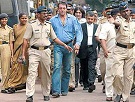
Ever since the Supreme Court pronounced its verdict and sentenced actor Sanjay Dutt to five years rigorous imprisonment in the 1993 Bombay blasts case, a motley group of friends and so-called well-wishers of the actor have sprung to his defence and are pleading, cajoling and even demanding that his prison term be curtailed. Among those who are pleading on his behalf are Mr. Markandey Katju, Mr. Digvijay Singh, Ms. Jaya Bachchan and a host of friends from the cinema world. All of them argue that he has “suffered a lot” over the last 20 years during the pendency of the trail, that he has a family to take care and that he is a much reformed man now. Are these arguments valid? What are its implications for us as a democratic nation?

First of all, it must be made clear that there is nothing new or original in these arguments. His counsel made similar pleadings before the Supreme Court as well, but the court did not see any reason to curtail his prison term and send him on parole. Therefore to advance these very arguments all over again after the court has sentenced him, smacks of disrespect for the judicial process, to say the least. But the bigger issue is the unconstitutionality of these arguments because they go against a basic tenet in our constitution- equality before law and the equal application of the laws (Article 14). This tenet is the corner stone of any democratic constitution. It is therefore shocking to see even a former judge of the Supreme Court and seasoned parliamentarians openly campaigning for remission of Dutt’s sentence after the Supreme Court’s verdict.

Their arguments are flawed for other reasons as well. They say he got married some years ago, that he has two little children to take care and that he has already suffered because of the prolonged trial over 20 years. Often the justice system and judges are blamed, but just look at the number times Dutt has approached the higher courts for bail over this period. Also, how is Dutt worse off than other accused in this case. In fact, there are some other accused who deserve sympathy because they did not have Dutt’s resources to hire expensive lawyers and bombard the courts with a variety of pleas. As a result they languished in jail for years. And, most certainly, they have families too which, unlike Dutt’s family, have languished as well. That is why the Supreme Court has been lenient to many of them. The Aam Aadmi may not know the fine points of constitutional law but he can certainly see how a section of the elite is trying to short circuit the justice system for the sake of a film star. Dutt must protect himself from his friends!

How twisted these arguments in support of Sanjay Dutt are can be gauged from the following facts of the case: The police charged Sanjay Dutt and other accused in this case of hatching a criminal conspiracy between December, 1992 and April, 1993 to commit terrorist acts and to disturb communal harmony in the Bombay region by using bombs, hand grenades, explosive substances like RDX, weapons like AK-56 rifles and carbines and that all this was used to trigger a series of bomb blasts and terrorist strikes in a number of locations in Bombay on March 12, 1993 in which 257 persons were killed and 713 injured. Dutt was also charged with illegal possession of arms which were smuggled into the country by Dawood Ibrahim and his associated.

Following his arrest, .Sanjay Dutt made a confessional statement on April 26 and again on April 28, 1993 before a Deputy Commissioner of Police in Bombay, in which he said:

He possessed three fire arms – a 270 Bruno Rifle, a 370 Magnum Double Barrel Rifle and a 12 bore Double Barrel gun- with valid licenses. He bought these weapons because he was fond of hunting. In December, 1991, while shooting for a film in Dubai, he was introduced to Dawood Ibrahim and his brother Anees Ibrahim. Thereafter, Anees used to visit him regularly on the sets. In mid-January, 1992, Hanif Kandawala, Samir Hingora and two others visited his residence and gave him three AK-56 rifles, some magazines and 250 rounds. Two days later, he returned two rifles, but kept one along with some ammunition. In September, 1992 he purchased another 9 mm pistol with ammunition from a member of the Dawood gang, who visited him on the sets of a movie in R.K.Studios, Bombay. In April, 1993 he went to Mauritius for a movie shoot. There he heard of the arrest of Kandawala and Hingora and got frightened. He asked a friend – Yusuf Nulwalla -to rush to his house, collect a black bag that was in his room and dispose off the contents. This bag contained the third AK 56 rifle. This confessional statement of Sanjay Dutt was corroborated by the confessions made by Kandawala, Hingora, Nulwalla and three others.

Look at the kind of company that Dutt kept between 1991 and 1993 (Dawood Ibrahim, Anees Ibrahim et al) and look at the kind of weapons he stored in his house. Although he had three licenced fire arms, he accepts three AK-56 rifles, hand grenades and huge cache of ammunition from his friends. His lawyers and friends say this was for “self defence”! Have you ever come across another citizen who arms himself in this manner? Where will India be if all those who can afford it, followed Dutt’s example? In short, the arguments advanced in Dutt’s support are preposterous to say the least.

All these bleeding hearts need to introspect and consider the following: Although the Bombay Police had credible information that Sanjay Dutt was in possession of deadly weapons which he had acquired from those who had planned and executed the terrorist acts in March, 1993 in Bombay, they did not raid his house; the designated TADA Court, which heard the Bombay blast cases declared that Dutt had not committed a TADA offence but only offences under the Arms Act. As a result of this decision, the court sentenced him to only six years of rigorous imprisonment, whereas the punishment could have been much harsher if he was found guilty of a TADA offence; The CBI strangely allowed this decision of the court to go unchallenged. As a result, the issue before the Supreme Court was limited only to the appeal of Dutt for probation; and lastly, the Supreme Court itself reduced Dutt’s sentence from six to five years. How many offenders in terrorist cases in this country will be so lucky? After all these fortuitous circumstances, you have people like Mr.Katju, and Mr.Digvijay Singh argue that he be let off. Do they have any consideration for the 257 persons who were killed and 713 who were injured in blasts and grenade attacks engineered by Dutt’s friends?

Actually, all those who want the rule of law to prevail in the country ought to ask the man who was Bombay Police Commissioner in April, 1993 as to why he did not raid Sanjay Dutt’s house when he had information that the actor had acquired illegal weapons. They also must ask the man who was Director of CBI in 2007 to explain why he did not challenge the TADA Court judgement in Sanjay Dutt’s Case in the Supreme Court even though he challenged the verdicts in respect of some other offenders. These are the real issues in this case and the people have a right to know the truth.

If Sanjay Dutt shuns his friends for a while and shuts himself off from the cacophony created by them, he will be able to engage with his conscience and take a decision to accept the Supreme Court verdict, serve out the remaining three and half years in jail and come back to the world of glamour and cinema in the latter part of 2016 with his head held high. Such a decision would be in consonance with the Constitution of India (which mandates equality before law and equal application of the law) and the best democratic principles. It would also show him as a citizen who acknowledges that the safety and security of millions of fellow citizens is above everything else. He can return to do the next Munnabhai movie in 2017 with dignity and moral authority and this will catapult him to the pinnacle of his profession.

If on the other hand, Dutt remains a prisoner of his so-called well wishers who see a three year jail term as something of a calamity, he will be missing the woods for the trees. The political manoeuvrings of his friends may mean a few months less in jail, but the short cut he takes today will haunt him throughout his life.

So, Sanjay Dutt must make up his mind. Will he succumb to his short-sighted friends or will he opt for the right kind of prayaschit, choose to be a long distance runner and emerge taller than many of his so-called well wishers? Let us wait and watch!

Thursday, July 12, 2012

Religion, Caste, Regionalism and Politics in India


Dr. M.N. Buch
Visiting Fellow, VIF

When Guru Govind Singh, the Tenth Guru, ruled that he would be the last human guru and the Guru Granth Sahib itself would be the eternal Living Guru, he said that in case of any doubt search within the Shabad, or the Guru Granth Sahib and all doubts would be resolved. To me the Constitution of India is the Shabad and when I have any doubt I go back to the Constitution and it speaks loud and clear to me. The whole Constitution is designed to make India a secular republic in which there is justice, liberty, equality and fraternity for all, in which there is total equality before law and in which the dignity of the individual is of paramount importance. The Constitution, in order to promote equality, abolishes untouchability through Article 17 and through Article 18 it abolishes titles. Regardless of birth and circumstance all Indians are equal and in this there is no room for differentiation on account of religion, caste, class, region or any other factor which divides man from man.

How are we governed? India is a Union of States and the bounds between the Union, or the Centre and the States are prescribed by the Seventh Schedule of the Constitution which gives the exclusive jurisdiction of Parliament and of the State Legislatures within their respective domains and the concurrent jurisdiction for both regarding those items which fall within the Concurrent List. Within the framework of the States by the 73rd and 74th Amendments of the Constitution have been constituted rural and urban local bodies, which form the third tier of government. The Preamble makes India a democratic republic and government at all levels is to be conducted by democratically elected people who will then elect the Council of Ministers in the Centre and the States and will constitute the village or town council, as the case may be. The execution and implementation of decisions of the elected representatives of the people would be done by officers appointed by the President or the Governor, as the case may be and they, too, will function independently as per the Rules of Business under Article 77 in the case of the Government of India and Article 166 framed for the Government of a State. Every Indian above the age of eighteen is entitled to be included in the electoral roll and cannot be excluded on grounds of religion, race, caste, sex or any of them under Article 325. There will be a single electoral roll and the Constitution specifically prohibits the preparation of a special electoral roll. Under Article 326 election to the House of the People of Parliament and the Legislative Assemblies of States is to be on the basis of adult franchise, which is universal. The Constitution specifically prohibits any discrimination on any grounds whatsoever in the matter of elections, which are the very basis for the formation of government. From this one can infer that the theme of the Constitution is that we move towards a casteless, classless, secular society in which neither religion, nor sex, nor domicile will in any way influence or determine the course of elections.

Having said this one would also have to look at the ground reality. The State of Karnataka has two dominant castes, the lingayats and the vokkaligars. Deve Gowda, former Prime Minister and Sadanand Gowda, the outgoing Chief Minister of Karnataka are vokkaligars, BSR Yeddiyurappa, on the other hand, is a lingayat. Yeddiyurappa had to resign as Chief Minister because he was arrested in a case of corruption and is even now facing investigation on charges of corruption framed by the Supreme Court of India. When he was removed from office, virtually kicking and screaming, he insisted that Sadanand Gowda be made Chief Minister. The BJP national leadership conceded this demand. Thereafter Yeddiyurappa wanted to return to office and when this was not allowed he sulked and instigated a revolt in BJP. Instead of expelling him BJP once again succumbed to his demand that Sadanad Gowda should be removed and Jagadish Shettar, a lingayat be made Chief Minster. The top leadership of BJP again gave in and Gowda is out and Shettar is in. Neither the merit of Gowda nor of Shettar has been the determinant of who should be Chief Minister. What has triumphed is caste equations. One can now look forward to a vokkaligar revolt. What happens to good government in Karnataka is one one’s concern.

Let us move to Uttar Pradesh and the elections held earlier this year. This is one State, in population India’s largest State, where caste has been the determinant of electoral politics and equations. The Samajwadi Party has Yadavs, Gujjars and Ahirs as its solid vote base. The BJP and the Congress are considered upper caste parties, though Mayawati and BSP did play the spoiler by deliberately giving seats in substantial numbers to the Brahmins and Rajputs. The fairly sizable population of Muslims in Uttar Pradesh was wooed by the Congress and the Samajwadi Party. The Congress has always looked upon the Muslims as creatures of its own backyard, whose votes could be taken for granted. However, there is such total disillusionment with the Congress among the Muslims that in Uttar Pradesh they have substantially drifted towards the Samajwadi Party and in Bihar towards the Janata Dal (United). The Congress has been left high and dry. That the Congress is quite happy to play the religious card is proved by the fact that during the entire election campaign Rahul Gandhi was paraded in the Muslim dominated areas sporting an emerging beard of a fortnight’s growth which gradually thickened as the days passed. If a beard makes one a Muslim, then many of the Syrian Orthodox priests of Kerala and people such as Acharya Giriraj Kishore would win hands down because their beards compete with the best that a Mullah can sport. Crocodile tears over the Batala House encounter, false promises about what Congress will do for the Muslims failed because the Muslim refuses to be considered part of a homogenous group whose only desire is to be appealed to as a Muslim. He refuses to be a vote bank which can be taken for granted. He is an Indian, a human being and an individual and wants to be treated as such.

The Indian Muslim of 2012 is not the same person as the Muslim of 1947. Because India is secular and because its leadership, by and large, is committed to secularism, the majority of Indian Muslims has voted with their feet to be Indians and have refused to migrate to Pakistan. In population India is the second largest Islamic country in the world after Indonesia. The Muslim population is so large that it cannot really be called a minority and the Muslim is asserting his rights in the same manner as any other citizen of India. He wants security, justice, equality of opportunity, he wants his children to be educated, he wants his cut of the development pie and he wants a share of power. These are the legitimate aspirations of every Indian and any party which fails to recognise this has no business to be in the game of politics in India. This lesson the Congress has not learnt and it will never learn. Even Gujarat, whose name is anathema of all our neoliberals, has reached the stage where many Muslims are prepared to move forward from the horrors of 2002, because the results of purposive government has been that the Muslims are now beginning to feel physically secure and certainly they are not left untouched by the economic development of that State. Paradoxically, the very State which conjures up vision of the horrors of 2002 is also the State where about 150 Muslims were elected on a BJP ticket in the local government elections. In Gujarat the Muslim community is moving forward in the matter of education and economic development. A secular party such as the Congress can surely do much more than this. It can prove that it no longer thinks of the Muslims as a collective vote bank and instead desires to move forward to treat the Muslims as individual citizens whose support it seeks.

What is preventing this? It is Congress which set up the Sachar Committee, whose mandate was to look at the position of the minorities in India. But the said committee ended up with only looking at the position of Muslims. The committee has remarked that in the matter of education, employment, holding of political office and economic development the Muslim is far behind the Hindu and that he needs special assistance to be able to catch up. The tenor of the report is that government and the majority community have both discriminated against Muslims, denied them equal opportunity in the matter of education and employment and, therefore, the Muslim is virtually a second class citizen in India. Justice Rajinder Sachar never really asked the question, “Why are the Muslims backward?” The Committee’s report itself states that compared to the majority community the level of education amongst Muslims is low. In every State of India the female literacy rate of Muslims is lower than the average of female literacy in that State. Fewer Muslim girls go to school than, for example, Hindu or Christian girls. Even when we were in the throes of the horrors of partition, no one in India had said that Muslim children, especially girls, should not be educated. Because there was no legal compulsion to educate, because India had no Truancy Act whereby absence from school could invite a penalty for the parents, school enrolment of Muslims, especially girls, definitely lagged behind the admission rate for other communities. Naturally Muslims lag behind other communities in the matter of higher and technical education also and this directly affects their employment profile because so many of them are unemployable. This has to be corrected very fast if Muslims are to keep on par with other communities. Certainly reservation in jobs will not give the desired results because the few Muslims who are already educated would monopolise jobs, leaving the needy in the community high and dry.
The parties which call themselves secular, the Congress, Samajwadi Party, Trinamool Congress, etc., should have launched a campaign for bringing Muslim children to school and ensuring that they completed their education. An educated person cannot be denied employment because if India cannot employ him or her, jobs would be found somewhere else in the world. From 1923 the Madras Presidency, which included Tamil Nadu, Andhra Pradesh minus Telangana and Hyderabad, Malabar District in Kerala and Mangalore in Karnataka, had a reservation policy which virtually denied Brahmins an entry into higher education and government jobs. There was no Sachar Committee to look at the plight of the Brahmins, but the community collectively decided that regardless of what happened to the then current generation, the children would be educated. Denied admission in Tamil Nadu they migrated in large numbers to wherever they could be admitted in India. Universities in Madhya Pradesh, Maharashtra, Uttar Pradesh were flooded with Tamil students and today children of the community virtually rule Silicon Valley in the United States of America. The way to eliminate religion as a determinant of politics is to make the Muslims take the educational path to progress and instead of appealing to narrow religious sentiments the parties which seek power should persuade backward communities like the Muslims take advantage of what the education system has to offer. In the long run this would pay rich dividends to the community, the country and our political parties.
The use of religion, caste and class as a political weapon is potentially fraught with danger. When differences are highlighted base passions are ignited and caste wars in India are endemic. The result of the caste divide in Bihar was utter lawlessness in the State and this has pushed Bihar’s progress back by half a century. Nitish Kumar’s greatest achievement is that he is able to cut through caste barriers and has launched Bihar on a development path which unites rather than divides. The significant improvement in law and order in Bihar is not necessarily because of better policing but because of more impartial policing and the Chief Minister’s efforts to put development above caste considerations.

The most dangerous form of divisiveness is religion. The post Godhra riots in Gujarat in 2002 were by no means the worst in that State’s history. The 1969 riots lasted longer and took a larger toll of life. Maharashtra, especially the city of Bombay, has experienced some of the bloodiest communal riots in India, almost all of them under a Congress regime. What set the Gujarat riots apart is the allegation of State patronage of the riots. This has not been proved and at least in North Gujarat and Saurashtra either there were no riots or the district administration acted firmly and promptly to nip the trouble in the bud. In Central and South Gujarat, on the other hand, there was a real communal divide and there the riots were more prolonged. The fact that since 2002 there have been no major riots in Gujarat shows that the Chief Minister has since encouraged effective law enforcement and that the 2002 riots were an unfortunate episode which is being blown out of proportion. However, the fact remains that in Central and South Gujarat there is a Hindu-Muslim divide and that is the principal cause of riots in that part of the State. The lesson to us is that if the divide continues it is inevitable that violence will occur. Why blame the Muslim League and Jinnah for partition of the country when right from Gram Panchayat up to Parliament all our politicians are busy playing the game of setting caste against caste, religion against religion, all for the sake of a few votes. The Indian State is capable of containing and eliminating separatist movements, terrorism, militancy and even violent Naxalism. It is not these factors which will destroy India. It is the politics of divisiveness, religion, caste, class, regionalism which is posing the real danger to the integrity of our nation. If the political parties decide to fight elections on the basis of ideology, programmes and plans instead of flaunting the caste and religious factors, most of the problems of India will disappear and certainly the country will no longer be split apart by religion, caste, class, or region.

How deeply is caste entrenched? In the upcoming presidential election one candidate, P.A. Sangma, is projecting himself as a tribal, a Christian and a North Easterner. The BJP is doing the same for Sangma. There is not a word about how as Chief Minister of Meghalaya, as an Union Minister and Speaker of the Lok Sabha Sangma put in a sterling performance which is no less than that of Pranab Mukherji. Ethnicity in this case rather than caste, minority status as a Christian and the regional appeal of the North East are the dominant factors in the election campaign. Does this promote equality, secularism and rational politics? The whole campaign for reservation for other backward classes, which is a thinly disguised cover for intermediate castes, is directly aimed at further entrenching the caste system in our psyche. When we take a highly competitive examination like the Civil Services Examination, ultimately the selection is of fifty percent of those who are neither SC, nor ST, nor OBC. The general category, therefore, becomes another caste. The OBCs are resented by SC and ST people because reservation for OBCs cuts into their own employment opportunities. To this witch’s brew we now want to add reservation for Muslims. There is already a demand from Christian groups that members of the SC who lost their status on conversion to Christianity should be recognised as Christian dalits and given all the concessions available to a scheduled caste, notwithstanding the fact that caste is a function of the Hindu religion and does not apply to any other religion.

They say that a house divided cannot stand. Our politicians are using a sledge hammer, a battering ram to cause our house to splinter so that the whole nation gets divided and sub-divided between religion, caste and region. Let us not discount regionalism because it is this which has led the movements such as those for Vidarbha, Telangana, Bodoland, Gurkhaland, separatism as in Kashmir and other forms of violent militancy in different parts of the country. Such fissiparous tendencies can only be combated if we pull ourselves back from the brink of fragmentation caused by religion, caste, class and regionalism.