Showing posts with label Simla Agreement. Show all posts

Tuesday, April 9, 2013

Indo Bangladesh Relations


Maj Gen (Retd.) P K Chakravorty

Introduction

Pakistan Army surrendered to the Indian Army in Dacca on 16 December 1971. It was a victory which resulted in the creation of a new nation Bangladesh which found its rightful place in the committee of nations. India withdrew its Army and returned 93,000 Pakistani Prisoners of War back to Pakistan in accordance with the Simla agreement. The new nation was shaping up when a group of Army officers on 15 August 1975 assassinated the President Sheikh Mujibur Rehaman and his entire family. The only survivors were two daughters of the President, Sheikh Hasina and Sheikh Rehana who were in Germany. The assassination caused consternation and the Bangladesh Army called the shots. Sheikh Hasina returned to Bangladesh after six years of exile on 17 may 1981. In the mean time Bangladesh witnessed the rise of another lady Begum Khaleda Zia, the widow of late General Zia ur Rehaman who was assassinated in 1981. She heads the Bangladesh Nationalist Party (BNP). She ensured the fall of Ershad in 1990 and was elected Prime Minister for three sessions. Sheikh Hasina was first elected Prime Minister in 1996 and thereafter in 2008. Currently she is the Prime Minister making all out efforts to focus on economic development and improved international relations. Her current term ends on 29 December 2013 and elections could be held possibly in January 2014. Her main opponent would be Begum Khaleda Zia of BNP which currently has 30 seats in the Bangladesh Parliament Vis a Vis 230 of the Awami league.

Current situation

Bangladesh is economically becoming stronger with each passing day. The GDP of Bangladesh as per Purchasing Power Parity (PPP) is US $ 306 billion. Despite global economic recession the country has been maintaining a steady growth rate for the last decade at about 6% and this financial year the growth rate is about 6.4%. The country has doubled her revenue collection in the past four years. Further the foreign exchange reserves have risen to $ 12.3 billion as compared to $ 5.78 billion in 2009. The per capita income has risen to $ 848 from $676 four years ago. Currently, Bangladesh produces the best textiles in the world. The biggest achievement is that poverty is down to 31.5% from 40.4% in 2005. Education is being given tremendous importance. Schooling is free in the primary sections but figures of actual attendance vary as a large number of children are not able to attend school due to multiple reasons. Overall there is a gradual stabilisation which is reducing the illegal immigration from Bangladesh into India. Though it is estimated that there are about 10 million illegal immigrants of Bangladesh in India, improvement in socio economic conditions would lead to control over this issue.

The security forces of Bangladesh have stopped interfering with political activities and are contented undertaking military tasks. The Bangladesh Army with seven divisions and a strength of 300,000 would be receiving Russian armoured vehicles, Air defence systems from Russia on account of $1.2 billion deal signed by Prime Minister Sheikh Hasina in Jan 2013. The Navy has strength of 22.000 personnel and their primary task is coastal patrolling. They have five frigates, two submarines and numerous small surface ships. The Air Force has a strength of about 22000 and has four fighter squadrons based on F 7 and four helicopter squadrons. Bangladesh is likely to get about eight Mig 29 shortly. The Armed Forces no longer are involved in politics as was observed post 1975 till about 1990. Currently they are very keen on undertaking UN peace keeping operations which fetches them a lot of goodwill and monetarily benefit their personnel. It is reported that the UN has stated that peace keeping operations will be curtailed if the Army interferes in domestic politics. It is pertinent to note that Bangladesh would be commencing two nuclear plants with Russian assistance.

Recently the youth of the country are involved in the Shahbag protests which are being undertaken in the Shahbag portion of Dacca since 05 February 2013. The movement commenced demanding capital punishment for Abdul Quader Mollah and others convicted of crimes prior and during the liberation War in 1971. The International Crimes Tribunal had sentenced him to life imprisonment and this did not satisfy the nation. The current demand is to ban the Bangladesh Jamaat-e-Islami party as its leaders have been convicted of genocide and war crimes. The movement is apolitical and comprises the younger generation who would like the completion of the trial of the Father of the Nation Bangabandhu Sheikh Mujibur Rehaman along with his family members. The Jamaat-e-Islami has opposed the Shahbag movement and is stated to have killed Ahmed Rajib Hyder a blogger who had been posting anti Islamic posts. The BNP initially supported Jamaat but have now taken a neutral position. There has been a hartal by 23 liberal groups against the Jamaat who have been perpetrating sporadic violence.

Relations with India

India has on her part left no stone unturned to assist Bangladesh. Possibly after about 41 years Bangladesh is responding positively to India’s policies of cooperation. India and Bangladesh have excellent trade relations and exports of Bangladesh to India have crossed $500 million mark and may reach the one billion mark in future. Further to revive traditional community trading that used to exist prior to 1947, Border Haats have been started between the two countries. India’s concerns pertain primarily to Security, border boundaries, water and connectivity.

As regards security India’s main concern was use of Bangladesh by militant groups as a launch pad for executing operations against India. The present Bangladesh Government has extensively cooperated with India on this subject resulting in reducing the insurgency in the North Eastern regions of our country. The two Home Ministers have also signed an Extradition treaty on the subject.

India shares a border of 4096 km with Bangladesh. The Radcliffe line has created enclaves which need to be rationalised. India has 111 enclaves in Bangladesh and Bangladesh has 55 enclaves in India. Further there are Adversely Possessed Lands habitually used for cultivation by people of a community who suddenly found a fence hindering their activities. Both the Governments have come to an understanding and this would lead to signing of an agreement which would need ratification by Parliament. For Bangladesh it would be a simple task, but for India which would need a Constitutional amendment, it would be difficult as the Bharatiya Janta Party (BJP) has declared it opposes the settlement. It is a matter of time as people in these enclaves are keen to resolve the issue and have faith in both countries. The agreement on the border would also lead to transit rights enabling better connectivity between Bengal and Assam. This would allow people and goods to travel easily between the two countries by rail, road and some places by river.

The two countries share 54 rivers and so far only problems relating to the River Ganga have been resolved by a 30 years agreement on 12 December 1996. Hydro electric dams are being built in Meghalay and Tripura. Further, it is reported that Bangladesh is going to buy 500 mw of electricity from India. Both countries have worked out a draft agreement for Teesta River which was to be signed in September 2012 during the visit of Prime Minister Manmohan Singh to Bangladesh has been delayed due to last minute change of stand by West Bengal Chief Minister Ms Mamta Bannerjee. The issues raised by the state are being renegotiated and it is expected that the concern of West Bengal would be suitably addressed.

It is of utmost importance that the land and the Water Agreements are signed between India and the Bangladesh. This will put relations between us on a firm pedestal. Recently our President Shri Pranab Mukherjee visited Bangladesh in March 2013 and the BNP leader Begum Khaleda Zia cancelled her meeting with him stating flimsy reasons. It is necessary we make conditions congenial for re election of Awami League in 2014.

Conclusion

Sheikh Hasina Wajed has taken a strong stand against anti India terror activities on its soil. She is slated to visit India in September 2013. The agreements must be signed to facilitate her return to power in 2014.

Tuesday, February 5, 2013

Dealing with the Neighbour from Hell – Slandering the Indian Army


PP Shukla 
(Joint Director, VIF)

Since the recent episodes on our side of the Line of Control in January 2013, there has been a spate of articles seeking to justify and somehow explain the Pakistani actions, even if many are prefaced with the pro-forma demurral that the beheadings – this time and in the past - were condemnable. Many of the spurious arguments used by the appeasers of Pakistan have been disposed of in earlier writings; one of the newer ones has been that the Indian Army has done similar things. Happily, Raksha Mantri Antony has denied these allegations, and so has the former Army Chief, Gen Malik. But this has not settled matters. Proof of the culpability of the Indian Army, as adduced in some sections of our media, is that Pakistan has lodged several such accusations against the Indian Army with the UN Military Observers Group for India and Pakistan [UNMOGIP] over the last decades. This latter body has, in turn, taken this up with India, but has received no reply.

There is a history to all this, and it would be important for the unbiased reader to be aware of this and draw the correct conclusion regarding these kinds of arguments. There was a time when UNMOGIP played an active role along the Cease-Fire Line, as it was called before the 1972 Simla Agreement, and India was dealing with this body on a continuing basis. The last time that it played a substantive role was in 1965, especially in the run-up to the war that broke out in the autumn of that year. The events that led to war were, as usual, precipitated by Pakistani action in sending infiltrators across the LOC, while denying any role in this. By now, this is Standard Operating Procedure, but then it was relatively new, having been done only once before, in September-October 1947.

Accordingly, both sides complained to UNMOGIP in August 1965. That body was then headed by an Australian, Lt Gen Robert Nimmo, who had been its head since 1950. He enquired into the charges made by both sides and submitted his report to the UN Secretary General, U Thant. The latter made a report to the full Security Council on 3 September 1965, and reported as follows.

“UNMOGIP received an Indian complaint of Pakistani shelling, on 1 September, of pickets and a battalion Headquarters in the Chamb area of the Jammu-Bhimber sector of the Cease-Fire Line. The complaint stated that at 0230 hours on that date one and a half Pakistani tank squadrons crossed the Cease-Fire Line in this area supported by artillery. Pakistani artillery was also said to have fired on a battalion Headquarters in the Punch area from 1630 on 1 September and on an Indian battalion Headquarters in the Jangar area. The substance of these complaints was subsequently confirmed by United Nations Military Observers. A Pakistani complaint reported that Indian soldiers had crossed the CFL in strength in the Kargil, Tithwal, and Uri-Punch sectors as reported above. Pakistan, in this complaint also affirmed the crossing of the CFL by Pakistan troops in the Bhimber area on 1 September as a defensive measure to forestall Indian action, asserting also that in this sector the Indian Air Force had taken offensive action against Pakistan troops. Also on 1 September armed infiltrators ambushed an Indian convoy at Gund north-east of Srinagar on the Leh road and both sides sustained casualties. On 2 September the Jammu team of UNMOGIP received an Indian complaint that Pakistan aircraft had attacked the road between Chamb and Jaurian during the morning of 2 September and that Jaurian village was in flames. The air attack on Jaurian village was confirmed by UN Military Observers.” [Emphasis added].

The purpose of this long quote and the added emphasis is to demonstrate that the Indian complaints were confirmed by Gen Nimmo, while the Pakistani complaints were not. This is important, because, as mentioned above, the charges against the Indian Army in recent years rest on the record of Pakistani charges against it, and lodged with the UNMOGIP. It is another of Pakistani SOP’s to make such false charges, and the events of 1965, which were subjected to comprehensive scrutiny by UNMOGIP and the UN Security Council, testify to this.

Gen Nimmo died in January 1966 in Islamabad, apparently of a heart attack, this being the very day that the Tashkent Conference began. Prime Minister Shastri died at the end of the Conference.

There is more: this may be seen in the statement made by Secretary General U Thant, which again deserves to be quoted at length.

“In mid-June of this year [1965] for example, Gen Nimmo reported that during the five months, a total of 2231 complaints from both sides charging violation of the Cease Fire had been submitted to UNMOGIP. Most of these involved firing across the CFL [Cease Fire Line], although some concerned crossings of the Line by armed men. As of that date, 377 violations in all categories had been confirmed by the Observers…”.

The point to note is that there was a gross exaggeration in the number of incidents alleged to have taken place. This was at a time when India used to maintain contact with UNMOGIP, and there was the danger that charges would be proved false, as did indeed happen regularly. Today, when India no longer deals with that body’s complaints, it would be tempting for Pakistan to make even more charges than in 1965. It is safe therefore to conclude that the charges being purveyed in the media today are wild exaggerations.

The Nimmo Report itself was never made public. The records show that Prime Minister Shastri wanted it made public, but found no support among the principal actors – USSR, USA and the UK. He acknowledged that the Report had some negative things to say about the conduct of India too, but its conclusions were unequivocal and placed the blame on Pakistan. It is probably not too late even now for our Ministries of Defence and External Affairs to upload these on their websites, and fulfil Shastri’s wishes.

To sum up, what the record shows is that Pakistan has been habitually misrepresenting the facts to the international community, and it should not surprise anyone that this continues today. Both in terms of the number of charges, and, more importantly, in terms of the veracity of the allegations, the historical record shows that reports made by Pakistan to UNMOGIP were just not true. The dishonesty was taking place right from the start, of course, but they were being made even at a time when there was the serious risk of their being challenged and proven false. Today, India no longer has any truck with UNMOGIP, and it is therefore much safer to trump up charges against it. For Pakistan, it is a safe bet: India will not answer, and so the appeasers in India can repeat and endorse the allegation. Alternatively, India is forced to answer, and thereby brings UNMOGIP – and by extension, the UN – back into play on the Kashmir issue.

There is an important tail-piece to the 1965 episode described above. The Security Council meeting of 3 September was followed by a debate on 6 September at which the Indian Foreign Secretary, CS Jha, [and a representative of Pakistan] was also present. The speech of the Indian representative contains the following passage. He was responding to the Pakistani charge that India was in Kashmir as a colonial power.

“If there is colonialism, it exists in Pakistan. The Pashtuns, the Baluch, and the East Pakistanis, are being ruled without any regard to their civil rights, to their fundamental human rights and freedoms. This is colonialism as the world understands it.”

Events since then, with the emergence of an independent Bangladesh and the on-going resistance in Baluchistan, certainly provide a ringing endorsement of the Indian Foreign Secretary’s judgement.

As to UNMOGIP itself, the fact is that Shastri wanted its numbers to be increased in 1965, so that it could do a more thorough job of monitoring. This did not happen, unfortunately, and after 1972, India stopped all dealings with UNMOGIP. The important thing is to see this to completion, and wind up the operations of the body on the Indian side, even if Pakistan will not agree to this on its side.

There remains the question of why the appeasers and pro-Pakistan elements are so gullible as to buy into any allegation against the Indian Army. The motive behind such reports requires to be examined and understood, so that the public at least is not misled.

Wednesday, June 27, 2012

India’s Neighbourhood Policy


Satish Chandra
Distinguished Fellow,VIF

India’s neighbourhood policy has of late attracted scrutiny not only because of our troubled relationship with many of our neighbours but also because of projections, including at the level of the Prime Minister, that a peaceful neighbourhood is a sine qua non for the realization of its growth ambitions. It is not without significance that many Pakistanis have for long pedaled a similar self serving view, urging India to meet Pakistan’s demands on the grounds that the failure to do so had led to the prevailing fractious environment which was stymieing India’s global ambitions.

While the increased attention to our neighbourhood policy is to be welcomed it is too much to suggest that a stable neighbourhood is absolutely mandatory for India’s progress. There are countries, like for example China or South Korea, which despite a fractious relationship with some of their neighbours have nevertheless done remarkably well. Accordingly, there is no reason why India cannot do likewise even if it has one or more unfriendly neighbours given good governance and sagacious leadership. While it should certainly strive for a harmonious relationship with all its neighbours this should not be at the cost of its core national interests.

It is a sad but unfortunate truism that many of India’s neighbours regard it, often quite wrongly, as selfish and overbearing and seek to countervail it through relationships with regional and extra regional powers. With a view to rectifying the situation many recommendations have, from time to time, been made about changes required in the conduct of India’s dealings with its neighbours. While some are eminently reasonable, others are unnecessary and even counter productive.

Some of the recommendations that merit favourable consideration may be enumerated as follows:

  • Most of our neighbours suffer from a deep sense of neglect due to the absence of sustained linkages particularly at the political level. Exchange of high level visits between India and each of its neighbours on a frequent and regular basis related to the entire gamut of national activity would help alleviate this feeling of neglect and also foster closer understanding and cooperation. It would, in addition, minimise misperceptions about India and promote mutual trust.
  • In its exchanges with each of its neighbours India must not hesitate in spelling out its expectations and laying down red lines that should never be crossed in relation to its core interests. In this context, while India should be relatively relaxed about the linkages developed by its neighbours with other regional or extra regional powers it should certainly frown upon such linkages being used against its interests.
  • Proactive steps must be taken to resolve at the earliest long standing political and economic disputes with each of its neighbours which inevitably vitiate the relationship;
  • Jointly evolve with each neighbour comprehensive economic, commercial, educational and cultural cooperation programmes designed to create win win situations for both countries and integrate them more closely. Joint management of waters, connectivity, energy grids, easier movement of peoples etc could all form part of this exercise.
  • India’s implementation record in fulfillment of political and economic understandings solemnly undertaken leaves much to be desired. Time bound fulfillment of its promises is essential if India is to command respect.
India has sometimes been quite unnecessarily faulted for lacking an overarching South Asia policy and being overly focused on security related issues.
In regard to the former it may be pointed out that, given the enormous difference in the nature, depth, complexity and texture of India’s relationship with each of its neighbours, adoption of a common policy towards all of them is neither possible nor desirable. For instance, India’s policies towards Nepal---a country with which it has open borders and free movement of people --- cannot possibly be replicated with Pakistan--- a country with which it has fought four wars and which constantly seeks to undermine it.

Similarly, India’s focus on security related issues is both natural and necessary as this happens to be a core concern for us and we can only avoid it at our peril.

Worse still is the proposition enshrined in the Gujral doctrine and reiterated in the recently enunciated Non Alignment 2.0, put out by a group of eminent Indian analysts, that India must constantly go the extra mile to reassure its neighbours and be prepared for unilateral concessions rather than insist on reciprocity. It is no one’s case that India should not err on the side of generosity in dealing with neighbours who are mindful of its concerns. For instance, in the case of Bangladesh which has been helpful to us in addressing our concerns on critical issues like terrorism and connectivity we should be much more proactive than we have been in terms of finalizing an agreement on the sharing of the Teesta waters, implementing the border settlement accord, fast tracking the projects envisaged under the $1 billion line of credit extended and in fact even doubling the amount of the credit accorded. But a similar generous approach vis a vis Pakistan which misses no opportunity to stab India in the back would be counterproductive. Indeed, it can be argued that India’s failure to penalize Pakistan for its involvement in terrorist activities directed against India has only emboldened it to continue in its anti Indian policies in a business as usual mode.

Indian history is replete with the accord of unilateral concessions made by it to its neighbours but they have neither been reciprocated nor led to better relations. For instance, neither the Indus Waters Treaty nor the Simla Agreement induced Pakistan to give up its inimical policies in regard to India. Under the former India despite being the upper riparian with 40% of the catchment of the Indus waters gave Pakistan the right to 80% of the waters and under the latter it gave up without any quid pro quo the over 5000 square miles of territory captured by it during the 1971 conflict and the nearly 92000 PoWs in its custody. Similarly, all the unilateral Indian gestures to win over China such as abandoning its own special rights in Tibet, recognizing China’s claim to Tibet, canvassing for the PRC government’s representation in the UN, etc came to nought and were reciprocated by China’s seizure of Indian territory in Jammu and Kashmir and its attack on India in 1962.

In these circumstances, we would be well advised to desist from making any unilateral concessions towards any country and adhere to the time tested practice of dealing with all countries, including neighbours, on the basis of reciprocity. Where a neighbour addresses our concerns we must richly reward it and where it acts against us we must strictly penalize it.

Monday, May 14, 2012

Why A Siachen Agreement Should Be A Non Starter


Satish Chandra
Distinguished Fellow,VIF

Following Zardari’s recent visit to India a reciprocal visit to Pakistan by Dr Manmohan Singh in the next few months is a strong probability. In order to make the visit a “success” a clutch of agreements would need to be signed of which the one on Siachen is likely to be the centerpiece.

PM’s visit to Pakistan and the conclusion of agreements with it, particularly on issues as sensitive as Siachen, would be unwise until it gives us satisfaction on terror and abandons its inimical approach towards India.

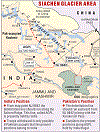
Siachen had no military presence from either side till 1984 when India prempting a Pakistani move by 48 hours occupied the high ground in the area constituted by the Saltoro ridge on the western wall of the 76 Km long glacier. The imperatives of terrain make it impossible for the other side to dislodge whoever is in occupation of the Saltoro ridge through direct assault.

Though the delineation of the 1949 Karachi Agreement Ceasefire Line and later the 1972 Simla Agreement Line of Control (LOC) stopped short of the Siachen area at point NJ9842, the definition of the Line clearly placed this area on the Indian side of the alignment by use of the words “thence north to the glaciers” through NJ9842. Pakistan projects the LOC as moving not north to the glaciers but north east to the Karakorum pass.

Both India and Pakistan have, since the late eighties, been exploring the possibility of a demilitarization of the area and withdrawal of forces to specified agreed positions. An agreement has, however, proved elusive as Pakistan has been unwilling to authenticate the Actual Ground Position Line (AGPL) which would detail the existing location of the forces of the two sides in the area. Given Pakistan’s proclivity to violate its understandings with India it would be imprudent for us to give up our insistence on Pakistan’s authentication of the AGPL. Indeed, some Indians have argued that apart from authentication, stringent safeguards, punitive clauses and guarantees must also be included to obviate the possibility of Pakistani perfidy. There is sound logic for this approach as Pakistan locational advantage in the area would enable its forces to seize a demilitarized Saltoro ridge in just 48 hours while this would take over a week for Indian forces.

There is also a compelling case that the changed circumstances of the day demand that we abandon the quest for an accord on Siachen. In this context, it may be recalled that when such an agreement was originally mooted in the late 1980’s we were taking many casualties in the area which is no longer the case due to vastly improved logistics. Furthermore, while we could, at that time, have addressed Pakistan’s occupation of the Saltoro ridge in violation of an understanding with us, by bringing to bear our superiority in conventional arms elsewhere the prevailing nuclearised environment makes this far more difficult today.

Above all, the strategic importance of the Saltoro ridge should not be underestimated and demands that we continue to occupy it. Failure to do so will prevent us from dominating the Northern Areas and the Shaksgam valley. Should Pakistan occupy the Saltoro ridge it would lead to Sino Pak link ups northwards towards the Shaksgam Valley and eastwards towards the Karakorum Pass as well as place in grave jeopardy our defence of the Shyok and Nubra valleys.

In these circumstances, reports that our Army Chief designate is expected to endorse Dr Manmohan Singh’s inclination to concede to Pakistan’s demands on Siachen are worrisome.