
Showing posts with label International Crimes Tribunal. Show all posts

Tuesday, April 9, 2013

Indo Bangladesh Relations


Maj Gen (Retd.) P K Chakravorty

Introduction

Pakistan Army surrendered to the Indian Army in Dacca on 16 December 1971. It was a victory which resulted in the creation of a new nation Bangladesh which found its rightful place in the committee of nations. India withdrew its Army and returned 93,000 Pakistani Prisoners of War back to Pakistan in accordance with the Simla agreement. The new nation was shaping up when a group of Army officers on 15 August 1975 assassinated the President Sheikh Mujibur Rehaman and his entire family. The only survivors were two daughters of the President, Sheikh Hasina and Sheikh Rehana who were in Germany. The assassination caused consternation and the Bangladesh Army called the shots. Sheikh Hasina returned to Bangladesh after six years of exile on 17 may 1981. In the mean time Bangladesh witnessed the rise of another lady Begum Khaleda Zia, the widow of late General Zia ur Rehaman who was assassinated in 1981. She heads the Bangladesh Nationalist Party (BNP). She ensured the fall of Ershad in 1990 and was elected Prime Minister for three sessions. Sheikh Hasina was first elected Prime Minister in 1996 and thereafter in 2008. Currently she is the Prime Minister making all out efforts to focus on economic development and improved international relations. Her current term ends on 29 December 2013 and elections could be held possibly in January 2014. Her main opponent would be Begum Khaleda Zia of BNP which currently has 30 seats in the Bangladesh Parliament Vis a Vis 230 of the Awami league.

Current situation

Bangladesh is economically becoming stronger with each passing day. The GDP of Bangladesh as per Purchasing Power Parity (PPP) is US $ 306 billion. Despite global economic recession the country has been maintaining a steady growth rate for the last decade at about 6% and this financial year the growth rate is about 6.4%. The country has doubled her revenue collection in the past four years. Further the foreign exchange reserves have risen to $ 12.3 billion as compared to $ 5.78 billion in 2009. The per capita income has risen to $ 848 from $676 four years ago. Currently, Bangladesh produces the best textiles in the world. The biggest achievement is that poverty is down to 31.5% from 40.4% in 2005. Education is being given tremendous importance. Schooling is free in the primary sections but figures of actual attendance vary as a large number of children are not able to attend school due to multiple reasons. Overall there is a gradual stabilisation which is reducing the illegal immigration from Bangladesh into India. Though it is estimated that there are about 10 million illegal immigrants of Bangladesh in India, improvement in socio economic conditions would lead to control over this issue.

The security forces of Bangladesh have stopped interfering with political activities and are contented undertaking military tasks. The Bangladesh Army with seven divisions and a strength of 300,000 would be receiving Russian armoured vehicles, Air defence systems from Russia on account of $1.2 billion deal signed by Prime Minister Sheikh Hasina in Jan 2013. The Navy has strength of 22.000 personnel and their primary task is coastal patrolling. They have five frigates, two submarines and numerous small surface ships. The Air Force has a strength of about 22000 and has four fighter squadrons based on F 7 and four helicopter squadrons. Bangladesh is likely to get about eight Mig 29 shortly. The Armed Forces no longer are involved in politics as was observed post 1975 till about 1990. Currently they are very keen on undertaking UN peace keeping operations which fetches them a lot of goodwill and monetarily benefit their personnel. It is reported that the UN has stated that peace keeping operations will be curtailed if the Army interferes in domestic politics. It is pertinent to note that Bangladesh would be commencing two nuclear plants with Russian assistance.

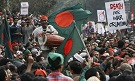
Recently the youth of the country are involved in the Shahbag protests which are being undertaken in the Shahbag portion of Dacca since 05 February 2013. The movement commenced demanding capital punishment for Abdul Quader Mollah and others convicted of crimes prior and during the liberation War in 1971. The International Crimes Tribunal had sentenced him to life imprisonment and this did not satisfy the nation. The current demand is to ban the Bangladesh Jamaat-e-Islami party as its leaders have been convicted of genocide and war crimes. The movement is apolitical and comprises the younger generation who would like the completion of the trial of the Father of the Nation Bangabandhu Sheikh Mujibur Rehaman along with his family members. The Jamaat-e-Islami has opposed the Shahbag movement and is stated to have killed Ahmed Rajib Hyder a blogger who had been posting anti Islamic posts. The BNP initially supported Jamaat but have now taken a neutral position. There has been a hartal by 23 liberal groups against the Jamaat who have been perpetrating sporadic violence.

Relations with India

India has on her part left no stone unturned to assist Bangladesh. Possibly after about 41 years Bangladesh is responding positively to India’s policies of cooperation. India and Bangladesh have excellent trade relations and exports of Bangladesh to India have crossed $500 million mark and may reach the one billion mark in future. Further to revive traditional community trading that used to exist prior to 1947, Border Haats have been started between the two countries. India’s concerns pertain primarily to Security, border boundaries, water and connectivity.

As regards security India’s main concern was use of Bangladesh by militant groups as a launch pad for executing operations against India. The present Bangladesh Government has extensively cooperated with India on this subject resulting in reducing the insurgency in the North Eastern regions of our country. The two Home Ministers have also signed an Extradition treaty on the subject.

India shares a border of 4096 km with Bangladesh. The Radcliffe line has created enclaves which need to be rationalised. India has 111 enclaves in Bangladesh and Bangladesh has 55 enclaves in India. Further there are Adversely Possessed Lands habitually used for cultivation by people of a community who suddenly found a fence hindering their activities. Both the Governments have come to an understanding and this would lead to signing of an agreement which would need ratification by Parliament. For Bangladesh it would be a simple task, but for India which would need a Constitutional amendment, it would be difficult as the Bharatiya Janta Party (BJP) has declared it opposes the settlement. It is a matter of time as people in these enclaves are keen to resolve the issue and have faith in both countries. The agreement on the border would also lead to transit rights enabling better connectivity between Bengal and Assam. This would allow people and goods to travel easily between the two countries by rail, road and some places by river.

The two countries share 54 rivers and so far only problems relating to the River Ganga have been resolved by a 30 years agreement on 12 December 1996. Hydro electric dams are being built in Meghalay and Tripura. Further, it is reported that Bangladesh is going to buy 500 mw of electricity from India. Both countries have worked out a draft agreement for Teesta River which was to be signed in September 2012 during the visit of Prime Minister Manmohan Singh to Bangladesh has been delayed due to last minute change of stand by West Bengal Chief Minister Ms Mamta Bannerjee. The issues raised by the state are being renegotiated and it is expected that the concern of West Bengal would be suitably addressed.

It is of utmost importance that the land and the Water Agreements are signed between India and the Bangladesh. This will put relations between us on a firm pedestal. Recently our President Shri Pranab Mukherjee visited Bangladesh in March 2013 and the BNP leader Begum Khaleda Zia cancelled her meeting with him stating flimsy reasons. It is necessary we make conditions congenial for re election of Awami League in 2014.

Conclusion

Sheikh Hasina Wajed has taken a strong stand against anti India terror activities on its soil. She is slated to visit India in September 2013. The agreements must be signed to facilitate her return to power in 2014.

Monday, April 1, 2013

War Crime Trials: Bangladesh on the Edge


Neha Mehta 
(Research Associate, VIF)

The 1971 Liberation War in Bangladesh has been the worst chapter in Bangladesh’s history that witnessed genocide, rape and murder at the hands of the army of West Pakistan and their collaborators in East Pakistan (present day Bangladesh). This resulted in the 1971 civil war between Mukti Bahni (Liberation army) supported by India against the Pakistani forces which had the full support of Jamaat-e-Islami. It had formed paramilitary forces like Razakars, Al-Badr and Al-Shams that were against the independence of East Pakistan. During the nine months that the war continued the Pakistani army and their collaborators killed millions of people, mainly targeting Bangladeshi intelligentsia, minority groups, women and pro-independence forces that left a permanent scar in Bangladesh’s psyche. An estimated 3 million people lost their lives through various acts of genocide, in addition to 200,000 women who were raped. Such atrocities were instrumental in the migration of over 10 million people to India.

A politically divided nation that still retains the essential ideological divide is presently facing deep crisis and uncertainty owing to the verdicts of the International Crimes Tribunal. Setting up the International Crimes Tribunal was part of PM Sheikh Hasina’s election manifesto of the 2008 elections, taking into consideration the long held demand of the people to get justice for the crimes committed more than 40 years ago. Hence, in 2010 an International Crimes Tribunal (Bangladesh) was set up to try cases against the collaborators of the Pakistan army. This included a total of nine Jamaat-e-Islami leaders and two from Bangladesh Nationalist Party (BNP)1, covering almost the whole of Jamaat-e-Islami leadership including Jamaat’s current leader, Motiur Rahman Nizami and also the party’s head in 1971, Ghulam Azam.

The current political environment in the country has become extremely volatile with a clear division over the verdicts given by the International Crimes Tribunal. On the one hand, the Jamaat-e-Islami has out rightly rejected the verdict, going on a rampage instead to have their demands met. They have demanded the dissolution of the tribunals and freedom for the accused. To that effect, they have tried all means possible to put pressure on the government, domestically as well as internationally. The government however, has refused to relent and is not bowing to any kind of pressure employed by Jamaat. Rather, the nationalist fervour in the country has gained ascendancy and there is a clamour for awarding the maximum punishment as seen in the Shahbag square movement. The Bangladesh Nationalist Party (BNP), the main opposition party, an ally of Jamaat-e-Islami has not been openly supportive of them lest they be deemed anti nationalist and anti liberation war. In addition, with elections around the corner it would be detrimental to their image.

The present upheaval has plummeted the country into a state of anarchy as a consequence of the verdict given on the three Jamaat-e-Islami leaders in the International War Crimes Tribunals. The first verdict that came out on January 21, 2013 awarded death sentence to Abdul Kalam Azad alias Bachchu Razakar in absentia (supposed to be in Pakistan) for genocide and crimes against humanity. It was after the second verdict that announced life sentence to Jamaat-e-Islami’s assistant secretary-general, Abdul Quader Mollah on February 5, 2013 which resulted in student protests at the Shahbag square. It led to huge uproar amongst the people who strongly reacted against the verdict and wanted nothing less than the death sentence for the accused. In addition, the largely peaceful student demonstrators demanded a ban on fundamentalist political parties in Bangladesh. The demonstrators and the government, however, were on the same side in the case which led the government to amend the International Crimes Tribunal Act (1973) with a provision that allows the state to file an appeal with the Supreme Court against inadequate award of sentence by the Tribunal.

However, it was the death sentence given to Maulana Delawar Hussain Sayedee who is Jamaat-e-Islami Nayab-e-Ameer which became the tipping point leading the student wing of Jamaat-e-Islami in unleashing a reign of terror and take law into their own hands. They vandalised public properties and engaged in street fighting resulting in many deaths. In addition, numerous attacks on the places of worship of minorities especially the Hindus as well as their houses were carried out by the activists of the Jamaat-e-Islami and its student wing Islami Chhatra Shibir.

Political parties like the Jamaat-e-Islami identified as the collaborators and perpetrators of the war crimes in 1971 have always been known to damage the secular fabric of Bangladesh with their extremist activities and right wing leanings. It was seen in abundance in the last government of Khaleda Zia, in which Jamaat-e-Islami was part of the four party alliance forming the government. The period of their rule, (2001-2007) saw a corresponding rise in terrorist activities that wreaked havoc in the country and led to a very unstable political environment. The 2005 bombing in which around 500 bomb explosions occurred at 300 locations in 63 out of the 64 districts of Bangladesh as well as the attack on the political rally of Awami League in 2004 in which the present PM Sheikh Hasina almost lost her life are some of the examples. It was a time during which terrorism increased to unprecedented levels with attacks being planned against secular minded opposition parties as well as against India. Their aim essentially was to establish an Islamic state.

The efforts to derail the War Crimes trial since it started to function in 2010 have continued since then with a spate of controversies and pressure being put to stop the trials Earlier also, there were attempts to destabilise the current government in order to thwart the war crimes trial as was seen in the Feb 2009 mutiny by the Bangladesh Rifles. It was suspected to have been orchestrated by the Jamaat-e-Islami so that the Awami League could not keep their election promise.

In addition, in December last year the presiding Judge of Bangladesh’s International Crimes Tribunal Mohammed Nizamul Huq’s email and skype conversations with a Brussels based lawyer were hacked. This led to his resignation and he was accused of being biased as it was alleged that he discussed the working of the tribunal with an outsider. However, the timing of the controversy that had erupted was particularly crucial as it was around this time that the verdict of Maulana Delawar Hussain Sayedee was awaited. It was aimed to bring into question the credibility of the judges and increase the pressure on the government. Owing to the controversy, calls were made for a retrial of this case, which were rejected. This was done essentially to stall the war crimes trial and project it as being one sided and biased in order to generate opinion against it internationally and domestically.

Additionally, diplomatic pressure was put on Bangladesh by the Turkish President Abdullah Gul’s letter to President Zillur Rahman that called for “clemency” to the accused on trial in the International Crimes Tribunal for the “sake of peace in the society”.2 This move, however, surprised the government, that otherwise has excellent relations with the country and it was perceived as meddling in the internal affairs of Bangladesh leading to tensions between the two.

It is anticipated that verdict would be given to all the accused this year itself due to the amendment brought about to the war crimes law that made the appeal process to be completed within 90 days timeframe.3 Going by the recent spate of violence by the activists from the Jamaat-Shibir, gives a clear idea how volatile Bangladesh is going to be in the coming months.

The war crimes trials started after more than 40 years in 2010. This was not done earlier in order to restore the unity of the nation and to establish a politically stable democracy, so as to not divide the country ideologically at its birth. Therefore, the war criminals were granted amnesty by Sheikh Mujib-ur-Rahman, the father of the nation to essentially assimilate the group into the new nation. Nonetheless, such an action did not lead to its desired results, as is quite apparent historically with the spate of military coups, assassinations, political instability and steady rise of religious fanatics and extremism in the country. The desire to change the secular credentials of Bangladesh and turn it into an Islamic State has been a constant aim of the right wing parties in Bangladesh.

A backlash from the Jamaat after the verdicts was something that was expected but the youth movement at Shahbag showed the resolve of the Bangladeshi youth who led the way to make sure that the extremists get the severest punishment. The coming few months leading up to the elections to be held later this year or early next year would be crucial with a range of issues between the incumbent government and the opposition parties that could lead to a deadlock. The law and order situation particularly would be volatile owing to the verdicts that are awaited in the International Crimes Tribunal that might again bring the country to a standstill. However, the people of Bangladesh have waited long enough for justice to be done. Therefore it is imperative for the Awami League government to see that justice is done against the people who committed such heinous crimes against millions of Bangladeshi’s during the Liberation War.

Endnotes
  1. Ethirajan, Anbarasan (Dec 2012), “Bangladesh war crimes judge Nizamul Huq resigns”,Accessed on: 15 March 2013, URL: http://www.bbc.co.uk/news/world-asia-20677752
  2. The Daily Star (Dec28, 2012), “Tension with Turkey”, Accessed on: 28 March 2013, URL:http://www.thedailystar.net/newDesign/news-details.php?nid=262861
  3. The Economist (March 2013), “Bangladesh's war-crimes trials: Bloodletting after the fact”, Accessed : 6 March 2013, URL: http://www.economist.com/blogs/banyan/2013/03/bangladeshs-war-crimes-trials