Showing posts with label Saltoro Ridge. Show all posts

Monday, May 14, 2012

Why A Siachen Agreement Should Be A Non Starter


Satish Chandra
Distinguished Fellow,VIF

Following Zardari’s recent visit to India a reciprocal visit to Pakistan by Dr Manmohan Singh in the next few months is a strong probability. In order to make the visit a “success” a clutch of agreements would need to be signed of which the one on Siachen is likely to be the centerpiece.

PM’s visit to Pakistan and the conclusion of agreements with it, particularly on issues as sensitive as Siachen, would be unwise until it gives us satisfaction on terror and abandons its inimical approach towards India.

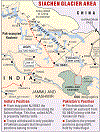
Siachen had no military presence from either side till 1984 when India prempting a Pakistani move by 48 hours occupied the high ground in the area constituted by the Saltoro ridge on the western wall of the 76 Km long glacier. The imperatives of terrain make it impossible for the other side to dislodge whoever is in occupation of the Saltoro ridge through direct assault.

Though the delineation of the 1949 Karachi Agreement Ceasefire Line and later the 1972 Simla Agreement Line of Control (LOC) stopped short of the Siachen area at point NJ9842, the definition of the Line clearly placed this area on the Indian side of the alignment by use of the words “thence north to the glaciers” through NJ9842. Pakistan projects the LOC as moving not north to the glaciers but north east to the Karakorum pass.

Both India and Pakistan have, since the late eighties, been exploring the possibility of a demilitarization of the area and withdrawal of forces to specified agreed positions. An agreement has, however, proved elusive as Pakistan has been unwilling to authenticate the Actual Ground Position Line (AGPL) which would detail the existing location of the forces of the two sides in the area. Given Pakistan’s proclivity to violate its understandings with India it would be imprudent for us to give up our insistence on Pakistan’s authentication of the AGPL. Indeed, some Indians have argued that apart from authentication, stringent safeguards, punitive clauses and guarantees must also be included to obviate the possibility of Pakistani perfidy. There is sound logic for this approach as Pakistan locational advantage in the area would enable its forces to seize a demilitarized Saltoro ridge in just 48 hours while this would take over a week for Indian forces.

There is also a compelling case that the changed circumstances of the day demand that we abandon the quest for an accord on Siachen. In this context, it may be recalled that when such an agreement was originally mooted in the late 1980’s we were taking many casualties in the area which is no longer the case due to vastly improved logistics. Furthermore, while we could, at that time, have addressed Pakistan’s occupation of the Saltoro ridge in violation of an understanding with us, by bringing to bear our superiority in conventional arms elsewhere the prevailing nuclearised environment makes this far more difficult today.

Above all, the strategic importance of the Saltoro ridge should not be underestimated and demands that we continue to occupy it. Failure to do so will prevent us from dominating the Northern Areas and the Shaksgam valley. Should Pakistan occupy the Saltoro ridge it would lead to Sino Pak link ups northwards towards the Shaksgam Valley and eastwards towards the Karakorum Pass as well as place in grave jeopardy our defence of the Shyok and Nubra valleys.

In these circumstances, reports that our Army Chief designate is expected to endorse Dr Manmohan Singh’s inclination to concede to Pakistan’s demands on Siachen are worrisome.

Tuesday, May 8, 2012

No Ground to Vacate Siachen


Kanwal Sibal
Member Advisory Board, VIF

Peace with Pakistan is a desirable goal, but peace should be equally desired by both sides and both should contribute to it in equal measure. The burden of making peace should not fall on India while Pakistan retains the freedom to disrupt it at will.
Normalization of India-Pakistan relations should not be predicated on demands by Pakistan and concessions by India. Historically, Pakistan is not a victim of India’s war-mongering; it is India that has suffered Pakistani military aggression and jihadi terrorism. Pakistan is more obliged to convince India of its peaceful intentions rather than the reverse.

Claims

The notion that India as the bigger and stronger country has to be generous with Pakistan is egregious. If this principle should dictate the conduct of international relations then China should be generous towards India on issues that divide us- which it decidedly is not- and the US, as the world’s most powerful country, should be making concessions to virtually all others- which it decidedly does not do. 

Once again we hear talk about culling the low hanging fruit of Siachen in order to politically enable the Prime Minister to visit Pakistan towards the year end. This agreement will supposedly provide the required substantive outcome that can be jointly celebrated. Why India must make a territorial concession to make its own PM’s visit possible and Pakistan need not act on terrorism is not explained.

Those who advocate withdrawal from Siachen- or more appropriately Saltoro as Siachen lies to its east- need to clarify whether we are occupying Pakistani territory. If we are, withdrawal could be mooted. If we are not, then why should we withdraw from our own territory simply because Pakistan contests India’s sovereignty over this part of J&K and insists we accept its position. Should such obduracy inspire trust in its intentions?

The 1949 and the 1972 agreements delineate the LOC till NJ9842, with the line going “northwards towards the glaciers” beyond that. “Northwards” cannot in any linguistic or geographical interpretation mean “north-eastwards”, but Pakistan and the US unilaterally drew the line several decades ago from NJ9842 north-eastwards to the Karakoram pass controlled by the Chinese. 

In reality, because the entire state of J&K acceded to India legally, the areas not in control of Pakistan are rightfully Indian whether we physically occupy every inch of our own territory or not. We were compelled to occupy the Saltoro Ridge to prevent Pakistan (under a certain Brigadier Musharraf) from occupying it and threatening our hold over the Shyok valley and potentially Ladakh itself. Why should Pakistan have wanted to occupy these punishing heights if they have no strategic value? 

Saltoro need not have “strategic” value if our borders with both Pakistan and China were demarcated, neither had any claim to our territory and relations with both were normal and friendly. It is because this is not the case that we are being compelled to position ourselves the closest possible to the source of the threats. Why withdraw to positions easier to hold physically and lose available defence depth? Should the army brass take decisions on these questions or the civilian authority?

Siachen is the Pakistan army’s agenda. General Musharraf admitted that Kargil was Pakistan’s riposte to Siachen. The argument that an Indian concession on Siachen will strengthen the hands of Pakistan’s civilian government in its peace efforts is dubious as we are being asked to appease the Pakistan army for failing to dislodge us from Saltoro. How will placating it strengthen the army’s disposition towards India and the civilian authority in Pakistan itself?
If prior to Kargil India was disposed to end the Saltoro stand-off by experimenting with Pakistan’s trustworthiness, with reducing the human cost of occupying such forbidding heights as additional reason, after Kargil India has strong reason to be deeply distrustful of Pakistani intentions. 

Context

What is the guarantee that safeguards built into any agreement will not be violated by Pakistan at an opportune time, as happened at Kargil? Meanwhile, with technical and infrasrtuctural improvements the human cost has come down drastically. What is the compulsion to place faith in an adversary that still fails to address India’s key concerns?

The jihadi groups in Pakistan still exist; Hafiz Saeed is not being curbed; those responsible for Mumbai have not been tried even after four years and to Kashmir has now been added the emotive issue of water. Pakistani defiance of the US on the issue of terrorism and truck with Islamic extremists has a lesson for India. Pakistan’s Afghan ambitions remain problematic for the region. Any concession on Saltoro should has to be assessed in this larger, unsettled context.

Course

Pakistan’s movement on the trade issue is to be welcomed. In response, even without receiving MFN status yet, India has already commmitted itself to MFN plus treatment for Pakistan and permitting Pakistani investment in India without reciprocal action by Pakistan. There is no case for rewarding Pakistan also on military-security issues in addition

What happens if just before PM’s visit to Pakistan to sign the Saltoro agreement there is a major terror attack in India? Will we postpone the visit? If this happens just after the visit and the agreement, will we freeze its implementation? What will that say of our political judgment? Terrorism remains the most critical issue.

Ideally, Saltoro should be part of an overall settlement of the J&K issue. As a first step, before any evenly balanced demilitarization eventually takes place as a CBM, the LOC should be jointly demarcated beyond NJ9842 along the Actual Ground Position Line, which we now seem to be demanding in what General Kayani sees as a hardening of our posture.