Brig (retd) Gurmeet Kanwal
(Visiting Fellow, VIF)
Since independence, India has faced a large number of external and
internal security challenges. The Indian army, the paramilitary forces
and the Central Armed Police Forces (CAPFs) have worked hand-in-hand to
manage and neutralise these challenges. While the army has been
responsible to maintain the integrity of the country’s long land
boundaries through four wars and the Kargil conflict, the CAPFs have
been largely responsible to manage the land borders and lend a helping
hand to the army for counter-insurgency operations. Some insurgencies
are now being fought primarily by the CAPFs by themselves.
In May 2001, the Cabinet Committee on Security (CCS) had approved the
concept of “one border, one force”. The Line of Actual Control (LAC)
along the border with Tibet is now being managed largely by the
Indo-Tibetan Border Police (ITBP). In the west, the entire border with
Pakistan is manned by the Border Security Force (BSF) except the Line of
Control (LoC) in Jammu and Kashmir (J&K). Maintaining the sanctity
of the LoC is the responsibility of the army and some BSF battalions
have been placed under its operational control for this purpose. For
over 50 years since the Kashmir conflict began in 1947-48, soon after
independence, the two armies were engaged in a so-called
‘eyeball-to-eyeball’ confrontation with daily loss of life and property
that could justifiably be called a ‘low intensity limited war’. An
informal cease-fire has been in place all along the LoC, including at
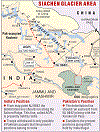
the Actual Ground Position Line (AGPL) along the Saltoro Range west of
the Siachen Glacier, since November 25, 2003.
The border with Nepal was virtually un-attended till very recently as
Nepalese citizens have free access to live and work in India under a
1950 treaty between the two countries. Since the eruption of a Maoist
insurgency in Nepal, efforts have been made to gradually step up
vigilance along this border to prevent the southward spread of Maoist
ideology. The responsibility for this has been entrusted to the
Sashastra Seema Bal (SSB), erstwhile Special Security Bureau that is now
a Ministry of Home Affairs force. The Bhutan border is also managed by
the SSB. Since the Royal Bhutanese Army drove out the Bodo and ULFA
insurgents from its territory some years ago, the border has been
relatively quiet. The border with Myanmar also remains operationally
active. Several insurgent groups have secured sanctuaries for themselves
in Myanmar despite the cooperation extended to India by the Myanmarese
army. The cross border movement of Nagas and Mizos for training,
purchase of arms and shelter when pursued by Indian security forces,
combined with the difficult terrain obtaining in the area, makes this
border extremely challenging to manage. This border is manned by the
Assam Rifles (AR), India’s oldest paramilitary force.
Along the Bangladesh border that has seen some action in recent
years, the BSF is in charge. This border remains in the news as there
are frequent clashes between the BSF and the Bangladesh Rifles (BDR).
Managing this border is a peculiar challenge that is usually referred to
as ‘Enclaves and Adverse Possessions’. There are 111 Indian enclaves
(17,158 acres) within Bangladesh and 51 Bangladeshi enclaves (7,110.02
acres) in India.” Thirty-four tracts of Indian land are under the
adverse possession of Bangladesh and 40 pieces of Bangladeshi land are
in India’s adverse possession. Though the Land Border Agreement of 1974
has provisions for the settlement of the issue of adverse possession, it
has not been implemented so far as the problem is politically
sensitive.
The CCS had also approved the nomination of the Central Reserve
Police Force (CRPF) as the country’s primary counter-insurgency force.
Since then, the BSF has been withdrawn from internal security duties in
J&K and has been replaced by CRPF battalions. The CRPF is also the
primary strike force for anti-Naxalite or anti Maoist operations in the
left wing extremism (LWE) affected states in central India. Though it
has suffered many casualties in operations so far and is still on a
learning curve, it is gradually gaining experience in counter-insurgency
operations and can be expected to acquit itself creditably in future.
Over the last few decades, the CAPFs have seen rapid expansion, some
of which appears to have been hastily undertaken. They face many
structural problems and need to be reorganized to suit their evolving
roles. Also, the lack of inter-departmental coordination has led to the
sub-optimal exploitation of the combat potential of the various forces,
which is not in the nation’s best interests. It is time the government
appointed a high-powered Study Group to enquire into the challenges
being faced by the CAPFs, with a view to recommending remedial measures
to improve their efficiency.