Showing posts with label Cabinet Committee on Security. Show all posts

Wednesday, May 8, 2013

Defence Planning and Budgetting Woes Persist


Brig (retd) Vinod Anand, 
Senior Fellow, VIF

The defence budget for 2013-2014 was passed in the Parliament without as much as a whisker of debate. The Parliament’s Standing Committee on Defence (SCD) as a statutory requirement did go through the demands for grants by the MOD but their recommendations and observations are generally given a go by and in many cases are totally overlooked. The SCD has regularly pointed out the infirmities in implementing our defence planning process, lack of adequate allotment of funds for the defence services and problems in our defence procurement mechanisms and procedures.

The Tenth (2002-2007) and Eleventh Five Year Defence Plans (2007-2012) lapsed without getting the approval of the government and this too after defence reforms were introduced and HQ IDS was formed to address many of the issues concerned with defence planning and budgeting processes. Pity is that while HQ IDS had worked out these two plans in time they could not be finalized by the government in the entire tenure of their plan periods. This only shows that the government is not seized with urgency of shoring our defence capabilities. The SCD also has ‘consistently been raising serious concern over non-finalisation of long-term plans which have resulted into adhocism in the planning processes’. As a matter of fact the Twelfth FYDP (2012-2017) has already commenced without being approved by the government. This exercise should have finished at least a year before the commencement of the plan.

Last year when the former Army Chief pointed out the critical gaps in defence capabilities, the Defence Acquisition Committee (DAC) headed by the Defence Minister quickly gave his assent to the 12th FYPD and also finalized 15 year Long Term Integrated Perspective Plan (LTIPP) 2012-2027. But after that a year has lapsed without getting the required approvals from Ministry of Finance and the Cabinet Committee on Security for its 12th five year plan and LTIPP. The current plan aims at improving armed forces combat effectiveness against China and Pakistan, upgrade military infrastructure along the "northern borders", ensure third-generation night-fighting capabilities, induct attack helicopters and overcome the slippages or the critical hollowness in arms and ammunition besides inducting additional platforms and connected defence systems for Indian Air Force and Navy.

Further, the Defence Minister and MOD had gone on record to state that a National Security Strategy(NSS) document would be made from which would flow out Defence Planning Guidance (DPG) and thereafter a National Military Strategy (NMS) would be formulated that would be reflected in our defence plans. In fact a draft NSS had been circulated amongst the various ministries and stakeholders but thereafter it has not seen light of the day. The SCD of 14th Lok Sabha had deliberated on the issue of NSS and was looking forward to its formulation but now the current SCD of 15th Lok Sabha has completely forgotten about it.

Last year a proposal for raising a Mountain Strike Corps in the North East by the Army was sent back (after one year of consideration at the MOD/government level) for reappraisal by the COSC so that requirements of other services can also be taken into account. The COSC has given its recommendation for raising of the Corps but the requisite approvals from the Cabinet Committee on Security are still awaited. The problems are further compounded by the fact that there is no common view on NSS and threat perceptions amongst the services in the absence of an articulated NSS, DPG and NMS.

Resource allocation for the defence services is an area where same problems have continued to persist without being addressed in a meaningful manner. Firstly, the funds allotted are always much less than the projections; secondly, there is the question of surrender of funds and thirdly the ever present requirement of improving capital to revenue ratios of the defence budget.

The table given below depicts the projections for funds made by respective services for the current year and last year and the allotments made. It is very rare that the services have been allotted funds as projected. Therefore, the SCD has been oft repeating its recommendation that ‘keeping in view the increasing trend of military expenditure of neighbouring countries, India should also expand the size of allocations made to Defence Budget so that Indian forces are fully equipped with modern weaponry’.

(Budget estimates in Crores of Rupees)

Service BE 2012-13 BE 2013-14
Projected Allotted Projected Allotted
Army 112096.22 96564.83 118883.46 99003.03
Navy 44478.90 37314.44 52940.22 36343.46
Air Force 56838.25 48220.26 90530.48 57503.94

Looking at above figures it is evident that that allotment of funds to Army is short by about Rs. 19880, Navy is short by Rs. 16596 crore and Air Force is short by Rs. 33026 crore in Budget Estimate of 2013-14. The services also did not fare well in this regard last year; and last five years data of budget for capital acquisitions also reveals that the allotment of funds to services have been much less than projected. Further, last year there has been under spending of Rs. 16040 crore under the capital head which only indicates that not enough momentum is being imparted to the modernisation drive of our armed forces.

In addition there has been consistent lower allocation as percentage of GDP over the years. For instance, in 2009-2010 it was 2.19 percent, 2010-11 it was lower at 1.98, 2011-12 it was 1.90, it declined to 1.78 last year and it stands at 1.79 in the current year. Our neighbours like China and Pakistan spend 2.1percent and 3 percent of the GDP on defence; the US spends even more at 4% of GDP.

Another feature of the capital budget of 2012-13 and 2013-14 has been that the committed liabilities consume a large portion of the budget thus leaving very little for new schemes. The most affected are the technology intensive services like the Air Force and Navy but the Army is also not far behind. For instance, in 2013-14 the capital budget for new schemes for the Air Force is meagre Rs. 2010 crores, for Navy 443 crores and for Army is 494 crore whereas the committed liabilities for the three services are to the tune of Rs 64,680 crore.

Though the revenue to capital budget ratios have improved over the years to an average of 60: 40, the SCD feels that ‘Ministry has not shown any commitment to increase the capital ratio in comparison to revenue ratio for the forces’ as the ratio should at least be improved to 55:45. This ratio seems to have been achieved earlier in the defence budget of 2008-09. However, this ratio needs to be stepped up to 50:50 with increased outlays for the budget so that modernisation of forces could proceed at a faster pace.

Our defence procurement system has been modified and improved many times without resulting into any appreciable improvements on the ground. Our procurement system, organisations, procedures and mechanisms have not been able to fast track the acquisitions which the armed forces need to narrow the capability gap which exists with our potential adversaries. Last year Comptroller and Auditor General castigated the entire arms procurement process and cited several incidents of inordinate delays. There have been unacceptable delays in obtaining critical air defence equipment and spares for damaged Israeli aerostat radars; the weapon packages for MIG-29Ks meant for our aircraft carrier were not finalised as a result they were delivered without weapon systems and because of poor monitoring and inadequate attention to contracts clauses additional problems arose in acquisition of Low-Level Transportable Radars.

Financial powers of the Defence Minister, Defence Secretary and Services HQs were enhanced last year to process capital procurement cases for filling in some of the critical deficiencies. Defence Minister was empowered to process procurement cases of upto Rs. 500 crore; Service HQ level have been delegated with financial powers to process procurement cases upto Rs.50 crore, Capital Cases above Rs.50 crore and upto Rs.75 crore are approved by Defence Secretary. There was a proposal also to increase the amount. Finance Minister could process upto Rs1000 crore and beyond that was the domain of Cabinet Committee on Security. Results so far indicate that there has not been much impact of the enhancement of financial powers as procurement woes for several reasons continue to persist.

In one of the controversial recommendations by the Naresh Chandra Committee it was proposed that the practice of blacklisting firms of suppliers should be discontinued. It has also suggested that the Prevention of Corruption Act be modified to give a certain degree of protection to officers dealing in defence purchases as there are possibilities of making 'an error of judgment'. This flies in the face of the procurement procedures which are based on the principles of probity, integrity and transparency and so on. Without doubt there is a need to streamline the procedures but including the above provisions would only add to more flaws and possibilities of wrong doing in the defence purchases.

Without doubt we need to rectify the situation where we import 70 percent of our military hardware needs. These include a greater role in indigenous production of the private sector. The Defence Research and Development Organisation should work in closer cooperation with the armed forces than is the case at present. The DRDO also needs to be allotted about 10 percent of the defence budget to spur research and innovation.

A Technology Perspective Capability Roadmap (TPCR) has been prepared based on the LTIPP so that DRDO, Defence Public Sector Undertakings and the Indian industry could plan their research and development roadmap accordingly. A new Defence Production Policy has also been posted on the MOD’s website in order to give encouragement to indigenisation of defence industry. This policy is based on the Defence Procurement Procedure of 2011 which has been again modified. It is too early to tell whether the new policy would be instrumental in addressing the woes of our procurement and indigenization.

All these steps would take some time to mature, meanwhile our military preparedness continues to suffer; no wonder that our difficult neghbours like China and Pakistan have been flexing their muscles without an appropriate response from our side. Ladakh incident is a wake up call and if we do not get our act together we would be staring at a repetition of 1962 debacle which could be worse than the previous one because this time Pakistan would be too glad to join in against India.

Tuesday, April 2, 2013

Synergising the Combat Potential of the Central Armed Police Forces


Brig (retd) Gurmeet Kanwal 
(Visiting Fellow, VIF)

Since independence, India has faced a large number of external and internal security challenges. The Indian army, the paramilitary forces and the Central Armed Police Forces (CAPFs) have worked hand-in-hand to manage and neutralise these challenges. While the army has been responsible to maintain the integrity of the country’s long land boundaries through four wars and the Kargil conflict, the CAPFs have been largely responsible to manage the land borders and lend a helping hand to the army for counter-insurgency operations. Some insurgencies are now being fought primarily by the CAPFs by themselves.

In May 2001, the Cabinet Committee on Security (CCS) had approved the concept of “one border, one force”. The Line of Actual Control (LAC) along the border with Tibet is now being managed largely by the Indo-Tibetan Border Police (ITBP). In the west, the entire border with Pakistan is manned by the Border Security Force (BSF) except the Line of Control (LoC) in Jammu and Kashmir (J&K). Maintaining the sanctity of the LoC is the responsibility of the army and some BSF battalions have been placed under its operational control for this purpose. For over 50 years since the Kashmir conflict began in 1947-48, soon after independence, the two armies were engaged in a so-called ‘eyeball-to-eyeball’ confrontation with daily loss of life and property that could justifiably be called a ‘low intensity limited war’. An informal cease-fire has been in place all along the LoC, including at the Actual Ground Position Line (AGPL) along the Saltoro Range west of the Siachen Glacier, since November 25, 2003.

The border with Nepal was virtually un-attended till very recently as Nepalese citizens have free access to live and work in India under a 1950 treaty between the two countries. Since the eruption of a Maoist insurgency in Nepal, efforts have been made to gradually step up vigilance along this border to prevent the southward spread of Maoist ideology. The responsibility for this has been entrusted to the Sashastra Seema Bal (SSB), erstwhile Special Security Bureau that is now a Ministry of Home Affairs force. The Bhutan border is also managed by the SSB. Since the Royal Bhutanese Army drove out the Bodo and ULFA insurgents from its territory some years ago, the border has been relatively quiet. The border with Myanmar also remains operationally active. Several insurgent groups have secured sanctuaries for themselves in Myanmar despite the cooperation extended to India by the Myanmarese army. The cross border movement of Nagas and Mizos for training, purchase of arms and shelter when pursued by Indian security forces, combined with the difficult terrain obtaining in the area, makes this border extremely challenging to manage. This border is manned by the Assam Rifles (AR), India’s oldest paramilitary force.

Along the Bangladesh border that has seen some action in recent years, the BSF is in charge. This border remains in the news as there are frequent clashes between the BSF and the Bangladesh Rifles (BDR). Managing this border is a peculiar challenge that is usually referred to as ‘Enclaves and Adverse Possessions’. There are 111 Indian enclaves (17,158 acres) within Bangladesh and 51 Bangladeshi enclaves (7,110.02 acres) in India.” Thirty-four tracts of Indian land are under the adverse possession of Bangladesh and 40 pieces of Bangladeshi land are in India’s adverse possession. Though the Land Border Agreement of 1974 has provisions for the settlement of the issue of adverse possession, it has not been implemented so far as the problem is politically sensitive.

The CCS had also approved the nomination of the Central Reserve Police Force (CRPF) as the country’s primary counter-insurgency force. Since then, the BSF has been withdrawn from internal security duties in J&K and has been replaced by CRPF battalions. The CRPF is also the primary strike force for anti-Naxalite or anti Maoist operations in the left wing extremism (LWE) affected states in central India. Though it has suffered many casualties in operations so far and is still on a learning curve, it is gradually gaining experience in counter-insurgency operations and can be expected to acquit itself creditably in future.
Over the last few decades, the CAPFs have seen rapid expansion, some of which appears to have been hastily undertaken. They face many structural problems and need to be reorganized to suit their evolving roles. Also, the lack of inter-departmental coordination has led to the sub-optimal exploitation of the combat potential of the various forces, which is not in the nation’s best interests. It is time the government appointed a high-powered Study Group to enquire into the challenges being faced by the CAPFs, with a view to recommending remedial measures to improve their efficiency.

Wednesday, July 4, 2012

Why India’s Mega Cities Need to be Protected


Nitin Gokhale,
Visiting Fellow, VIF

Mumbai in July 2011.

Three bomb blasts in a matter of half an hour shook Mumbai again, killing 21 people.


A sense of déjà vu prevailed. But there was a vital difference between earlier attacks on Mumbai and the July 2011 bombings.

This time telephone and mobile lines, overloaded with panicky calls, froze.
So much so that key decision-makers in the Mumbai metropolitan area, from the Chief Minister downwards, could not communicate with each other for over 15 minutes in the immediate aftermath of the blasts.

This incident brought home, starkly, the shortcomings in India’s policing infrastructure: Communication equipment remains outdated; mobility is severely hampered; preventive and pre-emptive measures against a terrorist attack are virtually non-existent.

That there are massive challenges to India’s internal security—aided by external factors—is now a well-known fact. What is not common knowledge however is that the Ministry of Home Affairs (MHA) has been making deliberate and concerted efforts to plug the very obvious gaps in the security architecture of the country.

However given the size, diversity and myriad nature of threats that exist in India, the MHA and various organisations under it have a mammoth task ahead to secure the country.

While India has had reasonable success in confronting the secessionist, ethnic movements in the North-east and in Kashmir, the externally-sponsored jihadi threat in India’s biggest cities is emerging as the greatest challenge for the security managers.
The jihadi elements are a more potent threat for two reasons: One, they have linkages across continents and certainly across Asia, are technology-savvy, are well-funded and their target is India’s big metropolises.

The repatriation from Saudi Arabia of Zakiuddin Anasari alias Abu Jundal, one of the masterminds of the 26/11 Mumbai attacks and his subsequent revelations have brought home this fact more starkly than ever before.

Till two decades ago, the biggest threat in Indian cities was limited to ethnic or communal flare ups. Riots of the kind that happened in Ahmedabad, Meerut, Kolkata, Bhiwandi between Hindus and Muslims and in Delhi between Sikhs and Hindus were the main law and order challenges faced by Indian policemen.

Turning Point

But the serial bomb blasts in Mumbai in March 1993 and the subsequent riots thereafter completed transformed the security landscape in India. Terror had arrived big time in India. The modus operandi adopted by the new perpetrators of violence was something that was unknown to the Indian security apparatus. RDX was used for the first time.

The well-entrenched local mafia network actively supported, funded and armed by an external agency inimical to India introduced a paradigm shift in terror tactic that has been bleeding India time and again for the past two decades.

The delivery boys of violence are no longer identifiable easily. They operate in the shadows; have a pan-India presence and sanctuaries across Asia. Their funding comes from Pakistan, their foot soldiers can be from any state in India.

Their favourite weapon is the IED: the improvised explosive device. Unobtrusive but deadly.

Jaipur, Surat, Bangalore, Ahmedabad, Pune, Mumbai, Delhi…the list reads like a who’s who of Indian cities. The figures are staggering. According to the South Asian Terrorism Portal (satp.org) between 1994 and May 2012, over 61,000 people including civilians, security personnel and terrorists, have died in violence in India.

That’s on an average 5,000 people dying violently in a year!

For example n estimate by Asian Economy Institute in the immediate aftermath of the Mumbai attack of November 2008 said, the Indian Economy took a hit of over 100 billion dollars during the three days that the Lashkar-e-toiba terrorists held the city and indeed India to ransom.

Terrorism is therefore clear and present danger for an India that is economically growing faster than most of the world and is poised to become a regional power in the next decade.

Thus the Government’s first priority is to evolve a meaningful, effective counter-terrorism strategy.

At the centre of this strategy is the security of 10 big cities.

So what constitutes protection of cities and mega cities? So what are the vulnerabilities in big cities? And how do governments hope to tackle them?

Ever since the 9/11 incident forced a paradigm shift in the concept of securing urban areas, security mandarins have grappled with conflicting ideas to evolve a workable counter-terrorism model.

In 2006-07, MHA designated seven urban areas-- Mumbai, Kolkata, Delhi, Chennai, Hyderabad and Bangalore and Ahmedabad—as mega cities in need of a special security grid.

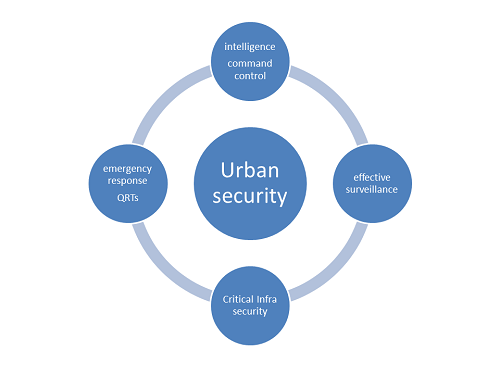
Thus Mega City Policing is built around four major components.


A correct mix of tech Int (technology-based intelligence) and HumInt (Human Intelligence) is required to prevent terrorist attacks anywhere. Indian agencies have so far been pre-dominantly dependent on human intelligence but slowly, technical intelligence is being given equal if not more importance. In order to evolve a comprehensive security plan.

Under the MHA’s Mega City Policing scheme coupled with city-specific plans, new technically gadgets and schemes are being included in the plans.

Financial assistance is given to mega cities for procurement of modern and innovative equipment like Night Vision Devices, GPS/GIS for dial 100 system and patrol cars, surveillance camera systems, CCTV systems, security equipments like portable x-ray machines, vehicle scanner, vehicle number plate identification system, cyber patrol and communication monitoring system, integrated GIS based automated vehicle tracking and management system, etc.

The Mega Cities are asked to prepare individual, city specific plans for consideration of the Government every year. The Plan should be based on a study on specific problem areas of Mega City Policing including details of demographic growth pattern, special problems faced in policing in large urban areas and crime investigation, traffic management, infrastructure available in terms of modern control rooms, digital radio trunking, communication system, PCR van network etc.

Therefore, the crucial equipment that the government is looking for is in two areas: Pre-event and post event.

MHA has recognised that seamless integration of the different components of a security system is essential to obtain maximum efficiency and effectiveness. The integration also needs to extend to backend applications such as e-governance systems and other online and IT systems.

As Home Minister P. Chaidambaram said in 2009: "The police stations in the country are, today, virtually unconnected islands. Thanks to telephones and wireless, and especially thanks to mobile telephones, there is voice connectivity between the police station and senior police officers, but that is about all. There is no system of data storage, data sharing and accessing data. There is no system under which one police station can talk to another directly. There is no record of crimes or criminals that can be accessed by a Station House Officer, except the manual records relating to that police station.”

The Home Ministry has, since 2009 consistently increased the budget for internal security and specifically for modernisation of police forces. However tardy and sometimes indifferent implementation by state governments has created gaps in India’s preparedness for internal security.

In April 2012, P. Chidambaram told a Chief Ministers conference: “Modernisation of Police Force (MPF) scheme was allotted Rs.1,111 crore in 2011-12, but we had to surrender Rs. 311 crore because some States had large unspent balances. For the current year, we have been able to secure Rs.900 crore and I would urge State Governments to address the deficiencies in the implementation of the scheme to help me request the Finance Minister for more funds.”

In fact funds are not a problem. An effective roadmap for strengthening internal security is.

Some elements are in place. For example, the Multi Agency Centre (MAC) and the Subsidiary MACs at the State capitals. NATGRID is work in progress. CCTNS (Crime & Criminal Tracking Network and Systems), under implementation since 2010, has reached the crucial milestone of selection of System Integrator, but only 16 out of 35 States/UTs have completed the task. On the other hand, the development of Core Application Software (CAS) has been completed, field testing is under way, and agreements have been signed to establish nation-wide connectivity.

The Cabinet Committee on Security (CCS), India’s highest decision-making body for security-related matters had approved an Rs 8,500 crore plan to revamp the country’s maritime security architecture.

It had identified that for effective coastal security, India requires maritime patrol boats, ferries, fast attack vessels, maritime surveillance systems and equipment, access control systems, biometric systems, CCTV equipment, thermal imaging system, explosives detection equipment, radar systems, screening technologies, cameras x-ray body scanners and baggage scanners, early warning systems, identification systems, transponders, etc.

The Indian Coast Guard itself is looking to procure 5 offshore patrol vessel, 10 fast-attack craft, 20 interceptor boats, hovercrafts, radars, 12 Dornier aircraft and 30 helicopters, among other things.

In short, India’s homeland security agencies, which primarily consist of the paramilitary forces, state and central police forces and the intelligence agencies, are likely to spend over $ 7.5 billion and state governments close to $ 2 billion on the modernization of their police and para-military organizations in the next 3-5 years. A huge market exists but unless a proper roadmap and strict deadlines to implement the plans evolve, no amount of good intention is likely to make India secure.