Showing posts with label Shaksgam Valley. Show all posts

Monday, May 14, 2012

Why A Siachen Agreement Should Be A Non Starter


Satish Chandra
Distinguished Fellow,VIF

Following Zardari’s recent visit to India a reciprocal visit to Pakistan by Dr Manmohan Singh in the next few months is a strong probability. In order to make the visit a “success” a clutch of agreements would need to be signed of which the one on Siachen is likely to be the centerpiece.

PM’s visit to Pakistan and the conclusion of agreements with it, particularly on issues as sensitive as Siachen, would be unwise until it gives us satisfaction on terror and abandons its inimical approach towards India.

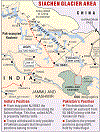
Siachen had no military presence from either side till 1984 when India prempting a Pakistani move by 48 hours occupied the high ground in the area constituted by the Saltoro ridge on the western wall of the 76 Km long glacier. The imperatives of terrain make it impossible for the other side to dislodge whoever is in occupation of the Saltoro ridge through direct assault.

Though the delineation of the 1949 Karachi Agreement Ceasefire Line and later the 1972 Simla Agreement Line of Control (LOC) stopped short of the Siachen area at point NJ9842, the definition of the Line clearly placed this area on the Indian side of the alignment by use of the words “thence north to the glaciers” through NJ9842. Pakistan projects the LOC as moving not north to the glaciers but north east to the Karakorum pass.

Both India and Pakistan have, since the late eighties, been exploring the possibility of a demilitarization of the area and withdrawal of forces to specified agreed positions. An agreement has, however, proved elusive as Pakistan has been unwilling to authenticate the Actual Ground Position Line (AGPL) which would detail the existing location of the forces of the two sides in the area. Given Pakistan’s proclivity to violate its understandings with India it would be imprudent for us to give up our insistence on Pakistan’s authentication of the AGPL. Indeed, some Indians have argued that apart from authentication, stringent safeguards, punitive clauses and guarantees must also be included to obviate the possibility of Pakistani perfidy. There is sound logic for this approach as Pakistan locational advantage in the area would enable its forces to seize a demilitarized Saltoro ridge in just 48 hours while this would take over a week for Indian forces.

There is also a compelling case that the changed circumstances of the day demand that we abandon the quest for an accord on Siachen. In this context, it may be recalled that when such an agreement was originally mooted in the late 1980’s we were taking many casualties in the area which is no longer the case due to vastly improved logistics. Furthermore, while we could, at that time, have addressed Pakistan’s occupation of the Saltoro ridge in violation of an understanding with us, by bringing to bear our superiority in conventional arms elsewhere the prevailing nuclearised environment makes this far more difficult today.

Above all, the strategic importance of the Saltoro ridge should not be underestimated and demands that we continue to occupy it. Failure to do so will prevent us from dominating the Northern Areas and the Shaksgam valley. Should Pakistan occupy the Saltoro ridge it would lead to Sino Pak link ups northwards towards the Shaksgam Valley and eastwards towards the Karakorum Pass as well as place in grave jeopardy our defence of the Shyok and Nubra valleys.

In these circumstances, reports that our Army Chief designate is expected to endorse Dr Manmohan Singh’s inclination to concede to Pakistan’s demands on Siachen are worrisome.

Monday, May 7, 2012

India-China Relations are Marked by Strategic Stability, Tactical Aggressiveness

Gurmeet Kanwal
Visiting Fellow, VIF

Relations between India and China have been fairly stable at the strategic level. Economic relations are much better now than these have been in the past. Mutual economic dependence is growing rapidly even though the balance of trade is skewed in China’s favour. 

The two countries have been cooperating in international fora like WTO talks and climate change negotiations. There has even been some cooperation in energy security. However, at the tactical level, China has been exhibiting a markedly assertive political, diplomatic and military attitude. Instability in the security relationship, in particular, has the potential to act as a spoiler; and, it is this relationship that will ultimately determine whether the two Asian giants will clash or cooperate for mutual gains. The major cause for instability in the China-India relationship is the half-century old territorial and boundary dispute over which the two countries fought a border war in 1962.

The pointers to the future are not particularly positive. China continues to be in physical occupation of large areas of Indian territory in Jammu and Kashmir. On the Aksai Chin plateau in Ladakh in J&K, China is in possession of approximately 38,000 square kilometres of territory since the mid-1950s. In addition, Pakistan illegally ceded 5,180 sq km of Indian territory to China in 1963 in the Shaksgam Valley of Pakistan Occupied Kashmir under a bilateral boundary agreement that India does not recognise. Close to this area, the Chinese built the Karakoram highway that now provides a strategic land link between Xinjiang, Tibet and Pakistan. China continues to stake its claim to about 96,000 sq km of Indian territory in the eastern state of Arunachal Pradesh, which it calls Southern Tibet. 

Chinese interlocutors have repeatedly claimed that the Tawang Tract, in particular, is part of Tibet and that the merger of this area with Tibet is non-negotiable. In 2005, India and China had agreed on “guiding principles and parameters” for a political solution to the territorial dispute. One important parameter was that “settled populations will not be disturbed”. In the case of Tawang, the Chinese have gone back on their commitment. If such errant behavior continues, India will find it difficult to accept Chinese assurances of peaceful resolution of the territorial dispute at face value.

The Line of Actual Control (LAC) between India and China is yet to be physically demarcated on the ground and delineated on military maps. In fact, despite the Border Peace and Tranquility Agreement (BPTA) signed with the Chinese in 1993 and the agreement on Confidence Building Measures in the Military Field signed in 1996, border guards of the People’s Liberation Army (PLA) have transgressed the LAC repeatedly to intrude into Arunachal Pradesh and Ladakh. They have even objected to Indian road construction efforts and the presence of Indian graziers at their traditional grazing grounds. To be fair to the Chinese, they too claim similar transgressions by Indian patrols.

Patrol face-offs are commonplace and usually end with both the sides warning each other to go back to their own territory. While no such incident has resulted in a violent clash so far, the probability of such an occurrence is high. Demarcation of the LAC without prejudice to each other’s position on the territorial dispute would be an excellent confidence building measure but little progress has been made in 15 rounds of talks between the two Special Representatives, including the January 2012 meting at New Delhi. Under the circumstances, China’s intransigence in exchanging maps showing the alignment of the LAC in the western and the eastern sectors is difficult to understand. 

The military gap between Indian and China is growing steadily as the PLA is modernising at a rapid pace due to the double-digit annual growth in the Chinese defence budget while India’s military modernisation plans continue to remain mired in red tape. China’s negotiating strategy is to stall resolution of the dispute till the Chinese are in a much stronger position in terms of comprehensive national strength so that they can then dictate terms. The rapidly blossoming strategic partnership between China and Pakistan is also a major cause for concern. Chinese leaders have proclaimed that their friendship with Pakistan is “higher than the mountains and deeper than the oceans.” China has also guaranteed Pakistan’s territorial integrity.

During any future conflict with either China or Pakistan – even though the probability is low, India will have to contend with a two-front situation as each is likely to collude militarily with the other – a situation for which the Indian armed forces are not prepared. Hence, it is in India’s interest to strive for the early resolution of the territorial dispute with China so that India has only one major military adversary to contend with.