Showing posts with label Chabahar. Show all posts

Friday, July 3, 2015

Thoughts on India’s Central Asia Strategy

Amb Rajiv Sikri, 
Distinguished Fellow, VIF

It is indeed encouraging that in a few days Prime Minister Modi will be visiting all the Central Asian countries simultaneously, something that no Indian Prime Minister has done so far. However, India seems to be grappling with the same issues and dilemmas in relation to Central Asia that were present in the nineties, notwithstanding periodic efforts to kick-start the relationship. Why is this so? There are both objective constraints, as well as some missed opportunities.

If it is to have an enduring impact, Prime Minister Modi’s visit will have to go beyond promoting goodwill and the usual bilateral agreements and discussions. He must go with a clear strategic perspective of India’s relations with the Central Asian countries; without that, it won’t be possible to develop a viable Central Asia policy. India’s relations with the Central Asian Republics (CARs) must take into account developments in the wider Eurasian space that includes the five CARs, Afghanistan, Pakistan west of the Indus, Iran, Tibet, Xinjiang and Mongolia, and the Indian state of Jammu and Kashmir, including those regions currently occupied by Pakistan and China.

Throughout history, Eurasia has been a strategic not a mere geographic space. As a geographical area on to which the back doors, so to speak, of major Asian powers open, Eurasia has always attracted, and will continue to attract, the attention of outside powers. It is a ‘negative security space’, an area where major powers cannot afford to let competing major powers or forces exercise a dominating influence because that would pose a threat to their own security. The Cold War and the impermeable political borders of Eurasia during this period dulled strategic perceptions about this region, but that was a geo-strategic aberration.

For the last quarter century, Eurasia has been once again at the centre of global geopolitics. In the second half of the 19th century and the early 20th century, it was the setting for the ‘Great Game’ between imperial Britain and Tsarist Russia. A century later, the geostrategic imperatives remain unchanged, only the ‘game’ has become more complicated, with energy emerging as an additional factor in strategic calculations. Connectivity across Eurasia has dramatically improved. Roads, railway tracks as well as oil and gas pipelines and power transmission lines are criss-crossing the region. Of course, so are drug smugglers, terrorists and fundamentalists.

The CARs, both collectively and individually, are today much weaker than their geographically contiguous large neighbours like Russia and China. Between the two, Russia’s influence has declined while China’s has steadily increased in the CARs over the last quarter century. Since 9/11, the United States has also become an active player in the region. These three powers are the principal outside players. Other powers such as Europe, Japan, Turkey, Iran, Pakistan and India still play only marginal roles.

Russia is taking purposeful steps to regain its preponderant influence in the CARs. It has enmeshed most of them in regional security and military arrangements like the Collective Security Treaty Organization (CSTO) as well as through bilateral military agreements. A Russia-dominated Eurasian Economic Union including Kazakhstan and Kyrgyzstan has been set up; Tajikistan too may join it. Russia has many additional levers in Central Asia viz. a significant and influential Russian origin population; good networking; dependence of many CARs on remittances of migrants working in Russia; transit facilities for landlocked CARs; and considerable economic interdependence of CARs with Russia. While wanting to reduce the strong grip of Russia that held them for seven decades, the CARs realize that they can neither ignore nor do without Russia.

A rising China is systematically and relentlessly sucking the CARs into its economic whirlpool. Energy supplies for its fast-growing economy, a proximate market for its products, and a security buffer for Xinjiang – these are China’s main concerns vis-à-vis the CARs. Having taken over Xinjiang, it now seeks to dominate the CARs. This won’t be easy, since China faces many serious long-term challenges. Xinjiang, which has extensive ethnic, economic, social and other ties with the CARs could turn out to be China’s Achilles heel. Uighur nationalism remains strong. The fate of the Muslim Uighurs carries resonance among the Islamic ummah. Some Uighur elements appear to have developed linkages with the al-Qaeda, the Taliban and, more recently, the Islamic State too. Xinjiang’s security and stability could be compromised by turmoil or turbulence in the CARs. China realizes this – its latest Defence White Paper mentions the dangers from separatist forces fighting for “East Turkestan independence.” Moreover, despite benefiting from China’s economic growth the CARs remain wary of becoming economically too dependent on China, and worry about creeping Chinese demographic expansionism. Historically, China has been viewed by Central Asians as an expansionist and dominating power, and recent Chinese muscle flexing in Southeast Asia would have reinforced traditional suspicions about China’s attitude towards weak neighbours.

Capitalizing on the favourable climate after 9/11, the United States rushed to establish a number of bases in the region, which it has since had to vacate under the combined pressure of Russia and the CARs. While its other global preoccupations have reduced US interest in Central Asia under President Obama, US policy has always been to somehow detach the CARs from Russia’s sphere of influence and integrate them economically with Afghanistan and South Asia. The ongoing Russia-US standoff over Ukraine would have only reinforced US determination in this respect. Central Asians welcome the United States as a check on both China and Russia, but they realize the fickleness of US policies and level of interest, and remain wary of US proclivity to work for regime change and exert pressure on human rights issues.

Where does India fit into this picture? Over the centuries the most extensive connections of Central Asians with the outside world have been with India. Nor has India ever posed any ideological, demographic or territorial threat to Central Asia. Thus Central Asians have always had a romantic attraction towards India, reinforced by close and friendly relations during Soviet times. That is a good starting point, but nothing more. Today, at a general level, the CARs want a more active Indian presence to balance the other major players who carry considerable baggage. So far, however, the CARs and India haven’t been able to reconnect meaningfully principally because of the absence of easy and reliable connectivity. Since there does not appear to be any immediate solution to this problem, economic and people-to-people linkages between the CARs and India remain weak. Trade routes are long, cumbersome and uneconomical. The legal systems, regulatory and taxation provisions in the CARs leave much to be desired. There are other factors too why Indian private entrepreneurs find the CARs comparatively less attractive than many other places viz. poor air connectivity; difficulties in getting visas; unfamiliarity with local languages; and some bad experiences of Indian companies in the CARs in the early years after their independence. Perhaps economic relations will get a boost if India were to conclude a Free Trade Agreement with the Eurasian Economic Union. A study group has been recently set up to examine this proposal.

More than trade in goods, the two sides should focus on trade in services and use of the CARs as a transit point. Leveraging their location, the CARs could, however, become a passenger and cargo hub for air traffic from India to Siberia and the Russian Far East region in one direction, and to Europe in the other, in the way Dubai, Abu Dhabi, Doha and Singapore have positioned themselves. The CARs could also develop their potential as a tourism destination for Indians with competitive pricing, a more liberal visa regime and better air connectivity. There could even be joint marketing of Central Asia and north India to the rest of the world as a “Mughal Trail.

A blueprint for India-Central Asia cooperation was outlined in India’s ‘Connect Central Asia Policy’ three years ago. This needs to be fleshed out and implemented earnestly. One of the first things that India should do is to change its image in the CARs. Instead of the traditional stereotype of Soviet times, India should be projected as a modern, scientifically and technologically advanced country with capabilities that are relevant for the development of the CARs. Some of the concrete initiatives that could be pushed are: encouragement to private Indian airlines and charter flights to operate between India and Central Asia; significant expansion of existing programmes of technical cooperation so that more young people visit India to develop skills that are needed in their home countries; larger loans on soft terms for infrastructure projects. In return, India would very much like to gain access to the rich natural resources of the CARs and some specialized defence technologies and production facilities.

It must be emphasized, however, that India’s interests in Eurasia are fundamentally strategic. The CARs are superficially stable but inherently fragile states, with incomplete nation building, underdeveloped political institutions and traditions, no accepted mechanism for periodic transfer of political power, and economically still considerably tied to a beleaguered Russia. Weak and unstable states with centrifugal tendencies could become a haven for terrorists, separatists, drug dealers and fundamentalists, linked up with similar elements in Afghanistan, Pakistan and West Asia. India has a strong interest in seeing stable and secular CARs. This is a formidable challenge that will not be easily met without large-scale investments that promote economic development and reduce unemployment among the youth, thereby giving people long-term hope about a brighter future.

A stable Eurasia is in the interest of all countries of the region. However, the prospects of long-term stability and peace are bleak if the great powers indulge in a new zero-sum ‘Great Game’ in Eurasia. Wisdom lies in all countries adopting a cooperative rather than a competitive approach. The Shanghai Cooperation Organization (SCO) is potentially a promising vehicle for such cooperation. India hopes to join it as a full member, but this is not a given since the attitude of China remains ambivalent. Unfortunately, the SCO is China-dominated and China-driven. While full membership will certainly raise India’s profile in Central Asia, it is unlikely to help India achieve its core interests in Central Asia. China and Pakistan, both individually and jointly, seem determined to unilaterally pursue their perceived strategic interests in the region.

Apart from the CARs, developments in Xinjiang, geographically contiguous to both the CARs and India, have direct and far-reaching implications for India’s security. India needs to carefully study and anticipate various scenarios in Xinjiang. China’s strong strategic partnership with Pakistan, and physical connectivity via Xinjiang, has been reinforced by the ambitious China-Pakistan Economic Corridor project. The success of China’s Silk Route Economic Belt initiative will enable China to dominate the Central Asian Republics and Afghanistan (where it is making significant investments and is also trying to play a political role). If China were to emerge as the preponderant power in Eurasia, this would constitute a tectonic geopolitical shift that India, can countenance with equanimity, as this would significantly undermine India’s strategic interests and security.

Thus India’s approach to this region cannot be passive. India must strive to get a firm foothold in the Eurasian space, including Afghanistan, so that forces inimical or hostile to India’s interests like China and Pakistan do not dominate it, particularly if economic and other influence is backed by a military presence. In order to ensure its security, India has to exercise at least some degree of influence, if not control, over the trans-Himalayan strategic space in Eurasia. It must become relevant to the growth, development and prosperity of the CARs. For this to happen, it has to be involved in Eurasian energy politics. Small individual investments of the kind India has made in Kazakhstan are inadequate. What is needed is a big project that creates long-term mutually beneficial linkages of India and the CARs and, equally important, is in conformity with the strategic interest of the concerned parties.

In this context, Iran’s strategic relevance to India has gone up. Apart from other factors like Iran’s intrinsic importance as a major player in the Persian Gulf, and Iran’s rich oil and gas reserves, Iran is currently India’s only route to Afghanistan and the Central Asian Republics. India and Iran will also need to cooperate to try to stabilize Afghanistan. Already a formidable regional power, Iran’s role will only increase after a nuclear deal is clinched with the P-5+1. After submitting to US pressure over Iran for a decade, India is now repairing its disrupted ties with Iran. The recently signed Memorandum of Understanding on the development of Chabahar port, not merely as an economic but more so as a strategic project, and the reactivation of the North-South Corridor are long overdue and important concrete steps in this direction. These need to be followed up urgently with high-level exchanges, including at the Prime Minister’s level.

Since Russia, Turkmenistan, Iran and Qatar have about two-thirds of the world’s exportable surplus of natural gas, Eurasia should be at the centre of India’s gas import strategy. For all these countries too, India is a proximate and attractive long-term market. Russia can no longer count on the long-term loyalty and dependence of its traditional European customers, the more so after the Ukraine crisis. India is an important alternative market. Turkmenistan is already pushing the TAPI pipeline project to export its gas to India and Pakistan. As for Iran, it will definitely want to tap large gas markets like India once sanctions are removed, hopefully quite soon. Qatar’s future as a major gas exporter is linked with Iran, with which it shares the same principal gas field (South Pars/ North Dome). India already has energy investments in Russia and Kazakhstan and there is an agreement in principle with both countries to explore the possibility of energy pipeline projects to India. If the Central Asian countries work with Russia and Iran, Eurasia can be hard-wired with India in a web of interdependence. This has to be conceived and executed as a strategic project, not merely as an economic or energy deal.

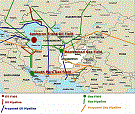
India must try to persuade Russia, Kazakhstan, Turkmenistan and Iran to let India develop, or at least allocate to India, some large gas fields that can be a source of long-term gas supply to India. The greater challenge will lie in transporting Eurasian gas to India. The LNG route is too long and expensive, at least for now. Purely land routes from Eurasia to India pose many problems. Given the continuing lack of trust between India and Pakistan, and the uncertainties surrounding Afghanistan, it is doubtful if either the Turkmenistan-Afghanistan-Pakistan-India (TAPI) or the Iran-Pakistan-India (IPI) pipeline projects will actually fructify. Under these circumstances, the only feasible alternative is a land-cum-sea pipeline from Eurasia to India via the Iranian port of Chabahar.

One possible route is from western Siberia in Russia to Chabahar via west Kazakhstan and Turkmenistan. The advantage of this route is that it involves fewer countries and can also incorporate existing swap arrangements between Iran and Turkmenistan. Another route is from eastern Siberia in Russia to southeast Kazakhstan via the Altai region, on to Kyrgyzstan and Uzbekistan’s Ferghana Valley, thence west to Khojent in Tajikistan at the mouth of the Ferghana Valley, and thereafter into Afghanistan, along the Mazar-e-sharif – Herat – Delaram - Zaranj route (which is outside the Taliban’s area of influence) before entering eastern Iran and down south to Chabahar. The advantage of this route is that it would also serve Uzbekistan, Kyrgyzstan, Tajikistan and western Afghanistan, and thereby help to stabilize these countries. On the flip side, it would definitely be a more complicated project. Perhaps it might be better to start with the first option and then consider the eastern route later.

From Chabahar, there would be an undersea pipeline via Oman to ports in Gujarat. Two gas hubs would come up. One would be in Chabahar, fed by Russian, Turkmen and possibly also Kazakh gas from the north, together with Iran’s own gas from South Pars. Another hub would be in Oman where the gas piped from Chabahar under the sea would meet up with Qatar gas piped across the UAE. An Indian company, South Asia Gas Enterprise (SAGE), has done a study on the commercial and technical viability of such undersea pipelines between Iran/Oman and India, and is actively working with the concerned governments to take it forward.

One hopes that as Prime Minister Modi prepares to visit Central Asia, his Government and his advisers are looking at conceptualizing a major strategic project of the kind suggested above. If such a project were to be endorsed by the CARs during his visit, that would be a significant breakthrough in India’s floundering Central Asia policy.

Published Date: 2nd July 2015, Image Source: http://www.presstv.ir
(Disclaimer: The views and opinions expressed in this article are those of the author and do not necessarily reflect the official policy or position of the Vivekananda International Foundation)

Monday, September 9, 2013

National Interests should Guide India’s Afghan Policy

Kanwal Sibal, 
Dean, Centre for International Relations and Diplomacy, VIF

2014 will be a turning point in Afghanistan. Power will be handed over to a new President after elections. The US military will complete its withdrawal. The Afghan National Security Forces (ANSF) will take over the security responsibility for the country.

The prospects for all these transitions do not look promising. The new President will have to be a Pashtun in order to ensure broad-based ethnic support. President Karzai was parachuted to the presidency without elections in post-war circumstances in which the US and the West could impose their will. His re-election was mired in controversy, created primarily by his western supporters. Despite many levers at their command, the US and the West have not been able to manage Karzai. This shows how difficult it has been for the US and others to oversee the political process in Afghanistan even under military occupation. With the impending withdrawal, their control over politics will become even less. The larger question is whether a new Pashtun leader can emerge who can assure cross ethnic support? Will he able to deliver political stability and a degree of economic development in the very difficult circumstances that his country will be facing?

The US has signed a Strategic Partnership Agreement with Afghanistan, but the follow-up agreement- the Bilateral Security Agreement- on the status of the residual US forces that will remain in military bases has not been finalized. The US has failed to secure a suitable agreement in Iraq. If it fails in Afghanistan, it is threatening a “zero option”. Whether this is pressure tactics or is a veritable option is not clear. In any case, the fact that this is being considered shows that the US has no clear answer for the future. “Zero option” has the air of a “zero answer”!

The ANSF may have numbers and reports that they are performing well does not guarantee they will be able to operate successfully in a post-US withdrawal environment, especially if the US leaves in a scenario that is politically unsatisfactory for all sides. The ANSF lacks heavy weaponry, air power and sophisticated intelligence capability. Will they be able to really cope as a cohesive force?

The economic prospects in Afghanistan are not very reassuring despite the pledges of assistance made at Tokyo and the announced longer-term commitments made by countries not to abandon Afghanistan. If the US exercises a zero military option, will that be compatible with a major economic commitment prolonged in time, especially in a tight economic situation in the US and the Eurozone? Plans by countries to invest in Afghanistan not only depend on internal stability but also will take some years to yield results, enough to make a difference on the ground.

Adding to the problem is the general instability around Afghanistan. The internal situation in Pakistan is fraught despite recent elections. Iran has a new President but the nuclear dossier remains problematic and sanctions on Iran have been further tightened. The Arab world is in turmoil, with the so-called Arab Spring having withered very rapidly. Religious extremism is spreading and this gives political oxygen to such forces battling in Afghanistan.

India has to cope with the situation as it develops. We have faced the worst when the Taliban took over Afghanistan in the mid-90s. We know of course what the dangers are ahead and have tried to play our limited role in preventing untoward conditions from developing through our political and economic engagement with Afghanistan.

India is pursuing a very responsible policy in Afghanistan. We want a sovereign, stable, democratic and prosperous Afghanistan, one that is free from extremism and where human rights, especially those of women are respected. India is doing nothing contrary to the achievement of this objective in Afghanistan.

We are maintaining friendly relations with Afghanistan based on equality and respect for sovereignty. We are not interfering in Afghanistan’s internal affairs, arming any particular group or providing safe-havens for terrorists or anti-government political groups to carry on violent activities against the legitimate government of Afghanistan.

We have legitimate interests in Afghanistan as a neighbouring country and every right to be present there. The international community cannot accept the curtailment of Afghan sovereignty by endorsing the principle that the Afghan government should give precedence to the interests of any particular country over that of any other. It is for the Afghan government to take independent decisions in a responsible way. India has no intention to occupy the legitimate space that other neighbouring countries of Afghanistan seek there.

India has established a strategic relationship with Afghanistan. This is anchored in a longer-term bilateral and regional perspective. India has geo-political, strategic interests in this entire region that forms a part of our strategic neighbourhood. Afghanistan borders Central Asia and Iran, apart from China and Pakistan. India has had intimate age-old ties with Afghanistan, Central Asia and Iran, with the history of our country linked to this region over centuries.

Central Asia is landlocked and so is Afghanistan. The development of this region faces a particularly difficult challenge because of this. This entire region needs the broadest possible choices for its development. It is natural for it to look for enhanced ties with India as the biggest economy in Southern Asia that can substantially contribute to this objective. We are wiling to respond.

Afghanistan has huge mineral resources that await exploitation. India is ready to invest large sums in this sector, beginning with iron ore extraction. Afghanistan is ready to offer to India a natural resources corridor for development. For realizing this objective, India needs better access to Afghanistan, as Pakistan is not as yet willing to provide transit facilities through its territory to Afghanistan.

India is looking at the Chabahar port in Iran as an access route to Afghanistan as well as Central Asia. We have recently committed $100 million to this project. US/EU sanctions on Iran are a complication for such efforts to give Afghanistan alternative options for its trade and facilitate foreign investment there. The US government should take a positive view of Indian investments in Iran that are specifically directed at easing Afghanistan’s difficult situation, which will be important for stimulating the Afghan economy, at present too dependent on foreign assistance and income derived from the presence of foreign troops on its soil.

In developing trade and energy ties between Central Asia and the Indian subcontinent, a project that the US favours as part of the New Silk Road project, Afghanistan is a critical hub. We support the TAPI pipeline project that will bring Turkmenistan gas to Pakistan and India through Afghanistan. India can fruitfully participate in projects to increase electricity grids in the region to alleviate regional energy-related problems.

India is participating in several international efforts to contribute to development in Afghanistan, whether it is the Istanbul Process and the Heart of Asia conferences in Kabul in June 2012 and in Istanbul in April 2012, or the initiative we took ourselves to organize a Delhi Investment Summit on Afghanistan, also in June 2012, followed by the Tokyo Conference on aid to Afghanistan in July 2012.

India’s own bilateral aid to Afghanistan has reached $2 billion. Some see in this an effort by us to seek undue influence in Afghanistan. If India’s foreign assistance programme and the billions Indian companies are investing abroad are considered, this is not a very big sum. There is full participation of the Afghan authorities in selecting Indian assistance projects that are infrastructural as well as geared to meeting the basic requirements of people and localities spread over the country. A large number of our projects are in the Pashtun areas. India has earned great popularity because of the manner in which we have conducted ourselves.

Economic development in Afghanistan and the region is essential to check-mate the growth of extremist ideologies in the region and associated terrorist activity. These concerns are uppermost in India’s mind as we are most exposed as a country to terrorism and supporting ideologies. As a secular, multi-religious state, we are particularly sensitive to such threats. Any boost given to these extremist forces, even unwittingly, should be unacceptable as our security is threatened.

It is with concern therefore that we view the outreach by US, Britain and others to the Taliban. We are not against any genuine attempt at reconciliation if all sides want it on a basis that respects the red lines drawn by the international community for a dialogue with the Taliban. We find that these red lines are being blurred by NATO’s anxiety to withdraw from Afghanistan by 2014, whatever the ground situation.

Such a strategy gives the upper hand to the Taliban groups in Pakistan in negotiations as they know time is on their side.

The rhetoric remains that the reconciliation process should be Afghan-led and Afghan-owned, but the manner in which the dialogue is being structured does not suggest that it will be an independent intra- Afghan process. President Karzai has already distanced himself from the US initiative. We feel that nothing should be done behind the back of the Kabul government. Latest statements from persons close to President Karzai express the deep concern of the Kabul government about understandings that the US may have reached with Pakistan and the possibility of south and eastern Afghanistan being handed over to the Taliban, which could divide the country and trigger an all-out conflict.

The end-game in Afghanistan is being played out in an atmosphere of great suspicion and bickering amongst the principal parties involved. The manner in which the Doha office of the Taliban was opened has made matters worse. The conduct of the Taliban in declaring themselves the Islamic Emirate of Afghanistan made their own end-game clear.

The link between the Taliban and Pakistan is evident. One will have to wait and watch whether the declared US position that no single country will be allowed to dominate post-2014 Afghanistan can be sustained by it when its intention to withdraw from Afghanistan is so clear.

India has not been kept adequately in the picture about the dialogue with the Taliban, despite India’s vital concerns being involved. India suffered when the Taliban came to power in 1996. That was the only time India had no diplomatic relations with Afghanistan and terrorists were being trained on its soil for attacks against India. If the Taliban were to be accommodated again, India has reason to be concerned.

We find that the policies of our western friends in Afghanistan are neither sufficiently steady nor transparent.

The argument that the Taliban has various currents in it and there are “moderate” Taliban has been exposed as hollow by what has transpired in Egypt where the same arguments distinguishing between various strands in the Muslim Brotherhood and welcoming their assumption of power have proved devoid of worth.

India does not want conditions of ethnic conflict to be created again in Afghanistan. The international community must safeguard against it. The post 2014 situation in Afghanistan remains very uncertain as the country will be faced with a political and military transition even when the external danger to the country has not been neutralized.

Establishing democracy in Afghanistan by integrating forces into the polity that are currently threatening the country will be a most difficult enterprise.
The root of the problem must be dealt with, which is external support for Afghan extremists and their instrumentalization for achieving the military ambitions of a third country. So long as there are safe havens for extremists outside Afghanistan, the problems will not go away. If the Taliban retain influence in eastern and southern Afghanistan, it is because their staging grounds are outside.

India’s traditional ties have been with the Pashtuns in Afghanistan. A large number of our development projects are in Pashtun areas, which have been very well received by the local people. We support ethnic harmony in Afghanistan, with the Pashtuns adequately represented in governance, but this has to emerge through a democratic process, without the shadow of externally supported violence.

Our strategic partnership with Afghanistan is not directed against any third country. The primary element in this strategic relationship is not military. India is willing to contribute to the capacity building of the Afghan national security forces through training and supply of non-lethal equipment so that they can better provide security to the people after the withdrawal of foreign troops from the country. Our goals are primarily economically oriented. We do not want to supplant NATO.

In principle, however, India could provide a limited amount of combat equipment too, as sought by the Afghan government. The concerns of Pakistan should be irrelevant in this regard. Pakistan is having a military relationship with Sri Lanka unbothered by our sensitivities. China is arming Pakistan, providing it even strategic capabilities, without any one advising Pakistan to defer to Indian sensitivities about the security threat posed to us. The US is arming Pakistan too, disregarding our sensitivities.

For elements in the US to caution us against increasing our military engagement with Afghanistan because of Pakistani sensitivities is inconsistent with the policy choices they make in our region in their national interest. India could argue, as the US does, that our arms assistance to Afghanistan will not change the balance of power between it and Pakistan. Pakistan is a nuclear capable state with large and well-equipped armed forces, whereas Afghanistan has a fledgling, ill equipped force that is no match for the Pakistani military. Our decision on the question should be based on our judgment on how far we want to or can go in giving arms assistance to Afghanistan, not what Pakistan or the US thinks. In our own interest, we should be prudent.

It is a hugely perverse notion that the real problem in Afghanistan is India-Pakistan rivalry. Those who feel that their intervention in Afghanistan has not worked to stabilize the situation to the extent that they may have wanted and now want to cut costs at all costs, should not seek to transfer the responsibility for their failure on India’s shoulders.

India was not responsible for the rise of religious extremism in the region; it was not responsible for the civil war in Afghanistan after the Soviet departure; it did not put the Taliban in power in Kabul; it had no hand in the presence of Al Qaida and Osama bin Laden in Afghanistan; it had no responsibility for US/NATO military intervention in Afghanistan; the Taliban groups or the Haqqani group are not in India; NATO soldiers have not been killed by groups operating from Indian soil. If the US has had to resort to drone attacks against terrorists in Pakistan, it is not because of India.

We seek a friendly relationship with Afghanistan. We seek no exclusive relationship. Afghanistan should have friendly relations with all its neighbours. We are willing to work with all of them. India and China are already talking to each other on Afghanistan. There should be no problem in discussing Afghanistan with Pakistan in a constructive way that opens up the doors for transit facilities eventually. The new government in Pakistan should think along those lines, rather than allowing Pakistan’s policies to be guided by the ambitions of its armed forces.

We have been very constructive in our dealings with the US on the Afghan issue. We have supported the international military intervention in Afghanistan and the ouster of the Taliban regime from power. We have been sensitive to US equities and concerns in Afghanistan despite serious provocations from Pakistan, including the terrorist attacks against the Indian Embassy in Kabul and India-related targets there. We continue to be willing to work with the US in a positive and mutually beneficial way in Afghanistan.
On June 27, US Special Envoy for Afghanistan Ambassador Dobbins, sent to India to re-assure us about the US initiative to negotiate with the Taliban, did not convey the impression that the US was playing a sure hand, was confident about its strategy and had alternative options in view.

He said the US hoped for presidential candidates in Afghanistan that have cross-ethnic appeal. The US was not entering the dialogue with the Taliban with any certainty that it will start, how it will develop, whether progress will be made and whether it will result in diminished violence and peace. The Taliban had to say whether they will accept the conditions and meet the US and the Afghan High Peace Council. The issue of terrorism had to be directly addressed and that a pre-condition for starting talks was a statement that the Taliban will begin to distance themselves from the Al Qaida, but reaching an agreement will require concretely severing all ties. Ending violence was not a pre-condition for talks, but an agreement had to include cessation of hostilities and respect for the Afghan Constitution. He concluded by stating that it was not certain that negotiations will end the war but that it was worth trying.

Such a tentative and uncertain reading of the situation, without a clear and confident road map, justifies our concerns about the wisdom of taking a step to politically accommodate such a retrograde and obscurantist force as the Taliban with the assistance of the Pakistani military whose disruptive strategic ambitions in Afghanistan are in fact at the root of the problem.


(Based on a talk recently delivered on the Capitol Hill, Washington)

Monday, August 13, 2012

Afghanistan and America’s New Silk Road Strategy


Vinod Anand
Senior Fellow, VIF


The security situation in Afghanistan continues to follow a declining curve. Not only the NATO supply routes through Pakistan have been attacked by the Taliban the logistics coming through Uzbekistan via the Northern Distribution Network have also come under Taliban attack. Relations between the US and Pakistan have not improved much; Pakistan’s stance on Haqqani group continues to sour US-Pakistan relationship with. The US Congress has voted for the Haqqani group to be designated as a terror group. It is well accepted that Pakistan continues to provide shelter to Quetta Shura and other assorted militant groups despite its avowals to the contrary. America has been advocating a regional solution to the Afghan puzzle and its ‘new Silk Road Strategy’ unveiled last year is claimed to be a part of the same. Though the strategy largely stresses on regional economic integration with Afghanistan yet it is not devoid of geo-strategic connotations. Finding a regional solution to the Afghan imbroglio has been one of the main planks of Obama’s Af-Pak strategy since 2009. However, so far, the US has largely been looking for a US led solution.

The question therefore arises is whether America’s new Silk Road strategy is really new or whether it is old wine in the new bottle? What are the objectives and significance of this strategy?

America’s Silk Road Strategy can be said to have gone through three iterations. The initial phase commenced with the demise of Soviet Union at the end of 1991. The US and the West were first off the block in making efforts to wean the nascent Central Asian nations away from the Russian influence. At that time Russia had also become weak and expected the West to help it out economically.

The Americans passed a Freedom Support Act of 1992 and a Silk Road Strategy Act of 1999. The main goals were to promote democracy and human rights, foster pro-West orientations in Central Asian nations, support economic growth, and development of transport and communications. Kazakhstan was seen as an ‘energy behemoth’ where American companies invested a great deal in its hydrocarbon sector. According to the thought process of the US administration the US efforts were seen as ‘strengthening independence of the Central Asian states and forestalling Russian, Chinese and Iranian efforts to subvert them’. The overall objective was to integrate theses countries into the European system.

When the US and its allies intervened in Afghanistan post September 2001 terrorist attacks to route out the Taliban the Russians, Chinese and the Central Asian states welcomed the Western powers’ intervention in Afghanistan because it suited their short term strategic interests of dealing with security threats arising from Afghanistan. The Central Asian nations states even offered bases to the US and western troops.

However, the next phase of America’s Silk Road Strategy can be said to have begun in 2005-2006 when the US started promoting a ‘Greater Central Asia Concept/ Strategy’. The term ‘greater Central Asia’ included many areas and countries surrounding the Central Asian nations. Ostensibly, the aim was to promote greater economic integration especially focused on connecting Central Asia and South Asia. The main goal of this phase of strategy was to weaken the Russian control over hydro carbon sector on Central Asian countries like Turkmenistan and Kazakhstan by building pipelines that bypassed Russian territory. Therefore, not only Turkmenistan-Afghanistan-Pakistan-India gas pipeline project was a manifestation of this concept, even the Nabucco gas pipeline and Baku-Tbilisi-Ceyhan oil pipeline projects (getting oil from Kazakhstan) also were part of this strategy. The argument offered was that the Central Asian nations need diversification of outlets for their natural resources and other products.

To give substance to the greater Central Asian concept the State Department in 2006 included Central Asia in a revamped Bureau of South and Central Asian Affairs. When Obama appeared on the scene he wanted to reset relations with Russia because of the complex geo-strategic situation prevailing in Afghanistan and Central Asian region which was again a sub-set of the overall global environment wherein the American power was considered to be on the decline. Though Russians and the Central Asian countries did help out the US and its allies by allowing transit of logistics through the Northern Distribution Network (the existing infrastructure and road/rail network of which could become a basis for another silk route) yet the ‘reset’ could not be realized.

The new Silk Road Strategy announced by Hillary Clinton last year (July 2011) is therefore not new; the basic premises of the American strategy in Central Asia have not undergone any change; if at all there is some change, it is in the priority of ends which it wants to achieve in the current milieu of Afghanistan. Top most priority for the US currently is how to get out of Afghanistan gracefully. Connecting Central with South Asia through a network of multimodal transport corridors and networks that include road and rail networks, pipelines, electricity grids and power transmission lines with Afghanistan as a hub are being seen as a panacea to cure at least the economic ills being faced by the region, especially that of Afghanistan leading to peace and stability there. Such a strategy is expected to provide enough revenues to the Afghan government to run its affairs without being dependent on foreign aid in the long run. But the multi-million dollar question remains, security first or the development first? Some American analysts propound the thesis that economic development and growth is possible even in unstable and insecure environment. However, without security all the talk of pipelines and investments in the mineral ores sector of Afghanistan by economic heavy weights like China, India and others would remain a chimera.

Hillary Clinton while explaining this U.S. policy towards Afghanistan had stated that in coming years it would focus on encouraging “stronger economic ties through South and Central Asia so that goods, capital, and people can flow more easily across borders.” She again articulated this new Silk Road concept at a meeting of regional ministers and others in September 2011, stating that “as we look to the future of this region, let us take this precedent (of a past Silk Road) as inspiration for a long-term vision for Afghanistan and its neighbors”. She envisioned a ‘web of economic and transit connections that will bind together a region too long torn apart by conflict and division’.

This kind of regional cooperation and economic integration was further mooted in Istanbul and Bonn Conferences of 2011 on Afghanistan. For instance, the Istanbul Conference had recognized Afghanistan’s role as the land bridge in the ‘Heart of Asia’, connecting South Asia, Central Asia, Eurasia and the Middle East, and reaffirmed their support in the strongest possible terms to the secure, stable and peaceful future of Afghanistan. It also endorsed Afghanistan’s willingness and determination to use its regional and historical position to do its part to promote security and peaceful economic cooperation in the region. The Conference had also stressed the central role of the United Nations in the international affairs which was perhaps an oblique reference to the proclivity of the US to adopt unilateralist approach to international affairs or bypass the UN.

India, together with Russia and Iran has been working on another version of Silk Road. They are founder partners of the International North South Transport Corridor the main goal which was to link not only Central Asia and Russia but also Europe. However, due to many bottlenecks and poor infrastructure in Iran and many other geopolitical problems associated with Iran the full potential of this Corridor has not been realized. India also built a road from Iran border town Zaranj to Delaram in Afghanistan linking up with the Garland highway of Afghanistan. This is one of the most important road-links in land-locked Afghanistan. Zaranj is also linked by Iranian road network to Chabahar port. However, unstable conditions and the influence of the Taliban in the Southern areas of Afghanistan have prevented this route to be exploited fully. Therefore, attempts by India to establish its own versions of silk route have not been very successful.
Further, the Indian companies have decided to invest about US Dollars 10 billion in the iron and steel sector of Afghanistan to exploit the mineral resources of iron ore deposits of Hajigak in Afghanistan. The questions are being asked as to how the products will be evacuated. One project that may take off is construction of 900 KM railway line from Chabahar port to Bamiyan and Hagijak in Afghanistan which would be used for transportation of the products. But then any project by India in Iran upsets the Americans. The abandoning of Iran-Pakistan-India gas pipeline could have been due to the US pressure besides un-remunerative price quoted by the Iranians for the gas and heavy transit fee asked for by Pakistan (in addition to the security risks).

Broadly, India has been willing to work with any power or a group of countries which could help India gain access to Central Asia including Afghanistan.

The new Silk Road strategy also justifies the leadership role of the US on the premise that the US is the biggest investor in the region. Such an articulation would definitely be contested by China and Russia because of the geopolitical aspects of such a strategy. Though the American intelligentsia talks about the imperatives of involving Russia and China in the realization of this strategy, on the ground very little has been done so far except for utilizing the NDN that goes across Russia and the Central Asian states before connecting to Afghanistan. The SCO as a regional organization has not been given much recognition and credibility by the US and NATO. India would also be chary of any negative connotations associated with this concept that may impact its relations with countries like Russia or other powers in the region. Further, China in its own version of Silk Road strategy has announced its plans for construction of a gas pipeline from Turkmenistan to China via Afghanistan and Tajikistan thus avoiding the turbulent Pashtun held areas. In addition China is also doubling up the capacity of the existing Turkmenistan-China gas pipeline to 61 billion cubic meters per year. Not only this China is also going to invest in the oil exploration in Afghanistan that is expected to generate US dollars 7 billion of revenues for Afghanistan. All this is likely to have a negative impact on the construction of TAPI.

On the other hand, if the US as part of its new Silk Road vision is able to influence Pakistan to grant overland transit rights to India then it would be a win-win situation for all involved with Pakistan being one of the biggest gainers as it will earn huge revenues. However, the current state of US-Pak relations leaves much to be desired. Though, Pakistan is part of the TAPI project for building the gas pipeline from Turkmenistan to India it has so far refrained from seeing the wisdom of acceding to India’s proposal for granting access to Afghanistan in the reverse direction. Therefore, there are many impediments in the realization of the new Silk Road Strategy.

It also needs to be seen than India and the US have signed Strategic Partnership Agreements with Afghanistan, with the intention to intensify their consultation, coordination and cooperation to promote a stable, democratic, united, sovereign and prosperous Afghanistan. In the India-US Strategic Dialogue that took place in June in Washington, according to one analyst, India had refrained from openly endorsing the New Silk Road architecture proposed by the US, with the two sides discussing only the “vision” of enhanced regional connectivity. The two have “reiterated that success in Afghanistan and regional and global security require elimination of safe havens and infrastructure for terrorism and violent extremism in Afghanistan and Pakistan”.

In the final analysis, the new Silk Road Strategy can be seen as a socio-economic approach combined with geo-political aspects to extricate the US and its coalition allies from an unwinnable situation in Afghanistan. Though regional cooperation has been mentioned as the panacea for the ills of this region the US continues to emphasize on its leadership role without purposefully working towards a regional approach to the Afghan imbroglio. There are many contradictions in the US approach to the region as its new concept excludes countries like Iran, Russia and regional grouping like SCO from its formulations. The above is also compounded by the fact that major players in Central Asia have their own versions of the silk road/routes. And India should be willing to cooperate with any grouping or nation that can help it getting connected to Central Asia and beyond.