Showing posts with label Northern Distribution Network. Show all posts

Friday, September 28, 2012

When Bastions Become Insecure, Orderly Retreat Becomes Unavoidable


Sushant Sareen
Senior Fellow, VIF

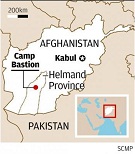
The portents of the Taliban strike against Camp Bastion in Helmand earlier this month are rather depressing and disheartening. Despite the brave face being put on by the NATO commanders, the devastating attack raises serious questions about the viability and sustainability of not only the exit strategy devised by the Americans but also their purported plan to retain some bases in a supporting role post 2014. The recent spate of attacks on NATO targets – Camp Bastion, the suicide bombing of a bus carrying Westerners to the airport, the damage caused to the aircraft of the US Chairman Joint Chiefs of Staff Committee at Bagram, the series of ‘green-on-blue’ attacks, targeted assassinations and what have you – have instilled a deep sense of foreboding both within Afghanistan and without.

Confidence in the ability of the current dispensation in Afghanistan to hold fast against the Taliban / Al Qaeda combine after the exit of the ISAF was never very strong. After the Camp Bastion attack, it would have been badly shaken, if not completely shattered. With nothing on the ground to reverse the sentiment of gloom and doom, chances are that the main players would have already started to prepare for the post-2014 situation. Some would be opening their channels of communication with the Taliban, others preparing for a fight to the finish against them and still others hedging their bets in all directions. In the process, the authority of the government, or whatever remains of it, would get severely compromised, making it even more difficult to maintain a modicum of stability once the foreign forces withdraw substantially.

Tempting as it would be to underplay the attack on Camp Bastion – after all, this wasn’t the first time that an ISAF base had been attacked – the simple fact is that the ferocity of the attack, the meticulous planning and flawless execution, and most of all the damage it caused (both material as well as psychological) makes it something of a game-changer. Coupled with the growing chasm between the foreign and local troops because of the spike in ‘green-on-blue’ attacks, manifest in the suspension of joint operations and training of troops, the Camp Bastion attack has put a big question mark over the efficacy, and indeed practicability, of the post-2014 strategy of the Americans.

By all accounts, the US strategy, as things stand, is that while the bulk of the troops will withdraw by the end of 2014, a small force – the numbers being bandied about range between 10000 and 35000 – will stay behind in a support and training role. Three to five bases are likely to be retained by the Americans in Afghanistan to house these troops and mount both ‘search and destroy’ as well as rescue missions. While the Afghan national security forces will be handed over security responsibilities, the Americans will be there to back them until the situation stabilises. Clearly, this is hardly a confidence inspiring strategy and, if anything, it is going to be unworkable. To put it simply, the only real choice before the Americans is to either comprehensively defeat the Taliban, their associates, proxies and supporters, or else cut and run from Afghanistan. Anything else will be a halfway house that is never going to work.

As the drawdown takes place, a security vacuum will be created. Although the ANSF will try and fill this vacuum, it is unlikely to have a good grip over the security situation. The Taliban are expected to make major inroads and hold sway (even if informally) over large swathes of territory, particularly in the South and East of Afghanistan. What is more, there are real apprehensions that the Taliban or their associates and affiliates could extend their baleful influence – either through force of arms or through imaginative use of psychological warfare to convince the local people to side with them as they are bound to emerge victors eventually – in parts of Afghanistan which currently are relatively unaffected by the insurgency.

Expecting the relatively small numbers of US troops to be able to stall such advances by the Taliban, who will also have the advantage of momentum and morale on their side, is not very realistic. This is not to say that the Taliban will sweep through Afghanistan. Chances are that there will be many more bloody engagements between the combatants and while there will be no clear victor after these engagements, they will end up exhausting both the Afghan regime as well as their American supporters.

What is worse, the Americans will be largely confined to their bases, practically under siege from hostiles in the surrounding countryside and extremely wary of their Afghan colleagues because of the ‘green on blue’ attacks. In such a situation, will not the US troops be more engrossed in securing their base and their backs rather than in targeting the Taliban or training and supporting the ANSF? And after the Camp Bastion attack, how secure will these bases be? How will these bases maintain their logistics lines? Will they be supplied only by air because the land routes will be extremely vulnerable to attacks by the insurgents? Will these bases only send out airborne patrols because ground patrols, if any, will be subjected to unremitting attacks? What will happen if the Taliban are able to mount a couple of devastating Camp Bastion type attacks on these bases, extracting a heavy price in men and material? Will not the continued US troops presence in Afghanistan become financially, militarily and politically untenable in such a scenario?

Currently, ballpark estimates of cost of maintaining a single soldier in Afghanistan is $ 1 million per annum. If around 10000 troops are retained in Afghanistan post 2014, it will mean an annual expenditure of around $ 10 billion. A force of around 25000 will entail a cost of $ 25 billion. How long will be the US continue to bear this expenditure? Until 2024? Appears unlikely. What is more likely is that once the bulk of the force is withdrawn, and the security situation takes a turn for the worse, there will be a growing clamour in the US to call back rest of the forces and figure out some other way to contain the Taliban and other Islamist radical groups that are bound to make Afghanistan their base.

Apart from the financial burden, continued presence in Afghanistan will also make the US hostage to Pakistan. While the dependence on Pakistan for ground lines of communication (GLOC) will reduce drastically because these would have probably become un-useable since they will be passing through Taliban dominated areas, the Pakistani airspace will remain crucial for the US military in Afghanistan. And if it is not Pakistan, then the US will remain hostage to all sorts of political, financial and diplomatic arm-twisting by the countries through which the Northern Distribution Network operates.

Quite clearly, the US exit strategy has gaping holes insofar as the future security scenario in Afghanistan is concerned. Although the military commanders are insisting on staying the course and the American politicians are emphatic about not abandoning Afghanistan, once things start going horribly wrong, none of these commitments will be worth the paper they are written on. The military bases that US intends to retain fit in well into the exit strategy only to the extent that they will allow for an orderly retreat as and when the time comes to throw in the towel. Perhaps the Americans have learnt the lesson from the British to not announce a complete withdrawal because that would mean that the next day there won’t be a single Afghan left on their side. By withdrawing to their bases, a strong signal will be conveyed that the Americans are here to stay for the foreseeable future, something that will keep many Afghans on their side and at the same time allow for bulk of the forces to exit. Once they are in their bases, they will be better places to leave lock, stock and barrel as and when the time for doing this comes.

Of course, quitting Afghanistan will not mean the end of the US fight against radical Islamists. Nor will it mean turning the back on the anti-Taliban Afghans. But instead of boots on the ground or bombs from the air, the Americans will probably devise a somewhat smarter and perhaps more effective strategy to support anti-Taliban and anti-radical groups in Afghanistan and around the Islamic world.

Monday, August 13, 2012

Afghanistan and America’s New Silk Road Strategy


Vinod Anand
Senior Fellow, VIF


The security situation in Afghanistan continues to follow a declining curve. Not only the NATO supply routes through Pakistan have been attacked by the Taliban the logistics coming through Uzbekistan via the Northern Distribution Network have also come under Taliban attack. Relations between the US and Pakistan have not improved much; Pakistan’s stance on Haqqani group continues to sour US-Pakistan relationship with. The US Congress has voted for the Haqqani group to be designated as a terror group. It is well accepted that Pakistan continues to provide shelter to Quetta Shura and other assorted militant groups despite its avowals to the contrary. America has been advocating a regional solution to the Afghan puzzle and its ‘new Silk Road Strategy’ unveiled last year is claimed to be a part of the same. Though the strategy largely stresses on regional economic integration with Afghanistan yet it is not devoid of geo-strategic connotations. Finding a regional solution to the Afghan imbroglio has been one of the main planks of Obama’s Af-Pak strategy since 2009. However, so far, the US has largely been looking for a US led solution.

The question therefore arises is whether America’s new Silk Road strategy is really new or whether it is old wine in the new bottle? What are the objectives and significance of this strategy?

America’s Silk Road Strategy can be said to have gone through three iterations. The initial phase commenced with the demise of Soviet Union at the end of 1991. The US and the West were first off the block in making efforts to wean the nascent Central Asian nations away from the Russian influence. At that time Russia had also become weak and expected the West to help it out economically.

The Americans passed a Freedom Support Act of 1992 and a Silk Road Strategy Act of 1999. The main goals were to promote democracy and human rights, foster pro-West orientations in Central Asian nations, support economic growth, and development of transport and communications. Kazakhstan was seen as an ‘energy behemoth’ where American companies invested a great deal in its hydrocarbon sector. According to the thought process of the US administration the US efforts were seen as ‘strengthening independence of the Central Asian states and forestalling Russian, Chinese and Iranian efforts to subvert them’. The overall objective was to integrate theses countries into the European system.

When the US and its allies intervened in Afghanistan post September 2001 terrorist attacks to route out the Taliban the Russians, Chinese and the Central Asian states welcomed the Western powers’ intervention in Afghanistan because it suited their short term strategic interests of dealing with security threats arising from Afghanistan. The Central Asian nations states even offered bases to the US and western troops.

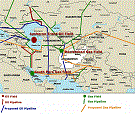
However, the next phase of America’s Silk Road Strategy can be said to have begun in 2005-2006 when the US started promoting a ‘Greater Central Asia Concept/ Strategy’. The term ‘greater Central Asia’ included many areas and countries surrounding the Central Asian nations. Ostensibly, the aim was to promote greater economic integration especially focused on connecting Central Asia and South Asia. The main goal of this phase of strategy was to weaken the Russian control over hydro carbon sector on Central Asian countries like Turkmenistan and Kazakhstan by building pipelines that bypassed Russian territory. Therefore, not only Turkmenistan-Afghanistan-Pakistan-India gas pipeline project was a manifestation of this concept, even the Nabucco gas pipeline and Baku-Tbilisi-Ceyhan oil pipeline projects (getting oil from Kazakhstan) also were part of this strategy. The argument offered was that the Central Asian nations need diversification of outlets for their natural resources and other products.

To give substance to the greater Central Asian concept the State Department in 2006 included Central Asia in a revamped Bureau of South and Central Asian Affairs. When Obama appeared on the scene he wanted to reset relations with Russia because of the complex geo-strategic situation prevailing in Afghanistan and Central Asian region which was again a sub-set of the overall global environment wherein the American power was considered to be on the decline. Though Russians and the Central Asian countries did help out the US and its allies by allowing transit of logistics through the Northern Distribution Network (the existing infrastructure and road/rail network of which could become a basis for another silk route) yet the ‘reset’ could not be realized.

The new Silk Road Strategy announced by Hillary Clinton last year (July 2011) is therefore not new; the basic premises of the American strategy in Central Asia have not undergone any change; if at all there is some change, it is in the priority of ends which it wants to achieve in the current milieu of Afghanistan. Top most priority for the US currently is how to get out of Afghanistan gracefully. Connecting Central with South Asia through a network of multimodal transport corridors and networks that include road and rail networks, pipelines, electricity grids and power transmission lines with Afghanistan as a hub are being seen as a panacea to cure at least the economic ills being faced by the region, especially that of Afghanistan leading to peace and stability there. Such a strategy is expected to provide enough revenues to the Afghan government to run its affairs without being dependent on foreign aid in the long run. But the multi-million dollar question remains, security first or the development first? Some American analysts propound the thesis that economic development and growth is possible even in unstable and insecure environment. However, without security all the talk of pipelines and investments in the mineral ores sector of Afghanistan by economic heavy weights like China, India and others would remain a chimera.

Hillary Clinton while explaining this U.S. policy towards Afghanistan had stated that in coming years it would focus on encouraging “stronger economic ties through South and Central Asia so that goods, capital, and people can flow more easily across borders.” She again articulated this new Silk Road concept at a meeting of regional ministers and others in September 2011, stating that “as we look to the future of this region, let us take this precedent (of a past Silk Road) as inspiration for a long-term vision for Afghanistan and its neighbors”. She envisioned a ‘web of economic and transit connections that will bind together a region too long torn apart by conflict and division’.

This kind of regional cooperation and economic integration was further mooted in Istanbul and Bonn Conferences of 2011 on Afghanistan. For instance, the Istanbul Conference had recognized Afghanistan’s role as the land bridge in the ‘Heart of Asia’, connecting South Asia, Central Asia, Eurasia and the Middle East, and reaffirmed their support in the strongest possible terms to the secure, stable and peaceful future of Afghanistan. It also endorsed Afghanistan’s willingness and determination to use its regional and historical position to do its part to promote security and peaceful economic cooperation in the region. The Conference had also stressed the central role of the United Nations in the international affairs which was perhaps an oblique reference to the proclivity of the US to adopt unilateralist approach to international affairs or bypass the UN.

India, together with Russia and Iran has been working on another version of Silk Road. They are founder partners of the International North South Transport Corridor the main goal which was to link not only Central Asia and Russia but also Europe. However, due to many bottlenecks and poor infrastructure in Iran and many other geopolitical problems associated with Iran the full potential of this Corridor has not been realized. India also built a road from Iran border town Zaranj to Delaram in Afghanistan linking up with the Garland highway of Afghanistan. This is one of the most important road-links in land-locked Afghanistan. Zaranj is also linked by Iranian road network to Chabahar port. However, unstable conditions and the influence of the Taliban in the Southern areas of Afghanistan have prevented this route to be exploited fully. Therefore, attempts by India to establish its own versions of silk route have not been very successful.
Further, the Indian companies have decided to invest about US Dollars 10 billion in the iron and steel sector of Afghanistan to exploit the mineral resources of iron ore deposits of Hajigak in Afghanistan. The questions are being asked as to how the products will be evacuated. One project that may take off is construction of 900 KM railway line from Chabahar port to Bamiyan and Hagijak in Afghanistan which would be used for transportation of the products. But then any project by India in Iran upsets the Americans. The abandoning of Iran-Pakistan-India gas pipeline could have been due to the US pressure besides un-remunerative price quoted by the Iranians for the gas and heavy transit fee asked for by Pakistan (in addition to the security risks).

Broadly, India has been willing to work with any power or a group of countries which could help India gain access to Central Asia including Afghanistan.

The new Silk Road strategy also justifies the leadership role of the US on the premise that the US is the biggest investor in the region. Such an articulation would definitely be contested by China and Russia because of the geopolitical aspects of such a strategy. Though the American intelligentsia talks about the imperatives of involving Russia and China in the realization of this strategy, on the ground very little has been done so far except for utilizing the NDN that goes across Russia and the Central Asian states before connecting to Afghanistan. The SCO as a regional organization has not been given much recognition and credibility by the US and NATO. India would also be chary of any negative connotations associated with this concept that may impact its relations with countries like Russia or other powers in the region. Further, China in its own version of Silk Road strategy has announced its plans for construction of a gas pipeline from Turkmenistan to China via Afghanistan and Tajikistan thus avoiding the turbulent Pashtun held areas. In addition China is also doubling up the capacity of the existing Turkmenistan-China gas pipeline to 61 billion cubic meters per year. Not only this China is also going to invest in the oil exploration in Afghanistan that is expected to generate US dollars 7 billion of revenues for Afghanistan. All this is likely to have a negative impact on the construction of TAPI.

On the other hand, if the US as part of its new Silk Road vision is able to influence Pakistan to grant overland transit rights to India then it would be a win-win situation for all involved with Pakistan being one of the biggest gainers as it will earn huge revenues. However, the current state of US-Pak relations leaves much to be desired. Though, Pakistan is part of the TAPI project for building the gas pipeline from Turkmenistan to India it has so far refrained from seeing the wisdom of acceding to India’s proposal for granting access to Afghanistan in the reverse direction. Therefore, there are many impediments in the realization of the new Silk Road Strategy.

It also needs to be seen than India and the US have signed Strategic Partnership Agreements with Afghanistan, with the intention to intensify their consultation, coordination and cooperation to promote a stable, democratic, united, sovereign and prosperous Afghanistan. In the India-US Strategic Dialogue that took place in June in Washington, according to one analyst, India had refrained from openly endorsing the New Silk Road architecture proposed by the US, with the two sides discussing only the “vision” of enhanced regional connectivity. The two have “reiterated that success in Afghanistan and regional and global security require elimination of safe havens and infrastructure for terrorism and violent extremism in Afghanistan and Pakistan”.

In the final analysis, the new Silk Road Strategy can be seen as a socio-economic approach combined with geo-political aspects to extricate the US and its coalition allies from an unwinnable situation in Afghanistan. Though regional cooperation has been mentioned as the panacea for the ills of this region the US continues to emphasize on its leadership role without purposefully working towards a regional approach to the Afghan imbroglio. There are many contradictions in the US approach to the region as its new concept excludes countries like Iran, Russia and regional grouping like SCO from its formulations. The above is also compounded by the fact that major players in Central Asia have their own versions of the silk road/routes. And India should be willing to cooperate with any grouping or nation that can help it getting connected to Central Asia and beyond.