Showing posts with label British. Show all posts

Friday, September 28, 2012

When Bastions Become Insecure, Orderly Retreat Becomes Unavoidable


Sushant Sareen
Senior Fellow, VIF

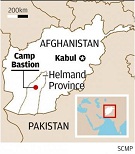
The portents of the Taliban strike against Camp Bastion in Helmand earlier this month are rather depressing and disheartening. Despite the brave face being put on by the NATO commanders, the devastating attack raises serious questions about the viability and sustainability of not only the exit strategy devised by the Americans but also their purported plan to retain some bases in a supporting role post 2014. The recent spate of attacks on NATO targets – Camp Bastion, the suicide bombing of a bus carrying Westerners to the airport, the damage caused to the aircraft of the US Chairman Joint Chiefs of Staff Committee at Bagram, the series of ‘green-on-blue’ attacks, targeted assassinations and what have you – have instilled a deep sense of foreboding both within Afghanistan and without.

Confidence in the ability of the current dispensation in Afghanistan to hold fast against the Taliban / Al Qaeda combine after the exit of the ISAF was never very strong. After the Camp Bastion attack, it would have been badly shaken, if not completely shattered. With nothing on the ground to reverse the sentiment of gloom and doom, chances are that the main players would have already started to prepare for the post-2014 situation. Some would be opening their channels of communication with the Taliban, others preparing for a fight to the finish against them and still others hedging their bets in all directions. In the process, the authority of the government, or whatever remains of it, would get severely compromised, making it even more difficult to maintain a modicum of stability once the foreign forces withdraw substantially.

Tempting as it would be to underplay the attack on Camp Bastion – after all, this wasn’t the first time that an ISAF base had been attacked – the simple fact is that the ferocity of the attack, the meticulous planning and flawless execution, and most of all the damage it caused (both material as well as psychological) makes it something of a game-changer. Coupled with the growing chasm between the foreign and local troops because of the spike in ‘green-on-blue’ attacks, manifest in the suspension of joint operations and training of troops, the Camp Bastion attack has put a big question mark over the efficacy, and indeed practicability, of the post-2014 strategy of the Americans.

By all accounts, the US strategy, as things stand, is that while the bulk of the troops will withdraw by the end of 2014, a small force – the numbers being bandied about range between 10000 and 35000 – will stay behind in a support and training role. Three to five bases are likely to be retained by the Americans in Afghanistan to house these troops and mount both ‘search and destroy’ as well as rescue missions. While the Afghan national security forces will be handed over security responsibilities, the Americans will be there to back them until the situation stabilises. Clearly, this is hardly a confidence inspiring strategy and, if anything, it is going to be unworkable. To put it simply, the only real choice before the Americans is to either comprehensively defeat the Taliban, their associates, proxies and supporters, or else cut and run from Afghanistan. Anything else will be a halfway house that is never going to work.

As the drawdown takes place, a security vacuum will be created. Although the ANSF will try and fill this vacuum, it is unlikely to have a good grip over the security situation. The Taliban are expected to make major inroads and hold sway (even if informally) over large swathes of territory, particularly in the South and East of Afghanistan. What is more, there are real apprehensions that the Taliban or their associates and affiliates could extend their baleful influence – either through force of arms or through imaginative use of psychological warfare to convince the local people to side with them as they are bound to emerge victors eventually – in parts of Afghanistan which currently are relatively unaffected by the insurgency.

Expecting the relatively small numbers of US troops to be able to stall such advances by the Taliban, who will also have the advantage of momentum and morale on their side, is not very realistic. This is not to say that the Taliban will sweep through Afghanistan. Chances are that there will be many more bloody engagements between the combatants and while there will be no clear victor after these engagements, they will end up exhausting both the Afghan regime as well as their American supporters.

What is worse, the Americans will be largely confined to their bases, practically under siege from hostiles in the surrounding countryside and extremely wary of their Afghan colleagues because of the ‘green on blue’ attacks. In such a situation, will not the US troops be more engrossed in securing their base and their backs rather than in targeting the Taliban or training and supporting the ANSF? And after the Camp Bastion attack, how secure will these bases be? How will these bases maintain their logistics lines? Will they be supplied only by air because the land routes will be extremely vulnerable to attacks by the insurgents? Will these bases only send out airborne patrols because ground patrols, if any, will be subjected to unremitting attacks? What will happen if the Taliban are able to mount a couple of devastating Camp Bastion type attacks on these bases, extracting a heavy price in men and material? Will not the continued US troops presence in Afghanistan become financially, militarily and politically untenable in such a scenario?

Currently, ballpark estimates of cost of maintaining a single soldier in Afghanistan is $ 1 million per annum. If around 10000 troops are retained in Afghanistan post 2014, it will mean an annual expenditure of around $ 10 billion. A force of around 25000 will entail a cost of $ 25 billion. How long will be the US continue to bear this expenditure? Until 2024? Appears unlikely. What is more likely is that once the bulk of the force is withdrawn, and the security situation takes a turn for the worse, there will be a growing clamour in the US to call back rest of the forces and figure out some other way to contain the Taliban and other Islamist radical groups that are bound to make Afghanistan their base.

Apart from the financial burden, continued presence in Afghanistan will also make the US hostage to Pakistan. While the dependence on Pakistan for ground lines of communication (GLOC) will reduce drastically because these would have probably become un-useable since they will be passing through Taliban dominated areas, the Pakistani airspace will remain crucial for the US military in Afghanistan. And if it is not Pakistan, then the US will remain hostage to all sorts of political, financial and diplomatic arm-twisting by the countries through which the Northern Distribution Network operates.

Quite clearly, the US exit strategy has gaping holes insofar as the future security scenario in Afghanistan is concerned. Although the military commanders are insisting on staying the course and the American politicians are emphatic about not abandoning Afghanistan, once things start going horribly wrong, none of these commitments will be worth the paper they are written on. The military bases that US intends to retain fit in well into the exit strategy only to the extent that they will allow for an orderly retreat as and when the time comes to throw in the towel. Perhaps the Americans have learnt the lesson from the British to not announce a complete withdrawal because that would mean that the next day there won’t be a single Afghan left on their side. By withdrawing to their bases, a strong signal will be conveyed that the Americans are here to stay for the foreseeable future, something that will keep many Afghans on their side and at the same time allow for bulk of the forces to exit. Once they are in their bases, they will be better places to leave lock, stock and barrel as and when the time for doing this comes.

Of course, quitting Afghanistan will not mean the end of the US fight against radical Islamists. Nor will it mean turning the back on the anti-Taliban Afghans. But instead of boots on the ground or bombs from the air, the Americans will probably devise a somewhat smarter and perhaps more effective strategy to support anti-Taliban and anti-radical groups in Afghanistan and around the Islamic world.

Thursday, June 7, 2012

Governance and The Prime Minister

Dr. M.N. Buch
Visiting Fellow, VIF
The whole theme of the Constitution of India is that this country must be governed and how this should be done is laid down in every Article of the Constitution and in particular in Chapter 1 of Part V of the of the Constitution for the Union and Chapters 1 and 2 of Part VI for the States.

The post of Prime Minister exists because Article 74 so mandates and it is he and his Council of Ministers who, in accordance with the Business Allocation Rules and the Rules of Business of the Executive Government framed under Article 77, will advise the President on how the executive functions of government will be conducted. In this there is no ambiguity and the Constitution and the Rules framed under it demand that the Prime Minister will in fact govern. The Constitution does not permit or forgive lack of governance and a Prime Minister who does not govern has no right to occupy that post. Of course as the person who, together with his Council of Ministers, enjoys the confidence of the House of the People he is the one required to initiate and pilot legislation and to carry out the wishes of the Legislature as stated through laws, the budget, debate and resolutions, etc. The Prime Minister, therefore, straddles the twin horses of the Executive and Legislature, both wings of the State being concerned with governance.

In order that a Prime Minister may govern there has to be an environment of government in which the Prime Minister can function effectively. It is for this reason that the Prime Minister enjoys and must enjoy a degree of independence in functioning in which, while discharging his responsibility to the House and to the electorate in general, the Prime Minister is not subjected to nagging, pettifogging complaints which prevent him from performing his fundamental duty of governance. Does such an environment exist in India? After independence at least till imposition of Emergency and its aftermaths such an environment did exist and though people such as Ram Manohar Lohia were the gadflies who tormented Jawaharlal Nehru for taking the decisions which a Prime Minister should, nor was he ever bogged down in controversies in which self-defence took precedence over governance. That was the period in which India took momentous decisions. We entered an era of planning and there was an immense thrust of building basic infrastructure so that the sinews of a modern industrial state were created. Whatever might be the complaints about adequacy and quality of electric power, the fact is that from a situation in which only five thousand towns and villages in India were electrified in 1947 when the British left, today we have one hundred percent electrification. Life expectancy has increased from twenty-seven years to sixty-three years, epidemics are under control, food production has increased dramatically and India is a major industrial power today. There were inefficiencies which have prevented India from achieving its full potential, but that does not detract from the magnitude of achievement during a period when India was actually governed. Not surprisingly this was also the period when corruption was at its lowest ebb, which proves that taking decisions leads to less corruption than dithering and then taking decisions in panic.

To whom should the Prime Minister be accountable? Obviously to Parliament and, by implication he should be accountable to the President. He is accountable to the electorate because every five years there is an election and the ruling party, if it wants another term in office, it has to convince the voters that its achievements in government have benefitted the average citizen and, therefore, it should get another term. If the ruling party fails to convince the electorate, then it loses power and the Prime Minister his office. We have seen this happen in India where a powerful Indira Gandhi was ousted at the polls, only to return to power at the next election. Atal Bihari Vajpayee won power and then lost it, just as the Congress under Rajiv Gandhi won power and subsequently lost it. This is normal in a democracy, but the lesson learnt from our elections is that a party and a Prime Minister whose conduct of government does not live up to the expectations of the people will lose power. In other words, what the people of India want is a firm government and not a government whose every step seems to be dictated by populism and immediate expediency. One wishes that this lesson is learnt by the present government and all governments to follow.

This background about governance has been sculpted because ever since Anna Hazare and his cohorts launched a movement for the enactment of a Lokpal Act drafted by them government has been on the defensive. That is not all. Various actors have come on the stage and encouraged by a complete collapse of executive government have begun enacting solo dramas of their own which do not necessarily combine to create a great play but individually lead to such chaos on stage that the audience cannot make head or tail of what is going on. The nearest resemblance in real life of what is happening in the world of government is a lunatic asylum at bedlam hour in which no one can make any sense of what people are saying or doing. This is made possible because in the manner in which coalition governments function in India no government can orchestrate a scenario of governance which makes any sense and, therefore, chaos reigns supreme.

This point needs to be illustrated or elaborated. The Constitution in Article 112 directs that the President will cause to be laid before both Houses of Parliament and an annual statement of the estimated receipts and expenditures of the Government of India. In popular parlance this is called the budget. Under Article 113 each item of expenditure as estimated which is not charged upon the Consolidated Fund of India is to be presented to the House of the People in the form of a demand for grants and the House may approve or disapprove a grant. The aggregate of the approved grants would be the final amount of expenditure agreed upon by the House of the People and this would take the form of an Appropriation Bill under Article 114. No expenditure can be incurred before the enactment of the Appropriation Act. This entire process is initiated by the Executive, discussed and voted upon by Parliament and then handed back to the Executive as the sanction on which it will operate in the matter of expenditure. This is purely a matter between Parliament and the Executive, with each Minister being accountable to Parliament on how the grants relating to his department have been spent.

In order that Parliament can judge whether the manner in which government has spent funds is according to what has been voted the Constitution, Part V, Chapter 5 provides for the office of the Comptroller and Auditor General of India. Under Articles 149 and 151 Comptroller and Auditor General audits the accounts of government and in the case of the Union Government he presents his audit report to the President and in the case of the States to the respective Governors, who is then required to present the report to the House of the People and the State Legislative Assembly, as the case may be. Till then these reports are not in the public domain and have to be kept between CAG and government. It is for Parliament then to decide whether it accepts the audit report and directs government to take action thereon, or that it rejects the report or only partially accepts it. The Comptroller and Auditor General, when auditing an office, can comment on the propriety and wisdom of expenditure, but it cannot do what the present CAG has been doing, that is, sitting in judgement over the decisions of the Executive and stating that had some other decision been taken there would have been accrual or a certain amount of gain to government and that failure to take such decision has resulted in loss. Such hypothetical questions and views come within the realm of speculation and not audit.

No one is denying that our system has been highly corrupted by the arbitrariness of political decision making and the complete and absolute surrender of the Civil Services to political bullying. This surrender has to a large extent been converted into a nexus between politicians and civil servants. That is another story. At the same time CAG is not competent to state that if at the time that spectrum was being made available to telecommunication firms, the auction route had been followed government would have gained Rs. 1,76,000 crores and, because this was not done, government has incurred this much of loss. What about the proposition that if the auction route had been followed initially there would not have been growth in the telecommunication sector? These are political and administrative issues and are not within the realm of audit, To assume corruption from such a defective audit report is a complete distortion of facts, but tragically this is what has led to the Anna Hazare movement which started with good intentions but which has now grown berserk and is threatening the very existence of meaningful executive government in India. Once again let me hasten to submit that this is not an apology for the wrongdoing of government under the guise of compulsions of coalition nor does it excuse government from taking a firm stand but always succumbing to the pressures of such puny partners as Mamata Banerjee or Karunanidhi. Any movement to curb corruption which also forces government to provide good government would be welcome, but unfortunately Anna Hazare’s movement is not the one which can do this.

More than Anna Hazare it is some of his more irresponsible associates such as Arvind Kejriwal and Prashant Bhushan whose voices, in ascending order of shrillness, have launched a most incontinent attack on the Prime Minister and his Ministers for taking decisions in cases where lack of decision making would have been fatal. Let us take the allocation of coal blocks. No decision of a Minister or the Prime Minister is open to question in this behalf unless it can be shown that there is some personal gain to the Minister concerned, which is not justified by law or the rules of financial propriety. Unless the decision has an element of criminality which could justify the registration of a First Information Report (FIR) no investigating agency with police functions can sit in judgement over such decisions. Increasingly CBI, which is accused by opposition parties of being a political handmaiden of government, is being involved in reviewing administrative decisions which it has neither the authority nor the competence to do. Legally CBI does not exist except as a government body constituted by executive order. The police is created by the Indian Police Act or the relevant State Acts and it operates according to the powers vested in it by the Code of Criminal Procedure in the matter of maintenance of public order, prevention of crime, investigation of offences and their subsequent prosecution. The Delhi Special Police Establishment, popularly known as CBI, is such a police force constituted under the Delhi Special Police Establishment Act, enjoying legal powers as conferred by the Act. CBI as such has no legal powers. It is not the administrative superior of government officers or ministers because the Rules of Business confer no such powers on it and it certainly does not have the competence to sit in judgement over the administrative decisions of senior officers and ministers. No investigating agency ever has such competence. Despite this, increasingly, CBI, through what are called preliminary enquiries, is interfering in the general administration, which it has no competence to do. It is still a mystery why when under Entry 8 of List 1 of the Seventh Schedule of the Constitution Parliament has the right to enact a law creating a Central Bureau of Investigation and conferring on it both functions and power, this has not been done and for which there does not seem to be any initiative on the part of government. It would be a sad day for our democracy if agencies like CBI begin sitting in judgement against the decisions of ministers.

In this behalf let me tell a true story. In 1977 when Indira Gandhi was ousted from power and the Janata Government was formed, in Madhya Pradesh also we had a Janata Government dominated by BJP. K.L. Pasricha, the then Chief Secretary, issued an order to all Secretaries of the State Government to review the orders of their ministers in the past five years and to bring to notice for action such cases where they felt that the minister’s order was wrong. My colleague, B.J. Hirjee and I independently wrote to the Chief Secretary that under the Rules of Business it was the job of the Secretary to ensure that if an order of his minister is contrary to rules or the law, or even the canons of propriety, he should advise the minister accordingly and if the minister did not agree, then to bring the matter to the notice of the Chief Minister through the Chief Secretary in a process called Coordination. If, therefore, the Minister had taken a decision and the Secretary had failed to advise him correctly, then he was equally responsible for the wrongdoing and would have to bear the brunt of consequences. He could not hide ex post facto under the excuse of wrongdoing by the Minister, thus sitting in judgement over his Minister. We both stated that allowing a Secretary to sit in judgement over his Minister’s orders ex post facto is not permissible in a democracy. The same applies to CBI or any other agency. Of course if they are investigating a criminal case duly registered under law, then it would be a different matter.

Our past experience of bringing government to a halt on account of allegations against the Prime Minister has been very unhappy. V.P. Singh, who went on to be Prime Minister, alleged that in the purchase of Bofors 155mm guns for the army illegal gratification had been paid. Rajiv Gandhi, then Prime Minister, first denied the allegations, then said neither he nor his dear ones had taken any bribe and became increasingly embroiled in an unseemly controversy in which the Indian Express came out with an expose. For the remaining years of his tenure Rajiv Gandhi was just defending himself and could be described as a lame duck Prime Minister. V.P. Singh neither provided clinching proof in the matter, nor withdrew the allegations and this, while creating an environment of distrust which has still not dissipated, brought government to a halt.

Contrast this with the case of Yoshihiro Tanaka, Prime Minister of Japan. It was alleged that he took a bribe of Dollar Two Million from Lockheed Corporation for purchase of aircraft. The complaint was registered as a criminal case, duly investigated, found proved. Tanaka was prosecuted, convicted, given a jail sentence and his party expelled him and he was removed as Prime Minister. A corrupt man was punished but the Prime Minister’s post was unscathed. In India we persecute but do not prosecute and this seriously harms the post.

If the Prime Minister is convinced that neither he nor his colleague did wrong then it is his duty to categorically state that neither CBI nor anyone else could inquire into their conduct and that under no circumstance would he concede what Arvind Kejriwal and Prashant Bhushan are demanding. Having said that the Prime Minister must resolve to govern firmly and justly and not be deviated from this path by the likes of his present detractors.