Showing posts with label New Delhi. Show all posts

Wednesday, July 9, 2014

Modi’s First Budget Session – Some Bitter Medicine and Some Sweeteners?

Dr. A Surya Prakash, 
Distinguished Fellow, VIF

Prime Minister Narendra Modi and the National Democratic Alliance will face its first big challenge when the two Houses of Parliament open for what is essentially the Budget Session after the recent Lok Sabha election. The nation’s eyes are riveted on this session because it will lay bare not only the economic policies of the new government but also give us a glimpse of the Modi government’s political management.

The government’s first general budget and the railway budget will tell us a lot about Mr.Modi’s model of governance. Although, throughout the election campaign Mr.Modi promised to give New Delhi a shake-up, provide a more efficient government and re-work priorities in order to give the economy a big boost, his ability to translate this into action will be seen in these two budgets. During the campaign, Mr.Modi said that he would strive to repair the economy, step up economic growth, specifically target skill development among the youth and massive job creation and give infrastructure development a big boost. The nation will keenly watch his government’s first budget to see whether he is headed in the direction which he said he would prior to the Lok Sabha election.

Prime Minister Narendra Modi lamented the other day that while every government has had a honeymoon period during which it receives all round encouragement and even the opposition shuns criticism, he has had no such luck. On completing a month in office, Mr.Modi said he did not have the luxury of a “honeymoon” because a series of allegations against his government surfaced in less than 100 hours of his entering office.

The Prime Minister’s remarks are indicative of the gargantuan problems that his government has to tackle from day one on various fronts and these include problems arising from natural calamities or from acts of God; problems that he has inherited from the previous government and some man-made problems. The meteorological office has said that the shortfall in the Monsoon in June is around 40 per cent and if this is not made up substantially in July, many parts of the country could be heading towards a major drought. This is a natural calamity and the biggest worry for the Modi government. While the people have blessed him with a decisive mandate in the election, nature appears to be subjecting him to the biggest challenge an Indian Prime Minister faces – failure of rains and a drought.

The next set of problems confronting the government are those which Mr Modi has inherited from the predecessor government. These include the runaway price rise which the Manmohan Singh government failed to handle, the terrible financial condition of the Union Government, the steep rise in government borrowings and debt servicing; the growing fiscal deficit, the growing current account deficit and the declining value of the rupee. The United Progressive Alliance (UPA) government appears to have left every sector of government in doldrums including the Indian Railways, which has accumulated losses of over Rs 28,000 crores and the mess in the aviation sector including accumulated losses of over Rs 30,000 crores of Air India. And as if all this is not enough, there are some minor pinpricks like the controversies generated by statements of ministers.

But, the first month of the government has also seen many positive developments. Mr.Modi’s decision to invite all the leaders of SAARC nations for his swearing-in ceremony was a super hit and his visit to Bhutan went off very well and showed that he was keen on good relations in the neighbourhood. The foreign office has been hyper active ever since the new government took charge, because of a series of high profile visitors and scheduled visits by Mr.Modi and the External Affairs Minister, Ms. Sushma Swaraj. While Ms.Swaraj had a successful trip to Bangladesh, the Chinese Foreign Minister, Mr.Wang Yi visited India for the first official interaction between the two governments. This was followed by visits by the French Foreign Minister Laurent Fabius and the U.S Senator John McCain. The latest arrivals are Britain’s Foreign Secretary William Hague and Chancellor George Osborne. Meanwhile, Mr.Modi will leave for Brazil for the BRICS summit after the presentation of the Union Budget in Parliament. He is scheduled to visit the U.S in September.

Mr. Modi has shown that he is ready to face the difficulties and bite the bullet. Soon after the polls, he told the people that they may have to swallow some bitter medicine because the economic situation is in a bad shape. Thereafter, his government raised railway fares by 14 per cent, knowing fully well that the decision will be unpopular. The government has also increased diesel, petrol and LPG prices. This shows that Mr.Modi is not afraid of taking hard decisions. He has the strength to do so because his party enjoys a clear majority in the Lok Sabha and therefore cannot be blackmailed by coalition partners. The people have given him such a clear mandate so that he may take firm decisions which are in the best interests of the country, without fear of losing office. On his part, Mr.Modi has also been preparing the people for what lies ahead. This is also why the public response to the ‘bitter pill’ is not all negative. Some say such measures are necessary to bring the economy on track while others ridicule the government and ask if this is the ‘acche din” (good days) that Mr.Modi promised?

However, what cannot be lost sight of is that Mr.Modi’s popularity is both a blessing and a curse for him. It is a blessing because it has given him a clear mandate to do things, but it is also a curse because his popularity has generated phenomenal expectations among the people . In fact, the expectations are so high that whatever he does may fall short of what the people expect from him. This is also one of the reasons for the rather short honeymoon.
On the political front, everyone is keenly watching what the Modi government’s response will be to the Congress demand that its leader be given the status of Leader of the Opposition (LOP) in the Lok Sabha. The first Speaker of the Lok Sabha, Mr.G.V.Mavalankar laid down the rules for recognition of political parties in Parliament and the rules he laid down have been followed ever since. 
Mr.Mavalankar said that a party in opposition to the government must have the strength to constitute the quorum in the House (10 per cent) to be eligible for the status of a Parliamentary Party. A party which fell short of this number, but had a minimum of 30 MPs was classified as a Parliamentary Group. The status of Leader of Opposition was accorded to the leader of the largest parliamentary party. This rule was later incorporated in Directions of the Speaker and followed for 62 years since the two Houses were constituted in 1952. Therefore, only parties which had 55 seats in the Lok Sabha were given the status of parliamentary party in the House. This is why the Congress Party never granted the status of Leader of the Opposition to any one when Jawaharlal Nehru was the Prime Minister During Indira Gandhi’s time, because of the Congress split in 1969, Dr.Ram Subhag Singh became LOP in Lok Sabha for the first time for one year in 1969-70. Thereafter, again, there was no LOP either in Indira Gandhi’s or Rajiv Gandhi’s Prime Ministership. Therefore, during the 33 years that three members of this family headed the Union Government, for 32 years there was no LOP in Lok Sabha.

However, the Congress Party now wants the Narendra Modi government to forget history and to grant it LOP status even though it has only 44 MPs. The initial response of the Modi government is not to oblige the Congress. This will lead to the first political confrontation between the two sides and could spill onto the Rajya Sabha. Although Mr.Modi has over 330 MPs on his side in the Lok Sabha, he is on a weak wicket in the Rajya Sabha. The NDA is short of at least 60 MPs for a majority in the Upper House. The Congress Party, which has 68 MPs can, along with supporting parties block the BJP at every stage in the Rajya Sabha because the BJP has just 43 MPs and can count on the support of 12 more from the NDA partners. However, the ruling alliance will need at least 123 in the 245 member House to pass legislation. The BSP has 14 members and the AIADMK has 11. There are 9 independents. The Modi government will try to secure at least issue-based support from these parties to deal with the shortage of numbers in the Rajya Sabha, but it will be a tall order.

Although it has been rejected by the people in the Lok Sabha election, the Congress may use its strength in the Rajya Sabha to make life difficult for the Modi government. It may therefore make demands like grant of LOP status in the Lok Sabha in return for help in the Upper House.

All in all, Mr.Modi has been given a great opportunity and a challenge. Thus far he has shown that he is up to the task. But, he will actually reveal his cards when Finance Minister Mr.Arun Jaitley presents the Union budget on July 10. Let us keep our fingers crossed!

Published Date: 8th July 2014, Image source: http://media.newindianexpress.com

Monday, October 8, 2012

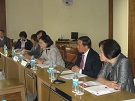
Interaction with Dr. Ing-Wen Tsai, Former Chairperson, DPP, Taiwan


On 20th September 2012, Vivekananda International Foundation (VIF) hosted an interaction with Dr. Ing-Wen Tsai, former Chairperson of the Democratic Progressive Party (DPP), Taiwan and Presidential Candidate from the DPP in January 2012. Dr. Tsai was accompanied by Mr. Antonio Chiang, columnist and former Deputy Director, National Security Council, Taiwan. H.E. Wenchyi Ong, Representative of the Taipei Economic and Cultural Centre in India was also present on the occasion.

The VIF team was led by its Director Mr. Ajit Doval, K.C. and comprised of Amb.P.P.Shukla, Jt.Director, Gen.(retd)N.C.Vij, Distinguished Fellow, Lt.Gen.(retd)Ravi Sawhney, Distinguished Fellow, Vice-Admiral (retd) Raman Puri, Mr. Sushant Sareen, Senior Fellow and Brig. (retd) Vinod Anand, Senior Fellow. Professor M.D.Nalapat, Honorary Director, Geopolitics and International Relations, Manipal University also participated in the interaction.

The nearly two hour long discussion mainly focused on the Asia-Pacific region, on the Taiwan economy and on India-Taiwan relations and prospects for enhancing cooperation and growth.

Friday, June 8, 2012

India’s Myanmar Policy Gains Momentum

Brig Vinod Anand
Senior Fellow, VIF

Indian Prime Minister’s visit to Myanmar after a gap of 25 years was recognition of the fact that the positive changes occurring on Myanmar’s political firmament had created conditions for enabling such a high level visit.

Though India had been engaging Myanmar earlier also for strategic and security reasons, raising the level of political exchanges highlights the fact that the Indo-Myanmar relations have reached a turning point and are poised for an exponential expansion. A dozen Memoranda of Understanding signed after the visit also indicate the diverse fields in which India is engaging Myanmar.

Politically, reestablishment of formal relations with Aung Suu Kyi can be seen as one of the major gains of the visit. While she had close linkages with India in the past including active support by the Indian government to the democracy movement in the 1980’s, there was a break in this relationship due to geopolitics of the region. Though there were informal linkages and India had been pressing both sides, the military junta of the past and Suu Kyi led NLD to reconcile their differences, Suu Kyi had maintained a public distance from New Delhi. She was no doubt encouraged by support that she got from the West including public statements at the highest level, for instance from President Obama who in the Indian parliament had called for support to democratic forces in Myanmar. However, finally it was India’s proposal for reconciliation that possibly led to political rapprochement and transition which is now reasonably well established. This was confirmed during the Prime Minister’s visit and his joint statement with Aung Suu Kyi. The common platform was a strong message to India’s past detractors and this could be seen as the biggest political gain for New Delhi.

Myanmar’s strategic salience as a land bridge to China on the one hand and to the South East Asia on the other hand can not be over emphasised. While approaches from China through Myanmar are important from military, security and economic point of view the connectivity to South East Asia is relevant from the economic point of view. Security and stability in the border areas is an imperative for overall development and establishment of multi-modal corridors linking India and Myanmar and beyond. Both Indian and Myanmar leaders have assured each other that territories of either country would not be allowed to be used for activities inimical to the other, including for training, sanctuary and other operations by terrorist and insurgent organisations and their operatives. This is relevant because recently a ceasefire agreement has been signed between NSCN (K) between the local government of Sangaing division of Myanmar which had been viewed negatively in Indian strategic circles. However, Indian PM gave a positive interpretation to the agreement saying that it would be useful for ushering in peace.

India has also sought to support border regions by providing monetary assistance and open border haats (markets for trade) to develop the area. Evidently, where Indian officialdom needs to pay attention is in implementation of the decisions taken on some of the projects and schemes. The record so far in respect of execution of projects has not been very satisfactory so far.

Strengthening of relations with the Myanmar military particularly in the field of training is another gain in this field though this was not as much reflected in the joint statements.

Major gains were also made on trade and economic front. India is developing major interests in energy, minerals, and iron ore in particular as well as hydro power sector of Myanmar. The target of bilateral trade to $3 billion, by 2015 is modest and achievable. India’s offer of soft loan of $500m could be a driver towards expansion of bilateral trade. Trade and economy related MOUs will add to impetus in this direction and include, Memorandum of Understanding regarding US$ 500 million Line of Credit, Air Services Agreement between India and Myanmar and Memorandum of Understanding on Establishment of Joint Trade and Investment Forum.

The visit will provide impetus to the Look East Policy. It needs to be noted that the year 2012 is being commemorated as two decades of India’s Look East Policy and comprehensive engagement with Myanmar would impart impetus to the realization of such a policy. Further Myanmar is scheduled to take over as the Chairman of ASEAN in 2014 and both leaders reached an understanding to coordinate and cooperate in making the forthcoming ASEAN-India Commemorative Summit successful.

Some of the initiatives in relation to major vectors of Look East policy are as follows:-
(a) Communication Linkages. Agreement to expand road linkages from India to Myanmar and Thailand by 2016 would improve connectivity to South East Asia exponentially. India is also implementing Kaladan multimodal transport project that involves upgrading the Sittwe port and constructing a highway to connect the town of Paletwa in Chin state to the Indian border in Mizoram state by 2015.

(b) Support to Regional Role. Support to Myanmar’s role in ASEAN, Bay of Bengal Initiative for Multi-Sectoral Technical Cooperation (BIMSTEC) and the Mekong Ganga Cooperation (MGC) has been affirmed. Myanmar is the current chairman of BIMSTEC and can play a very useful role in furthering the objectives of this grouping.

(c) Diverse Engagement. India is expanding engagement in diverse sectors, including science & technology, tourism, transport & infrastructure, information communication technology, agriculture and energy.

(d) Tourism. Opening up air service to Myanmar and road linkages would not only promote tourism but would also intensify people-to- people exchanges.
(e) Education. The number of training slots for Myanmar under technical assistance programme has been increased from 250 to 500 every year. An agreement on the setting up of the Myanmar Institute of Information Technology will boost capacity in the ICT sector in Myanmar.

Chinese official reaction to Indian PM’s visit was on expected lines as the Foreign Ministry spokesman Liu Weimin told a press briefing that China welcomes the engagement. "Both India and Myanmar are China's friendly neighbours. China is happy to see the development relations between them. We hope such development of friendly relations is conducive to the stability and prosperity of the whole region". However Chinese media has been less considerate and has clearly stated that India is making up for lost time after it finds itself left out by Chinese and Western initiatives in Myanmar. The truth may however be somewhere in between.

China’s overall policy on Myanmar is likely to remain unaffected by these developments both Indian and Western entry to Myanmar. China’s deep political linkages with Myanmar would be evident by Beijing recently hosting a delegation from Myanmar’s largest political party the Union Solidarity and Development Party (USDP) comprising of military junta loyalists which had an audience with Vice President Xi Jinping.

While there was a setback seen with suspension of work on the Myitsone dam, indications are that this is likely to be limited and some say that on the ground work is continuing. Thus China’s policy of trade routes and transportation corridors to the Indian Ocean through Myanmar is unlikely to be impacted.

India has been one of the last few major states to engage with the new regime in Myanmar including the emerging political order where Aung Suu Kyi despite her official status as only a parliamentary MP has a major role to play in the future. However India could be said to have made up for this lost time by establishing multi dimensional engagement covering all essential facets during the visit of Dr Man Mohan Singh. It is only effective implementation of the MOUs which have been reached with Myanmar that need to be monitored and executed.

Tuesday, June 5, 2012

Choosing the First Prime Minister of India

Prof. Makkhan Lal
Senior Fellow, VIF
Talking about the death of party democracy and High Command culture has become far too common now a days. There is an impression that this High Command culture began in the Congress with Mrs. Indira Gandhi and since then it has spread in other parties as well.

We blame today’s spineless/selfish leaders to not opening their mouth even when unjust decisions are imposed on the party. Presidential Election is round the corner and rather than electorates talking about electing a President all are talking about the wishes of the Congress High Command regarding the matter.

I have recently been re-reading Maulana Azad’s “India Wins Freedom” which has all those withheld portions that Maulana had desired to be published 30 years after his demise. We all know the kind of drama that was played in Courts’ galleries to stop its publication. Thankfully, the Courts did not interfere with the publication of withheld portions and after its publication heavens have not fallen. Maulana Azad’s India Wins Freedom, K.M. Munishi’s Pilgrimage to Freedom, N.V. Gadgil’s Government From Inside, D.P. Mishra’s Living an Era(in three volumes) and above all Sardar Patel’s Correspondence (Edited by Durga Das in 12 Vols.) throw light on how the process of all powerful High Command and the death of internal party democracy began in the Congress during the pre-Independence days itself in the Congress. Three episodes – namely choosing the First Prime Minister, Electing the First President of India and Ousting the Elected President of the Congress (Purushottam Das Tandon) – throw ample light on it. Here in this article I shall briefly deal with the appointment of the First Prime Minister of India in 1946. For the other two episodes all I can do is to recommend Chapter titled “Death of Party Democracy and Discipline” (pp. 251-333) of my book Secular Politics Communal Agenda besides the above referred books.

After losing general elections in 1937 Muslim League had gone virtually on war-path against the Congress in particular and Hindus in general and polarized the population on religious lines. To defuse the situation, at from the Congress’ side, Gandhi ji very wisely chose Maulana Abul Kalam Azad as the Congress President in 1940, just a couple of months before the Lahore resolution for the creation of Pakistan. Because of various factors like World War II, Quit India Movement and most of the Congress leaders in jails, the annual elections for the post of Congress President could not be held until April 1946. Maulana Azad continued to be the Congress President and represented the Congress in various negotiations with the then Government and visiting Missions. As the War was coming to an end, it was becoming clear that India’s freedom is not very far. It was also very clear that it will be the Congress President (due to the number of seats Congress had won in 1946 elections), who shall be invited to form the Interim Government at the Centre. Thus, suddenly the position of the President of the Congress Party became a matter of great interest.

Once the election for the post of Congress President was announced, Maulana Azad expressed his desire for the re-election. This fact has been accepted by Azad himself, but in a very twisted way. In his autobiography he writes:

“The question normally arose that there should be fresh Congress elections and a new President chosen. As soon as this was mooted in the Press, a general demand arose that I should be selected President for another term…. There was a general feeling in Congress that since I had conducted the negotiations till now, I should be charged with the task of bringing them to a successful close and implementing them.”1

Maulana’s this move “agonized Azad’s close friend and colleague Jawaharlal who had his own expectations.”2However, Gandhiji had made his choice known in the favour of Jawaharlal Nehru on 20th April, 1946. This was not the first time that Gandhiji spoke about his choice of Nehru; even before the process of election was set in motion. He had been speaking about it from the last several years. But Maulana’s desire for re-election and various newspaper reports about it upset Gandhiji and on 20.04.1946 he wrote to Maulana Azad, who had already been President of Congress for the last six years:

“Please go through the enclosed cuttings.… I have not spoken to anyone of my opinion. When one or two Working Committee members asked me, I said that it would not be right for the same President to continue…. If you are of the same opinion, it may be proper for you to issue a statement about the cuttings [the news item Gandhiji had sent him] and say that you have no intention to become the President again…. In today’s circumstances I would, if asked, prefer Jawaharlal. I have many reasons for this. Why go into them?”3

However, despite Gandhiji’s open support for Jawaharlal Nehru, the Congress Party overwhelmingly wanted Sardar Vallabhbhai Patel as the Congress President and consequently the first Prime Minister of India, because it considered Patel as ‘a great executive, organizer and leader”4 with his feet firmly the on the ground.5

The last date for the nominations for the post of the President of Congress, and thereby the first Prime Minister of India, was April 29, 1946. Let us not forget that by this time Gandhiji had already made his choice widely known. Still 12 out of 15 Pradesh Congress Committees, the only legal bodies having power to nominate and elect President of the Party, nominated Sardar Vallabhbhai Patel. The remaining three may not have nominated Patel but then they did not nominate anyone else also including Jawaharlal Nehru. Thus, no Pradesh Congress Committee proposed the name of Jawaharlal Nehru even on the last day of filing the nominations i.e. April 29, 1946. J.B Kripalani took the lead in finding the proposers and seconders for Nehru’s candidacy, in deference to Gandhi’s wishes, during the Working Committee meeting on 29.04.1946 in New Delhi. Kripalani succeeded in getting a few Working Committee members and local members of AICC to propose Nehru’s name for the post.6 Though, Gandhiji knew Jawaharlal’s nomination almost missed the April 29 deadline, and also even he could not get at least one Pradesh Congress Committee, the only legitimate body entitled to elect the President of the Congress, to nominate Jawaharlal.7

However once Nehru was formally proposed by a few Working Committee members, efforts began to persuade Sardar Patel to withdraw his nomination in favour of Jawaharlal. Patel sought Gandhiji’s advice who in turn asked him to do so and “Vallabhbhai did so at once.”8 But it must be mentioned that before advising Patel to withdraw Gandhiji had given enough hint to Nehru to allow the legitimate nomination of Sardar Patel to go through the process. Gandhiji said to Nehru:

“No PCC has put forward your name…only [a few members of] the Working Committee has.”9

This remark of Gandhiji was met by Jawaharlal with “complete silence”. Only after Gandhiji was informed that “Jawaharlal will not take the second place” he asked Patel to withdraw. Dr. Rajendra Prasad lamented that Gandhiji “had once again sacrificed his trusted lieutenant for the sake of the ‘glamorous Nehru’ and further feared that “Nehru would follow the British ways.”10

When Rajendra Prasad was using the phrase “once again” he indeed was referring to the denial of Presidentship of the Congress party to Patel in the years 1929, 1937 and 1946 in preference to Nehru. Let it also be mentioned that Prasad was not the only person to complain about Gandhiji “sacrificing his trusted lieutenant for the sake of the glamorous Nehru.” There were many others as well. But Gandhiji took the decision because he was convinced that “Jawaharlal will not take a second place but by giving Jawaharlal the first place India would not be deprived of Patel’s services and the both will be like two oxen yoked to the Governmental cart. One will need other and both will pull together”.11

Sardar Patel was close to 71 when all this drama was unfolding. Patel knew that this was the only chance he could get to lead the country. Nehru, then 56 only, still had age with him. Despite all this Patel accepted to take a second position because of two reasons: firstly, for Patel post or position was immaterial. Service to the motherland was more important; and secondly, Nehru was keen that “either he would take the number one spot in the Government or stay out. Vallabhbhai also reckoned that whereas office was likely to moderate Nehru, rejection would drive him into opposition. Patel shrank from precipitating such an outcome, which would bitterly divide India.”12

However, Jawaharlal Nehru’s so called unopposed elevation to the office of the President of the Congress did not automatically lead him to assume the office of the Prime Minister of India. Another drama was unfolding. Even after Nehru’s election as President of the Congress had become a foregone conclusion and results announced in the first week of May 1946, Maulana (the friend of Nehru) had already announced on April 29 that despite this fresh election for the President, he shall continue to hold office of the Congress President until November 1946.13 It was again Gandhiji who came to the rescue of Nehru and thwarted Maulana’s scheme. Gandhiji immediately wrote to him that Maulana’s “announcement does not seem proper.”14Maulana, seeing that his game has been exposed by Gandhiji, took a very strange stand. He wrote to Gandhiji “I did not expect that you would think that Congress is not safe in my hands.”15

The very same Maulana Azad, who had always been considered a great friend and confidante of Jawaharlal and who had issued a statement on 26th April 1946 to elect Nehru as Congress President, wrote in his autobiography, published posthumously in 1959:

“After weighting the pros and cans I came to the conclusion that the election of Sardar Patel would not be desirable in the existing circumstances. Taking all facts into consideration it seemed to me that Jawaharlal should be the new President….
“I acted according to my best judgment but the way things have shaped since then has made to realize that this was perhaps the greatest blunder of my political life. I have regretted no action of mine so much as the decision to withdraw form the Presidentship of the Congress at this junction. It was a mistake which I can describe in Gandhi’s words as the one of Himalayan dimension.

“My second mistake was that when I decided not to stand myself, I did not support Sardar Patel. We differed on many issues but I am convinced that if he had succeeded me as Congress President he would have seen that the Cabinet Mission Plan was successfully implemented. He would have never committed the mistake of Jawaharlal which gave Mr. Jinnah an opportunity of sabotaging the Plan. I can never forgive myself when I think that if I had not committed these mistakes, perhaps the history of the last ten years would have been different.”16

Looking back to all those tumultuous years Rajagopalachari, who had all the reasons to be angry, unhappy and uncharitable to Sardar Patel because it was Patel who deprived Rajaji the first Presidentship of India, wrote almost 22 years after Patel’s death:

“When the independence of India was coming close upon us and Gandhiji was the silent master of our affairs, he had come to the decision that Jawaharlal, who among the Congress leaders was the most familiar with foreign affairs, should be the Prime Minister of India, although he knew Vallabhbhai would be the best administrator among them all…

“Undoubtedly it would have been better if Nehru had been asked to be the Foreign Minister and Patel made the Prime Minister. I too fell into the error of believing that Jawaharlal was the more enlightened person of the two… A myth had grown about Patel that he would be harsh towards Muslims. This was a wrong notion but it was the prevailing prejudice.” 17

Before we close this chapter let us have a look at what one of the most sympathetic biographer of Nehru, who has not hesitated to distort even the well known facts in favour of Nehru, has to say on the issue of Nehru’s elevation to the Presidentship of the Congress and the Prime Ministership of free India:

“In accordance with the time-honored practice of rotating the Presidency, Patel was in line for the post. Fifteen years had elapsed since he presided over the Karachi session where as Nehru had presided at Lucknow and Ferozpur in 1936 and 1937. Moreover, Patel was the overwhelming choice of the Provincial Congress Committees…. Nehru’s ‘election’ was due to Gandhi’s intervention. Patel was persuaded to step down.

“One month after the election the Viceroy invited Nehru, as Congress President, to form an Interim Government. If Gandhi had not intervened, Patel would have been the first de facto Premier of India, in 1946-7. Gandhi certainly knew of the impending creation of Interim Government. One must infer, therefore, that he preferred Nehru as the first Prime Minister of free India. The Sardar was ‘robbed of the prize’ and it rankled deeply. He was then seventy-one while Nehru was fifty-six; in traditionalist Indian terms the elder statesman should have been the first primer and Patel knew that because of his advanced age another opportunity would probably not arise.

“There is striking parallel with Congress election of 1929; on both occasions Gandhi threw his weight behind Nehru at the expense of Patel.”18
Notes and References:
  1. Maulan Abul Kalam Azad, 1957 India Win Freedom,p. 161.
  2. Rajmohan Gandhi, 1991, Patel: A Life, Ahmedabad, p. 369.
  3. Ibid. p. 370
  4. Ibid
  5. Ibid
  6. Ibid
  7. Ibid
  8. Ibid. p. 371
  9. Ibid
  10. Durgadas, 1969, India from Curzon to Nehru and After, New Delhi, p. 230.
  11. Rajmohan Gandhi, 1991, Patel: A Life, Ahmedabad, p. 370.
  12. Ibid. p.371.
  13. Ibid.
  14. As quoted in Rajmohan Gandhi, 1991, Patel: A Life, Ahmedabad, p. 372
  15. Ibid p. 372
  16. Maulan Abul Kalam Azad, India Win Freedom, p. 162. The last two paragraphs of the quotation were withheld from the publication. As per the will of Azad many of the paragraphs, including these two, were published thirty years after his death.
  17. Swarajya, 27.11.1971; also quoted in Rajmohan Gandhi, Rajaji: A Life, p. 443, Penguin.
  18. M. Brecher, Nehru: A Political Biography, pp. 314-15, Oxford.