Showing posts with label Vivekananda International Foundation. Show all posts

Tuesday, December 12, 2017

H.E. Mr. Sergey V Lavrov, Minister for Foreign Affairs, the Russian Federation, delivers the First Kadakin Memorial Lecture at the Vivekananda International Foundation, New Delhi, 11 December 2017

His Excellency Sergey V Lavrov, Minister of Foreign Affairs of the Russian Federation, delivered the First Kadakin Memorial Lecture at the Vivekananda International Foundation (VIF) on 11 December 2017, to a select gathering that comprised India’s national Security Advisor (NSA), Mr. Ajit Doval, Foreign Secretary, Dr. S Jaishankar, members of the diplomatic corps, members of the strategic community and media. The special lecture titled, ‘Global Affairs and New Vistas of Russian-Indian Cooperation’, has been instituted in memory of former Russian Ambassador to India, Alexander Kadakin who served at New Delhi since 2009 until his demise in January 2017.
H.E. Lavrov began his lecture by recalling Ambassador Kadakin, his commendable role in cementing India-Russia relations and for being a true friend of India. Starting his career as Third Secretary at the Russian Embassy in New Delhi in 1972, Kadakin served in India on many occasions, including as Ambassador earlier from 1999 to 2004 and the as Minister Counselor between 1989 and 1992. He spoke fluent Hindi and served as translator for Soviet Premier Leonid Brezhnev’s official visits to India in the 1970’s.
A major part of the visiting foreign minister’s address was devoted to India-Russia relations both in the bilateral and multi-lateral arena. On global issues, he emphasized the importance of joint Indian-Russian initiatives within various multilateral frameworks like the Brazil, Russia, India, China and South Africa Grouping (BRICS), the Shanghai Cooperation Organization (SCO) and the Russia, India, China (RIC) Dialogue.
SCO and One Belt One Road (OBOR)
The Foreign Minister specifically stressed upon the importance of the SCO said that Russian welcomes India into the SCO as an important country in promoting multilateral political, security economic and people-to-people interaction within the group and to foster a stronger Eurasian Union. He also was optimistic about Pakistan’s inclusion in the SCO along with India and felt that the SCO could emerge as an important grouping for dispute resolution between India and Pakistan.
Talking at length on OBOR, the Minister said that Russia feels the concept is very interesting that could emerge as an important mechanism for building harmonious relationships and to facilitate deeper regional trade and investment. H.E. Lavrov said that almost all the central Asian countries have already signed contracts with China for cooperation in the OBOR while Russia and other members of the Eurasian Economic Union have also concluded economic cooperation agreements with it.
Afghanistan
Foreign Minister Lavrov stressed the importance of a multilateral region-led interaction to stabilize Afghanistan. He recognized the legitimacy of the current Afghan Government and mentioned all those multilateral organizations which consist of Afghanistan’s neighbouring countries and other regional states - such as participants of the SCO, the Moscow format, the Heart of Asia-Istanbul Process, the Kabul Process and the Regional Economic Cooperation Conference on Afghanistan - as integral to settling the Afghan problem. His views on the Taliban were candid when he mentioned that the role of the Taliban in stabilizing Afghanistan could not be overlooked but that they would have to accept norms and rules laid down by the UN. He disagreed with the US policy on Afghanistan and said that the US was compromising on UN mandated norms. H.E. Lavrov denied that Russia had supplied arms to the Taliban though he accepted some contacts with them purely for the release of hostages.
Asia-Pacific
H.E. Lavrov also spoke about a common Russian and Indian vision for the Asia-Pacific and in maintaining regional security and economic architecture that is open, inclusive, and based on multilateralism, universally recognized principles of international law, and that are imperative for lasting peace and stability in the region. In this regard he reiterated the commitment of both the nations to further promote dialogue on regional security architecture including within the East Asia Summit framework.
The Minister lauded India's independent foreign policy approach, but in an indirect reference to the ‘Quadrilateral’ , he said, "We believe that sustainable security architecture in the Asia Pacific region cannot be achieved through bloc arrangement and is only possible through an open ended collective basis." The Russian Foreign Minister also talked about the need for peaceful settlement of the disputes, saying that use of force or threatening to use force will not resolve any issue. Calling India a key partner for Russia, he said further strengthening of ties between the two countries can address numerous problems in the Asia Pacific region.
Terrorism
Foreign Minister Lavrov made special mention of the scourge of terrorism and spoke of the common need to combat ideological dimensions of international terrorism. He further said that Russia and India both “condemn terrorism in all its forms and manifestations including the recent heinous terrorist attacks around the world and reaffirm our determination to prevent and counter terrorism in all its forms and manifestations. We reaffirm that all acts of terrorism are criminal and unjustifiable irrespective of their motivations, committed wherever and by whomsoever.” He emphasized the need for a comprehensive approach in combating terrorism, and in this context resolve to step up cooperation to prevent and counter terrorism and radicalization, combat the spread of terrorist ideology and propaganda and stop sources of terrorist financing. He said that India and Russia were on the same page is stabilizing Afghanistan and here we should not become victims of the Western discourse that sometimes tends to plant misleading stories.
Bilateral Issues
In the bilateral domain, the Minister recommended the need to build an economic stake by both Governments to take this relationship to the next level as both countries had pledged to take their bilateral trade to 30 billion dollars over the next few years. He said that both countries recognize the importance of increasing the efficiency of existing economic cooperation mechanisms at all levels – by encouraging direct contacts between the business communities of the two countries. Both need to look at ways to strengthen industrial cooperation and create close technological alliances and integrated manufacturing chains in those sectors where both Russia and India have significant capacities in terms of personnel and resources. Here, he emphasized Russia’s commitment to eventually ensure flow of technology to assist the ‘Make in India’ programme of the present Government.
The Minister concluded his address by mentioning that India and Russia have coinciding priorities, and therefore, both Governments should encourage their respective communities to engage with one another through greater economic engagement, stepping up of people to people contacts and educational and cultural exchanges in a more robust environment.
Event Date: 

Wednesday, July 9, 2014

Modi’s First Budget Session – Some Bitter Medicine and Some Sweeteners?

Dr. A Surya Prakash, 
Distinguished Fellow, VIF

Prime Minister Narendra Modi and the National Democratic Alliance will face its first big challenge when the two Houses of Parliament open for what is essentially the Budget Session after the recent Lok Sabha election. The nation’s eyes are riveted on this session because it will lay bare not only the economic policies of the new government but also give us a glimpse of the Modi government’s political management.

The government’s first general budget and the railway budget will tell us a lot about Mr.Modi’s model of governance. Although, throughout the election campaign Mr.Modi promised to give New Delhi a shake-up, provide a more efficient government and re-work priorities in order to give the economy a big boost, his ability to translate this into action will be seen in these two budgets. During the campaign, Mr.Modi said that he would strive to repair the economy, step up economic growth, specifically target skill development among the youth and massive job creation and give infrastructure development a big boost. The nation will keenly watch his government’s first budget to see whether he is headed in the direction which he said he would prior to the Lok Sabha election.

Prime Minister Narendra Modi lamented the other day that while every government has had a honeymoon period during which it receives all round encouragement and even the opposition shuns criticism, he has had no such luck. On completing a month in office, Mr.Modi said he did not have the luxury of a “honeymoon” because a series of allegations against his government surfaced in less than 100 hours of his entering office.

The Prime Minister’s remarks are indicative of the gargantuan problems that his government has to tackle from day one on various fronts and these include problems arising from natural calamities or from acts of God; problems that he has inherited from the previous government and some man-made problems. The meteorological office has said that the shortfall in the Monsoon in June is around 40 per cent and if this is not made up substantially in July, many parts of the country could be heading towards a major drought. This is a natural calamity and the biggest worry for the Modi government. While the people have blessed him with a decisive mandate in the election, nature appears to be subjecting him to the biggest challenge an Indian Prime Minister faces – failure of rains and a drought.

The next set of problems confronting the government are those which Mr Modi has inherited from the predecessor government. These include the runaway price rise which the Manmohan Singh government failed to handle, the terrible financial condition of the Union Government, the steep rise in government borrowings and debt servicing; the growing fiscal deficit, the growing current account deficit and the declining value of the rupee. The United Progressive Alliance (UPA) government appears to have left every sector of government in doldrums including the Indian Railways, which has accumulated losses of over Rs 28,000 crores and the mess in the aviation sector including accumulated losses of over Rs 30,000 crores of Air India. And as if all this is not enough, there are some minor pinpricks like the controversies generated by statements of ministers.

But, the first month of the government has also seen many positive developments. Mr.Modi’s decision to invite all the leaders of SAARC nations for his swearing-in ceremony was a super hit and his visit to Bhutan went off very well and showed that he was keen on good relations in the neighbourhood. The foreign office has been hyper active ever since the new government took charge, because of a series of high profile visitors and scheduled visits by Mr.Modi and the External Affairs Minister, Ms. Sushma Swaraj. While Ms.Swaraj had a successful trip to Bangladesh, the Chinese Foreign Minister, Mr.Wang Yi visited India for the first official interaction between the two governments. This was followed by visits by the French Foreign Minister Laurent Fabius and the U.S Senator John McCain. The latest arrivals are Britain’s Foreign Secretary William Hague and Chancellor George Osborne. Meanwhile, Mr.Modi will leave for Brazil for the BRICS summit after the presentation of the Union Budget in Parliament. He is scheduled to visit the U.S in September.

Mr. Modi has shown that he is ready to face the difficulties and bite the bullet. Soon after the polls, he told the people that they may have to swallow some bitter medicine because the economic situation is in a bad shape. Thereafter, his government raised railway fares by 14 per cent, knowing fully well that the decision will be unpopular. The government has also increased diesel, petrol and LPG prices. This shows that Mr.Modi is not afraid of taking hard decisions. He has the strength to do so because his party enjoys a clear majority in the Lok Sabha and therefore cannot be blackmailed by coalition partners. The people have given him such a clear mandate so that he may take firm decisions which are in the best interests of the country, without fear of losing office. On his part, Mr.Modi has also been preparing the people for what lies ahead. This is also why the public response to the ‘bitter pill’ is not all negative. Some say such measures are necessary to bring the economy on track while others ridicule the government and ask if this is the ‘acche din” (good days) that Mr.Modi promised?

However, what cannot be lost sight of is that Mr.Modi’s popularity is both a blessing and a curse for him. It is a blessing because it has given him a clear mandate to do things, but it is also a curse because his popularity has generated phenomenal expectations among the people . In fact, the expectations are so high that whatever he does may fall short of what the people expect from him. This is also one of the reasons for the rather short honeymoon.
On the political front, everyone is keenly watching what the Modi government’s response will be to the Congress demand that its leader be given the status of Leader of the Opposition (LOP) in the Lok Sabha. The first Speaker of the Lok Sabha, Mr.G.V.Mavalankar laid down the rules for recognition of political parties in Parliament and the rules he laid down have been followed ever since. 
Mr.Mavalankar said that a party in opposition to the government must have the strength to constitute the quorum in the House (10 per cent) to be eligible for the status of a Parliamentary Party. A party which fell short of this number, but had a minimum of 30 MPs was classified as a Parliamentary Group. The status of Leader of Opposition was accorded to the leader of the largest parliamentary party. This rule was later incorporated in Directions of the Speaker and followed for 62 years since the two Houses were constituted in 1952. Therefore, only parties which had 55 seats in the Lok Sabha were given the status of parliamentary party in the House. This is why the Congress Party never granted the status of Leader of the Opposition to any one when Jawaharlal Nehru was the Prime Minister During Indira Gandhi’s time, because of the Congress split in 1969, Dr.Ram Subhag Singh became LOP in Lok Sabha for the first time for one year in 1969-70. Thereafter, again, there was no LOP either in Indira Gandhi’s or Rajiv Gandhi’s Prime Ministership. Therefore, during the 33 years that three members of this family headed the Union Government, for 32 years there was no LOP in Lok Sabha.

However, the Congress Party now wants the Narendra Modi government to forget history and to grant it LOP status even though it has only 44 MPs. The initial response of the Modi government is not to oblige the Congress. This will lead to the first political confrontation between the two sides and could spill onto the Rajya Sabha. Although Mr.Modi has over 330 MPs on his side in the Lok Sabha, he is on a weak wicket in the Rajya Sabha. The NDA is short of at least 60 MPs for a majority in the Upper House. The Congress Party, which has 68 MPs can, along with supporting parties block the BJP at every stage in the Rajya Sabha because the BJP has just 43 MPs and can count on the support of 12 more from the NDA partners. However, the ruling alliance will need at least 123 in the 245 member House to pass legislation. The BSP has 14 members and the AIADMK has 11. There are 9 independents. The Modi government will try to secure at least issue-based support from these parties to deal with the shortage of numbers in the Rajya Sabha, but it will be a tall order.

Although it has been rejected by the people in the Lok Sabha election, the Congress may use its strength in the Rajya Sabha to make life difficult for the Modi government. It may therefore make demands like grant of LOP status in the Lok Sabha in return for help in the Upper House.

All in all, Mr.Modi has been given a great opportunity and a challenge. Thus far he has shown that he is up to the task. But, he will actually reveal his cards when Finance Minister Mr.Arun Jaitley presents the Union budget on July 10. Let us keep our fingers crossed!

Published Date: 8th July 2014, Image source: http://media.newindianexpress.com

Monday, October 8, 2012

Interaction with Dr. Ing-Wen Tsai, Former Chairperson, DPP, Taiwan


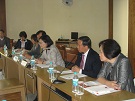
On 20th September 2012, Vivekananda International Foundation (VIF) hosted an interaction with Dr. Ing-Wen Tsai, former Chairperson of the Democratic Progressive Party (DPP), Taiwan and Presidential Candidate from the DPP in January 2012. Dr. Tsai was accompanied by Mr. Antonio Chiang, columnist and former Deputy Director, National Security Council, Taiwan. H.E. Wenchyi Ong, Representative of the Taipei Economic and Cultural Centre in India was also present on the occasion.

The VIF team was led by its Director Mr. Ajit Doval, K.C. and comprised of Amb.P.P.Shukla, Jt.Director, Gen.(retd)N.C.Vij, Distinguished Fellow, Lt.Gen.(retd)Ravi Sawhney, Distinguished Fellow, Vice-Admiral (retd) Raman Puri, Mr. Sushant Sareen, Senior Fellow and Brig. (retd) Vinod Anand, Senior Fellow. Professor M.D.Nalapat, Honorary Director, Geopolitics and International Relations, Manipal University also participated in the interaction.

The nearly two hour long discussion mainly focused on the Asia-Pacific region, on the Taiwan economy and on India-Taiwan relations and prospects for enhancing cooperation and growth.