Showing posts with label Trinamool Congress. Show all posts

Monday, April 8, 2013

Supporting War Criminals - Is Bengal’s Liberal Space Shrinking?

Dr. Anirban Ganguly 
(Research Fellow, VIF)

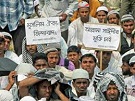
Something unprecedented happened over the last week end (30th March) in Kolkata. Sixteen Islamic organizations came together at the Maidan, the second largest public ground in the city, in protest against the ongoing War Crimes Trial in Bangladesh, against the Shahbag sit in and in support of the Vice-President of the Jamaat-e-Islami Bangladesh, Delowar Hossein Sayeedi one of the prime accused in the 1971 genocide in Bangladesh.

It was astounding to see a huge and belligerent crowd gather from all over the state to support one of the best known razakars and collaborators with the Pakistan army in its genocide against Muslims and Hindus in East Pakistan. Speakers addressing the gathering attempted to whip up hysterical support for the Jamaat and its leaders and pledged that just as West Bengal’s Muslims prevented Salman Rushdie from the entering the state and hounded out Taslima Nasreen in 2007 they would generate a movement against the pro-War Crime trial bloggers in Bangladesh and would take on their supporters with the same zeal. They even threatened to block any future visit of Sheikh Hasina’s to India.

But most shocking was their brazen support for Sayeedi, a known vocal anti-India preacher, a rabid anti-Hindu who has been active in organizing pogroms against minorities in Bangladesh over the years and one of the most avid collaborators in Pakistan’s genocide against fellow Muslims.

They openly declared their support for Sayeedi saying that a death sentence for Sayeedi in effect meant a death sentence for the Koran and Islam. These speakers chose to ignore the fact that Sayeedi was being tried for killing in cold blood their fellow religionists. It was for the first time that such a mobilization took place in Kolkata and it simply reinforced an emerging mindset which has begun trying to consolidate a pan-Bengal Islamic identity. Incidentally, it was from the Maidan in August 1946 that the call for ‘Direct Action’ was given by the Muslim League. The result of that call on the history of both parts of Bengal is too well known to even require a passing reiteration. But our politicians have deliberately chosen to ignore that past.

Not a single political party, and in them especially those who at the first opportunity, jump to dissect delusional dimensions of Hindu fascism and habitually get into describing various conjured Hindutva theatres of genocidal experiments or pontificate on the need to maintain the secular and syncretic texture of our nationhood, came forward to condemn the positions taken in the meeting. Not one political party even recalled the genocidal role that Sayeedi and his ilk played in the past and of how they helped to sustain Pakistani resistance to Indian soldiers. The Shahbag protesters have been calling for the establishment of a truly secular and constitutional Bangladesh where religious bigots would be reined in and their anti-national tendencies curbed and yet they find no support from our political secularists.

Both the Left and the Trinamool Congress (TMC) have maintained a studied silence having mortgaged over the years their politics to Islamic fundamentalist elements in the state. Comrades who jump at every opportunity to display their secular credentials in order to keep communal forces at bay through organizing rallies, sit-ins, and seminars have not issued even as much as a statement. In fact Sayeedi himself had a very clear benchmark for Communists, “Leftists are not Muslims. They don’t believe in prayers”, he had declared. It has always been an axiomatic truth for him that no non-Muslim could be allowed to live in Bangladesh. He assiduously worked for it ever since the War of Liberation in 1971. No wonder comrades in Bangladesh find it difficult to survive on their own and have prudently sided with Sheikh Hasina.

The Congress believing that it shall gain space with the electorates’ gradual disillusionment with the TMC has obviously kept quiet. Its studied silence is part of its larger grand design of mobilizing country wide minority support. Nor has the Indian media come forward to debate the phenomenon; it is still incapable of visualizing its status once congregations such as these begin spawning Sayeedi clones all over India. For the media and journalists Sayeedi had a simple equation, “Journalists write lies. They are the enemies of Islam”, it is well documented as to what Sayeedi did to those whom he considered as enemies of Islam. It is this stoic silence in face of a rising vocal Islamic fundamentalism which is worrisome and condemnable. The liberal space in Bengal is fast shrinking and we have paid a heavy price for such a constriction in the past.

Those in whose support the Maidan congregation was organized were at their vicious best when it came to treating minorities in their own country. Sayeedi himself, as head of the local Al Badr and Al Shams, has been convicted of killing Hindus, burning their homes and businesses and of forceful conversion. Sydney Schanberg, then correspondent of the New York Times, noted the selective approach in targeting Hindus, ‘the [Pakistani] army is now concentrating on Hindus, the killing is more selective, [and] has not stopped.’ Schanberg also recorded how the Pak army had ‘painted big yellow H’s on the Hindu shops to identify the property of the minority, eighth of the population that it has made it special targets.’

Archer Blood, the ‘dissenting diplomat’, then American Consul General in Dhaka cabled on 29th March 1971 on how the ‘Hindus [were] particular focus of [the] campaign and how the army was ‘going after Hindus with vengeance.’
Veteran Pakistani journalist Anthony Mascarenhas, who fled to London in order to tell the truth about the Pak army wrote in exasperation in his columns in the Sunday Times that the Pakistani military operation had two distinctive features: ‘ One, the cleansing process’, the other ‘rehabilitation effort’ – i.e. ‘turning East Bengal into a ‘docile colony of West Pakistan.’ Sayeedi and his political colleagues had wholeheartedly facilitated all of these; the Maidan congregators were silent on that.

It was Sayeedi who had once said of the Hindus of Bangladesh, ‘Why should we feel sad when the Hindu brothers choose to leave our country? Do we mourn when we have indigestion and materials leave our bodies?’

Do we then assume that those in West Bengal who have organized the Maidan rally in Sayeede’s support and those who have, through their silence given consent to their demands, really support that line? Aren’t they complicit in composing the final requiem for Bengal’s, once famed, liberal space?

Wednesday, October 3, 2012

Foreign Direct Investment and Economic Growth


Dr. M.N. Buch
Visiting Fellow, VIF


Paul Theroux in his book, ‘Riding The Iron Rooster’ has made some fascinating comments on China which can help us in trying to understand why China is today an economic power-house and India is still struggling. This book was written in 1988 and describes a series of train journeys that Theroux undertook across China in trains which were obviously not the new Bullet Trains that China has now introduced.

Starting from Victoria Station in London Theroux travels across Europe, Russia, and Mongolia and then enters China through Inner Mongolia, making landfall at Datong. After the emptiness of Mongolia Theroux finds Datong and the China it represents to be shabby, busy, disorderly, very crowded and thoroughly polluted by smog which was a combination of desert dust, fog and industrial smoke. The shops were full of goods; there was an air of prosperity, but coal as the source of energy and manufacture, especially of steam locomotives, created a lasting impression. The industrial process was not automated, but everyone was busy working. The guiding philosophy was the three great goals of the workers. To quote Theroux these goals were, “timing of production, so that no work was wasted; keeping the right mental attitude; and increasing productivity”.

I have begun this paper by referring at some length to the very first impression that Paul Theroux had when he entered China from Mongolia. It was one of a country which has industries, whose people had a mindset of production and whose government obviously had a commitment to manufacturing. After the revolution Mao Tse Tung deliberately fostered an economic policy which strove to build a huge manufacturing sector in the country so that China could become an industrialised nation. Remember the slogan that China would overtake America in steel production? The huge number of backyard furnaces that came up and produced very low quality pig iron was a part of this effort to industrialise. Not much pig iron was produced this way, but the people were weaned away from a rural psyche to one in which manufacturing became central to the economy. It must be remembered that in China only ten percent of the total land area is cultivable and more than sixty percent of the land consists of uncultivable wasteland. Geology, geography, topography, hydrology and soil morphology encouraged, in fact mandated, that China could not continue to prosper on the basis of agriculture alone. The industrial revolution in China was then an inevitable consequence of the land configuration, though to give Mao credit he hastened the transition from a basically subsistence rural economy to a very powerful industrial economy.

Industrialisation carries with it a number of prerequisites, sequential growth of support infrastructure, capital requirement and capital formation and research and development which would lead to invention, innovation and improvement. Industry cannot survive without power and the development of the power sector becomes a sine quo non for industrialisation. The development of communications so that goods, people and services can be transported over long distances is absolutely essential for industrial growth. Because a country starting from a low level of economic capability does need assistance for capital formation and for development of technology, China had to find partners. Therefore, despite the fact that China is a Communist country whose ideal is socialism and State ownership of the means of production, China opted for an open door policy in which foreign investment was welcomed and the off-shoring of foreign industry and its location in China was encouraged. China provided the land space and labour and many of the world industries established a base in China. A great deal of Chinese industrial grown has taken place because of this open door policy. The Chinese Government at no stage felt that it could not keep the multinational corporations under control and, therefore, the Chinese had no hesitation in letting in foreign capital. Despite the handicap of having a one-party rule and a judicial system which is certainly not Anglo Saxon, China has been able to reassure the foreign investor that his investment would be safe.

Let us contrast this with India. We have always been suspicious of foreigners coming and investing in India because after all the East India Company and its Dutch, French, Portuguese and Danish counterparts initially came to India for trade. Because of a succession of wars in Europe in which Britain emerged as the dominant naval power and also a great military power on land, the French, Portuguese and other European interventions in India were virtually liquidated and Britain emerged as the supreme European power. Starting from trading posts such as Bombay, Surat and Calcutta the British trader gradually grew into being an arbiter in matters of local, native administration and the East India Company expanded into an imperial power. These memories are fresh in the Indian mind and, therefore, the Indian people and the Indian politicians have always had a deep- rooted suspicion and antipathy towards the successors to the East India Company, the multinational corporations. That is why there is strong political opposition to allowing foreigners to come and take over our companies, our manufacturing units and our trade outlets. Surprisingly China, which calls itself a Peoples Republic and has the single party rule of the Communist Party of China, is today most openly capitalist and gives the warmest possible welcome to foreign investors. India, on the other hand, is a multi-party democracy in which the word “socialist” used in the Preamble to the Constitution is more a comforting slogan than a political commitment, but we are still hostile to the idea of foreigners participating in our economy because we still feel that Surat may become the base of a foreign empire. That does explain why there is such strong political revulsion whenever the question of opening up of our market to foreigners comes up for discussion.

Trade created an empire in India and, subsequently, this empire systematically destroyed such manufacturing capabilities that India had so that the factory-made goods of Britain may be sold in the Indian market and India may then be reduced to the position of a supplier of primary products to Britain. Despite this history the Government of India has decided to open up two sectors of the Indian economy to Foreign Direct Investment. These are retail trade and the civil aviation sector, the latter named being in absolute shambles because of mismanagement. Foreign Direct Investment in the retail sector is strongly opposed by the Left, BJP, Trinamool Congress and several such parties, some of which are a part of the present Congress led coalition. The argument advanced by government is that foreigners taking over the aviation industry will pump necessary working capital into the system and this part of the economy would revive. Similarly, Foreign Direct Investment in retail trade would cut out middlemen, create the infrastructure which would enable the supply chain to reach from the farmer right up to the customer in the retail store and would bring direct benefit to the cultivators while ensuing good quality of the produce and a reasonable price for the urban consumers. It is argued that the present system of agricultural production and marketing is such that there is considerable wastage of agricultural produce by inappropriate storage, spoilage and even destruction through putrefaction in the process of transporting the produce from field to market. The foreign investment retail chains would reach out directly to the producer, create adequate storage, including cold storage facilities and build an efficient transport system which would quickly bring goods to the retail stores. This would put more money in the hands of farmers, prevent wastage and enable the consumer to buy agricultural products at an affordable price. The fact that it would throw a very large number of small vendors, road side hawker and itinerant sellers who carry fruits and vegetables on hand carts right up to the doorstep out of a job does not seem to bother our American Business School, World Bank trained or oriented economists and policy makers.

We seem to be quite willing to allow foreign investors to invest capital, including working capital, in airline companies, most of which are utterly mismanaged. Why do we not encourage foreign investors like British Aerospace, Boeing, Dassault, etc., to invest in producing aircraft in India? Why do we not try and have foreign companies invest in building factories for producing the refrigeration equipment which keeps cold storage plants functional? In other words, why do we not encourage foreign companies to invest in the secondary sector in a big way in India? We have had a fair amount of success in the Build, Operate and Transfer model (BOT model) of road construction and certainly on highways such as that which connects Bhopal to Indore the BOT model has enabled a first rate road to be built. If a sufficiency of off-shoring of manufacturing facilities is done in India we would certainly be able to create more gainful employment, India would be able to evolve an industrial culture instead of the present satisfaction with trading and as our manufacturing capacity increases, we would become a major industrial power, economic power and military power. Obviously we need to take a fresh look at our policy relating to Foreign Direct Investment in India. Given the choice I would cut down all FDI in retail trade, the service sector such as running an airline and in real estate. I would have an open door policy towards investment in the secondary sector, including the setting up of hundred percent foreign owned manufacturing facilities in India. I would certainly give meaningful incentives for investment in physical infrastructure. My only restriction would be that employment generated by these activities would go to the citizens of this country so that their earning and welfare are enhanced.

The great advantage of having a powerful industrial economy is that it forces the manufacturing companies to invest in more research and development because if they do not improve, innovate and invent, their products will become unsaleable in the market. Therefore, industrial growth will bring about simultaneous growth in scientific research for the purpose of innovation and invention. This, in turn, will strengthen our institutions of technology and management because as industry grows, as the need for research grows, the market for these disciplines will expand, the research and development establishment will become stronger and the Institutes of Technology and Management will be forced to redesign teaching methodologies to keep up with the new demand.

My final words would be that government must realise that so far as the foreign direct investor is concerned, he would prefer an activity in which his own capital investment is miniscule, there is a quick turnover of commodities and, therefore, profits are earned almost simultaneously with trading. The gestation period in envisaging, constructing, commissioning of an industrial establishment and then going into commercial production is quite long and profit would have to be deferred to an appropriate date in the future. That is why in India trade is more attractive than manufacture. This would be true of the foreign direct investor also. We need to break this mindset, to make the industrialist realise that waiting for profit is not such a bad idea after all because the production capacity created will yield results year after year after year and that a well managed industrial enterprise will always be more profitable than just trade, whilst being less risky because it is unlikely to be affected by daily market fluctuations which retail trade has to face. Therefore, let economic reforms be targeted at opening up our economy to productive investment but not indiscriminately to trade. America and the developed world want exactly the opposite to happen and this we must resist.

Tuesday, June 19, 2012

Ideology and Political Parties


RNP Singh
Senior Fellow, VIF

The nationalist movement provided, particularly after 1920s, a broad framework of ideologies for political parties in India. Nationalism, socialism, secularism and democracy became the main plank of the Congress during last leg of the freedom struggle which remain so till now.

After independence, a section of political parties including Bharatiya Jan Sangh emphasized on a nationalist movement based on rejuvenated Hindu values and thought. The communists wanted to unite the freedom struggle with social revolution leading to the establishment of the rule of the proletariat and peasantry guided by Marxism-Leninism. Thus, during formative years, the ideologies of political parties were based on socialism, secularism, nationalism, Hindutva and Marxism. Of course, there were parties based on religious identity, such as Muslim League and Shiromani Akali Dal (SAD) which visualized religious communities as separate political entities.

The people within the Congress Party held different views and were categorized as rightists, centrists, and leftists. The first group within the Congress Party who opposed the overall policy of the Congress were the Socialists, who left the party in 1948, and formed the Socialist Party. The Socialist Party underwent several splits and reunions. In 1951 Kripalani formed KMPP but after 1952 elections, KMPP and Socialist Party merged to form PSP, so that an anti-Congress non-communist group could be forged. In 1955 Lohia left the PSP and revived the old Socialist Party. Again in 1964 SSP was formed as a result of the merger of the Socialist Party, with the PSP. Another group in the Congress Party led by C. Rajagopalachari who proclaimed their opposition to the Congress policy of giving a big role to the state in regulating, directing and changing the national economy and raising the public sector to the commanding heights came out of the Congress and founded the Swatantra Party in 1959. The Swatantra Party stood for a liberal ideology. This party, however, soon went into oblivion, though it performed well in the 1967 General Elections and emerged as the second largest party in the Lok Sabha.

There was split in the Congress Party in 1969. The split was known between radicals led by Mrs. Indira Gandhi and the conservative elements led by the old guard of the party called the ‘Syndicate’. But in fact, ideology did not play any significant role in the split. The birth of the new Congress Party under Mrs. Gandhi’s leadership was attributed more to the changed style of functioning of the Congress rather than to any changes in the party ideology. The later development showed that Indira Gandhi’s ideological vehemence and radical slogans were only a means to establish herself as an undisputed leader of the party.

The relation between the Congress and Socialists was always ambiguous. There were differences on co-operating with Congress which were in a way responsible for the splits in the Socialist Party. The ideological opposition to the theory and practice of Communism and formal adoption of the objective of building of socialistic pattern of society by the Congress made the position of Socialists virtually indistinguishable from that of the Congress and drew them closer to the Congress Party. Narendra Dev and Lohia opposed any tie up with Congress. In 1953 talks between JP and Nehru on co-operation failed. In 1962 Ashok Mehta was expelled from the PSP and he joined the Congress as a cabinet minister at the centre.

The most vigorous opposition to the Congress came from the Communists. Soon after independence the Communists waged an armed struggle in some parts of the country to overthrow the Indian Government. But soon the Communists gave up the path of armed struggle and joined the democratic process of election. The ideological debates on the character of Indian states, path to revolution in India, strategy and tactics of the revolutionary path led to several splits in the Communist Party. However, their participation in elections and success in forming and running governments at the state level firmly placed them in the arena of parliamentary politics. The splintered groups which believed in armed struggle were further split into several groups and later merged into one group named as CPI (Maoist) which is engaged today in guerrilla warfare against the established government.

Interestingly, after the inner debate in the party over the character of the Indian state and revolution, the undivided CPI came to the conclusion that it should support the Congress Party and form a united front with it. The other section which took a hostile attitude formed CPM in 1964. The split in the CPM and formation of the CPI (ML) and other revolutionary groups based on Maoism in 1967 and the splits within splits of these groups show the salient differences over strategy and tactics among the Communists. However, a closer examination of splits among the Communists reveals the interpretation of leadership rivalries, personality clashes, organizational matters and programmatic positions.

After the split in the Janata Party in 1979, its constituent Bharatiya Jan Sangh formed the Bharatiya Janata Party (BJP) in 1980. Besides adopting the main ideological base of the erstwhile Jan Sangh, the BJP adopted Gandhism, socialism and Cultural Nationalism as its ideological plank. The main reason for the BJP’s rise in 1990s was its forceful presentation of Indian nationalism and stiff opposition to the Congress programme of Muslim appeasement. It awakened the people against the danger posed by the Congress to Indian culture and the values of Hindutva. Its ability to penetrate into the middle class, to redefine nationalism and articulate the cultural and material aspirations of the people helped the BJP to consolidate itself. Its ability to redefine itself, expand its social base and forge alliances with regional parties helped it significantly in its rise.

In the functioning of political parties, caste, religion, language and region also have acquired ideological overtones. The Muslim League during the pre-partition days claimed that Indian Muslims constitute a separate political community. Islam and Urdu provided the two distinguishing marks. After partition the Muslim League was revived in 1948, although there were splits in it later. The AIMIM in Andhra Pradesh is the continuation of the Majlis of the Nizam period. It is mainly based in Hyderabad city, it almost exclusively appeals to the Muslims of the state.

Similarly SAD of Punjab has its roots in religion and its membership is restricted to Sikhs only. The leaders of the SAD believe that the Sikhs constitute a separate political community (Panth). The Akal Takht is the highest seat of religious and political activity. The SAD launched a campaign for a Punjabi Suba (separate state for Sikh) that excluded the Hindi-speaking areas and included areas where Sikhs are in a majority. In 1970s and 1980s it carried out a militant struggle for Khalistan. There are Christian parties too in the country, as in Kerala.

Language and region also acquired the nature of ideology. As language and region grow together, regionalism takes the form of linguistic nationalism. When they are further combined with religion, culture, or ethnic identity, they become a powerful force. It is witnessed in the South, West and East, in the emergence of several regional parties and separatist groups. The consolidation of TDP, rise of Shiv Sena, AGP, BJD (and its earlier version Utkal Congress), National Conference and PDP in J&K, JMM, Trinamool Congress etc. shows how region has the potential to assume the form of an ideology.

With the emerging trend of the formation of regional parties, centre-state relations are getting strained. Leaders of the regional parties demand more powers for the state in a federal frame work. This trend has also given rise to the decline of National Parties in those states as it has resulted in consolidation of regional parties. Regional identity and interests remained a potential issue for political mobilization. Often this has taken the form of centre-state problems.

However, the ambitions of the leaders of regional parties generally do not remain confined to the region only and they also tend to catch up with national aspirations and therefore, they compete with the national parties for power. They therefore, adopt belligerent postures particularly against the Congress, the established national party. The BJP, the more nationalistic of the national parties, quickly grasped this emerging trend and forged alliance with these parties. Later the Congress too followed suit but it is yet to come to terms with reality of co-existing with the regional parties.

Inspite of different ideological positions, to get themselves registered with the Election Commission, it is mandatory for all parties to declare themselves as secular, socialist and democratic. It is a different thing as to how they interpret these principles. Even parties who appeal to people on the basis of caste and religious identities regard themselves secular. For instance SAD, Muslim League, National Conference, Kerala Congress and Shiv Sena too stand by secularism. They say that they stand for secularism and oppose pseudo-secularism. BSP stands for emancipation and empowerment of Dalits and so on. This is the way how Indian parties have evolved and the values of secularism and socialism have been internalized in the Indian psyche.


Except in the initial years after independence, ideology did not become a bar to forge alliances among the parties. The Communist and Muslim League fought elections in Kerala together. Both Congress and CPI could forge alliances and together and they could arrive at electoral understanding in that state. The coming together of socialists, former Congress men and the Jan Sangh to form the Janata Party showed that ideology is no hindrance in party chemistry. Interestingly, the CPI and Jan Sangh, ideologically poles apart were the constituents of Samyukta Vidhayak Dal government (SVD) in Bihar, in 1967 led by Karpoori Thakur, a Socialist.

Thus, we find that relation of any party with any other is not fixed on ideological position. Parties are always ready to make compromises due to electoral compulsions and political requirements. The coalitional arrangements change as per the requirements of situation. Some of the socialists joined hands with the BJP in 1998 and they are happy together since then. DMK and AIDMK switch sides between NDA and UPA. In UP, the BSP formed a government with the support of the BJP. SAD and National Conference became partners of NDA.

Theoretically any party except BJP could fit into the UPA. The Third Front which went into oblivion immediately after its birth but is struggling to take shape again, can accommodate any party except BJP and Congress, while the NDA can take any party except the Congress and Communists. The exclusion and inclusion is more due to party competition and electoral considerations rather than ideological positions.

The loss of values of ideology could be due to changing perceptions of the people, leaders and the followers at the ground level. Ordinary people hardly bother about ideological quarrels. For both, people and followers, pragmatic politics have become the norm. Parties are increasingly looked upon as means to serve personal interests. Now we see fewer and fewer leaders having fixed loyalties. Some political leaders change parties as per their convenience. The parties too now follow an “open door policy” in accepting leaders from other parties.

The country has travelled a long way from the principled politics of 1950s to personalised politics today. Whether this flexibility of ideological values is better for our democratic future is matter of opinion and debate.