Showing posts with label World Bank. Show all posts

Tuesday, November 12, 2013

China and the United States – Big risks to the Global Economy and Markets

Dr. V. Anantha Nageswaran, 
Visiting Fellow, VIF

US stocks reach all-time high as government shuts down

George Orwell is reported to have remarked famously that telling the truth would be a revolutionary at a time of universal deceit. It cannot be more apt than now when financial markets are dancing to the commentary that is peddled by central banks and other cheerleaders that the world is embarking on a self-sustaining recovery even as the IMF and the World Bank are reducing their growth forecasts. The United States emerged from a fortnight long government shutdown in October. The US Congress voted to lift the debt ceiling but for three months. GDP growth in the fourth quarter in the United States will be lower than previously estimated. The Bloomberg Consumer Comfort Index at minus 37.9 is at its worst level since October 2012. It has fallen for six weeks in a row.

Some indicators in Europe are turning up but it is not yet clear if Europe has what it takes to achieve a self-sustaining recovery. Export growth in Asia – China, Taiwan and Korea –slipped in September. Although October foreign trade data improved in China, it is hard to see a sound economic rationale for the rebound to sustain. No one is prepared to tell financial markets and investors that rising asset prices without fundamental improvement simply means that they are blowing bubbles. US banks have, almost uniformly, reported disappointing results. The few that did report better results have resorted to the use of clawing back loan-loss reserves to shore up profits. IBM has reported its sixth straight quarter of declining revenues. Corporate profits were flat in the US in 2012. Yet, Earnings per Share (EPS) of S&P 500 companies went up slightly in 2012 only because companies bought back shares. The rise in the S&P 500 index stock value is entirely due to an expansion of P/E multiple. To put it bluntly, that is bubble blowing, especially when fundamental economic and corporate backdrop are both turning unfavourable.

The final denouement of this bubble-blowing behaviour is the price of the stock, Twitter (TWTR is the stock code). It opened for trading at USD26.0 on 7 November and jumped to an intra-day high of USD50.09 before closing at USD44.90. That is a one day jump of 72.7%. According to John Mauldin’s research note (‘Bubbles, bubbles everywhere’, Nov. 2, 2013), “since 1990, the P/E multiple of the S&P 500 has appreciated by about 2% a year; in 2013, the S&P's P/E has increased by 18%!” He was citing another market commentator Doug Kass. Some of the worst debt practices of the 2007-08 period are back.

It is hard to believe but true that barely after five years of the last crisis of such a huge magnitude, policymakers and investors are blowing big bubbles again. Investors are obsessed with the liquidity provision by central banks. Mohamed El-Erian of PIMCO has brought out this point rather well in a recent commentary:

In normal (healthier) times, markets look to central banks to provide the appropriate regulatory and monetary policy environment; and central banks look to markets to deliver efficient pricing and resource allocation. Today, this co-dependence has become a lot less healthy.

Markets are now conditioned to expect a solid and continuous “central bank put”; and the revealed-preference of central banks for repeated interventions to support asset prices undermines efficient market functioning and discipline. For their part, and as illustrated as recently as last month’s non-decision on tapering by the Federal Reserve, central banks find it hard to reduce their direct market interventions lest they cause severe disruptions to market pricing, liquidity and financial conditions – as indeed occurred after the May 22 mention of “taper” by Fed officials.


On October 30, the US House of Representatives passed, with bipartisan support, legislation “that would roll back a major element of the 2010 law intended to strengthen the nation’s financial regulations by allowing big banks like Citigroup and JPMorgan Chase to continue to handle most types of derivatives trades in house”. (http://dealbook.nytimes.com/2013/10/30/house-passes-bill-on-derivatives/). The interesting part is that Citigroup lobbyists wrote about 70 of the 85 lines of the House Bill. With this, the House has passed eight bills this year that would roll back provisions of Dodd-Frank.

Now, in any other country, it would be a major scandal if the regulated wrote the law that would regulate them. It is one thing for lawmakers to seek their views before a law is amended or passed. It is another thing to let them write the provisions that they would like to see. It has ‘Conflict of interest’ written all over it. Unfortunately, America remains the intellectual leader for global financial capitalism. Practices such as these, in combination with reckless monetary policy and investors’ carefree attitude, makes America a big risk to international financial stability.

China Credit Taps running again

Turning to China, even as analysts wrote copiously on the Fitch downgrade threat to US sovereign debt, they completely ignored the press release that Fitchratings put out on the same day. Fitch had tied China’s ratings to economic rebalancing. Of course, Fitch appears to want to wait until the National People’s Congress meeting in 2014 is over, before taking any rating (downgrade) decision. However, based on the government’s record thus far on re-balancing, the case for a downgrade of China debt already exists.

It was some time in 2007 when the former Prime Minister Wen Jiabao called the Chinese economy increasingly unstable, unbalanced, uncoordinated and ultimately unsustainable. Not much has improved since then. If anything, China’s economy has become more unstable and unbalanced. This is what Fitch ratings had to say on the China macro situation:

Capital formation rose to account for 48.1% of GDP in 2012 - unprecedented for any large emerging market. If investment continues to grow faster than GDP, it would soon exceed domestic savings (50.8% of GDP in 2012) - and China would sink into a trade deficit, dependent on capital inflows to fund growth. Fitch believes the authorities are determined to avoid such an outcome.

Investment and debt are closely connected and Fitch believes China has a debt problem to match its extraordinarily high investment rate. The stock of debt in China's economy has surged to around 200% of GDP at end-2012 from 129% at end-2008 when the authorities unleashed a credit-fuelled stimulus. The agency believes no economy can operate indefinitely with a rising leverage ratio - another reason why growth is on an unsustainable path.

There has been no progress in rebalancing the economy away from investment towards consumption, year to date. Investment contributed 4.1 percentage points (pp) of China's 7.6% growth in H113, against 3.4pp from consumption. Credit continues to grow faster than GDP: the flow of new "total social financing" was up 30.6% year-on-year in H1 2013 while nominal GDP rose by 8.8%. Fitch believes China faces a process of structural economic adjustment - which could be bumpy. Moreover, some of the costs of fixing China's debt problem are likely to fall on the sovereign.


In August, Total Social Financing (TSF) was up by Yuan (CNY) 1.6trn. Consensus forecast was for an increase of just CNY 950bn. In September, TSF rose again by another huge amount – CNY1.4trn. China’s macro-economic turnaround in the third quarter has been entirely due to another round of credit flood.

Such huge numbers on new credit creation (these are ‘flow’ of new credit created every month and not stock of credit) have persuaded some analysts that these numbers might be overstating the actual credit creation and that some double counting might be involved (see http://bloom.bg/193v6g5). However, Fitch has a response to this:

Some double-counting is inevitable, but limited and offset by the numerous channels of credit not captured by either metric, e.g. corporate credit transformed into interbank claims, inter-company credit and payables, private equity (PE) funds (particularly local government PE funds), and person-to-person lending. This is further supported by the fact that growth of total banking sector assets remains so strong (Figure 5), which would not be the case if TSF data contained substantial double counting or diverged visibly from broader financial sector trends.

In Fitch’s view, the principal reasons why credit continues to outstrip GDP are: 1) the majority of non-household principal obligations falling due are being rolled over/refinanced, resulting in a fall in net repayments of credit and propping up credit flows; 2) as the stock of credit rises, an increasing share of new financing is going toward servicing interest payments, which has little or no impact on the real economy; and 3) a substantial portion of credit is going toward long-term projects that have yet to come on line.

Source: ‘Chinese banks - Indebtedness Continues to Rise, With No Deleveraging in Sight’, FitchRatings, 18 September 2013

We present below some charts that tell their own story.


“Credit/GDP will have risen an estimated 87pp in the five years ending in 2013, nearly twice that observed in other countries prior to financial sector stress”.

Source: ‘Chinese banks - Indebtedness Continues to Rise, With No Deleveraging in Sight’, FitchRatings, 18 September 2013


Source: ‘Chinese banks - Indebtedness Continues to Rise, With No Deleveraging in Sight’, FitchRatings, 18 September 2013


Source: ‘Chinese banks - Indebtedness Continues to Rise, With No Deleveraging in Sight’, FitchRatings, 18 September 2013


Source: ‘Chinese banks - Indebtedness Continues to Rise, With No Deleveraging in Sight’, FitchRatings, 18 September 2013

China calling on the United States to behave responsibly was clearly a case of the pot calling the kettle black. China’s suggestion that it was time the world abandoned the U.S. Dollar as the global reserve currency might be a reasonable one but certainly, the alternative is not the Chinese yuan. In fact, presently, the Euro looks a safer bet than either the US dollar or the yuan. However, there is a big question mark hovering over sustainable economic growth in the Eurozone.

Finally, when central banks are the only game in town – they are the plaintiffs, the jury, the judge and the executioner – it is foolish to try to view asset prices through the prism of economic fundamentals.


During a brief interview on FOX Business, David Stockman, the author of The Age of Deformation exclaimed "There’s no one in the stock market today except drugged-up day-traders and robots... This is utterly irrational." The blame (and benefactors) are clear, he blasts, "how could someone in their right mind believe that you can have interest rates... at zero for nine years? ... That is the greatest gift to the speculators, to the 1%, to the leveraged traders, to the carry trade ever imagined!" He concludes, "we're almost on the edge of another explosion at the present time." (http://www.zerohedge.com/news/2013-11-07/david-stockman-blasts-brace-exp...). Enough said.

Wednesday, April 10, 2013

Don’t Deny BRICS its Relevance


Kanwal Sibal, 
Dean, Centre for International Relations and Diplomacy, VIF

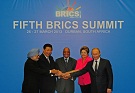
Media commentary in India on the fifth BRICS Summit, held in South Africa on March 27th, has not been particularly positive. Attention has been drawn to the artificial character of this grouping originally thought up by Goldman Sachs, the conflicting interests of its constituents, the disparate nature of their political systems, the doubtful advantages to India of membership, and, now fears of Chinese domination of this ensemble because of its overwhelming economic and financial weight.

If the logic of this criticism were to be accepted, it will apply partially to the United Nations, the IMF and the World Bank too, where differences in the political systems, power equations and interests of countries are even more marked, with the influence of one country-the United States- being the most decisive. The G-20 also cannot be exempt from such criticism too. Yet India is a member of all these international organizations or groupings, without self-questioning.

Nature

The perceived anti-West orientation of BRICS is troubling for some. True, the Russians pushed for its creation in order to forge a partnership between major non-western countries to promote multipolarity. Members like India- and this would apply to Brazil and South Africa as well- believe in a reform of the West-dominated international system in which their voice is not sufficiently heard. Groupings like BRICS can act as platforms for calls for change, without the three countries in question slipping into any futile anti-westernism.

We should not overuse the democracy argument to question our cohabitation with China and Russia in BRICS. If we are supposedly in bad company, then it is worth recalling that US financial and economic links with China, or those of major European democracies, are incomparably greater than ours. We should also be careful not to buy into the highly tendentious western criticism of Russian democracy for geopolitical reasons.

We are against policies of regime change, interference in the internal affairs of sovereign countries, politicization of human rights issues and doctrines of humanitarian intervention etc. India-Russia annual summit declarations show congruence of thinking on the principles that should govern international relations. With Brazil and South Africa too we have such consonance. The BRICS platform enables all of us to project our opposition to western efforts to create new, destabilizing norms.

In BRICS only India and China have sharp bilateral differences. Should we be in a grouping that provides space to China to expand its influence internationally, eventually at our expense? Russia too should have similar concerns theoretically, but it is working closely with China politically, economically and, once again, militarily, as the decision to sell it 24 SU-35 aircraft, the very that lost out in competition for the supply of 126 aircraft to us, shows. This is discomforting for us as it devalues the relative importance of India-Russia relations to China’s advantage.

Despite this negative feature of BRICS for us, there are clear strategic advantages of membership. BRICS is an instrument of pressure for change in the international system. The eThekwani Declaration calls for new models and approaches as regards global governance. It notes the negative spillover effects of the monetary policy of US, Europe and Japan which have led to increased volatility of capital flows, currencies and commodity prices, with negative growth effects in developing countries. It calls for prioritizing the G20 development agenda. It expresses concern at the slow pace of IMF reforms and demands that International Financial Institutions should reflect in their structures the growing weight of BRICS and other developing countries. The core principles and the developmental mandate of the Doha Round are stressed, besides asking that the next Director-General of the WTO should be a representative of a developing country. All this reflects India’s thinking and interests.

Declaration

The declaration calls for a comprehensive reform of the UN, including its Security Council, with Russia and China reiterating the importance they attach to the status of Brazil, India and South Africa in international affairs and supporting their aspiration to play a greater role in the UN. This kind of patronizing formulation was not needed by India, which is less than what Russia offers us bilaterally.

The eThekwani declaration is moderate, with no anti-western bias. The paragraph on Syria is balanced; the one on Palestine repeats standard formulations. On Iran, there is a call for a negotiated solution, with concern expressed about threats of military action as well as unilateral sanctions. The paragraph on terrorism accords with India’s position. The one on Afghanistan is unobjectionable. The paragraph on climate change is non-controversial. The importance of peaceful, secure, and open cyberspace through universally accepted norms, standards and practices is emphasized.

Steps

Because the summit was held in Durban, the focus on Africa in the proceedings- with participation of several African countries in discussions- and the final declaration is prominent.

The decision to set up a New Development Bank with substantial and sufficient initial contribution to finance infrastructure in emerging and developing countries has attracted adverse attention, as if working outside the World Bank or ADB is unacceptable. Differences over the size of funding and fears of Chinese domination have been highlighted. A Contingent Reserve Arrangement (CRA) with an initial size of 100 billion US $ to help BRICS countries forestall short-term liquidity pressures has also been established. These are steps in the right direction.

We should not be dismissive about the declared aim of progressively developing BRICS into a full-fledged mechanism of current and long-term coordination on a wide range of key issues of the world economy and politics. This is part of our sensible policy of playing on all chess boards with prudence, calibration and no ideological bias.

Tuesday, October 30, 2012

India Shining? Or India, The Dark Continent?


Dr M N Buch (Visiting Fellow, VIF)

The newspaper headlines and electronic media such as NDTV24×7, Times Now, CNN-IBN keeps screaming at us that India is the land of scams, the very fountainhead of corruption. On the one hand are the Indian people – harried, betrayed, looted by those in power. On another we have the predators, the politicians and bureaucrats. As if a third hand had sprouted on our body politic we have the crusaders, the knights in shining armour, the Anna Hazares, Arvind Kejriwals, the father and son Bushan duo, the Sisodias, Damanias and Kiran Bedis, fighting valiantly to expose the corrupt and punish the guilty. Or does one sense a certain tarnish on their armour, a certain uneasy feeling that a desire for publicity, a hunger to be in the limelight, a vaulting ambition to unseat those in power so that they themselves can assume power? Is the campaign against corruption, based less on commitment and more on the benefit that flows to the campaigner really aimed at eradicating the disease rather than on just exposing, selectively, some of the powerful for the vicarious pleasure that scandal-mongering gives? In other words, is India a total cesspit of corruption, or is there another India also in which the average citizen goes about his peaceful occupation and keeps the country ticking?

This essay is not really young India’s contribution because I am already seventy-eight years old and I joined the India Administrative Service more than fifty-five years ago. India, like me, was still young as an independent country, being only ten years old in 1957. We were in a very exciting era in which a leader of the stature of Jawaharlal Nehru had launched India on a path of development which promised to pull a sleepy colony from its slumber to become one of the great industrial powers of the world. Smug though it may sound we young officers also were galvanised by the thought that in our own small way we, too, were a part of the process of modernisation. Great things did happen, dams were built, food self sufficiency was attained, the capital goods industries went into production, education and healthcare took large leaps, electric power brought light to rural India. We, who had been the brightest jewel in the British crown, were suddenly moving by leaps and bounds to catch up with the developed world. The sheer sense of pride we had as Bhakra Dam went on stream, Bhilai Steel Plant began to produce steel or the Railways began producing their own locomotives. No country that is genetically corrupt can achieve all this and our scientists, engineers, technologists, doctors, researchers, even our politicians and civil servants proved that we are better than the best. No country in the world could produce a team equal to one headed by S.N. Mehta of the ICS and Tata Rao, a great electrical engineer, who together built the Madhya Pradesh Electricity Board into a powerful engine of economic and social change in the largely tribal state of Madhya Pradesh.

Even if the paper is not written by a young man it is still the outpourings of a person who is xenophobically Indian. I believe in this country, I have faith in its future and I take great pride in the commonsense of its people. Therefore, unlike the Kejriwals of today I would like to draw up some sort of a balance sheet which would help us look at ourselves in perspective, recognise the legitimacy of the demand to eradicate corruption because the fact is that not only at top levels but even, or especially, at the level of normal routine the citizen has become the victim of bureaucratic inefficiency, even deliberate harassment, political corruption and even downright cheating by unscrupulous businessmen. In the delivery of services by both government and the private sector there is a feeling based on reality that the citizen will face a shortfall. Even in performing its minimum function of maintaining law and order and controlling crime government seems to be failing, with political interference in police functioning being the main cause. It is almost as if the will to govern no longer exists, though the desire to use power for personal gain is very much in evidence.

The negative side of the report card can be extended to cover a volume, but the negative is also constructed out of elements which highlight what is wrong without looking at the whole picture. Therefore, unless one is looking at a situation such as faced by Germany at the end of World War II, when the nation stood destroyed by the colossal mistakes of an unbridled megalomaniac, if the negative is viewed in perspective it often becomes manageable and capable of remedy. The question, therefore, is whether the near failure of governance in India, the widespread political and bureaucratic corruption, the systemic shortcomings, are still manageable and capable of remedy or do we now need a total revolution? Is the India Against Corruption campaign of washing dirty linen in public such a revolution or is it only another form of J.P. Narain’s failed ‘sampurna kranti’? Is there cause for despair or is there still real hope?

A perspective requires a study of what is positive in the system. One must, therefore, begin with seeing the institutions which the British left us and which the Constitution enshrined. The first is parliamentary democracy itself. Despite the brief interlude of the Emergency institutionalised democracy does work in India. It accommodates the political philosophy of Hindutva without sacrificing the basic secular character of our democracy. It encourages middle-of-the road politicians and parties to set a benchmark to which both extreme right and extreme left have to adhere. It allows the Marxists to rule two major States and wield great influence nationally. It forces fissiparous regional parties like DMK and the Akali Dal to subordinate their regional interests to national interests and it makes the Government of Gujarat acquiesce to prosecution of communal elements in the State who allegedly enjoy state patronage, many of whom have been convicted and sentenced by our independent courts. In fact the fiercely independent judiciary itself is a legacy of the British, with the courts standing as a stout wall which protects our democracy. This is an unparalleled achievement and one could state with little fear of contradiction that no other country has such proactive courts as our Supreme Court and High Courts. Politicians may accuse the judiciary of sometimes encroaching on the territory of the executive, but no one dares to defy or disobey a court order.
There are three other institutions which need mention. One is our totally apolitical Armed Forces. Our Armed Forces are a democratic organ of a democratic State and anyone who underplays this fact is a fool. This is definitely one of the major positives of our report card. Then we have the Civil Services, including the Police. They have been under immense stress as values erode and politics becomes corrupt, fissiparous, or demanding of our Services to become partners in wrongdoing. No doubt there is some erosion of values and probity, but there are many fine Civil Service and Police officers who have been true to their salt, been steadfast in doing their duty and have stood their ground against all odds. To this we must add our great civil Constitutional institutions such as the Comptroller and Auditor General, the Public Service Commission, Union and State and Commissions such as the National Human Right Commission and the Information Commission. “They stood, and earth’s foundations stay”, to quote Housman.

Empowerment in its broadest sense is a definite positive in India. The British studiously avoided empowering us. They did delegate certain functions to Indians and made marginal institutional changes, but in terms of giving Indians real power in the way that the Preamble of our Constitution does or Part III of the Constitution through the Fundamental Rights confers on all citizens was missing from the British mindset. Empowerment after independence has been devolved politically right down to panchayat level and now, through the Seventy-third and Seventy-fourth Amendments of the Constitution, urban and rural local government forms the third tier of government in India. At local government level, through reservations which are legally mandated, women, tribals and scheduled castes and other backward classes which hitherto did not enjoy a share of power have now been constitutionally made partners in government. The most significant change has been reservation for women in local government, which has forced a conservative and, in the case of States such as Haryana a fundamentalist orthodox society, to share power with women. This has not ended discrimination against women but as more and more of them begin to enjoy political power one can see a perceptible shift in gender equations in large parts of the country. Khap panchayats of Haryana still exist but the voices of women can no longer be stilled and the movement for gender sensitisation and equality is bound to gather pace.

On the social front one finds a great deal of ferment in what has hitherto been a caste bound socially static society. One change is that those who had been oppressed for millennia on account of birth are standing up, demanding and .fighting for their rights. Social structures cannot change overnight, but as more of the underprivileged raise a cry for an equal share of power, wealth and development, the social momentum for equality is bound to accelerate. Many people, especially of my generation, find it anathema that those who happen to be born in a lower caste are now coming and sitting not only beside us but sometimes above us. There have been violent clashes between different social groups on this account and stories of atrocities against lower caste people are still heard frequently. Here, too, there is a change. It is not the Brahmins and the Thakurs who are the main exploiters of the Dalits. The main clash is now between OBCs and the Dalits. If the highborn can learn to live with those whom they consider shudras, the day is not far when OBCs will also have the accept Dalits as equals. Where we are failing is that government, which should play a strong proactive role to promote a casteless society and to come down with a heavy hand on those who use their collective caste status to oppress others, often plays a wait and watch role. If government becomes proactive we can very quickly become a society based on merit rather than caste and class. One would have thought that the Socialists would be in the vanguard of a campaign to promote castelessness, but unfortunately the two main Socialist groups, the U.P. group of Mulayam Singh Yadav and the Bihar Group of Lalu Prasad Yadav, have preferred to play the intermediate caste card for political gain and these two groups have in fact encouraged caste based politics which is highly divisive. In a country undergoing social ferment which can only create a new, positive dynamics, divisive caste politics is trying to reverse what is a desirable forward progression in India. Nevertheless I still look upon social ferment as a healthy sign and would put it on the positive side of the report card.

How well have we managed our economy? Have we eliminated poverty, tackled malnutrition, provided jobs, increased productivity, balanced the budget, controlled prices and generally created an environment in which there is healthy growth with equity? I would like to answer this question somehow obliquely. In the beginning of 1962 I became District Collector of Betul, a beautiful, jungle clad, hilly district in the Satpuras, with a large tribal population. When compared with districts in the more prosperous areas of India or, for that matter, in the Chambal or Malwa regions of Madhya Pradesh, Betul was backward; there was visible poverty and very little industrial activity. Soon after I took over, a Swedish Bishop, who had served as a missionary in the district more than thirty years ago, came to call on me. He expressed surprise at the enormous progress made by the district, which took me aback. I asked him why he felt that there was progress. He told me that whereas in the past many people were bare bodied he did not find a single person without a shirt on his back or footwear on his feet, many tribals were on bicycle, there was electricity even in rural areas and that in a district where wheat was almost unknown he found it to be the major rabi crop now. I had taken a spot view of the district, whereas the Bishop had taken a longitudinal view. I swore that day that in future when I looked at any issue I would also like to create a perspective in which I could compare what was and what is. If we view India through this prism it is amazing how much progress we have made. When the British left only about five thousand towns and villages were electrified. Today there is universal electrification and though power supply in rural areas is erratic, intermittent and of poor quality, at least the basic service is in place. If we emulate the example of Gujarat which has separated the agricultural feeder from the main feeder, ensured twenty-four hours supply on the main feeder at full tariff and prescribed hours of top quality supply on the agriculture feeder we, too, can improve the quality of power and the quantum of power throughout the country. Here there is a management failure but not an economic failure. If we set the power system right there would be a massive upsurge of economic activity and this is something which is capable of both implementation and management.

India had a rudimentary industrial structure when the British left and today we are one of the most powerful industrial economies in the world. We look at the aberrations of the system, but why do we not recognise that Ratan Tata, Rahul Bajaj, Keshub and Anand Mahindra, Dhirubhai, Mukesh and Anil Ambani, the great Chettiar industrialists of the South have created absolutely new industrial and economic models which have made India prosperous? We bother about Mukesh Ambani spending rupees six hundred and fifty crores on his house in Bombay, but we do not even mention the fact that the world’s biggest refinery of petroleum products is the Reliance Group’s establishment at Jamnagar, which has created thousands of direct and indirect jobs. One does not excuse the Ambanis for any shady practices they may have adopted to create this vast empire, but the fact is that Dhirubhai and his sons have played a major transformative role in developing Indian industry.

NREGS is the flagship vessel of government to create rural employment. The idea is sound because if we create rural jobs which are productive we can ameliorate rural-urban migration and also improve living standards in rural areas. However, in practical terms the scheme is somewhat ill-conceived because its main focus is employment and not asset creation. The minute we change this scheme to create permanent rural assets which benefit the rural economy, the scheme will suddenly become a major source of increasing productivity on a long term basis in the agriculture sector. One has only to visit those areas of Jhabua District where a successful watershed management programme has dramatically increased fodder and fuel supply, raised the water table, brought about a higher agricultural yield and very substantially stopped the seasonal migration of the villagers in search of wage employment. The thought was correct, the design of the scheme was defective and, therefore, unsatisfactory implementation coupled with corruption was an inevitable consequence. What we need here is not Kejriwal; what we need is a system which automatically forces planners to think and then from these thoughts emerge practical proposals which can be implemented without difficulty.

I would say that on the whole the economy has not done badly. The major failure of government in this behalf is a total inability to grasp what causes inflation and to take remedial measures in reasonable time. That is also because the economic managers and advisors of government are unfortunately not grounded in Indian realities and, therefore, outdated, totally irrelevant and out of context, World Bank influenced ideas flow from them and virtually dictate policy. Prices can be controlled through better networks of roads which enable produce to be moved from rural areas, a wholesale market which buys directly from the producer and not through middlemen, a host of storage facilities which enable grain, for example, to flow into the market on a year round basis, in which there is no sharp drop in prices when the harvest season sets in and a sharp increase as the season passes and grain becomes in short supply, and a well developed market intelligence system which enables commodities to be quickly moved from the producer to the areas of high demand. It does not take a genius to look at what is obvious but it takes hard work, based on proper planning and priorities, to achieve desirable results. I consider it a big negative in this country that we still have not been able to develop a system which could encourage price stabilisation, while paying a fair share to the producer.

Our social infrastructure has definitely improved. There are more schools, more colleges, more institutes of technology and management and medicine than before and whereas peaks of excellence may have flattened, the overall standard has risen. We may not win Nobel Prizes, but we are a better educated and more technically qualified people than before. I hold the view that if the Education Ministry could put its act together we can revolutionise our educational system and standards. This is also true of healthcare. But unfortunately here the primary healthcare has not kept pace with a high level medical and surgical care. What we need to do is to raise the median to a higher level so that the quality of primary and community level health care dramatically improves. This, again, is an achievable objective.

India may not be shining like burnished gold but it certainly is not the Dark Continent. I would say that we are progressive but not optimally efficient, we are not genetically corrupt but there is systemic corruption in India which we are not serious about eradicating. We have a dynamic economy, but as a people we seem to prefer the brake pedal to the accelerator. We lack strong, purposeful democratic government despite a firmly entrenched democratic polity. None of these, however, need cause us despair, though there are twinges of distress. We can overcome all these shortcomings with greater citizen participation, greater accountability which rewards the good and punishes the bad and with reformed political parties which emphasise values and ideology and prepare themselves both for exercise of power and to sit in opposition. Platitudes? Never -- for all this is in the realm of the possible.

Wednesday, October 3, 2012

Foreign Direct Investment and Economic Growth


Dr. M.N. Buch
Visiting Fellow, VIF


Paul Theroux in his book, ‘Riding The Iron Rooster’ has made some fascinating comments on China which can help us in trying to understand why China is today an economic power-house and India is still struggling. This book was written in 1988 and describes a series of train journeys that Theroux undertook across China in trains which were obviously not the new Bullet Trains that China has now introduced.

Starting from Victoria Station in London Theroux travels across Europe, Russia, and Mongolia and then enters China through Inner Mongolia, making landfall at Datong. After the emptiness of Mongolia Theroux finds Datong and the China it represents to be shabby, busy, disorderly, very crowded and thoroughly polluted by smog which was a combination of desert dust, fog and industrial smoke. The shops were full of goods; there was an air of prosperity, but coal as the source of energy and manufacture, especially of steam locomotives, created a lasting impression. The industrial process was not automated, but everyone was busy working. The guiding philosophy was the three great goals of the workers. To quote Theroux these goals were, “timing of production, so that no work was wasted; keeping the right mental attitude; and increasing productivity”.

I have begun this paper by referring at some length to the very first impression that Paul Theroux had when he entered China from Mongolia. It was one of a country which has industries, whose people had a mindset of production and whose government obviously had a commitment to manufacturing. After the revolution Mao Tse Tung deliberately fostered an economic policy which strove to build a huge manufacturing sector in the country so that China could become an industrialised nation. Remember the slogan that China would overtake America in steel production? The huge number of backyard furnaces that came up and produced very low quality pig iron was a part of this effort to industrialise. Not much pig iron was produced this way, but the people were weaned away from a rural psyche to one in which manufacturing became central to the economy. It must be remembered that in China only ten percent of the total land area is cultivable and more than sixty percent of the land consists of uncultivable wasteland. Geology, geography, topography, hydrology and soil morphology encouraged, in fact mandated, that China could not continue to prosper on the basis of agriculture alone. The industrial revolution in China was then an inevitable consequence of the land configuration, though to give Mao credit he hastened the transition from a basically subsistence rural economy to a very powerful industrial economy.

Industrialisation carries with it a number of prerequisites, sequential growth of support infrastructure, capital requirement and capital formation and research and development which would lead to invention, innovation and improvement. Industry cannot survive without power and the development of the power sector becomes a sine quo non for industrialisation. The development of communications so that goods, people and services can be transported over long distances is absolutely essential for industrial growth. Because a country starting from a low level of economic capability does need assistance for capital formation and for development of technology, China had to find partners. Therefore, despite the fact that China is a Communist country whose ideal is socialism and State ownership of the means of production, China opted for an open door policy in which foreign investment was welcomed and the off-shoring of foreign industry and its location in China was encouraged. China provided the land space and labour and many of the world industries established a base in China. A great deal of Chinese industrial grown has taken place because of this open door policy. The Chinese Government at no stage felt that it could not keep the multinational corporations under control and, therefore, the Chinese had no hesitation in letting in foreign capital. Despite the handicap of having a one-party rule and a judicial system which is certainly not Anglo Saxon, China has been able to reassure the foreign investor that his investment would be safe.

Let us contrast this with India. We have always been suspicious of foreigners coming and investing in India because after all the East India Company and its Dutch, French, Portuguese and Danish counterparts initially came to India for trade. Because of a succession of wars in Europe in which Britain emerged as the dominant naval power and also a great military power on land, the French, Portuguese and other European interventions in India were virtually liquidated and Britain emerged as the supreme European power. Starting from trading posts such as Bombay, Surat and Calcutta the British trader gradually grew into being an arbiter in matters of local, native administration and the East India Company expanded into an imperial power. These memories are fresh in the Indian mind and, therefore, the Indian people and the Indian politicians have always had a deep- rooted suspicion and antipathy towards the successors to the East India Company, the multinational corporations. That is why there is strong political opposition to allowing foreigners to come and take over our companies, our manufacturing units and our trade outlets. Surprisingly China, which calls itself a Peoples Republic and has the single party rule of the Communist Party of China, is today most openly capitalist and gives the warmest possible welcome to foreign investors. India, on the other hand, is a multi-party democracy in which the word “socialist” used in the Preamble to the Constitution is more a comforting slogan than a political commitment, but we are still hostile to the idea of foreigners participating in our economy because we still feel that Surat may become the base of a foreign empire. That does explain why there is such strong political revulsion whenever the question of opening up of our market to foreigners comes up for discussion.

Trade created an empire in India and, subsequently, this empire systematically destroyed such manufacturing capabilities that India had so that the factory-made goods of Britain may be sold in the Indian market and India may then be reduced to the position of a supplier of primary products to Britain. Despite this history the Government of India has decided to open up two sectors of the Indian economy to Foreign Direct Investment. These are retail trade and the civil aviation sector, the latter named being in absolute shambles because of mismanagement. Foreign Direct Investment in the retail sector is strongly opposed by the Left, BJP, Trinamool Congress and several such parties, some of which are a part of the present Congress led coalition. The argument advanced by government is that foreigners taking over the aviation industry will pump necessary working capital into the system and this part of the economy would revive. Similarly, Foreign Direct Investment in retail trade would cut out middlemen, create the infrastructure which would enable the supply chain to reach from the farmer right up to the customer in the retail store and would bring direct benefit to the cultivators while ensuing good quality of the produce and a reasonable price for the urban consumers. It is argued that the present system of agricultural production and marketing is such that there is considerable wastage of agricultural produce by inappropriate storage, spoilage and even destruction through putrefaction in the process of transporting the produce from field to market. The foreign investment retail chains would reach out directly to the producer, create adequate storage, including cold storage facilities and build an efficient transport system which would quickly bring goods to the retail stores. This would put more money in the hands of farmers, prevent wastage and enable the consumer to buy agricultural products at an affordable price. The fact that it would throw a very large number of small vendors, road side hawker and itinerant sellers who carry fruits and vegetables on hand carts right up to the doorstep out of a job does not seem to bother our American Business School, World Bank trained or oriented economists and policy makers.

We seem to be quite willing to allow foreign investors to invest capital, including working capital, in airline companies, most of which are utterly mismanaged. Why do we not encourage foreign investors like British Aerospace, Boeing, Dassault, etc., to invest in producing aircraft in India? Why do we not try and have foreign companies invest in building factories for producing the refrigeration equipment which keeps cold storage plants functional? In other words, why do we not encourage foreign companies to invest in the secondary sector in a big way in India? We have had a fair amount of success in the Build, Operate and Transfer model (BOT model) of road construction and certainly on highways such as that which connects Bhopal to Indore the BOT model has enabled a first rate road to be built. If a sufficiency of off-shoring of manufacturing facilities is done in India we would certainly be able to create more gainful employment, India would be able to evolve an industrial culture instead of the present satisfaction with trading and as our manufacturing capacity increases, we would become a major industrial power, economic power and military power. Obviously we need to take a fresh look at our policy relating to Foreign Direct Investment in India. Given the choice I would cut down all FDI in retail trade, the service sector such as running an airline and in real estate. I would have an open door policy towards investment in the secondary sector, including the setting up of hundred percent foreign owned manufacturing facilities in India. I would certainly give meaningful incentives for investment in physical infrastructure. My only restriction would be that employment generated by these activities would go to the citizens of this country so that their earning and welfare are enhanced.

The great advantage of having a powerful industrial economy is that it forces the manufacturing companies to invest in more research and development because if they do not improve, innovate and invent, their products will become unsaleable in the market. Therefore, industrial growth will bring about simultaneous growth in scientific research for the purpose of innovation and invention. This, in turn, will strengthen our institutions of technology and management because as industry grows, as the need for research grows, the market for these disciplines will expand, the research and development establishment will become stronger and the Institutes of Technology and Management will be forced to redesign teaching methodologies to keep up with the new demand.

My final words would be that government must realise that so far as the foreign direct investor is concerned, he would prefer an activity in which his own capital investment is miniscule, there is a quick turnover of commodities and, therefore, profits are earned almost simultaneously with trading. The gestation period in envisaging, constructing, commissioning of an industrial establishment and then going into commercial production is quite long and profit would have to be deferred to an appropriate date in the future. That is why in India trade is more attractive than manufacture. This would be true of the foreign direct investor also. We need to break this mindset, to make the industrialist realise that waiting for profit is not such a bad idea after all because the production capacity created will yield results year after year after year and that a well managed industrial enterprise will always be more profitable than just trade, whilst being less risky because it is unlikely to be affected by daily market fluctuations which retail trade has to face. Therefore, let economic reforms be targeted at opening up our economy to productive investment but not indiscriminately to trade. America and the developed world want exactly the opposite to happen and this we must resist.