
Kanwal Sibal
China’s relations with our neighbours have two dimensions. One, its
policies towards them are derived from the state of its relations with
India. Two, they are bilateral in scope, independent of China’s
relations with us. Within these two broad parameters, there are several
strands that together weave the tapestry of China’s ties with our
neighbouring countries.
It should be kept in mind that some of India’s neighbours are China’s
neighbours too by virtue of its occupation of Tibet. If India has
geographical, political, economic and strategic reasons to fashion
viable neighburhood policies, China cannot but seek to build bridges
with countries that are its neighbours. Pakistan, Nepal, Bhutan and
Myanmar, which are our direct neighbours are directly contiguous with
Tibet. China will therefore have active policies of neighbourhhood with
these countries and we have to accept it as an ineluctable fact.
It would not be abnormal for China to believe that Indian power has
to be kept in check for having a trouble free periphery on its western
borders. There are border differences between the two countries; the
issues around Tibet and the Dalai Lama continue to distort ties. India
alone in Asia has the potential to balance China. The geopolitical
strategy of China towards India would therefore be to neutralize Indian
power as much as possible by encouraging its neighbours to stand up to
India, build their capacities to do so, and also establish its own
presence in the sub-continent as a power with legitimate interests
there. This is why China talks about India’s hegemonic ambitions in the
sub-continent. It capitalizes on the fears that smaller countries in the
subcontinent harbour against their giant neighbour with which they have
their own bilateral differences.
China is pursuing a policy of shoring up our individual neighbours to
the extent they have the capacity as well as depth of antagonism to
challenge India. Its political, military and economic relationship with
them is calibrated to its own strategic needs and an assessment how much
load these countries can bear in the face of the possible scale of
India’s reaction and countervailing policies.
Militarily, Pakistan has been the obvious choice for countering India
because of its perennial hostility towards India and the size of its
armed forces. Pakistan has therefore become China’s privileged partner
in the sub-continent, with hyperbolic descriptions of the quality of
their relationship. It is Pakistan’s biggest defence partner. The
relationship is being shored up further by collaborating in developing
the JF-17 fighter aircraft, the K-8 Karakoram advance training aircraft,
AWACS systems, Al Khalid tanks etc. It has transferred nuclear and
missile technologies to Pakistan to strategically neutralize India. This
has been the biggest strategic blow delivered by China to India in
which the West has also been complicit. It is now collaborating with
Pakistan to develop the Babur cruise missile. To balance the India-US
nuclear deal, China has agreed to supply two additional power reactors
to Pakistan in violation of its NSG obligations. This demonstrates the
depth of the strategic ties between the two countries and the length
China is willing to go nurture them. China also does not fail to deflect
western and Indian pressure on Pakistan on the issue of terrorism by
praising its contribution to the combat against international terrorism
and asking the international community to recognize this and show
understanding Pakistan’s domestic compulsions.
China has developed military ties with our other neighbours. This is a
critical area in bilateral relations between countries, but we are not
able to match China because of our policies on arms sales and, even more
importantly, the lack of a large enough domestic defence manufacturing
base which severely limits our export potential. This vacuum in our
neighbourhood has been filled up by China and others, with India making
some limited and often token transfers. This has created a relationship
of dependence between China and most of our neighbours in a vital area.
China has now established a military relationship with Nepal, limited
in scope in terms of transfers but very significant politically.
Chinese arms supplies to Nepal have been an extremely sensitive issue
for India. Whereas Nepal’s provocation in this regard had created a
crisis in the relationship during Rajiv Gandhi’s time, China supplied
arms to Nepal in 2005 during Gyanendra’s time without an Indian riposte.
They invited the Nepalese Defence Minister in September 2008 to observe
a military exercise and announced a military aid package worth $1.3
million. In December 2008, a PLA General visiting Nepal pledged $2.6
million of non-lethal military aid. Two Chinese military teams visited
Nepal in the course of 2008-2009. The political point has been made that
the provisions of the relevant treaty with Nepal requiring it to first
approach India for military supplies before approaching any other
country can be disregarded, especially with regard to acquisitions from
China. Nepal has been helped by China to recover its “sovereignty”
through these defence dealings.
China is one of the top sources of arms supplies to Bangladesh. It
has helped to revamp the country’s air force, supplied a short range
defence air defence system, a squadron of F-7 fighter planes, three
MI-171 helicopters worth about $600 to 800 million. Bangladesh has
bought 44 tanks and 3 armoured recovery vehicles from China for $164
million. The Bangladesh navy is equipped with Chinese frigates and
missile boats. In 2002, China and Bangladesh signed a “Defence
Cooperation Agreement” which includes military training and defence
production. In 2008 Bangladesh established an anti-ship missile launch
pad near the Chittagong port with Chinese assistance.
China is Myanmar’s closest defence ally, supplying most of its
military hardware: fighter aircraft, transport aircraft, tanks, armoured
personnel carriers, naval vessels, surface to air missiles. It has
assisted in constructing a naval base in Sittwe. Access to Myanmar’s
ports and naval installations provide China with strategic influence in
the Bay of Bengal. In 2009 Myanmar placed an order for 50 K-8
Karakorams, a joint venture between China and Pakistan. in August 2010
the Chinese and Myanmarese navies held a naval exercise; it was the
first visit by Chinese naval warships to Myanmar.
Sri Lanka’s relations with China have always posed a difficult
challenge for India. Sri Lanka has for decades tried to balance its
relations with India by courting China. Since 2005, under the Rajapakse
government, the already multi-dimensional and deep-rooted relationship
has become even stronger. China has helped modernize and expand the Sri
Lankan armed forces, providing it with tanks, jets, naval vessels,
radars, communication equipment, night vision devices, deep penetration
bombs, rocket launchers, anti-tank missiles etc, all the weapons Sri
Lanka needed to crush the LTTE . In Sri Lanka we have to contend with
Chinese and Pakistani military supplies. No doubt President Rajapakse
assures us that Sri Lanka will remain vigilant about India’s security
sensitivities, but that depends on how we define our security needs and
how Sri Lanka understands them. India is not in a position to demand the
curtailment of Chinese defence supplies to Sri Lanka, particularly as
we cannot fill the breach.
The second leg of Chinese penetration of the sub-continent is the
economic one. Since China’s objectives are essentially strategic the
accent on the economic side is on infrastructure projects of strategic
significance. China built the strategic Karakoram highway to establish a
direct land-link between the two countries. China has agreed to
rehabilitate and partially realign this crucial link that has been
ruptured because of flooding and landslides. A railroad link has been
mooted. China and Pakistan are discussing major development projects in
POK with not only business as the objective but also the consolidation
of Chinese presence in this area to better secure Sinkiang and add
pressures on India, but also “legitimize” Pakistan’s illegal occupation
of this territory which can become a hub of connectivity to Afghanistan
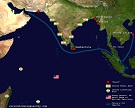
and Central Asia. The Gwadar deep-sea port, built with Chinese
assistance, seems intended initially to be the receiving point for
transporting hydrocarbons from the Gulf through Pakistan to Sinkiang,
but it has also a military significance as it has the potential of
becoming a lunch pad for Chinese naval presence in the Indian Ocean.
Gwadar gives China access to the Arabian sea in the west just as
corridors through Myanmar give it access to the Bay of Bengal in the
east.
If in the west China has been able to pursue its strategic projects
in Pakistan in a highly favourable political atmosphere, in the east it
has had similar favourable conditions in Myanmar. China has helped build
roads, railways, dams, bridges, airfields and seaports in Myanmar. It
is building a crude oil port as part of a pipeline project to transport
oil to its western provinces without having to go through the Malacca
Straits. It is active in securing oil and gas reserves in Myanmar. It
has built a strategic road along the Irrawady River linking Yunnan to
the Bay of Bengal, besides a railroad through Kunming via Dali that
links up with the Mandalay-Rangoon railway. Myanmar has officially
commenced the construction of the main gas pipeline from the natural
deep seaport of Kyaukpyu to Kunming in Yunnan. A railroad running
adjacent to the pipelines is planned. If all goes as planned the route
for the transport of Gulf oil and gas to China will change radically.
This will enhance China’s energy security besides expanding the presence
of Chinese ships in this part of Bay of Bengal to India’s strategic
discomfort.
As part of a strategy to build connectivity that ties neighbouring
countries to China, the latter is ready to participate commercially in
developing the deep-sea port in Sonodia Island near Cox’s Bazar in
Bangladesh. Bangladesh has sought China’s assistance to develop and use
the Chittagong port. This along with the port at Sonadia Island will
give China the connectivity it wants between Yunnan and the Bay of
Bengal. China, Myanmar and Bangladesh have signed an agreement to
establish a road and rail link.
China is giving special attention to infrastructure in Sri Lanka
because of its strategic location in the Indian Ocean, very close to
India’s southern coast. This fits into China’s plans to increase its
presence in the Indian Ocean both to protect its trade and energy flows
through these waters (80% of China’s oil goes through a sea lane a few
nautical miles from Sri Lanka) but also to project its naval power there
eventually, rather than remain vulnerable to US and Indian pressures in
possible future scenarios. The massive $ 1.5 billion Hambantota
Development project being built by China (it is financing more than 85%
of the project which will take 10 years to complete) will include an
international container port, an oil refinery, dry docks for ship
repairs and construction, bunkering and refuelling facilities, an
international airport etc. It will become a major transhipment hub.
While at present there is no talk of a Chinese naval base on Hambantota,
concerns about the future will remain. To keep an eye on developments
India has opened a consulate in Hambantota in 2010.
In the case of Nepal, the strategic economic stakes are less
important, but there is talk to extend the railway line built in Tibet
till Lhasa to the Nepalese border and complete a connecting highway
within Tibet to create greater connectivity in order to boost trade
exchanges, with a dry port being planned at Tatopani near the Tibet
border to create a “cross-border free trade zone”. The longer term
scenario of connecting Tibet to the Bay of Bengal through Kolkata is not
realizable until China settles its border issue with India. The
connectivity being created with Tibet cannot alter fundamentally Nepal’s
line of communication through India, though it provides Nepal with an
option to temporarily relieve any Indian squeeze.
The nature of China’s economic priorities in our neighbourhood is
demonstrated by its willingness to invest in strategic projects but
unwillingness to be generous in doling out assistance in general.
China’s direct investment in Pakistan until 2010 was relatively small at
$1.83 billion according to Chinese figures. Pakistan has little to
offer by way of strategic sectors like iron, copper, oil, gas and coal
in which China invests abroad to meet domestic needs. China does not
seem to have given any large loans to Pakistan. Its humanitarian aid is
modest. When massive floods hit Pakistan in 2010, China’s initial
contribution was a meagre $18 million, raised later to $250 million.
China has been directing Pakistan’s aid requests to the IMF.
China has been involved in aid projects in Nepal since decades, in
the highway sector, in particular. Other areas are health, education and
hydropower. It annual assistance to Nepal is not too large at about $
35 million. During his January 2012 visit to Nepal the Chinese Premier
announced a grant aid of US $120 million to be spent on mutually defined
projects.
Chinese investment in Bangladesh is modest at $200 million. Trade
between the two countries has grown to $8.26 billion in 2011 with a huge
imbalance in China’s favour (with Bangladesh’s exports at $449
million). Imports from China constitute 21% of the total Bangladesh
imports, which is huge. While Bangladesh has traditionally complained
vociferously about its trade imbalance with India, its tolerance levels
towards China has been high. The two countries have agreed on
introduction of 3G and 2.5G network and a fertilizer project. China has
been more generous with Sri Lanka. Since 2006, it has provided $3.06
billion in financial assistance for various projects.
An important element conditioning China’s policies in our
neighbourhood is the Tibetan question. China’s hold over Tibet remains
politically insecure though its military position there cannot be
shaken. The huge economic investments China has made in Tibet has not
turned political opinion in its favour. This problem will continue till
China’s political system changes, moving towards democracy and tolerance
of dissent. There is no political, ethnic, cultural or linguistic glue
that binds the Tibetans and Chinese. India can manage its diversity
without the heavy stick of state authority because of democracy; China
cannot at this stage. The uprising in Tibet in 2008 exposed the failure
of China to win the hearts and minds of the Tibetans. The rash of
current instances of self-immolations in the Greater Tibet area confirms
that failure.
In this context Nepal is important. The Chinese put pressure on India
on the issue of the Dalai Lama, which India both yield to and resists.
Nepal cannot resist such pressure and cooperates with China in keeping
an eye on the Tibetans in Nepal. The Chinese want to exclude any source
of instability in Tibet fuelled through Nepal. For that they need to be
active in Nepal itself rather than hunkering down defensively on their
side of Tibet and warding off any threat. China has always had a policy
of “balancing” Indian influence in Nepal, not the point of outright
confrontation, but enough to prevent India from completely dominating
Nepalese politics. Nepal is important for them, but they have been
realistic enough to realize that that they cannot dominate the country
or take the burden of sustaining it in case of an Indian squeeze as a
result. It serves their interests adequately to nourish politically and
economically influential anti-Indian lobbies in Nepal to a sufficient
degree. Earlier it was the Palace whose insecurities and prejudices
against India they exploited. The Palace nourished the Maoists to
counter the democratic forces in Nepal. China did not have to actively
back them. With the Maoists now in electoral politics and sharing power
in the country, China has now a replacement tool in its hands to
continue to wield influence in Nepal to further its own interests at
India’s expense.
In recent years, encouraged by the Maoists and the general hardening
of its position on the border issue with India, China is seeking more
parity with India in its relations with Nepal. They are pressing for a
bilateral treaty with Nepal similar to its treaty with India. China’s
challenge to Indian interests in Nepal has grown substantially but not
dramatically. China cannot manage the very turbulent politics of Nepal
given its limited experience of handling political party politics of the
highly convoluted and fractured type that operates in Nepal. China has
opened several Confucian Institutes in the Terai, which poses a
challenge in terms of Chinese activity close to our open border with
Nepal. The China-Pakistan connection, even without the two countries
working together in Nepal, facilitates Pakistani activity there as the
pro-Chinese forces in Nepal would logically have a more tolerant view of
Pakistan.
Bhutan has eschewed the kind of irrational attitudes that Nepal has
adopted towards India. It has not played the China card against India
for a variety of reasons. It has not had the kind of Palace versus
democratic forces confrontation that Nepal has had, and so the Bhutanese
monarch has not felt the need to cultivate an outside power against
India. The Bhutan King’s conservative attitude towards opening the
country to outsiders, his reluctance to allow any big power to open a
resident mission in Thimphu in order to have a plausible reason to deny
such a mission to China, his cooperation with India on water resources
for generating revenues for the country for its development, Bhutan’s
Buddhist identity that is separate from that of the Dalai Lama and which
therefore excludes the Tibetan religious and refugee factor from the
Bhutan-China relationship, all these factors cast the China-Bhutan
relationship in terms of Indian interests very differently from that of
China and Nepal.
The challenge for Bhutan is to settle the unresolved boundary issue
with China, something that it would like to do if it did not have to
contend with India’s concerns. India would not want China to succeed
diplomatically in isolating India and making it look intransigent by
settling the border issue with Bhutan and leaving the border with India
unresolved. Apart from this, and, indeed, more importantly, it is most
important for us that the delineation of the border between Bhutan and
China in the Chumbi valley takes into account our vital security
interests. We want therefore Bhutan to closely coordinate with us its
border talks with China which have been going on since the 80s, with 19
rounds of talks till 2010. The Chinese tempt the Bhutanese with
“concessions” in the pastoral lands in the north against acceptance of
their claims in the Chumbi valley area. They also pressure Bhutan to
open up diplomatic relations with China. So far the Bhutanese have
cooperated, though elements there have the sentiment that Bhutan is
paying a price because of India-China differences. In other words, they
would be able to get a good deal from China but for the complicating
Indian factor. The Chinese Prime Minister met the Bhutanese Foreign
Minister at the Rio+20 conference in June where he raised the question
of establishment of diplomatic relations between the two countries, and
this was publicized by the Chinese side. India has to be watchful about
Chinese blandishments to Bhutan and ensure that Bhutan continues to be
firm in its policy of not allowing any gap to develop in Indian and
Bhutanese approaches to the sensitive border question, especially with a
new and young monarch in power in Bhutan in a more democratic
framework.
With the patchy and fluctuating nature of India-Bangladesh ties over
the years, China has had ample opportunity to secure a deep footing in
Bangladesh. All India’s neighbours, barring Bhutan, play the Chinese
card against us in order to balance the overwhelming weight of India in
the subcontinent. They have tried to exploit to their advantage the
antagonistic ties between India and China and have deliberately created
space for China to expand its presence in their countries. Bangladesh
has been a thorn in India’s side under the military dictatorship and
Begum Zia; it has blocked us from promoting connectivity not only with
our own north-east but also Myanmar, with further linkages beyond with
South-east Asia. It has sheltered anti-Indian insurgents on its soil,
tying down Indian armed forces in the region and also retarding the
development of this part of India. It suits the Chinese that Bangladesh
should be a geopolitical problem for India in integrating its north-east
and raising its profile in South-east Asia. To what extent China has
given direct encouragement to Bangladesh when it has been under
unfriendly rule to counter Indian interests is difficult to pin-point,
but common sense suggests that they would play such a game subtly. It
would be in their interest to prevent Bangladesh from moving into the
Indian orbit decisively, and their presence and programmes ensure this.
The two countries have agreed on a “Closer Comprehensive Partnership for
Cooperation” with a strategic perspective. On Bangladesh’s invitation
and Nepal’s support China was admitted as an observer in SAARC.
China steadily tightened its grip on Myanmar during the long period
the West sought actively to isolate it through boycotts and sanctions.
This policy has undergone a change with the easing of military rule in
Myanmar, the introduction of limited democracy and US’s “re-balancing”
strategy in Asia-Pacific that seeks to hedge against the unpredictable
consequences of China’s rise. With the changed environment Myanmar has
cancelled a $3.6 billion dam project at Myitsone because of strong
public opposition to it. This might suggest that Myanmar will seek to
loosen China’s embrace, but the logic of neighbourhood and benefits that
Myanmar can derive from China’s economic strength will not necessarily
mean any dramatic downgrading of the bilateral relationship.
With growing Chinese economic and military power the challenges for
India to manage the inroads China will make into our region will become
increasingly difficult to manage in a situation where China, now far
ahead of India in its overall capacity to project power, continues its
policy of effectively containing India but continuing to engage it in
order to deflect attention away from this reality and creating economic
opportunities for itself in the Indian market, which, in turn, will tie
India’s hands even more in any push back policy directed at China. The
foretaste of our domestic resistance to this is the bizarre statement
recently by Ratan Tata that India should seek a way to become an ally of
China and that he is not aware of anything adversarial done by China
against us !!

