Showing posts with label Foreign Secretary. Show all posts

Thursday, July 19, 2012

India Thinks Chimera is for Real


Satish Chandra
Distinguished Fellow,VIF

Despite repeated rebuffs by Pakistan, New Delhi continues to entertain the belief that the troublesome neighbour will soften up with sweet diplomacy. What else explains the need for India’s Foreign Secretary to mouth the untruth that Pakistan wants to be constructive?

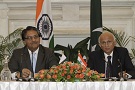
While having little to show by way of a concrete and tangible outcome, the recently held India-Pakistan Foreign Secretary level talks are nonetheless significant in terms of providing indicators of the likely timbre and trend of the relationship between the two countries in the months ahead.

A critical analysis of the media interaction of the Foreign Secretaries and the joint statement issued after their talks would lead to the following conclusions.

Discussions on Jammu & Kashmir were held as required but they did not yield any result other than an agreement to continue the talks. It would appear that even the four-point ‘Musharraf proposal’, which was being explored through the back channel, no longer enjoys much traction.

Pakistan has refused to acknowledge that it was in any way involved in the Mumbai attacks despite the additional corroborative evidence made available to it by way of Abu Jundal’s revelations. It also did not provide any credible assurance that it would bring the perpetrators of those attacks to justice expeditiously. The best that it could come up with was that it was prepared to engage in a joint investigation, which naturally India did not take up. Indeed, on his way back home the Pakistani Foreign Secretary made out to the Indian media that no evidence on Abu Jundal had been shared with him by his Indian counterpart.

However, the Secretaries agreed on certain issues, such as the convening of meetings of the expert-level working group on nuclear and conventional confidence building measures and the convening of another meeting on July 19 at Islamabad to maintain peace along the Line of Control so as to streamline and strengthen travel and trade arrangements. They also decided that the two sides should work for the early signing of the already finalised bilateral visa agreement as well as enhance media and cricketing exchanges. Finally, both leaders agreed that the India’s Minister for External Affairs will visit Pakistan in September 2012.

Despite the slim pickings from the aforesaid talks and the heat generated by the Jundal disclosures, both Secretaries went out of their way to paint an unrealistically rosy picture of the discussions. On his part, the Pakistani Foreign Secretary stated that the exchanges had been “substantive”, were held in a “cordial atmosphere” and over the years the level of cooperation on terrorism between India and Pakistan had “improved”. While it is understandable that Pakistan should wish to give a positive spin to its relations with India, given that it is in the dog house, it was strange to see our own Foreign Secretary doing likewise, albeit on a slightly lower key. Was there any reason for him to state, “There is a determination on both sides to take forward our dialogue with an open mind and a constructive spirit”, when this is manifestly not the case?

The convening of the Foreign Secretary level talks amidst such bon- homie despite the lack of any meaningful forward movement, and the scheduling of the Indian External Minister’s visit to Pakistan in September 2012, in the immediate backdrop of Abu Jundal’s corroborative disclosures regarding the ISI’s involvement in the Mumbai attacks, is a clear indicator that India will continue to engage Pakistan, whether or not the latter brings to book the perpetrators of those attacks. Indeed, it would be fair to extrapolate that even if there were to be another major terrorist incident in India, aided and abetted by Pakistan, it is highly unlikely that the Government would go beyond verbal protestations.

India’s pusillanimous approach vis a vis Pakistan is based on two factors. First, Prime Minister Manmohan Singh lacks the will to take stern measures against Pakistan and to penalise it for its involvement in terrorist actions against India. He appears to be convinced of the logic of what he signed on to in July 2009 at Sharm el-Sheikh with his Pakistani counterpart, that dialogue is the only way forward and that action on terrorism should not be linked with the peace process. Both processes must proceed independently.

Though in the wake of the upsurge of popular criticism following the enunciation of this approach at Sharm el-Sheikh, Mr Singh put on hold the resumption of the composite dialogue and made it contingent on forward movement in addressing India’s concerns on terror, this was only a temporary adjustment. Throughout 2010, steps were taken which gradually led to the resumption of the composite dialogue process the following year even though Pakistan did absolutely nothing to address India’s concerns on terrorism.

As a result, today India is in the strange position of being engaged in broad-based discussions with Pakistan on all bilateral issues at a time when Islamabad not only refuses to bring to book the perpetrators of the Mumbai attacks, but is actively involved in terrorist activities directed against India, which can at any time result in another 26/11.

Second, Mr Singh is keen to visit Pakistan, and for that an aura of normalcy in the relationship is critical. This is being sought to be achieved by creating a false sense of positivity in bilateral interactions and by refraining from taking any punitive steps against Pakistan.

The danger of such a weak approach is that it will only encourage Pakistan to continue its use of terrorism as a policy against India. The only way in which New Delhi can get Pakistan to seriously consider addressing India’s concerns on terrorism is by penalising it. Regrettably, India has never done so and is, therefore, in a sense responsible for Pakistan’s persistent delinquency in this regard.

The dangers posed by the Prime Minister’s desire to visit Pakistan arise from the requirement that such an exercise must be a ‘success’ or put in another way, marked by a number of agreements. But conclusion of the latter would come at the cost of major concessions by India. Pakistan, particularly in its dealings with India, is not known for it’s proclivity to go the extra mile in making settlements.

Accordingly, in the event of Mr Singh’s visit to Pakistan, as speculated, towards the end of this year, one should be prepared not merely for much bonhomie but also for sell-outs on issues like Sir Creek and Siachen, appropriately sweetened by economic goodies.


Tuesday, July 17, 2012

Cricket with Pakistan: India Hits Its Own Wicket Again

Sushant Sareen
Senior Fellow, VIF


It would be really interesting to know what exactly prompted the BCCI to invite Pakistan for a short cricket series in India later this year. Who raised this matter in the BCCI meeting and who all supported the decision? Where did the pressure come from – was it the PMO that took the decision and got the BCCI to rubber-stamp it? Did the CBI investigation in the Jaganmohan Reddy case have anything to do with the BCCI agreeing to host Pakistan? Or was it only the lure of lucre that prompted the BCCI to take this decision? Whatever the reason, one thing is clear: the Pakistanis have been proved right in their assessment of India as a namby-pamby country with a leadership that has made appeasement a pillar of foreign policy. Even worse, the Pakistanis would also be sniggering about how their stereotyping of India as a country of ‘banias and lalas’ who would do anything to earn an extra buck has come true, yet again.

Clearly, just as the Romans had their spectacles to befool the public and distract its attention, the Indian political leadership uses cricket as the opium to lull the masses into believing that all is now well with Pakistan and the bonhomie on the field (and off it during the series) is real and not contrived. It is another matter that when Shahid Afridi goes back after the World Cup semi-final, he makes disparaging remarks about Indian (or was it Hindu?) hospitality. Or when Sohail Tanvir is asked about the ban on Pakistani players in IPL, he blithely says that this is the ‘Hindu Zeheniat (mentality)! While Indians go overboard in welcoming Pakistanis, they would do well to remember the example of a renowned Pakistani ghazal singer who inadvertently told an Indian diplomat (who he thought was a Pakistani diplomat in India) that he enjoys the money and the booze in India but at the end of the day he doesn't forget that Indians are Kafirs. Of course after he was blacklisted and the black money and Black Label stopped flowing, the Kafirs became kosher!

A former Indian foreign secretary had once dismissed Pakistan's raising of the Kashmir issue at the UN as ‘the annual itch’. It now seems that India too has a ‘Pakistan itch’, what with politicians suffering withdrawal symptoms after a few months of disengagement. Not surprisingly, having received no satisfaction whatsoever on the issue of terrorism from Pakistan, the Indian leadership has reconciled itself to the unrelenting export of terror from Pakistan and come to the conclusion that there is nothing India can do except turn the other cheek. Talk to top officials and policymakers and it becomes clear that India is forging its Pakistan policy on the premise that its only hope lies in making a dent on Pakistan's unremitting hostility through promotion of trade and people-to-people relations. Even the earlier pretence of punishing/penalising Pakistan for exporting terrorism into India has now been given up.

A justification of sorts for resuming bilateral cricket ties with Pakistan has been given by Manish Tiwari, a spokesman of the ruling Congress party, who put forward the specious argument that politics and sports should not be mixed. For the ruling party to make such an argument means that it puts terrorism and mass murder in the category of politics. The bizarre corollary of this is that India will not break off sporting contacts even if there is another 26/11 type outrage because doing so would tantamount to mixing politics with sports. Indeed, if politics and sports should not mix, then why was South Africa boycotted when it practised Apartheid and why was India so reluctant on sporting contacts with Israel in order to express solidarity with the Palestinian cause? A leading light of the BCCI who is also a minister in the Central Government has been a little economical with the facts when he said that India played cricket with Pakistan even after the 1965 and 1971 wars and after the Kargil war. The facts are otherwise. Bilateral sporting contacts with Pakistan remained suspended for over a decade and only restarted in 1978. If at all there were any sporting contests, then it was at international events in which India did not have a choice but to play against Pakistan. The commencement of bilateral sporting contacts did not however lead to any improvement in the bilateral relations and in fact every time India resumed bilateral series, it opened itself to terrorist attacks (or should we says Pakistani politics?) first in Punjab, then in Kashmir and now in rest of India.

Apart from the disingenuous logic of the ruling party apparatchiks, the decision to once again resume bilateral cricketing ties with Pakistan is also a classic example of the complete absence of statecraft in this government. Given that one constantly hears the lament that India doesn’t have enough leverages over Pakistan, it is a little shocking how cavalierly India treats even the leverages it has. What should have been used as a reward for Pakistan if it delivered on bringing the planners and perpetrators of the 26/11 attacks to justice has been handed on a platter to Pakistan only so there can be some improvement in the atmospherics.

All this in large part appears to be motivated by the burning desire of Prime Minister Manmohan Singh to visit the land of his birth. Not that this visit will bring about any paradigm change in the state of Indo-Pak relations, unless of course the Indian government wants to play Santa Claus and bear gifts of Siachen and Sir Creek for the Pakistanis. The problem, however, is that these gifts will only whet Pakistan's appetite for more – Kashmir next? The other problem regarding the proposed visit (probably towards the end of the year) is that there will be no credible interlocutor with whom the Indian PM can engage with, at least not before March/April 2013. By the time his visit comes through, Pakistan will either have a lame-duck Prime Minister in office in Islamabad, or a caretaker PM (who in any case cannot make any far-reaching political decision). Therefore, unless Dr Singh intends to hold a dialogue with either Gen Kayani or Chief Justice Iftikhar Chaudhry or even the rising stars of Pakistani politics (a certain Mr Hafiz Saeed or his ideological alter ego, Imran Khan), his visit to Pakistan is going to be quite pointless.

All this aside, what is inexplicable is how Indian governments go out of their way to pull Pakistan out of the hole it keeps digging for itself. Every time Pakistan starts getting isolated in the international community, guess who comes to its rescue? India. After giving respectability to Gen Pervez Musharraf by inviting him to Agra, India has now once again taken a step to resurrect and rehabilitate Pakistan's image in the international community. While Indian officials never stop berating the Americans and Europeans for mollycoddling Pakistan despite its rank bad behaviour, the Republic of BCCI and the Republic of India have gone ahead and done something similar to what the West does. One can only wonder how the Americans will react when after the next terror attack India once again goes running to Uncle Sam asking him to take action against Pakistan.

Meanwhile, let us all put on our flannels and get ready to host Pakistan and fete Dawood Ibrahim’s close relative, Javed Miandad, in either The Oberoi, or better still in The Taj Mahal hotel. After all, isn’t cricket a religion in India and isn’t it true that cricket is ‘bigger than us all’ and the thousands who have died in terrorism are only a mere statistic?

Tuesday, July 10, 2012

Yet Another Round of Platitudes


Kanwal Sibal
Member Advisory Board, VIF


For those cynical about the dialogue process with Pakistan, the lack of substance in the joint statement issued after the latest round of Foreign Secretary level talks (July 4-5) confirms our neighbour’s unwillingness to fundamentally revise its thinking on core bilateral differences.

For those who remain hopeful about normalising relations with Pakistan despite decades of bitter experience, the platitudinous joint statement offers no peg on which to hang their optimism.
The talks were held in the same “frank and constructive atmosphere” prevailing in all past encounters, without, however, yielding much result. While we are committed to a “dialogue process”, the Pakistanis insist it should be “purposeful and result-oriented”- which, decoded, means India should make concessions. We accommodate Pakistan’s preferred but, in effect, harmless phraseology.

The issue of Peace and Security, including CBMs, has been discussed in the same “comprehensive manner” as before, but without comprehensive outcomes. Both sides have “emphasized the need to promote greater trust and mutual understanding through constructive dialogue”, repeating piously the hope expressed many times earlier. This trust and understanding refuses to materialize despite repeated “constructive” dialogues.

The issue of Nuclear and Conventional CBMs is complicated because India attaches importance to nuclear CBMs while Pakistan favours conventional CBMs. Pakistan continues to expand its nuclear arsenal and delivery capability with single-minded determination, even in a situation of mounting internal instability and financial stringency. It seeks to introduce tactical nuclear weapons as a counter to India’s “Cold Start” doctrine which it has studiously hyped.

Whether it talks of a conventional balance of forces or a strategic balance after both countries became nuclear, Pakistan omits from the equation India’s need to factor in the superior Chinese nuclear and conventional capability it must contend with. Pakistan, as China’s closest strategic partner, naturally refuses to take cognizance of this compulsion in India’s defence preparedness.

India’s interest in Nuclear CBMs is to make Pakistan accept a no-first-use agreement in order to raise Pakistan’s low threshold of nuclear weapon use. Pakistan, which has employed state terrorism against India under cover of its nuclear capability, is hardly likely to agree to a no-first use agreement until it decides to genuinely bury the hatchet with India. In that case India’s larger conventional strength, commensurate with its geographical size, large coast line and China’s menace, would pose no threat to it.

The source of conflict between India and Pakistan, it needs remembering, is its territorial claims on India and the use of jihadi terrorism to back them, and not any terror-backed Indian claims, territorial, water-related or religious on Pakistan.

On the issue of terrorism we have eschewed, to our credit, the absurd formulation conceded earlier that both countries are victims of terrorism, elevating Pakistan thus from a perpetrator of terrorism against us to a partner in arms against it.

Some equivalence has been conceded though in the formulation that both countries “affirmed the strong commitment...to fight and eliminate terrorism in an effective and comprehensive manner so as eliminate the scourge in all its forms and manifestations”, but having lost ground massively earlier it is not possible now to retrieve it diplomatically. Pakistan’s prevarications on the Mumbai terror attack, its give-me-more-and-more-evidence-which-I-will-ignore approach, its unwillingness to act against Hafiz Saeed and suppress the jihadi groups, and dismissal of Abu Jundal’s testimony as an “insinuation” hardly supports the above affirmation.

The formulation on Jammu and Kashmir is neutrally worded, with both sides prepared to “continue discussions in a purposeful and forward looking manner with the view to finding a peaceful solution by narrowing divergences and building convergences”. Given Pakistan’s claims about the centrality of the Kashmir issue and its reversion to its traditional position of resolving it on the basis of relevant UN resolutions, as confirmed in its parliamentary resolution earlier this year, this exercise of “narrowing differences and building convergences” is more an effort at verbal crafting than any serious political commitment.

Unsurprisingly, the Pakistani Prime Minster has, after the talks, promptly re-affirmed Pakistan’s full support for the Kashmiri cause till the UN resolutions are implemented.

The emphasis on cross LOC CBMs reflects our desire to win over public sentiment in the valley and Pakistan’s hope that these will eventually erode India’s sovereignty and give it a say in J&K affairs.
Pakistan, had in any case, made up for the tempered J&K formulation in the joint statement by its Foreign Secretary repeating the affront his Foreign Minister administered to us when he, like her, met the separatist Kashmiri leaders even before he held official discussions. Our displeasure conveyed to her then, which she dismissed with hauteur, has gone unheeded.

It is unacceptable that even Pakistani bureaucrats should be meeting Indian separatists in India’s capital, but we cannot now easily extricate ourselves from the web of our past mistakes. A right riposte would be to openly meet dissidents from J&K’s Northern Areas either in India or in third countries as Pakistan will not allow us to meet them in Islamabad.

The intention to promote more people to people, media and sports contacts, parliamentary exchanges etc is to be welcomed, even if the delay in signing the finalized revised bilateral Visa Agreement which would facilitate this remains unexplained.

The joint statement reflects the stalemate in ties- neither conspicuously improving nor notably deteriorating. Its ritual phraseology gives the text length but not any depth. Just as well, as we clutch at straws of peace with Pakistan as if we are drowning and end in making one-sided concessions to make the dialogue look meaningful. We should wait for drowning Pakistan to clutch at opportunities of peace with India.