Showing posts with label INS Vikramaditya. Show all posts

Thursday, April 25, 2013

Need to Transform Indian Navy into A Blue water Maritime Force


Radhakrishna Rao, 
Visiting Fellow, VIF

In the context of the South China Sea rapidly emerging as a turbulent oceanic stretch with China questioning the claims of a number of Asian countries over this disputed water body, late last year Indian Navy Chief Admiral DK Joshi had driven home the point that the Indian Navy is prepared to deploy vessels to the South China sea to protect Indian interests there. As it is, not long back India had sparred diplomatically with China over its gas and oil exploration blocks off the coast of Vietnam. China claims virtually the entire mineral rich South China Sea and has stepped up its naval presence here to ward off any challenge to its monopoly of this oceanic body. Joshi did also express the view that Beijing’s growing maritime strength was a “major cause of concern.” The moral of the story is that the Indian Navy cannot afford to keep its focus concentrated exclusively on the Indian Ocean region. It should build up the capability and power level good enough to take care of Indian interests in any part of the global oceanic stretch.

As diplomatic experts point out, China is beefing up its naval capability with a view to not only exercise virtual monopoly over the South China Sea but also challenge US dominance over the global oceanic waters. The combat edge of the Chinese navy is expected to receive a shot in the arm from the home grown,58,000-tonne class Liaoning aircraft carrier built around the decommissioned Soviet era ship Varyag. China has been able to successfully land the indigenous fighter J-15 on the deck of Liaoning, which is currently going through extensive sea trials.

Of course, Joshi did hit the nail on the head with the statement that while India was not a claimant in the dispute over territorial rights in South China sea, it was prepared to act, if necessary to protect its maritime and economic rights in the region. “China opposes any unilateral oil and gas exploration activities in disputed area in the South China sea and hopes countries respect China’s sovereignty and national interests as well as the efforts of countries within the region to resolve dispute through bilateral negotiations,” said an official of China’s Foreign Affairs Ministry.

Nearer home, recent developments in the neighbouring Sri Lanka and Maldives cannot but be a cause of concern for India. Along with Myanmar and Bangladesh, Sri Lanka and Maldives are considered vital components of the Chinese strategy of “string of pearls” aimed at encircling India. In addition to lending a big hand to a variety of infrastructure projects in these two island nations, China has already made inroads in the area of space cooperation with both Sri Lanka and Maldives. The immense strategic significance of space cooperation could provide China a powerful platform in the Indian Ocean region to further its geo strategic interests. As such, Indian intelligence and security agencies have suggested that ISRO (Indian Space Research Organisation) should take a proactive role in building and launching satellites for these two vitally located Indian ocean island nations with which India has had a long standing, cordial relations. But then unlike China, which already operates a string of powerful rockets capable of delivering satellite payloads of different weight class to required orbital slots, ISRO lacks the launch power to deliver satellites in two tonne plus class. For currently, ISRO operates a solitary launch vehicle PSLV (Polar Satellite Launch Vehicle), the most powerful version of which is capable of delivering a 1800kg satellite into a polar/sun-synchronous orbit.

Meanwhile, in a development of significance, Indian Navy’s offensive capability will stand augmented with the state owned Kolkatta based Garden Reach Shipbuilders and Engineers (GRSE)launching work on the third corvette with stealth features. With 90% of the indigenous contents, this third anti submarine warfare corvette under Project-28 will showcase India’s warship building potentials with domestic resources and indigenous expertise. Aimed at enhancing Indian Navy’s underwater warfare capabilities, the warship, is said to be a first of its kind to be fitted with indigenous state of art weapons and sensors.

On another front, India’s near futuristic naval base is also set to take shape on the eastern sea board .This vitally situated sea base with an eye firmly set on China will ultimately have underground pens or bunkers to protect nuclear submarines from prying eyes of spy satellites. The project named Varsha to be located close to Vishakhapatnam is considered a counterpoise to China’s massive underground nuclear submarine base on the south-western tip of Hainan Island.

And to further bolster its blue water capabilities, the Indian Navy plans to acquire five self propelled Fleet Support Ships (FSS) that should be capable of transferring all types of stores, ammunition, fuel and personnel to naval units. Clearly and apparently, blue water navies boast of large auxiliary fleets comprising longer range fleet support vessels designed to provide support far beyond territorial waters. As part of the plan to boost its long range surveillance capability, in December last, the Indian Navy received first of its eight P-81 maritime patrol aircraft from it had ordered from the American defence and aerospace major Boeing. The P-81 long range surveillance aircraft is well suited for anti submarine warfare. Indian Navy has also decided to exercise the option of going in for additional four P-81 aircraft with a view to strengthen its maritime patrol capabilities as well as counter piracy threats and the growing Chinese influence in the Indian Ocean region.

On a longer term canvas, Indian Navy has a 30 year plan for inducting 24 new submarines that was approved by the Indian Government in late 1990s.But unfortunately that plan went wrong with not a single new vessel inducted in the one and half decade since. The Indian Navy currently has 14 diesel–electric submarines in its fleet-10 Russian origin Kilo class vessels and four HDW German origin vessels-apart from one nuclear powered vessel borrowed from Russia on a 10 year lease. China on the other had has 60 diesel-electric submarines and 10 nuclear powered vessels in its fleet. As such the need of the hour is to strengthen the submarine fleet of the Indian navy which is looking at expanding the area of its “operations”.

There is no denying the fact that the Indian Navy would need to boost by a substantial extent its surveillance and reconnaissance, capability with a view to attain a blue water capability essential to meet the multi dimensional challenges of the future. The Indian Navy, currently the fifth largest in the world, plans to operate three aircraft carriers by the end of this decade. Indeed, air arm holds the key to attaining a credible blue water capability in all its manifestations. Against this backdrop, Indian Navy’s maritime doctrine rightly incorporates comprehensive modernization plan for its air arm through a mid life upgrades and modernization of its current aircraft fleet. The induction of Mig-29 multi role fighter aircraft with air combat, ground attack and maritime strike capability, would prove a major force multiplier for the air arm of the Indian Navy.

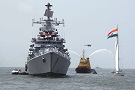
The 37,500-tonne Air Defence Ship (ADS), currently under construction at the Cochin Shipyard Ltd, will be capable of accommodating 30 combat aircraft mix of Mig-29K and LCA Tejas navy. Everything going as planned; this indigenous aircraft carrier will be inducted into the Indian Naval fleet by around the middle of this decade. Looking into the future, Indian Navy has also drawn up a plan to design and develop a vastly improved home grown aircraft carrier as a follow up to ADS. The Indian navy’s currently operational lone aircraft carrier Viraat is planned to replaced by INS Vikramaditya which is now undergoing sea trials in Russia .

However, the delay in the delivery of the retrofitted aircraft carrier INS Vikramaditya by Russia is a matter of concern for the Indian navy. This 45,000-tonne class carrier refurbished around Russian decommissioned vessel Admrial Gorhskov was to be handed over to India in December 2012. But problems in the boiler of the carrier revealed during the sea trials of September 2012 implied that the carrier required extensive rectification to render it fully operational. The saga of INS Vikarmaditya has been marred by time slippages in delivery schedule and steep cost escalation. India, which in 2004 had signed US$974-million deal for the retrofitting of this decommissioned Russian vessel, was ultimately forced to cough up US$2.3-billion. The air arm INS Vikarmadiaya comprises Mig-29K deck based fighters and Ka-30 early warning helicopters. Sometime back, Indian Defence Minister AK Antony had told the Indian Parliament that the Russia has been asked to deliver the retrofitted aircraft carrier before the end of 2013.

In a major milestone in developing a home grown deck based fighter, the naval version of India’s home-grown fighter aircraft Tejas is now getting ready for a flight test involving the crucial ski jump trials at the shore based test facility at Hans air station of the Indian Navy in Goa. The ski jump trial is crucial for establishing the carrier compatibility of the deck based fighter. Derived from the air force version, the naval Tejas is longitudinally unstable fly by wire aircraft making it agile war machine. The flight control system of LCA navy is being augmented with Leading Edge Vortex Controller (LEVCON) aiding reduction in approach speed for carrier landing. Landing gear for Tejas naval has been adequately strengthened to withstand increased landing loads in carrier operations. Phase Two of the LCA Tejas naval envisages the development of a single seat fighter with a new higher thrust engine and further design optimization.

With the kind of capabilities on the anvil, Indian Navy is seriously working towards transforming itself into a credible maritime force to tackle multi-dimensional challenges of the future. Against the fast changing global maritime dynamism, the Indian Navy has drawn up an ambitious plan to take care of the Indian ’interests and assets” across high seas of the world. Indian Navy is clear in its perception that the futuristic threat would be dynamic and could emanate from multiple sources. Perhaps the most striking feature of the on-going programme of modernization launched by the Indian Navy is its thrust on sourcing its requirements through the indigenous routes by harnessing the potential of the Indian industry. The Indian Navy has already made it clear that its plan for modernization is not China specific but based on the multiple threats facing India.

Indian Navy’s vision is to position itself as the third largest fleet in the world. The centrepiece of Indian Navy’s modernisation scheme revolves round besides the acquisition of aircraft carriers, the nuclear powered submarines. In 2009, India launched INS Arihant, its first home-grown nuclear submarine. This will give India a nuclear triad, currently capability possessed only by US, China and Russia. Arihant will carry Shaurya missile capable of carrying one ton class nuclear warhead with a range of 750-km.The 6,000-tonee plus Arihant equipped with a dozen K-15 ballistic missiles will constitute the robust under sea leg of the Indian nuclear triad.

The Nerpa class Chakra nuclear submarine which India has taken on lease from Russia in tandem with Arihant will give Indian Navy a greater degree of manoeuvrability to hoodwink the enemy’s surveillance system and strike hard as they remain submerged indefinitely. Arihant is now close to attaining its operational status. In particular the sea based nuclear strike capability being put in place by the Indian navy would provide credible second strike capability. Incidentally, the nuclear strike capability based on a submarine platform has the advantage in terms of stealth and survivability in cause of a first attack.
The vision of Indian navy is to operate 150 plus warships of various categories and 500 aircraft including fighter jets, helicopters and maritime reconnaissance aircraft by 2027. However the trump card of the Indian Navy is the Indo-Russian supersonic cruise missile BrahMos which has already been inducted into some of its warships. The 290-km range BrahMos with a phenomenal destructive power has been described as the “most powerful and most formidable” naval missile of its kind.

In keeping with the global trends, Indian Navy has been quite keen on making use of the space assets with a view to projects its combat power in littoral regions with a greater degree of confidence. The plan is to create and sustain a three dimensional, technology driven and satellite enabled network centric system to transform itself into a formidable sea power. To boost its strike capability, Indian Navy is quite keen to link up its long range missiles, radars and air defence systems as well as the sea bed assets to a central room through a highly dedicated satellite network.

Given the practical difficulties involved in guarding long and porous coastal stretch, the Indian Navy is looking at a string of satellites specially designed to take care of maritime security aspects. Against such a backdrop, Indian Navy should be excited over the possibility of the launch of multi band communications satellite GSAT-7 sometime this year by ISRO. This satellite which will serve as the exclusive space platform of the Indian Navy will go a long way towards strengthening the communications network of the Indian Navy to effectively link up its resources spread across the vast and sprawling oceanic region. It is expected to transform the entire maritime domain awareness of the Indian navy. As envisaged now, the satellite will have a 600-700 nautical miles footprint over the Indian Ocean region.

Further into the future, as the situation unfolds, the Indian Navy will look at having dedicated satellite systems for ocean monitoring, weather watch, navigation, surveillance and reconnaissance. Without doubt, in years ahead to sustain its expansion programme, Indian navy would be interested in acquiring advanced microwave imaging satellite systems, naval transit space platforms, electronic ferret satellites and other specialized space birds.

Indian Navy should draw inspiration from the fact that India has had a long and chequered maritime and ship building tradition. What is more, the setting up of cultural empire in South East Asia by Indian rulers was a tribute to the sea faring spirit of medieval India. According to the US based geo-strategist Parag Khanna, who is also the founding director of the Global Governance Initiative at the new American Foundation think tank, “In terms of geopolitics, India’s influence is still very limited…What underpins that is the reality that India is not going to be what initially was thought and hoped it would be a land based continental rival to balance China. Now, India is seen as much more a naval power—overseeing and having a strategic role with respect to the Indian Ocean and the trade routes there. That actually is the geopolitical future of India. It is a very strong future.”

Tuesday, February 26, 2013

Defence Procurement: Would You Do Business With India?


Dr M N Buch 
(Visiting Fellow, VIF)

Ever since we became independent we seem to be lurching from one crisis to another in any matter which concerns a deal or a transaction in which we make purchases or where decisions are taken regarding business. One harks back to the scandal attributed to the purchase of jeeps when Krishna Menon was High Commissioner in London. The most celebrated scandal in this behalf was the purchase of 155 mm guns from Bofors, a Swedish arms manufacturer renowned internationally for the quality of the product produced by the company. The Bofors anti aircraft gun of 40 mm, the Bofors quick firing gun version mounted on small naval vessels were the mainstays of most of the Allied Forces and even today the Bofors anti aircraft guns are widely used. The 155 mm gun is of such a superb quality that it could virtually dominate the Kargil battlefields and was a major factor in our being able to dislodge the Pakistanis. However, the purchase agreement was befouled by allegations of bribes being given by the suppliers through an Italian agent, in which the name of Rajiv Gandhi was also mentioned by V.P. Singh. The amount of bribe was Rs. 64 crores. Rajiv Gandhi denied any wrongdoing, V.P. Singh never produced any evidence which could have clinched the matter, CBI utterly failed to unearth irrefutable evidence and Quattrochi, the Italian agent, could never be brought to book. What resulted was that we virtually black-listed Bofors and every effort to purchase more guns to strengthen the artillery has been aborted by allegations of corruption, leading to blacklisting of almost all the manufacturers of a gun of this calibre and quality. The tragedy is that Bofors, despite all the mud slung at them, completed its part of the transfer of technology by making available very detailed drawings of the gun. These lay gathering dust in the Defence Ministry, despite the fact that the Ordnance Factory Board kept telling government that it could manufacture the gun on the basis of these drawings. Manufacture could have started at least eight years ago and by now the indigenous gun could have been in service with the Army. One allegation of corruption, which never led to any viable action against the persons named as the culprits, has left the Indian Army in the unenviable position of not having added a single worthwhile gun in over twenty years.

The acquisition by purchase or indigenous manufacture of warships upto the destroyer class by the Navy has had a relatively better record than weapon acquisition by the Army or the Air Force, but in terms of under water capacity the Navy has not advanced at all, whether it be the French Scorpene submarine or the German HDW. The Navy has been able to make very little progress because we just do not take any decisions in order to avoid complaints. Despite this there are serious allegations of financial irregularities. By now we should have had at least fifty submarines, including at least four or five nuclear submarines, but all we have managed is one nuclear submarine on lease from Russia and one indigenously manufactured nuclear submarine whose sea trials have yet to be conducted. Our lone aircraft carrier is now obsolete and its replacement, INS Vikramaditya (formerly Admiral Gorshkov), has had a 250 percent increase in cost and will not be delivered till the end of 2013, five years behind schedule. The keel of the indigenous aircraft has been laid but it is unlikely to be in service till 2017. Meanwhile China has acquired and put into service one aircraft carrier bought from Ukraine and is in the process of manufacturing one more carrier. Without a strong submarine fleet equipped to fire nuclear tipped missiles we cannot really boast of having a sea-land-air based nuclear deterrent in place. Those who are responsible for decision making must realise that in an environment in which our two chief opponents, Pakistan and China, have nuclear weapons and some delivery systems to target Indian cities, our delaying of decisions of purchasing or manufacturing necessary defence equipment has left the nation precariously vulnerable.

The cause celebre is a relatively minor acquisition of twelve helicopters for carriage of VVIPs. The proposal has been mooted by the Air Force about fifteen years ago because the MI8 helicopters on VIP duty are now totally obsolete, difficult to keep airborne and really not in a position to safely carry dignitaries such as the President and the Prime Minister. It was initially mandated that the new VIP helicopters would have an operational ceiling of 18,000 feet and the specifications were drawn up accordingly. Only one helicopter, the Eurocopter 200, could attain this height and this narrowed down the purchase to a single vendor. The then National Security Adviser, Brajesh Mishra, pointed out the unacceptability of a single vendor. The SPG, which guards the Prime Minister, also objected to the cabin size and said that it would not be in a position to protect the VIP unless the cabin specifications were changed. Therefore, the NSA recommended that the matter be re-examined. The file was shunted back and forth for at least five more years. Ultimately the Air Force recommended new specifications, lowering the ceiling to 15,000 feet and also stating the size and the layout of the main cabin. Now four firms give their tenders. Had the specifications not been changed the order was not large enough for any firm to change the aircraft design and also restructure the production line as this would be uneconomical. Therefore, there was no alternative but to change the specifications. It is now alleged that bribes were paid to the cousins of the Chief of Air Staff and, therefore, there was the suspicion that the specifications were altered to suit one company only, Finmeccanica, which manufacturers the Agusta Westland helicopter. The amount of bribe is stated to be in excess of Rs. 360 crores.

The above allegation is based on the statement said to have been made by two officials of Finmeccanica who were arrested in Italy on a complaint alleging corruption in the Indian transaction. No one has said that the process whereby the Agusta Westland helicopter was finally selected was in any way wrong. It is not alleged that technically and financially the best bid was not that of Finmeccanica and Russian and American (Sikorski) bids were wrongly rejected. The adherence to prescribed norms of the Agusta Westland helicopter has not been questioned, nor has its performance. It has also not been alleged that had the bribe not been paid the helicopter would be cheaper to that extent. Had this been stated then it would have meant that we were being overcharged in order to pay a bribe.

What has been the Indian reaction? The media, print and electronic, have virtually gone berserk in sniffing out and unearthing wrongdoing in the instant case. Television anchors wave papers on the screen and state that these give proof positive of wrongdoing in the helicopter deal. From this these anchors deduce that other deals not connected with this particular purchase also are suspect, that bribes have been given and that either because the same agent figured in more than one case, or because the supplying company was the same, every defence deal is based on corruption. What is written in those papers is never shown, nor is it categorically stated that they constitute the totality of documentation, nor is their any real attempt to prove that the so-called papers, which form part of a larger whole, are being read in context. Selective display of documents or use of words can be very dangerous. One recalls the story of the Giant Panda who walked into a restaurant in New York finished his meal, took out a revolver, shot dead the restaurant owner and left without paying for the food. When arrested he said, “Have you not read what we Pandas do? A Panda eats, shoots, and leaves”. Delete the commas and this would read “A Panda eats shoots and leaves”. Our Indian scribes, unfortunately, believe in retaining the commas in the above sentence, which not only changes the meaning of the context but also leads to very dangerous conclusions. There is no need to be judgemental about an issue because some television anchor waves papers in the air, pontificates holily about the evidence of wrongdoing that he has and then tries to browbeat people into saying ‘mea culpa’. If there is wrongdoing let it be investigated and the accused brought to trial. That trial will be in a court of law, not in a court of journalism.

To return to the helicopter purchase case, the need for new helicopters is amply proven and requires no clarification or elaboration. Changing of specifications, which would be universal and not confined to benefiting a particular manufacturer, is not only permitted but is normal. If the tender procedure is transparent, if bids are duly received and are examined impartially, if the product is what we need, if the price is acceptable, then the deal is complete and must be given effect to. If there are allegations that despite precautions bribes have been given, let the complaint be investigated and if a prima facie case is made out, then the accused persons must be brought to trial. However, the acquisition should be completed because it does not make sense to foreclose on a deal which is beneficial to India.

The Indian Air Force has been trying desperately to find a multi-role combat aircraft. The process of specifying norms, performance parameters, etc., has been long drawn out and the Air Force has virtually tested every alternative almost to destruction. Optimising the performance index of the aircraft, its lift and delivery capacity in the matter of weapons, the transfer of technology and the possibility of future total indigenisation, the maintenance schedule and cost, as also the operational life of the aircraft, the Air Force found the Dassault Rafale aircraft to be best suited to our needs. The American F16 and F18, The Anglo German Eurofighter and the Russian MIG-35 did not come up to the mark and were rejected. The technical and financial bids were taken into consideration when making a final selection. Over a year has passed and we have still not signed the final agreement. Meanwhile our television channels have tried to find a connection between a person who sued the Dassault Corporation over some deal for Mirage 2000 aircraft dating back to about eight to ten year. That gentleman sued the Dassault Corporation because he said he had not been paid an amount which had been promised to him by way of commission. My information is that he lost the case. Now an effort is being made to try and show that he is involved in the Rafale deal also so that even this acquisition is aborted. Are only television channels honest in this country and every one else is rotten to the core?

The process by which we arrive at conclusions is bizarre. There is a perception which we can ignore only at peril that Indian officialdom is corrupt. Let me narrate an incident dating back to 1968, when I was Director, Tribal and Harijan Welfare in Madhya Pradesh. One day my minister summoned me to the Secretariat, about ten kilometers from my office. When I entered his room I found a gentleman sitting there. The minister said that he had some problem and could I sort it out? I took the gentleman to my office where I would attend his case. I had not brought my driver and was driving the official vehicle myself. When we reached the Hamidia Hospital gate the gentleman asked me to stop. I asked him why and he said that we should have a cup of tea and some snacks before proceeding further. I told him that I would give him a cup of tea in my office but I found him still a little uneasy. Suddenly it stuck me what the man must be thinking. I was a sahib because the minister had offered me a chair. At the same time I was driving my own car and there was no attendant with me. This meant that I could not be the bada sahib who naturally would have travelled in style with paraphernalia. Therefore, unless the applicant entertained me I would not give him a proper hearing. This is what people felt about the bureaucracy even in 1968, when actually the bureaucracy was by and large honest and efficient. Today the position is that every single person is convinced that government and its minions are corrupt, despite the fact that there is a substantial number of people who are honest. The tragedy is that this perception of dishonesty is what our media is exploiting to blow things out of proportion.
Let us take the helicopter purchase case. If the aircraft is good let us buy it, but if bribes have been given let us deduct that amount from the payment to be made to Finmeccanica and also impose an equivalent fine. The aircraft acquisition, however, should go on and government out of panic should not negate the entire effort by cancelling the order. Let us have a similar attitude towards all defence requirements, which must be finalised unless there is incontrovertible proof of corruption. Waving sheets of paper before a television audience does not constitute such proof.

General N.C. Vij, former Chief of Army Staff, once told me that the process of weapon acquisition is so tortuous in India that by the time the weapon is received its half life is over. The following time frame for weapon purchase is suggested:-
  1. The Service Headquarters submits a proposal to government for acquisition of a certain weapon system, together with full justification, the cost estimate and tentative specification parameters. The process of preparing this proposal should not exceed one year.
  2. Examination of the proposal by government and a decision on the acquisition in principle, with a provisional budgetary allocation. The period for this should not exceed six months.
  3. Detailed specifications to be finalised by the Service Headquarters, acquisition of prototypes and the testing to destruction under different physical and weather conditions. This process should be completed within two years
  4. Stage two technical and administrative estimates and proposals to be submitted by the Service Headquarters to government. The process of decision making in this behalf must be completed within six months.
  5. Preparation of tender documents, issue of notice inviting tenders, receipt of tenders and the preparation of a comparative chart by the Service Headquarters, assisted by the Defence Ministry, together with short-listing of providers. This process should not take more six months.
  6. Examination of the scrutinised bids and the comparative statement, the short-listed providers of the systems and a final decision on acceptance of the bid by government. This should not take more than six months.
  7. Finalisation of whatever documentation is needed for the contract and issue of the work order. This should not exceed six months.
If the above scheduled is followed, then within six years from the proposal having been mooted the inflow of equipment concerned should begin and the whole process should be completed within seven to eight years from start to finish. If this happens our acquisition process would be within the given time frame, there would be no delays and because the process is continuous, the need or the possibility of giving bribes would be substantially reduced. Then people would be encouraged do business with India.

Let us take this whole issue very seriously because if the present trend continues we might as well disarm and disband the armed forces, deploy village kotwals or chowkidars armed with lathis to guard us and practise how to behave like slaves before the new conquerors who would inevitably make us captive. To obviate such an eventuality we need a government which is firm in its resolve and which refuses to be swayed merely because some complaints have been made, we need a machinery for quick investigation of complaints, but we also need a media which is responsible in its behaviour, exercises restraint where it is necessary in our national interest and which at least in defence matters puts the interests of the nation before its own hunger for attention.

Tuesday, December 4, 2012

Safeguarding India’s Maritime Interests


Nitin Gokhale 
(Visiting Fellow, VIF)

In July, days before he retired, the then Navy Chief Admiral Nirmal Verma commissioned a Naval Air Station at Campbell Bay on Great Nicobar Island, christening it INS ‘Baaz’ thereby signalling India's intentions to keep a close watch on the new developments unfolding in East and South East Asia On 3rd December, 24 hours before celebrating Navy Day, Admiral Verma's successor, Admiral DK Joshi announced that the Indian Navy is practicing to operate in the South China Sea to protect its economic assets.

Speaking to reporters in New Delhi Admiral Joshi told reporters that "Where our country's interests are involved, we will protect them and we will intervene."

The Eastern Naval Command - which looks at India's eastern sea board and is likely to play a key role when the Navy is deployed in South China Sea- is also being strengthened.

That the Indian Navy was strengthening its Eastern Fleet and was looking to expand its cooperation with key countries in East and South East Asia like Vietnam, Japan, South Korea, Philippines and Indonesia, is well known but no Navy chief or for that matter any senior government official in recent memory had spelt out India's plans to counter China in the South China Sea, in such a clear manner.

The declaration that Indian Naval ships could be deployed in the South China Sea if need be comes days after Chinese state media announced that the southern Hainan province, which administers the South China Sea, approved laws giving its police the right to search vessels that pass through the waters. Also Philippines, Vietnam, Taiwan and India protested a map on a new Chinese passport that depicts disputed areas as belonging to China. The Philippines also issued a statement saying it wants Beijing to "clarify its reported plans to interdict ships that enter what it considers its territory in the South China Sea."

Admiral D K Joshi said India's Oil and Natural Gas Corporation (ONGC) has 4 oil exploration blocks off the coast of Vietnam. "If required we will intervene to protect (them)," he said and added that it is the navy's duty to protect India's sovereign assets. India, the Admiral said, had two basic concerns- "freedom of navigation in international waters and protection of our internal assets."

It is in this context that INS Baaz, the southernmost air station of the Indian armed forces, becomes an important springboard for India's forays further east.

In July, Admiral Nirmal Verma had said: "The archipelago, separated as it is by more than 650 nm from our mainland, offers a vital geostrategic advantage to India. Not only do they provide the Nation with a commanding presence in the Bay of Bengal, the Islands also serve as our window into East and South East Asia”. He had added: They also sit astride some of the busiest shipping lanes of the Indian Ocean, most carrying strategic cargo for East Asian economies”.

Emphasizing upon the strategic location of INS Baaz Admiral Verma had reminded those gathered that INS Baaz, overlooks the Strait of Malacca, while also dominating the 6 degree channel”.

Since July this year India has clearly signalled its intention to its increased involvement East of Mallaca Straits by deploying frontline warships as part of India's 'Look East' Policy. The four Indian Navy ships, Rana, Shivalik, Karmukh and Shakti, under the command of Rear Admiral P Ajit Kumar, Flag Officer Commanding Eastern Fleet were on an operational deployment to the South China Sea and North West Pacific. Earlier in the deployment, the first bi-lateral maritime exercise between India and Japan 'JIMEX 12' (Japan India Maritime Exercise) was conducted, coinciding with the commemoration of 60 years of diplomatic relations between India and Japan.

The Navy's long-term Maritime Capabilities Perspective Plan in fact has identified a mix of two major roles for the force: One, the traditional blue water operational capability and two, a plan to effectively counter threats closer to the coast.

According to the report of the Standing Committee on Defence, tabled in Parliament in the last week of April, the Navy's short-term plan has the following objectives:
  • Augment airborne maritime surveillance, strike, Anti-Submarine Warfare and air defence capability through induction of shore-based aircraft, integral helos, carrier based aircraft, space based AIS and UAVs, along with suitable weapons and sensors.
  • Develop ASW (anti-submarine warfare) capability through induction of suitable platforms, weapons and sensors.
  • Build adequate standoff capability for sea lift and Expeditionary Operations to achieve desired power projection force levels, influence events ashore and undertake Military Operations Other Than War.
  • Induct assets and develop suitable infrastructure to augment forces available for Low Intensity Maritime Operations (LIMO), protection of off- shore assets and Coastal Security framework.
  • Induct force multipliers like satellite based global communications, reconnaissance and network enabled platforms to achieve Battle-Space dominance capability and perform network centric operations.
  • Induct state-of-the-art equipment and specialised platforms for Special Forces to enhance niche capabilities to conduct Maritime Intervention Operations and other envisaged roles.
  • Develop support infrastructure in island territories to support the planned force levels as well as support infrastructure for ships/submarines/aircrafts at ports and airbases.
Given the extensive plans presented to the Parliament, it is evident now that the Indian Navy is in the middle of its most ambitious expansion plan in the past three decades. Senior officers point out that the Indian Navy's perspective-planning in terms of 'force-levels' is now driven by a conceptual shift from 'numbers' of platforms - that is, from the old 'bean-counting' philosophy - to one that concentrates on 'capabilities'.

According to its near-term plans, the Indian Navy has plans to become a three Battle Carrier Groups force by 2020. But given the delay and cost overruns in both the aircraft carrier building programmes, the Navy may find itself operating the 1960s vintage INS Viraat.

While it's most prestigious acquisition-Russian Aircraft Carrier Admiral Gorshkov, to be renamed INS Vikramaditya - is unlikely to be inducted into the fleet until late 2013, one more carrier being built indigenously is way behind its original schedule.

Currently India operates a lone Aircraft Carrier, INS Viraat, a British-built 1960s vintage ship that is on an extended lease of life thanks to the Navy's innovative engineers and planners.

Vikramaditya, once--when-- inducted, will give India the much needed edge in its maritime capabilities since it will come with the latest MiG-29 K series of aircraft. Indian Naval Aviators are already hard at work training themselves on the planes but away from the ship.

Defence Minister AK Antony in fact told the Naval Commanders conference earlier this year: "India's strategic location in the Indian Ocean and the professional capability of our Navy bestows upon us a natural ability to play a leading role in ensuring peace and stability in the Indian Ocean Region."

Little wonder than the US wants India and especially the Indian Navy to play a major role in its quest to form new and lasting regional alliances in Asia. By clearly signalling India's intention to boldly deploy in South China Sea, India may have added a new dimension to the emerging maritime rivalry in Asia. How will Beijing react?