Deteriorating security environment in South Asia region along with a
massive beef up in defence preparedness by the People’s Liberation
Army(PLA) of China, have underpinned the need, as never before for
India, to bolster its military might in all its manifestations to blunt
the edge of the emerging multi-dimensional security threat.
Moreover, in the context of India’s declared national policy of no
first use of nuclear weapons, the country should be extra vigilant in
guarding against any threat to its territorial integrity. And looking
beyond the possibility of the security threat, India in keeping with
its status as an emerging technological power, should showcase its
military muscle encasing the technological prowess that is immune to the
threats of technology denial regime. Clearly and apparently, India
cannot afford to lose the opportunity of positioning itself as a
military power of global standing.
Indeed, in the context of the growing need to take care of Indian
interests across the world, the need for a heightened situational
awareness and quick mobility has become all the more pronounced. Only a
well - equipped aerospace command supported by a range of advanced
technology satellites could help India meet its emerging strategic
challenges and security threats with courage and confidence. Of course,
to begin with, India has the expertise, infrastructure and technology to
create the nucleus for the proposed tri service aerospace command .But
the only stumbling block is the green signal from the ruling
dispensation in New Delhi. There is no denying the fact that an Indian
tri service aerospace command would be a big morale booster for the
Indian defence forces. As such, Government of India should seriously
work towards giving a final go ahead for the proposed tri service
aerospace command. For the creation of an aerospace command is a dynamic
and continuously evolving process focussed on absorbing technological
developments as it mainfests.
Indian Air Force (IAF), which has been vigorously advocating the need
for an aerospace command for well over five years now, has already made
a detailed study of the issues related to the structure and functions
of aerospace commands in other countries. But then the type of the
aerospace command India would need to set up—of course after getting
clearance from the political leadership of the country—would reflect the
needs specific to the Indian situation, extent of funds available as
well as technology and expertise that could be pressed into service for
the purpose. The objectives, however, of the proposed Indian tri service
aerospace command, would be similar to aerospace commands in other
countries: enhancing situational awareness in all its manifestations, a
homogeneous platform for seamless integration of the capabilities of all
the three wings of the services and ensuring free access to space
while denying the adversary the opportunity to use space platforms in
the event of a war. Other well identified objectives of the Indian
aerospace command would include setting up a system to give out missile
launch warnings and monitoring the launch of enemy satellites. The
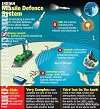
missile defence shield being put in place by the Defence Research and
Development Organisation (DRDO) could very well become an important
component of the aerospace command. And so are the unmanned drones for
surveillance and reconnaissance, Unmanned Combat Air Vehicles (UCAVs),
AWACS(Advanced Warning and Control System) aircraft, a range of missiles
meant for a variety of end uses and a constellation of satellites high
up in space. Indeed, the whole exercise of creating a multi layered
aerospace command should ultimately be aimed at ensuring that in a fast
changing battlefield scenario, all the available tools should be
harnessed to stay at the winning edge of the war.
Perhaps the biggest trump card in the endeavour to set up an Indian
aerospace command lies in the expertise that ISRO has built up in the
area of designing and developing state of the art satellites for wide
ranging applications. Incidentally, ISRO has so far built and launched
more than fifty satellites for uses such as scientific research, earth
observation, weather watch as well as communications, broadcasting and
navigation. As things stand now, India does not yet have a dedicated
defence satellite even as all the three wings of services have been
clamouring for exclusive satellite capability to boost their
preparedness and fighting fitness. Not long back, DRDO chief V.K.
Saraswat had pointed out to the well-conceived plan to build and launch a
series of home grown defence spacecraft systems with surveillance,
imaging and navigation capabilities that would not only help keep an eye
on “hostile developments in the neighbourhood” but also help guide the
cruise missiles and high precision weapons to hit targets with a high
degree of accuracy.
“There will be a series of defence satellites. Each year, you will
find one or two satellites going up. I cannot reveal you the numbers
because they are classified,” noted Saraswat. However, he made it clear
that each of these satellites would be equipped for a specific mission
and would carry payloads for a variety of end uses including
surveillance and reconnaissance, imaging, navigation and communications.
Going ahead, Saraswat stated that “the army, the navy and IAF each have
their own requirements and it would not be appropriate to say how many
each of them would need.” According to Saraswat, with these satellites
in orbit, Indian defence forces would be in a position to get a holistic
picture of the movement of troops and such other things in the
immediate neighbourhood. Saraswat also made a point that satellite
systems hold the key to the successful operationalization of India’s
ballistic missile defence shield.
Saraswat also revealed that the road map of the series of satellites
required by the Indian defence forces has been handed over to the Indian
Space Research Organisation(ISRO).But then with its current
infrastructure and support level, ISRO is having tough time meeting its
own requirements. With a single operational launch vehicle in the form
of the four stage Polar Satellite Launch Vehicle (PSLV) and a single
launch complex spread across Sriharikota island on India’s eastern
coast, ISRO is not in a position to accomplish more than 3-4 orbital
missions a year. There is no denying the fact that India would need to
build a second launch pad which is very critical to boosting the launch
missions by a substantial extent. In the context of India’s plan to
offer its launch services to international customers, ISRO would need to
boost its launch frequencies to at least six a year. China, which has
three landlocked launch complexes, is now building an ultra-modern
costal orbital complex at Wenchang in Hainan Island which happens to be
the epicentre of a massive Chinese naval build up.On its part, ISRO has
hinted at a plan for a second launch complex. But whether it would
assume a practical shape within a foreseeable future no one is sure as
yet.
Similarly, the glaring failure of the Indian space agency to qualify
the home grown cryogenic engine stage required to operationalize the
three stage Geosynchronous Satellite Launch Vehicle (GSLV) well on time
could jeopardise many of the high profile projects lined up by ISRO in
the near future. To meet the growing needs of Indian defence forces,
ISRO would need to not only build multiple launch centres and a
variety of launch vehicles equipped for varying orbital missions but
also involve the Indian industry in a big way in the task of building
and delivering satellites and launch vehicles in a ready to use
condition. Clearly and apparently, India lacks the “industrial culture “
fine-tuned for building spacecraft and space vehicles on a turnkey
basis.
Perhaps a major hindrance in the way of setting up the Indian
aerospace command is involving ISRO, a civilian space agency committed
to the “peaceful use of space,” in the entire exercise. As such, the
ruling dispensation in New Delhi should factor the possibility of such a
step attracting international censure including the US technology
embargo and trade sanction. In fact, in early 1990s, USA had prevented
Russia from transferring the cryogenic engine technology to India, by
citing the potential for the diversion of such a technology for military
build up. In late 1990s, USA had pressurized India into dropping its
Agni surface to surface missile programme with the observation that the
Agni series of missiles developed under India’s Integrated Guided
Missile Development Programme(IGMDP had drawn from the solid fuel
technology developed for India’s first civilian basic launcher SLV-3
which had its successful debut flight in 1980.As it is,SLV-3 was
developed under the leadership of the former Indian President
Dr.A.P.J.Abdul Kalam during his stint with ISRO. Incidentally,
Dr.Kalam who subsequently moved to DRDO, spearheaded the IGMDP which
served as a launching pad for developing a range of Indian missiles.
Indeed, satellites serve as the “ears and eyes” of a well equipped
aerospace command. The stunning success with which US led allied forces
were able to pull off their intervention in Afghanistan and Iraq has
highlighted the vital importance of the space based assets in realizing
the strategic goals in a cost effective and timely manner.
Meteorological satellites forecasting weather for facilitating bombing
raids and missile launches, navigation satellites guiding lethal
weapons to designated locations, reconnaissance satellites locating
the exact geographic position of military targets, electronic ferret
satellites gathering data on radar frequencies, communications
satellites providing real time secure links between defence forces
scattered over a vast geographical stretch for a coordinated strategy
and ocean watch satellites snooping on the naval movement of adversaries
which have all become a puppet in the string of the modern day warfare.
Not surprisingly then, the massive intelligence failure suffered by the
Indian army before and during the short lived Kargil skirmish of 1999
has been attributed to the lack of access to satellite resources.
On its part IAF is confident that a full fledged tri service
aerospace command would go a long way towards ensuring the safety of
Indian space assets and guarding the Indian air space with heightened
vigil. The IAF’s defence “space vision 2020” outlines the need to evolve
a strategy for the optimum utilization of space assets for sharpening
its combat preparedness. By all means, for IAF uninterrupted access to
dedicated constellation of military satellites is critically important
to sustain its strategic superiority through the concept of “see, reach,
hit and protect”. Satellites hold the key for the coordinated and
synchronized functioning of the aerospace command by seamlessly
integrating weapons systems, missiles, radars and sensor suites,
unmanned aerial vehicles, weaponzied drones, electronics and
communications network , fighter jets, transport aircraft, logistics and
support systems, defence forces spread across a vast geographical swath
for sustaining “strategic superiority” from the word go.
The clamour for setting up an Indian tri service aerospace command
assumed strident dimensions following the early 2007 anti satellite test
carried out by China. This exercise meant to refine Chinese space
warfare techniques involved the destruction of an aging weather watch
satellite positioned at an altitude of 537 kms above the earth by firing
a ground based medium range ballistic missile. And while addressing the
United Commanders Conference in New Delhi in mid-2008, Antony did not
mince his words while underscoring Indian angst over the “emergence of
anti satellite weaponry, a new class of heavy lift off boosters and
improved array of military space devices in our neighbourhood.”
Of course, Saraswat has been stressing on the need to develop
technological elements of anti satellite systems to prevent the rogue
satellite systems from immobilizing the Indian space assets. He has also
hinted at developing space laser sensor to monitor and track space
based killer devices. To support the Indian aerospace command, DRDO has
also a plan up its sleeve to develop and launch electronics intelligence
and communications intelligence satellites as exclusive defence space
platforms.
Space capability also constitutes a key element of the network
centric system to integrate the resources of all the three wings of the
services. Air Force Network (AFNET), inducted into IAF in 2010, on which
an integrated air control and command is being built, will be allotted a
slew of transponders on-board Indian satellites in INSAT constellation
being operated by ISRO. The fibre optic technology based AFNET grid
which will help link IAF’s command bases, radars, missiles, batteries
and airborne fighters would ultimately pave the way for the complete
situational awareness of the area that IAF wants to secure and
dominate. In the ultimate analysis, the success of the aerospace command
depends on the smartness with which the information super highways and
communications channels are exploited for real time coordination of the
“strategic moves” of the defence forces spread across a vast
geographical swath.
Equally critical to the successful operation of an aerospace command
is a versatile and well endowed C4ISR system. While the C 4 components
of the system—computers, command , communications and control—constitute
the backend, ISR(intelligence, surveillance and reconnaissance) make
up for the front end. The ISR made up of orbital, airborne, maritime and
fixed or mobile, ground based sensor systems help find, fix and track
hostile targets and evaluate the damage to enemy targets. On the other
hand, with an increasing number of smart weapons including missiles
rapidly becoming autonomous, they would need to be controlled and
manipulated through a network enabled command and control structure
supported by a constellation of satellites.
Meanwhile, with the Indian Space Research Organisation(ISRO)
preparing for the launch of India’s fully home-grown microwave earth
observation satellite RISAT-1 sometime towards the end of April,
Indian defence forces will have the reason to cheer. For they can
look forward to fall back on a “smart eye in the sky” to enhance their
situational awareness and surveillance capability along India’s borders
with China and Pakistan.
Significantly, it is the all weather and day and night imaging
capability of RISAT-1 that is particularly relevant to Indian defence
forces from the point of view of strategic planning. For the high
performance Synthetic Aperture Radar (SAR) payload of RISAT-1 is capable
of functioning even under conditions of cloud, dust and haze. Right
now, Indian defence forces have limited access to the IRS constellation
of earth observation spacecraft being operated by ISRO. But then these
satellites being passive systems can function only under the conditions
of brightness.
In April 2009, India’s four stage PSLV had orbited RISAT-II microwave
imaging spacecraft that ISRO (Indian Space Research Organisation) had
realized in tie up with Israel Aerospace Industries (IAI) on a fast
track mode. The launch of 300-kg.RISAT-II featuring an X-band SAR
payload was widely perceived as a response to the insecurity complex
generated by the 26/11 Mumbai terror attack. The all weather RISAT-II
has been described by strategic analysts as a high tech space
platform meant to keep a tab on terrorist movements along India’s
international borders with Pakistan.
Clearly and apparently, Indian defence forces can easily exploit the
potentials of RISAT-II to boost the intelligence gathering capability of
Indian armed forces in big way. For earth observation and surveillance
are considered the two faces of the same coin. RISAT-II’s revisit
capability of four to five days is considered advantageous factor in the
dynamic monitoring of the developments of strategic importance. Added
to that the highly agile RISAT-II can be manoeuvred to change its
viewing angle as per the requirements of the users.
At the moment, Indian defence forces don’t have a dedicated satellite
systems meant for surveillance, reconnaissance and intelligence
gathering .Of course, the ISRO built GSAT-7 satellite which is
expected to be launched during 2012-13 will serve as Indian navy’s
exclusive space platform for reliable , robust and fool proof
communications.
While India has a robust level of technological infrastructure and
human expertise required to create a tri service aerospace command in a
phased manner, the political leadership of the country should shed its
“complacency and indifference” to give a go ahead to the setting up of
the tri service aerospace command. For in the context of growing,
multi-dimensional threat to India’s national security and taking into
account the need to position India as a military power of global
standing, the setting up of a tri service Indian aerospace command
cannot be delayed under any circumstance. For the Indian defence forces,
an aerospace command could very well be a force multiplier and game
changer. And for India, it would be a hedge against the forces bent upon
challenging the territorial integrity of the country.
Author is Research Fellow in Vivekananda International Foundation