Showing posts with label CBI. Show all posts

Thursday, November 27, 2014

Key to Building New Temples of Modern, Progressive India

Dr M N Buch, 
Dean, Centre for Governance and Political Studies, VIF

When India became independent, the government led by Prime Minister Jawaharlal Nehru took a deliberate decision to launch a massive programme of building infrastructure in India and for this purpose opted for a planned economy. The state of the then infrastructure can be best illustrated by the fact that of the more than five and a half lakh rural settlements and about 4000 urban settlements in India, only 5000 had any electricity and this included our very large cities such as Bombay, Madras and Calcutta. Today the whole of India is electrified. Apart from Tata Steel, there was virtually no capital goods industry in India. We manufactured no aircraft, no ships, no motor vehicles, we did not produce aluminium or copper, our roads system was rudimentary and there was very little telecommunication connectivity. In 1960, I was Sub Divisional Officer in Kannod Sub Division of Dewas District (Madhya Pradesh), covering an area of approximately 1500 square miles, or 3750 square kilometres. The sub-division consisted of three tehsils and there was no telephone in the whole subdivision. Today, India has the fastest growing mobile telephony market in the world.

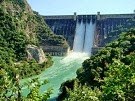
When one looks at what was achieved in the first fifteen years of independence, one is really amazed at the scale, the width and the speed of our achievements. Great hydroelectric cum irrigation projects like Bhakra-Nangal, Hirakud and Tungabhadra were built, huge thermal power stations such as at Sarni in Madhya Pradesh and Bokaro in Bihar (now Jharkhand) were constructed, copper and bauxite mines were brought under production, mining for iron ore and coal was brought to a new height and huge steel plants such as those at Bhilai, Rourkela and Durgapur were constructed in record time. Chandigarh was built from scratch as the new capital of the Indian part of Punjab as a replacement for Lahore. In all this frenzy of creation, there was no delay, no complaint of corruption, no lack of trust in the persons entrusted with the job and absolutely no complaints about quality. Le Corbusier was selected as the architect of Chandigarh by P.N. Thapar of the ICS, Harvey Slocum, the great dam builder of the United States was brought in to design and build the Bhakra Dam, S.N. Mehta of the ICS was given charge of Bhilai and whether it was the Locomotive Works at Chittaranjan or the fertilizer plant at Sindri, officers were chosen with care and given full freedom to deliver. The very Indians who are today being accused of being inefficient and corrupt were the people who built the temples of new India, which stand proud even today and continue to produce as efficiently as on the day they were inaugurated. The Nehruvian era also saw a massive upsurge in education, especially in the field of technology, medicine and agriculture. The Indian Institutes of Technology and Indian Institutes of Management, the Indian School of Mines at Dhanbad, the School of Planning and Architecture at Delhi the All India Institute of Medical Sciences at Delhi and the Postgraduate Institute of Medical Education and Research at Chandigarh and Pondicherry, the magnificent Agriculture Universities at Ludhiana and Pant Nagar are some examples of world class educational institutions which were created either during this era or immediately after it as a part of the continuing legacy in which India sought excellence. In the Indian Institute of Science in Bangalore we had an institution which gave the world a Nobel laureate like C.V. Raman. It is in the year 1957 that I joined the Indian Administrative Service and it personally gave pride to all of us to be participants in this magnificent race for development on which India had embarked.

From 1967 onwards, that is, twenty years after independence and in the immediate post Nehru era, this country seemed to lose the head of steam built up in the previous twenty years. This was the period of political uncertainty, of intrigue for power in which members of the legislature were suborned, subdued or purchased and governments were changed not on the basis of the ballot but through the means of the market, that is, buying and selling in a system which for twenty years had enjoyed an enviable reputation of political and civil service rectitude and professional competence of its technical personnel. Suddenly there crept in an element of political corruption which, in turn, corrupted the Civil Service, whose professional competence was eroded because of lack of political will and decision making and the increasing preponderance of political manipulators, corrupt businessmen, abandonment of planning and its substitution by populism, inordinate delays and cost overruns in project implementation, accompanied by shoddy workmanship. What is more, audit and vigilance functions suddenly became more important than project planning, technical design, systematic financing, adherence to schedule, maintenance of quality and delivery of the finished product. Together with this grew a lack of trust between ministers and officers, between political parties, between officers themselves, between civil servants and technology professionals and between project authorities, businessmen and contractors. Now everything was for sale, even human character. Whereas the real accountability of the past in which one trusted people who, in turn, justified that trust by doing their job faithfully, honestly and efficiently was replaced by a formalised but proforma accountability, no one was prepared to take any decisions without, in the case of the corrupt, a price being extracted and by the honest because they know that a decision could create trouble for them on petty account and, therefore, it was better to play safe. Is it surprising that the implementation of major projects or, for that matter even minor projects, has slowed down, complaints of corruption have reached their zenith and whereas we have not become honest as a result of that, we have certainly become a nation of prevaricators, we have become inefficient, we shirk responsibility and we try and hide behind a rampart of files to protect ourselves from the consequences of wrongdoing?

The whole aim of governance is to take decisions. Decision making is at various levels and in its own domain every decision is vitally important. At the level of national government, there has to be a long term perspective about where the country should be heading, there should be a clear-cut vision of our priorities and selection of priorities taking into account financial and human resources available to us. There has also to be a vision and model of how plans prepared in accordance with these priorities will be implemented. The personnel to implement them have to be carefully selected, they have to be suitably empowered and then given a freehand to deliver results. There has to be a system of monitoring, evaluation and superintendence, but within given parameters audit and vigilance functions have to be rational, aimed at correcting the errors, but certainly not designed to keep officials on tenterhooks, thus hamstringing them in decision making and implementation. Had S.N. Mehta who built the Bhilai steel project been subjected to the kind of harassment which officers have to put up with now, the Bhilai Steel Plant would never have been built. He would have protected his back rather than take the momentous decisions he did in the full knowledge and confidence that every bona fide act of his will be supported.

An essay like this should not be an excuse for personal anecdotes but I think the above point needs elaboration. In March 1964, the government suddenly told me that 25,000 refugees from East Pakistan would reach my district, Betul, of which I was D.C, in exactly one week. I was required to receive them, accommodate them in camps, look after them, feed them, put them to gainful employment and arrange for their permanent rehabilitation. The orders of the Chief Secretary were brief, concise and accompanied by a threat that even if one refugee deserted I would answer with my head. The rest was left to my discretion. It is to the great credit of my officers, my revenue staff, engineers, Electricity Board officials, forest officials, the medical staff and the police that we built three camps within a week, electrified them, arranged drinking water, rations, etc., so that when the first train load of refugees arrived they went straight into designated quarters, with officials to guide them. After an initial period of settling down, the refugees were put to work to clear 30,000 acres of poor quality forest and we built thirty-two villages where the refugees were settled and put to work on agriculture. I had no time to call for tenders or to follow any formal procedures. When I told the Chief Secretary this he made me write on one page a summary of what I had done and he obtained the Chief Minister’s orders ratifying all my actions. No one asked me any questions, no one upbraided me for not following the rules and instead the Chief Minister praised my performance during a debate in the Vidhan Sabha. Today I would have had to face audit objections as long as my arm, would have been harassed by the CBI, would probably have been suspended and sent to jail. That is why in today’s age, I would have permitted the refugees to run away or die. I would have prepared beautiful files but I would certainly not have taken the decisions I did which ensured that the Bengali refugees are thriving today in these newly established villages.

One makes this point because the question arises whether Indians were more honest in the past and are now suddenly dishonest collectively. There was some difference in that Nehru and his compatriots had come through the fire of the freedom movement, they were deeply nationalistic, they were sure of themselves and they enjoyed the complete trust of the Indian people, who were confident that whatever was decided by the leaders would be for the greater good of India. Because of these leaders, there was stability in government, there was no hesitation to take even unpleasant decisions and the leaders trusted the civil servants, engineers, doctors, etc., because there was a commonality of purpose between them. P.N. Thapar, M.S, Randhawa and P.L. Verma built Chandigarh. Kunwar Sen and A.N. Khosla built Hirakud and Slocum built Bhakra-Nangal. There was no hesitation to engage foreign experts or to assign steel plants such as Durgapur to a British consortium, Rourkela to the Germans and Bhilai to the Russians. We did not feel slighted because we borrowed talent from abroad because the objective was to build these new temples and not to sit on petty issues of prestige. All this was possible only because we had a climate of political certainty. When the first uneasy coalitions were formed in the States by breaking political parties through purchase, uncertainty crept in at political levels and corruption became a political imperative because money was needed to buy political power. Unfortunately even the single party governments of Indira Gandhi, Narasimha Rao and Rajiv Gandhi were unable to stem the rot and in the new climate of political uncertainty, indecisiveness and corruption became necessary concomitants of government. This has been followed by thirty years of coalition rule at the Centre and this has further vitiated the environment. Manmohan Singh is personally pea green incorruptible and one had expected of him that he would be able to bring rectitude back into government. The political realities of his coalition made it almost impossible for him to bring about any improvement and almost all the wrongdoing of his period was the result of the manner in which the coalition functioned. One could even go the extent of saying that when there is a coalition of opportunism, then it is almost axiomatic that each coalition partner will push its own agenda, the objective of which is personal enrichment and self advancement. Such a coalition cannot frame policy, it can only seek opportunities for promoting its own benefits. This automatically creates a miasmic atmosphere in which there is deep suspicion about the motives of everyone and there is a complete lack of trust.

The present government is not a coalition because it enjoys an absolute majority of a single party in the Lok Sabha. Whereas any democratic government is required to carry all parties, especially those which are politically opposed to the ruling party, along with government in all matters of national interest, it is not required to pander to the baser instincts and demands of a coalition partner who is opportunistic. Such a government is free to take decisions, including those which may be temporarily unpopular, and give clear-cut directives to its officials and to create an environment of trust in which officials feel personally accountable for completion of given tasks. In such an environment, the policy is well defined and their directions for the implementation are also specific and unambiguous. An official can now proceed with implementation in the full confidence that provided he follows policy directions, he will be fully protected. One does not know whether the climate in which people implicitly trusted each other in the fifties and sixties of the last century will ever return, but the present government can certainly ensure the following:
  1. Clarity in policy and firmness in the political will to implement it.
  2. The careful choosing of implementation teams
  3. Unambiguous policy directions on how a particular policy is to be translated into reality
  4. A clear statement to the team leaders and officers that government will support them to the hilt in their work.
  5. Interlocking accountability in which superintendence, supervision and monitoring are paramount, but in which the superior officer is held accountable for the deeds of his subordinates.
  6. Suitable empowerment of the official machinery so that it can perform its task.
  7. Sensible audit whose function is not only to find fault but to help the implementing authorities to perform the task better and maintain their accounts in a rational manner.
  8. Answerability for one’s actions only to one’s administrative superior and not to an outside agency like a vigilance organisation, CBI, etc., unless there is an allegation of criminality and an FIR is duly registered in this behalf. In other words, an officer implementing a policy decision will acknowledge only one superior, his administrative head and will not be answerable to other persons or authority.
Let us not underestimate our government machinery because it is still capable of doing amazing work. What it needs is clarity in policy, directions which are unambiguous and full support for all bona fide actions. Having served in India’s premier Civil Service, one can state with confidence that our government machinery, despite years of abuse, can still deliver the moon on a platter. If government governs, there will be real governance and we shall build hundreds of new temples of a modern, progressive India.

Published Date: 19th November 2014, Image source: http://bhakranangaldam.com

Friday, July 4, 2014

Appointment of Judges and Independence of Judiciary

Dr M N Buch, 
Dean, Centre for Governance and Political Studies, VIF

Though India is a Union of States we have a judicial system which is hierarchical, from the court of first instance right up to the Supreme Court. In all legal matters competent judicial officers can pronounce judgements on both Central laws and State laws. By contrast, in the United States, federal laws are interpreted and adjudicated upon by Federal courts and State laws by State courts. In India, the Supreme Court is at the apex, but under Article 227 of the Constitution, the power of superintendence over all courts and tribunals throughout the territory over which a High Court has jurisdiction vests in the High Court. At the same time, under Article 141, the law declared by the Supreme Court is binding on all courts and, therefore, the position of all courts, including High Courts vis-a-vis the Supreme Court is one of judicial subordination.

The appointment of judges to these two courts is strictly defined by the Constitution. In the scheme of things there is separation of powers between the three organs of the State which, nevertheless, are equal, that is, the Executive, the Legislature and the Judiciary. In order to ensure the balance of power, the Constitution provides for the Legislature to be constituted through a process of election, the Executive through a process of recruitment governed by an independent constitutional body called the Public Service Commission and the Judiciary to be completely free from interference by the Executive or the Legislature by giving the judges complete independence. Article 124 governs the appointment of judges to the Supreme Court and Article 217 does the same for the appointment of judges of a High Court. In the case of the Supreme Court, Article 124 (2) reads “Every judge of the Supreme Court shall be appointed by the President, by warrant under his hand and seal, after consultation with such of the judges of the Supreme Court and of the High Courts in the States as the President may deem fit… Provided that in the case of appointment of a judge other than the Chief Justice, the Chief Justice of India shall always be consulted”. In the matter of judges of the High Court under Article 217, the President is required to consult the Chief Justice of India, the Governor of the State and the Chief Justice of the High Court. The Supreme Court, in its wisdom, decided that consultation of the President with the Chief Justice means that a Collegium of Judges to be constituted by the Chief Justice will vet every case and on its recommendations the Chief Justice will give his advice to the President. This is an internal matter of the Supreme Court and need not be commented upon. As it is, there is a move to legislate for the setting up of a Commission for recommending judicial appointments, but this is still only at the proposal stage. Despite opinions to the contrary I would suggest that the system as it has evolved has served us quite well and we should not hasten to alter it.

The process of appointing judges to fill present vacancies in the Supreme Court had begun quite some time ago. Apparently in Septemebr 2013 Arun Jaitley wrote to the then Prime Minister, Dr Manmohan Singh, that the name of Gopal Subramaniam who, incidentally, had to resign as Solicitor General of India in an unconnected matter, was under consideration and, in the opinion of Arun Jaitley and the party of which he was Leader of Opposition in Rajya Sabha, there were strong reservations about this name. As has been reported, Arun Jaitley said that initially Gopal Subramaniam had offered his services to government in the Sohrabuddin case, which was pending before the Supreme Court. When it was decided that the Attorney General would handle the case, Gopal Subramaniam offered to assist the court as amicus curiae and though the court never formally invited him to do so, Gopal Subramaniam acted as if he was the amicus curiae and gratuitously advised the Supreme Court that (1) The investigation of the Sohrabuddin case be transferred from the Gujarat Police to CBI and (2) If Amit Shah was given bail, which had already been granted by Gujarat High Court, he should be restrained from entering the State of Gujarat. The Supreme Court ordered accordingly. In his letter, Arun Jaitley is reported to have said that this indicates the bias of Gopal Subramaniam and, therefore, he is not fit to be considered for appointment to the Supreme Court.

In a parallel development, it seems that CBI very foolishly had earlier recorded a note that Amit Shah should be arrested because this would cause Gujarat Police officers to be intimidated and through them CBI could reach its real target, Narendra Modi. This view was endorsed by Ashwani Kumar, then Director of CBI. Whereas I cannot vouch for the veracity of this report I would not be surprised if it were true because this is how CBI seems to function. Normally one should not interject a personal experience in an essay of the present sort, but I am forced to quote a personal experience in my official capacity as Head of the Delhi Development Authority to show that the notes recorded in the Sohrabuddin case are about par for the course for CBI. I received a letter from CBI in 1978 seeking permission under section 197 Cr.P.C. to prosecute Jagmohan, Ranbir Singh and other officers of DDA in what was known as the Kapashera, Samalkha and Andheria Mor demolition case. Sanjay Gandhi, Jagmohan and others were accused of mischief under section 427 IPC, criminal trespass under section 447 IPC, criminal intimidation under section 506 IPC, read with sections 34 IPC, that is, common intention and 120B IPC, that is, criminal conspiracy. I asked CBI to send me the case diary so that I could take a decision about giving permission to prosecute and after much hesitation and correspondence it was sent to me. I was horrified to find that the supervising officer’s note was also attached, which stated the purpose of the investigation was to bring home charges of criminal trespass, mischief, criminal intimidation, etc., against Sanjay Gandhi and others. This note itself indicated bias because the purpose of any investigation is to arrive at the truth and not try and fit the facts to arrive at a predetermined conclusion. The investigation was obviously tainted.

The case diary itself made strange reading. The demolitions were carried out at the behest of and as an agent of the Municipal Commissioner of Delhi, B.R. Tamta. He, therefore, was the main accused. In the case diary itself the investigating officer recorded that because B.R. Tamta had agreed to give evidence on behalf of the State he was not being named as an accused. Under Chapter XII Cr.P.C. the police has no power to drop from the list of the accused a person against whom there is prima facie evidence, nor can the police add to the list of accused a person against whom there was no prima facie evidence. Regarding pardon, that is governed by section 306 Cr.P.C. The Chief Judicial Magistrate, Metropolitan Magistrate or Magistrate First Class may tender pardon, but only in cases triable exclusively by the court of session or the court of a special judge and only where the offence is punishable with imprisonment of seven years or more. The police cannot tender pardon and in any case the maximum penalty for the offences for which Sanjay Gandhi, Jagmohan, etc., were charged only carried imprisonment for a maximum of two years. In such a case pardon cannot be tendered. I wrote to CBI that sanction could not be issued unless B.R. Tamta was also made an accused in the case. R.D. Singh, Special Director of CBI met me and threatened me with dire consequences if I did not issue sanction, on which I not only threw him out of my office but also finally rejected the application for sanction. The accused were never charge-sheeted or prosecuted in this case, but it did leave a lasting impression in my mind that CBI is not an ideal police force whose objective is to fight crime. Therefore, the attitude of Ashwani Kumar and his officers probably represented the reality of the matter, that is, CBI’s objective was not justice but to fix Narendra Modi so that he could be politically finished.

To return to the issue of appointment of judges, the Chief Justice of the Supreme Court recommended to government that four names, those of the Chief Justices of the Calcutta and Orissa High Courts and Gopal Subramaniam and Rohinton Nariman had the approval of the Chief Justice and the Collegium of Judges for appointment as judges of the Supreme Court. The President ultimately approved three names, but expressed reservation about Gopal Subramaniam. On this Gopal Subramaniam withdrew his assent for the post and in the process made scathing remarks about government. His allegation is that he was amicus curiae in the Sohrabuddin case and on this account he has been targeted by government for denial of the post of a judge of the Supreme Court. According to him, the Government of India is prejudiced against him and further, by denying him the post, has proved that it wants convenient judges on the Bench. He has further alleged that this will affect the independence of the Judiciary and will have harmful long-term effects.

Without going into the merits of the Gopal Subramaniam’s charges one cannot help but feel that in making an allegation that government wants to reduce the independence of the Judiciary there is a hint of slander. This is not the first time that government has rejected some names recommended by the Chief Justice of India or denied elevation to the Bench to certain judges of High Courts and to lawyers. In the United States of America, it is a well known practice to try and pack the Supreme Court with judges whose political views are in consonance with the philosophy of the ruling party. Franklin Delano Roosevelt, struggling with the Great Depression and wanting to push the New Deal, wanted liberal judges in the Supreme Court. President George Bush and President Ronald Reagan wanted conservative judges. Certainly Indira Gandhi wanted judges like A, N. Ray who, with Justice P.N. Bhagwati and others forming a Constitutional Bench of the Supreme Court ruled that when a proclamation of Emergency under Article 352 was in force the fundamental rights stood suspended, which meant that the right to life under Article 21 also stood suspended. Of course, the court did not clarify whether this meant that the Executive could arbitrarily and without trial put a man to death, but in effect that is how it can be read. Justice H.R. Khanna, in the lone dissenting judgement, strongly opposed this view and upheld the right to life and further ruled that the fundamental rights could not be suspended. Indira Gandhi never forgave him and he was not elevated to the post of Chief Justice. During the Emergency in the Bhimsen Sachar case, Chief Justice Tatachar of the Delhi High Court ruled that though the fundamental rights may have been suspended, the Code of Criminal Procedure remained intact, section 482 Cr.P.C. gave the High Court the inherent power to secure the ends of justice and, therefore, using the power of habeas corpus, he ordered the release of Bhimsen Sachar, Kuldip Nayyar and others. Similarly, the Gujarat High Court, in the case of Himmat, a journal produced by Rajmohan Gandhi, ruled against censorship and Himmat published without censorship thereafter. The Chief Justices of Delhi and Gujarat High Courts were denied elevation to the Supreme Court. Despite this, what is proved is that even during the Emergency, our Supreme Court and High Courts did not compromise on their independence, especially the High Courts, which proved that the independence of the Judiciary is strong and zealously guarded. Is it Gopal Subramaniam’s case that what could not be done in the Emergency, that is, bringing the courts to their knees has become possible because Gopal Subramaniam has not been elevated to the Bench? He is too eminent a lawyer to be pardoned for even suggesting such a thing.

The method of appointment and the autonomy of an organisation may be interconnected, but they are not inter-dependent. In any case, the scheme of the organisation of the State in India is such that the three major pillars, the Executive, the Legislature and the Judiciary are all autonomous within their own spheres. The Legislature has untrammelled powers of legislation, subject only to constitutional validity, approving the budget, calling the government to account through the collective responsibility of the Council of Ministers and through the various mechanisms worked out for legislative control. The Executive power vests in the President, who exercises it through officers appointed by him, but on the aid and advice of his Council of Ministers. The business of government is conducted according to the Business Rules framed under Article 77. This applies mutatis mutandis to the States also. In the exercise of executive powers, the Executive is autonomous, but subject to accountability to the Legislature and to such pronouncements that courts may make if adjudication is called for. Similarly, the Judiciary is autonomous, appointment of judges is not within the exclusive purview of the Executive, they cannot be removed except through due constitutional process and they are free in the matter of adjudication to pronounce judgement according to law. There is no encroachment on this autonomy nor ever has been. At the same time, the Legislature is constituted through election, a process under a constitutionally created Election Commission of India. Despite this the House is constituted by the President, who also summons it to session. The officers of the Executive are selected by a constitutionally created Public Service Commission, but their appointment is made by the President and protection is provided by Articles 311 and 312. In the case of the Judiciary, the selection is made by the Chief Justice of India and the appointment is made by the President. In all three cases, there is convergence at the level of the President. Article 124 makes consultation with the CJI mandatory, which means that a person not recommended by the CJI cannot be appointed to either the Supreme Court or a State High Court. That, however, does not mean that the President, on the advice of his Council of Ministers, cannot reject a name suggested by the CJI. There would be interference with independence if the President arbitrarily appoints judges. There is no interference if the President rejects a name suggested by CJI. That has happened in the past and may happen in the future also, which is precisely why Article 124 provides for a process of consultation.

Gopal Subramaniam is a legal luminary whose erudition and brilliance is universally recognised. He is eminently qualified for elevation to the Bench, which would be richer by his presence. Conversely his absence from the Bench is not tantamount to jeopardising the autonomy of the Judiciary. This last remark is made because by suggesting that the independence of Judiciary is in danger, Gopal Subramaniam has done no service to government, the Judiciary or even to himself.


Published Date: 3rd July 2014, Image source: http://www.orissadiary.com

Monday, June 23, 2014

Time for an Organised, Focused and Empowered CBI

Dr M N Buch, 
Dean, Centre for Governance and Political Studies, VIF

The word ‘corrupt’ is defined in the Twenty-first Century Dictionary as “morally evil, involving bribery, dishonest”. The word ‘corruption’ is defined as “the process of corrupting or condition of being corrupt, dishonesty”. In India, as one supposes in every country in the world, the taking or giving of a bribe or indulging in a corrupt practice is a crime, an offence and is liable to action before a criminal court of justice as per the law in this behalf. The Prevention of Corruption Act was enacted by Parliament in 1988, but the Indian Penal Code was enacted in 1860 and subsequently amended from time to time without diluting the basic format and contents of the Act of 1860. Chapter IX of the Indian Penal Code came into effect in 1860 and though sections 161 to 165A were repealed by the Prevention of Corruption Act 1988 and the offences therein transferred to the P.C. Act, even under the 1860 Act corruption was a criminal offence. Now all matters relating to corruption have been codified under one law, the Prevention of Corruption Act (PCA), 1988. The purpose of this Act is to ensure that if there is any corrupt practice by a public servant or member of the public who, in his dealings with a public servant, commits a corrupt act, then he or she would be liable for penal action under the PCA.

Under law, the power to investigate an offence vests in the police, though other agencies of government can, by law, be given the power to investigate specific offences under particular Acts. Under the Indian Forest Act, officers of the Forest Department are empowered to investigate offences relating to the forests and to wildlife and to prosecute the offenders in a court of law. Similar powers are vested in officers of the Excise Department in relation to excise offences. However, so far as the major part of criminal law is concerned the power to investigate an offence vests in the police. Under Entries 1 and 2 of List 2 of the Seventh Schedule of the Constitution, public order and police fall exclusively within the jurisdiction of the State Legislature, which can enact laws in this behalf. However, because criminal law and criminal procedure fall in Entries 1 and 2 of List 3 of the Seventh Schedule, Parliament and State Legislatures have concurrent legislative jurisdiction, with the laws of Parliament prevailing in case of conflict. Because investigation of offence is a part of criminal procedure, therefore, Parliament has legislated in this behalf, especially through the Code of Criminal Procedure. Chapter XII Cr. P.C. lays down the procedure that the police is bound to follow when investigating an offence. The police acquires jurisdiction for such investigation only after a First Information Report relating to the commission of a cognisable offence is reduced to writing and the officer incharge of a police station, on the basis of the information received, is of the view that a cognisable offence might have been committed, which calls for police investigation. This point is important because under section 155(2), the police cannot investigate a noncognisable offence without the order of a competent Magistrate. Under section 156, Cr.P.C. a police officer acquires jurisdiction to investigate a cognisable offence. Under section 157, the police officer may either proceed with the investigation or, for reasons to be recorded in writing, may decide not to investigate the matter either because the FIR does not suggest a case of a serious nature, or the police officer finds that there is no sufficient ground for continuing with the investigation. Subject to this, the police officer is required to investigate the matter, examine witnesses, collect evidence, including material evidence, carry out searches for recovery of objects relating to the offence and taking of other measures to bring the investigation to completion, resulting either in a challan being put up against the accused or a final report being submitted to a Magistrate seeking permission to close the case. This procedure applies to every police force in this country, including the Delhi Special Police Establishment, which is the legally constituted investigating arm of an executive agency called the Central Bureau of Investigation (CBI). It is made amply clear by section 22 of the PCA that, subject to certain modifications, the provisions of the Code of Criminal Procedure, 1973 will apply to all matters relating to investigation and trial of cases under the Act.

This brings us to the machinery for taking action under the Prevention of Corruption Act. In 1946, largely emanating from widespread complaints about corruption in purchases, etc., during the Second World War, Government of India enacted the Delhi Special Police Establishment (DSPE) Act 1946, constituted a special police force for investigating notified offences in Union Territories, with the power to enlarge the jurisdiction of DSPE in the matter of area of investigation, both in terms of types of offences and in terms of territory. However, under section 6 of the Act the jurisdiction of DSPE cannot be extended to a State without the consent of the State Government. Following the footsteps of the Central Government, many State Governments also enacted similar laws for creating a special police force for dealing with corruption and other notified cases. In Madhya Pradesh, the M.P. Special Police Establishment Act, 1947, created a Special Police Establishment for the State, superintendence over which was vested in the Lokayukt appointed under section 3 of the M.P. Lokayukt Evam Uploakayukt Adhiniyam, 1981. In the case of DSPE, government has vested superintendence in the Central Vigilance Commission through the Chief Vigilance Commissioner. This, then, is the sum total of the special police force which has jurisdiction under the PCA. What, then, is CBI?

Entry 8 of List 1 of the Seventh Schedule empowers Parliament to enact legislation for the setting up of a Central Bureau of Intelligence and Investigation. In other words, Parliament can enact a law creating the Intelligence Bureau and CBI, determine the structure of these two agencies, prescribe the jurisdiction and state how and to whom there will be accountable. From the date of adoption of the Constitution to the present date, Parliament has not been requested by government to enact such legislation, nor has Parliament taken any initiative in this behalf. Instead government chose to issue a notification on April 1,1963 creating, by an executive order, an organisation called the Central Bureau of Investigation (CBI). This bureau has six divisions, one of which is DSPE, its police investigating arm. DSPE has legal sanction, whereas CBI is just another government office. This point is laboured because in the environment created by Anna Hazare, CBI has been projected as something bigger than life, a supra government organisation which has the right to interfere in just about everything relating to government. It is unfortunate that in the process the Supreme Court itself has failed to take a balanced view of the legal position of CBI, which has encouraged CBI and its officers to behave as if through one of its divisions the organisation as a whole has police powers and that in addition its officers are the executive superiors of every officer of every rank in government from whom they can demand accountability for their executive decisions.

It is neither the purport of the Constitution nor the intention of the Legislature to use CBI as a substitute for executive government, to reduce the autonomy of the executive government in the matter of separation of powers or to place in judgement over the executive government an agency which is itself a creation of the executive government and only a very small part of it. By encouraging the CBI to think along these lines, the Supreme Court has done grave injustice to officers of government placed in high positions, where they are required to take important decisions and in the process the Supreme Court has reduced the stature of the Executive as an equal partner in the scheme of separation of powers. These are harsh words but they are being stated because it is expected of the Supreme Court that it will always take an objective, dispassionate, rational and balanced view of matters in which the decisions of the court can either enhance what the Constitution intended or weaken the basic concept of the separation of powers, CBI is an executive organ of the State and must comply with all requirements that the Constitution makes of such an organ, that is, it must be a part of the whole and not larger than the whole.

Before commenting further on the issue, let us look at the Prevention of Corruption Act, 1988, in particular Chapter 3 which defines offences and prescribes penalties therefore. Section 13 which deals with criminal misconduct by public servants is the critical issue. Under section 13 (1) (d) (iii), a public servant commits the offence of criminal misconduct if he “while holding office as a public servant obtains for any person any valuable thing or pecuniary advantage without public interest…” This is the clause which CBI uses to question, harass and even prosecute senior officers, the classical cases being those of Shyamal Ghosh, then Communications Secretary and P.C. Parakh, then Coal Secretary. Both are officers of known probity, professionally competent and completely straight forward. Shyamal Ghosh is facing prosecution and P.C. Parakh is under questioning and subject to harassment on account of decisions they took or did not take when holding office. According to CBI, both officers took decisions which gave persons or companies pecuniary advantage. CBI very conveniently forgets the total provision of this particular section of the law which reads “pecuniary advantage without any public interest”. No one will undertake a project or accept a contract unless he has estimated that it would bring him reasonable profit. Is it the case of CBI that all government work should be awarded on the basis of zero profit? It is obvious that a person will undertake a project or accept a contract in order to get some pecuniary advantage. If this becomes an offence, no government officer will ever accept a tender or issue a work order and this will bring the entire work of government to a halt. Even the CBI Director will not be able to issue an order for purchase of the very stationery on which the most unreasonable orders of CBI itself are written because if he purchases the stationery, the supplier will earn some profit and this, according to CBI, would be an offence under section 13(1) (d) (iii) of the Prevention of Corruption Act. It cannot be the case of CBI that mining for coal or promotion of mobile telephony is not in the public interest. Where is the offence made out against these officers? Unfortunately this particular provision of law is the one most misused by CBI to harass senior officers who are asked to explain their executive action to a police officer who is neither their superior nor is really competent to sit in judgement. Perhaps the section needs amendment by adding the word “undue” so that it now reads “any valuable thing or undue pecuniary advantage without any public interest”.

CBI has no legal status and cannot override the provisions of the Constitution. Article 53 (1) states that the President will exercise the executive power of the Union through officers subordinate to him. Under Article 74, the President is aided and advised by his Council of Ministers, but the manner in which the executive power will be exercised and the business of the Government of India will be conducted would be governed by rules framed under Article 77. The Rules of Business allocate and divide business between different Ministries and give the powers, functions and working procedures of Ministers and Secretaries to Government. In this process, a Secretary to Government is accountable to his Minister, to the Prime Minister through the Cabinet Secretary and to the Council of Ministers which, in turn, is collectively accountable to Parliament. A Secretary to Government is not accountable to CBI. If there is criminality in any of his actions, then certainly a FIR can be recorded and the CBI as a police force can investigate the offence. Subject to that, this practice CBI summoning executive officers and asking them to explain their executive decisions must stop. In other words, let it be made very clear to CBI through an Act to be framed in this behalf, that it enjoys certain police powers but it is neither an Ombudsman nor an agency to which senior officers are accountable. The Prime Minister must make this very clear to CBI and if its officers do not fall in line they must be immediately removed and if the worst comes to the worst, the CBI in its present form should be abolished, to be replaced by a fully accountable, fully empowered agency constituted under law. One finds it strange that for so many years, politicians and civil servants have avoided bringing CBI under a statute, with a defined structure and clearly stated jurisdiction, authority and powers. Does a CBI with no legal status find favour with politicians because an amorphous mass is more amenable to manipulation than a properly structured organisation? Narendra Modi has promised us firm government and effective governance. Why not start with a law which gives us a well organised, focused and empowered CBI?


Published Date: 20th June 2014, Image source: http://www.thehindubusinessline.com
(Disclaimer: The views and opinions expressed in this article are those of the author and do not necessarily reflect the official policy or position of the Vivekananda International Foundation)

Thursday, September 12, 2013

Why the Indian Economy is in a Mess?

Dr M N Buch, 
Dean, Centre for Governance and Political Studies, VIF

Up to the election of 2004, it was ‘India Shining’ all the way. Glasnost and Perestroika had removed the Soviet Union as a serious player on the world stage and the new Russia had not yet taken root. Rajiv Gandhi had come to power riding a wave of sympathy when Indira Gandhi was assassinated and India embarked on what was to become an era of economic liberalisation. Nevertheless, it was actually Narasimha Rao, as Prime Minister, who really brought about the partial liberalisation of the Indian economy. Manmohan Singh was the Finance Minister and is said to be the author of the new economic regime, but the fact is that he was the hack who carried out Narasimha Rao’s directives and implemented his policies. My own view is that Manmohan Singh is neither creative nor inventive in his economic thought and has, in turn, adopted that theory which was contemporaneously fashionable. He has been a Nehruvian socialist, a South-South protagonist in the North-South dialogue, a centrist-liberal, a market oriented capitalist, a neo-liberal, a disinvestment back-tracker under Left Front pressure and a populist do gooder because Sonia Gandhi’s National Advisory Council dictates it. Is it any wonder that we have no economic policy at all, only populist adventurism and economic ad hocism?

Today we are in a mess. The rupee has been fluctuating violently at historically low levels almost day by day, inflation is out of control, industrial growth has fallen and industrialists are in despair, the markets are in a free dive and investment is declining, global confidence is shaken and our foreign exchange reserves are under pressure as foreign funds are flowing out of India and all that government and ruling party spokespersons can say is, “The fundamentals of our economy are sound.” Well, surprise of surprises, the fundamentals of our economy are not sound, in fact, they are ailing seriously, if not terminally. Our failure to recognise this makes an ostrich with its head buried in the sand almost an avid seeker of knowledge when we compare this with our refusal to see the reality. There is something very flawed about our economy. It is this blindness which is preventing us from taking those painful measures, those hard decisions, which can set us back on the road to recovery.

At a later stage in this paper, I shall attempt, perhaps somewhat ignorantly, to look at the theoretical underpinnings or lack thereof of the economy and our policies. At this stage, let us look at the so called fundamentals of our economy. The primary sector, mainly agriculture, but also mining for essential raw materials, has been our mainstay and it is this sector, which is most labour intensive, which has provided the bulk of employment. Being rural based, this sector has contributed to the basic equilibrium in our settlement pattern, from village to metropolitan city. This is our strength, because neither do we have one or more primate city which dominates the whole country, nor is the rural to urban migration alarming. Some improvement has been initiated over the years in the agricultural sector and as against the earlier Green Revolution states such as unified Punjab, which included Haryana, now one finds significant agricultural growth in states such as Gujarat and Madhya Pradesh, but overall the picture is very patchy indeed. The first three Five Year Plans did put emphasis on agriculture and irrigation, but the effort has not been sustained and we are unable to break free of our almost total dependence on the monsoon. There is, therefore, a major flaw even in the fundamentals of agriculture, the largest sector in terms of employment, though not in the share of GDP.

Our approach to agriculture has not been either holistic or consistent. Agriculture has major components --- the farmer, the land and its tenure, soil productivity, the cropping pattern, water availability, amplitude of quality power supply, agriculture research aimed at applying technology, technique, seed, fertilisers and sound agricultural practices in order to maximise productivity, the support services of roads, developed markets, financial support through easy credit, value addition through processing and government backing to ensure that the farmer to consumer relationship is healthy and mutually beneficial. We also need to promote land related activities such as animal husbandry, fishing, poultry keeping, horticulture, fodder development and silviculture which meets the village requirements of fodder, fuel and secondary timber. But before we do any of these, we need a national land use policy which identifies and allocates land according to the use to which it is best suited, of which agriculture would be the most predominant. From this would flow land management at meso, mili and micro level, an art at which the Japanese seem to excel. Unfortunately, India has no national land use policy at all. So much for our fundamentals!

It is not as if we are unaware of the above issues. We are and from time to time we have even addressed some or all of them. But never wholly, holistically, harmoniously, or consistently and with persistence. Apparently we either tire very quickly or else are soon bored by consistency and want to move on to something new. Let me give two or three examples. We launched land reforms to give land to the tiller. Madhya Pradesh embraced this enthusiastically and enacted the Abolition of Proprietary Rights Act, 1950. We abolished Malguzari which was not quite zamindari and the Malguzar had only limited authority. He, however, was charged with the responsibility to manage the village commons, including the village forests. This function ceased in 1951 and from that year till 1961, when we brought the old “chhote jhad ke jungle” and “bade jhad ke jungle” within the ambit of protected forest under the Indian Forest Act, Madhya Pradesh lost four million hectares of village forests to indiscriminate felling, of which 2.8 million hectares were encroached upon. That is when village nistar rights were gravely affected, biotic pressure on reserve forests increased and villagers and forest officials entered into conflict. Yet another sound fundamental, Mr. Politician?

In the early fifties of the twentieth century. we launched S.K. Dey’s Community Development Programme. The whole country was divided into Community Development (CD) Blocks, each headed by a Tehsildar rank Block Development Officer, but forming with his team a separate cadre of development officers. We thus separated the Revenue, or regulatory and the development administration, from which eventually flowed Panchayat Raj. In a C.D. Block, all planning and implementation was participative and whereas the villagers prescribed their priorities, work was undertaken on the basis of fifty per cent contribution by the people in cash, materials or voluntary labour. Because the people had a stake in the work, they saw to it that it was done honestly and the roads, wells, minor irrigation works, schools and panchayat bhawans built sixty years ago are still intact. The Block was a complete unit, with a Primary Health Centre and extension officers in education, social welfare, agriculture, animal husbandry, cooperation, etc. In 1963, however, we abolished the C.D.B., gave up participative development and replaced it by hundred per cent government grants works. The fundamentals still OK?

A third example is of the watershed development and management programme. The whole country is divided into mili (about 5000 hectares covering about ten villages) and micro (about 500 hectares covering a village) watersheds. For each mili or micro watershed, a Project Implementation Agency was identified, whose job was to prepare a detailed management plan, do a participative rural appraisal with the villagers, form a watershed development committee and then oversee the work. With ridge to valley vegetation treatment of hill features, undertaking soil conservation works and suitably treating all waterways and creating water bodies, the programme has succeeded in converting sizeable tracts of drought prone areas into productive areas, reduced seasonal distress migration and substantially raised the water table and improved the availability of fuel and fodder. Employment is locally generated, first as wage labour on the works proper and then in the improved agriculture of the village. Because everyone benefits, there was very little corruption in the programme.

But can our “The fundamentals are sound” brigade leave well alone? Along comes the National Advisory Council (NAC), headed by Sonia Gandhi and with woolly headed do gooders, long on intention but very short indeed on practical commonsense, as members. They persuaded government to launch the National Rural Employment Guarantee Programme, supported by the MNREG Act, the purpose of which is to give a hundred days’ employment per capita per year. This is an employment programme, muster based, whose prime objective is not asset creation. NAC may think it was pioneering something, but all such programmes can trace their origin to the scarcity relief programme of British days. In his famine relief programme, Maharaja Sardul Singh of Bikaner at least built the Lal Bagh Palace. All we are building through NREGS is a massive web of corruption which has engulfed the entire Panchayat Raj system. The vast sums of money spent on a programme which, because it is muster based, has corruption built into its genes, have completely skewed our economy without creating any worthwhile assets which will give us long term returns. How can such a programme be part of our sound fundamentals?

An important component of the primary sector is mining for minerals which are the raw material for industry. This activity is extractive and impacts the environment, hence is the target of activists, some environmental, some social, some just plain cussed and, therefore, antiestablishment. Such activism has seriously affected mining for coal, iron ore, bauxite aggregate and sand, to mention just a few items. Thermal power plants are denied coal, thus inhibiting new plants. Steel plants are denied iron ore. Sand mines are closed. Apart from adversely affecting industry, this has led to huge job losses, estimated at over 50,000 in Bellary and over 20,000 in Hoshangabad. No one advocates exploitative mining which destroys whole ecological systems, or the corrupt practices that have burdened these industries in recent years. But one has to evolve a balance between exploitation, curbing corruption, and using the resultant ore for job creation and generating wealth and minimising the adverse environmental impact and rehabilitating the mined areas.
The German State of Rheinland Westphalia worked out about 70 years ago a policy whereby before mining began, the company had to submit a detailed plan of the mining operations, site for dumping overburden, restoring the site through backfill and layering with fresh soil, carrying out a vegetation plan and generally ensuring a return of the site to its old biodiversity. The policy has paid rich dividends, especially because it is vigorously enforced. That is the direction in which we must move, that is, extract, but responsibly and restore the land to its former state thereafter. We have a huge potential for employment and wealth generation in this segment of the primary sector and we must use this wisely.

The backbone of a modern industrial state is the secondary or manufacturing, sector. At the time of independence, this was still rudimentary, though the Second World War had given a fillip to manufacture because many of the industrial goods which were imported could not be brought in and the British war effort needed the contribution of Indian industry. However, the main push to industry was given after independence when India deliberately embarked on a voyage of developing capital goods industries and of infrastructural development. From the First Five Year Plan onwards, the State took the lead in capital investment in power, irrigation, metallurgy, defence industry and other sectors of the economy, which were generically clubbed together as the high ground of the economy. Various power projects, steel plants, aluminium, copper, etc., smelters all came up in the public sector. At that stage, only the State had the capacity to mobilise capital in sufficient quantity and at a scale necessary for investment in infrastructure and the capital goods industries. If this formed the core of Nehruvian socialism, which is now being condemned by modern economists and the neo-liberalists, it was nevertheless the only course open to India for rapid development at a time when India had few real industrialists and the average businessman would rather trade than manufacture. Japan went through a similar phase after the Meiji Restoration, but wisely that country kept open the doors of private enterprise and as the great Japanese business houses, the Ziabatsu, were able to undertake a larger role, the State stepped back from directly running the economy and allowed the private sector to take over. The State first led, then it worked in tandem and finally it allowed management to go into the hands of business houses whose primary objective was to maximise profit. The Japanese being a patriotic people, the State was able to retain a major role as facilitator and regulator and industry itself imposed self-discipline in which the interests of the nation were always kept paramount.

In sharp contrast, in India, as our planned economy increased the tentacles of the State, those in charge of governance began to taste economic power and not merely government power. Patronage soon skewed any sensible personnel policy in the public sector, nepotism led to unsuitable appointments to critical posts, the temptation of making money soon overcame the interests of the enterprise and the whole system began to fall apart because of inefficient management, overstaffing, delay in decision making and outright corruption. Huge amounts of money were frittered away in loss making activities and cumulatively this has certainly affected our economy adversely.

Rajiv Gandhi, followed by Narasimha Rao, did bring about a change of attitude in terms of opening up the economy to private enterprise. This did bring a large number of new start ups and sunrise industries and brought about rapid industrial growth in many sectors. Unfortunately, the government continued to vacillate because many of the sectors related to industry, mainly dealing with infrastructure, continued to be inefficiently run by government. Power has been one of biggest bottlenecks and this is one sector which government did not deregulate for a long time. Even today, private participation in power generation and distribution is hedged in by many constraints. These include a reluctance on the part of government to loosen its hold over what government considers a strategically important sector but which in fact is only a public utility. The constraints are in licensing of new power stations, environmental clearance on their location, making available land, reserving coal for the use of the power stations and evolving environmental norms which, while protecting the environment, do not completely negate the project itself. Much of the problem of the episode now popularly referred to as ‘Coalgate’ arose out of the fact that government has not holistically looked at the power sector. There is demand for power and it can be met by private investment, provided a reasonable return can be ensured. If on the one hand, government decides to allow private players to function whilst at the same time government insists on subsidising whole sections of users, which denies the generation company a fair return on its investment, how can we expect private participation?

Because all major minerals are a monopoly of the State and coal is a major mineral, unless government allocates coal to a power plant, how can it produce power? The Environment Ministry does not clear coal mining projects, in the allocation of coal blocks there are allegations of corruption and wrongdoing, the mining of coal never takes place and yet we expect the power plants to generate electricity. This scenario is so reminiscent of a lunatic asylum. If power is to be generated and a power plant is to be built, then it is the job of the ministries concerned to sit together, hammer out norms of environmental clearance and then ensure that the power plant gets all the necessary clearances automatically. The Coal Ministry and the Environment Ministry have to sit together and work out the areas from which coal will be mined and made available to the power plants. My own view is that even if coal is given free it would be worthwhile because that coal will be converted to electrical energy, the users of which would pay the State electricity duty and the use of that power for industrial production will create jobs and generate income. Instead of being apologetic, though one can understand that because in the allocation of coal mines government’s policy has been inconsistent, the Prime Minister should have stood up in Parliament and said that he has approved the allocation of coal, he stood by his decision and that anyone who did not like it could campaign for the defeat of the ruling party at the next election. Mere police agencies such as CBI or even the Supreme Court cannot sit in judgement over the executive decisions of the Prime Minister which he is constitutionally competent to take. It is the absolute lack of guts of government to stand by its decisions which is responsible for its woes.

Be that as it may, unlike China, India post liberalisation preferred the easy path of the tertiary sector for its own economy growth. In the tertiary sector, we emphasised IT and ICT as the core areas. The world was seeking the information highway and India provided it, which led to a massive upsurge in employment in the IT sector. Does information technology directly produce tangible goods? Obviously not because information technology is merely an enabler to access information, analyse data and suggest a course of action. By itself Information Technology produces nothing, though by using this technology manufacturing industry can extend its horizon and massively upgrade its own efficiency and profitability. China produces, we give ideas. India has the capacity for marrying both but our industrialists and businessmen prefer the easy path and our government enthusiastically falls in line. We are proud of our IT industry and we also claim to have the fastest growing mobile telephony sector in the world. But do we manufacture even one brand of mobile telephone? Do we produce any computers? We assemble some but that is only screw driver technology. All the hardware is designed and manufactured in the United States, Japan, Taiwan, Korea and China. Lenovo has become a big name both in IT and ICT and the market is flooded with Lenovo computers and Lenovo mobile telephones. Our over dependence on the tertiary sector for economic growth is also the source of our greatest weakness because this is a vulnerable sector which is very quickly affected by what happens elsewhere in the world and by itself generates neither manufacturing competence nor manufacturing capacity.

Yet government used growth in the sector to showcase its claim that India is amongst the fastest growing economies in the world, part of the global market and yet protected against global economic vicissitudes because of the fundamental strength of our economy. The hollowness of the claim has been suddenly exposed as inflation threatens to get out of hand, the rupee is devaluing from day-to-day and investor confidence in India is ebbing away. If our fundamentals are sound, why is this happening? Before we look at the unholy mess in which we find ourselves today, let us try and understand the theoretical underpinnings of our economy. Do we believe in the laissez faire of Adam Smith? Do we believe in capitalist free enterprise? Do we practise mercantilism which, in any case in the present day and age of open seas, does not lend itself to monopolising trade through a Navigation Act? Are we players in the monetarism advocated by Milton Friedman, who advocated that it is possible to control the economy by controlling money supply? Are we Keynesian in our belief that the State has a major role to kick start a flagging economy and to generate employment through public spending on works which create assets? Are we Marxian in outlook or Fabian socialist? Are we neo-liberals? What exactly are our economic moorings and to which brand of macroeconomics do we owe allegiance? Do we really believe that India is part of the global economy and is almost wholly controlled by global trends? Is that why a minor policy change by the Federal Reserve in the United States can make or break the Rupee? This last point is emphasised because the various apologists for government, ministers, economists and planners all claim helplessness because they say that it is global trends which are affecting the Indian economy and these forces are beyond our control. When Y.V. Reddy was Governor of the Reserve Bank and the entire banking system in the Western world and in South East Asia was collapsing, his conservative policies enabled our banks to be relatively immunised from the crisis. At that time, we claimed that we had the innate strength to resist the global trend. Today what has happened to that strength that a mere whiff of a rumour somewhere else causes the rupee to go into freefall?

Much has been written on what is causing our woes, but some points need to be made again, because failure of government to recognise that our policies are flawed has resulted in exacerbating the situation. Let us begin with inflation. There are many factors behind inflation, but excessive money supply is certainly not one of them. If money supply were excessive, would government be prepared to spend anything between Rupees 1.25 lakh crores and 3.0 lakh crores in subsidising grain for the poor under the Food Security Programme? And yet government adopts monetarism as one of the means of checking inflation. Money supply is attempted to be restricted by a high bank rate, which pushes up the cost of money by way of credit. In a country where there is a very strong parallel economy and where in any case the Reserve Bank is totally clueless about how much money is actually circulating, pushing up the bank rate does not push down consumption. What it does is to make the cost of legitimate capital needed for investment in business and industry unaffordable and thus render the product of such industry costly and uncompetitive in the global market. The way to counter this is not to make the rupee worthless. The way forward is to make money affordable so that the input costs reduce and the product can be produced at a competitive price. The high interest rate has some effects. The cost of capital is increased. Even at a high interest rate, industry could invest, provided there is an optimistic climate in which the possibility of reasonable returns cannot be ruled out. However, when this is accompanied by a fast devaluing rupee, the economic climate is vitiated and industry is holding back investment. This causes growth to stagnate, new start ups to be postponed or even abandoned, investment in upgradation and modernisation kept pending and, generally speaking growth suffers. This is the direct result of the monetarist policy followed by our government. This is also inhibiting industry from investing self owned capital in expansion, new start ups or modernisation. All this in a situation in which the banks are flush with funds but are not going for aggressive lending because the state of the market does not encourage this.
Another area in which we are on the wrong track is in our capacity to take sound decisions. The world can live with a harsh tax regime, provided it is practicable and consistent. In India, however, the tax regime is totally inconsistent, as has been proved in the Vodafone case. Our tax policies are not economics driven but are completely political in character. Somebody suggests to tax the rich and so everyone runs in that direction. Then someone else says that we must give concessions to encourage industry and that becomes the flavour of the day. Someone makes some complaint about wrongdoing because a certain order has been issued in a tax matter and everyone runs around like a chicken with its head cut off. Why can we not have a long term tax policy aimed at sending a message to investors about what they can expect in this country in terms of taxation and the policy of government regarding fair repatriation of profit?

I had said in the beginning of this paper that we take a holistic view of almost nothing. Many smaller activities are involved in any activity and one component can cause all components to fail. Industry has certain requirements, the first one of which is land on which industry can locate. Some States are able to handle the matter better than others, Gujarat being one of them. Industry is welcome to locate in Kutch where land is plentiful and does not have a gainful alternative. Water is a problem here, which the government has solved by bringing in Narmada water. A number of industries, therefore, have located in Kutch. The Gujarat Government had made it clear that it will not use coercion to acquire fertile land for industry, though it has no objection to private purchase. There is no ambiguity and, therefore, the industry has no inhibition in locating in Gujarat. We should certainly keep the interests of cultivators in mind, but we cannot adopt a policy whereby land is simply not made available for undertaking public works or for location of economic activity which provides large scale gainful employment. Therefore, land promises to be a big obstacle in any future development project.

There are many countries which have struck a balance between environmental considerations and development needs. There are very strong environmental regulations, but they stop short of bringing all economic activities to a halt. What these regulations do is to force industry to realise its key role in protecting the environment and to make it accept responsibility to discharge this role both in the setting up of the industry and in running it. There is regular environmental audit and violation of environmental laws invites and in fact gets severe punishment. However, industry is encouraged to establish new plants, but with responsibility. In India our approach is the reverse. There is a shortage of wood and, therefore, government has put a ban on use of wooden furniture in government offices. My approach would be to insist on the greater use of wood, with a specific mandate being given to the Forest Department to go in for aggressive afforestation and to create an environment in which the people and the private sector become partners in afforestation. Without sand, buildings cannot be constructed. Unless I find a sand substitute, I would not stop the use of sand but would regulate mining so that environmental damage is either avoided or minimised. In any case a ‘can do’ mindset would have to replace a ‘do not do’ mindset because ultimately Ludditism is not only an enemy of growth but is an ally of negative primitivism.

The obvious lack of policy direction is compounded by hair brained schemes to go on spending nonexistent money on so-called welfare programmes. Lord Keynes was a product of the Depression. He developed a theory that in times of depression or economic recession it is the duty of the State to kick-start the economy by judicious public spending on works which create permanent assets. If necessary the State would be justified, under controlled conditions, to print currency notes to fund such works, a process which goes by the name of deficit financing, which also covers revenue deficits in the budget. Franklin Delano Roosevelt, President of the United States, used the New Deal to fund public spending to overcome the effects of the Great Depression. The magnificent works in the Tennessee Valley, which harnessed the Tennessee River and its tributaries, generated hydel power and made available water for irrigation, is one of the finest monuments to well designed public spending to counter economic recession. In a way President Eisenhower’s post war programme of building 40,000 miles of interstate highways in the United States not only put money into the economy by way of public spending, but it created the infrastructure which today supports trade, commerce and industry in the whole of the United States. These are all Keynesian measures and are perfectly justified. This was the path we followed in our earlier plan period. There was a budget deficit on revenue account, but so what? It generated jobs, created assets and if there was a slight inflationary pressure, it was countered by greater productivity. That is still legitimate in India.

What is not legitimate is throwing money down the drain, which the National Rural Employment Guarantee Scheme as enshrined under the Mahatma Gandhi National Rural Employment Guarantee Act and the so-called Food Security Bill are doing and will do. The real addition to money supply in the parallel economy is from the corruption generally found in India and corruption in NREGS specifically. To this will be added the colossal amount to be spent on subsidising food grain, which can have only one result --- a virtual collapse of the economy. Money, which should go into infrastructure, agriculture, business, industrial growth, promotion of foreign trade, will be denied to all these sectors and will be thrown down the drain. The way to feed people is to generate jobs which give them the money to buy food. Giving subsidised foodgrain but denying money to the sectors which generate employment is the single most foolish decision that government has ever taken in India since independence. It is so perfect a method of ruining the economy that it should be archived as a permanent record of how foolish governments can be. In any case, India now needs economic administrators with a sound practical knowledge of Indian realities. What it does not need is foreign trained economic advisors, who are clueless about India and what it emphatically does not need is the National Advisory Council.

To sum up, we need to abandon every scheme which squanders money for possible electoral gain. We need very clear decisions on directions of growth, with ruthless planning on providing both the environment and the financial and natural resources thereof. We need gainful employment generation which creates long term assets, thus providing the equality of opportunity to all enshrined in the Preamble to the Constitution. We need massive State support for health, education, skill development and infrastructure building. We need policies which carefully balance environmental concerns and protection on the one hand and growth of employment on the other. We need a government which decides and stands by its decisions. We need a grievance redressal mechanism which refuses to allow irresponsible activism to trivialise the process and bring development to a halt. We need to promote equity, not through doles but by encouraging activities from the village level projects which create assets all the way up to major industries, which genuinely give people equality of opportunity. What is more, we need a government, not the present spavined, paralysed, dithering apology of a government that we have today. All this in a democratic set up because as has been proved over and over again, a self critical (not self destructive) democracy, in the long run, will always be better than totalitarianism. This is where we must say, “Yes, we can do, we shall do.”

Friday, July 19, 2013

Quattrocchi is Dead But Ghost of Bofors is Still Around

Dr. A Surya Prakash, 
Distinguished Fellow, VIF

The news of the demise of Ottavio Quattrocchi, the Italian businessman and close friend of UPA Chairperson Sonia Gandhi and her late husband and former Prime Minister Rajiv Gandhi, last week has prompted some people to say that with his passing, the Bofors kickbacks scandal is laid to rest. To put it mildly, this is wishful thinking.

So many in the dramatis personae of the Bofors Saga are no more. Rajiv Gandhi;Martin Ardbo (President of Bofors when the deal was signed and whose diary entries gave vital clues to the Swedish police); former Defence Secretary, S.K.Bhatnagar; Win Chadha, the company’s agent; and now Quattrocchi. With the passing of each of these individuals, commentators have speculated that the Rs 64 crore kickback scandal will die a natural death. But, no such thing has happened. The reason for this is simple: The people of India know that certain persons in power knocked off commissions and bribes while finalizing the contract with the Swedish arms manufacturing company for supply of 155 mm Howitzer field guns. They also know that a vigorous media investigation led to the unearthing of crucial facts regarding the payoffs and that clinching evidence was obtained by the Central Bureau of Investigation (CBI) about the payments made by AB Bofors from Swiss banks in 1997.

They also know that despite this evidence, not a single individual was jailed for accepting bribes and illegal commissions from the Swedish company when we purchased guns for our army. They also know that in recent years the United Progressive Alliance (UPA) government asked the U.K. Government to unfreeze the account in which Quattrocchi had stashed away his ill-gotten wealth from India’s defence contract and that it got “the caged parrot” - the CBI – to withdraw the case against the Italian businessman. A people who know so much cannot possibly forget the scandal, especially when there is no incentive to forget it.

Although the Rajiv Gandhi Government and the subsequent Congress governments at the Centre did everything possible to hush up the scandal, they never succeeded, because the people knew a lot about the payments. Also, while the government tried to bury the scam, there were independent investigators and institutions in the country which felt duty-bound to put the facts in the public domain. One such institution was a Delhi Bench of the Income Tax Appellate Tribunal (ITAT) comprising Mr.R.P.Tolani and Mr. R.C.Sharma. Disposing of a slew of appeals filed by Mr.Hersh W. Chadha, legal heir of W.N.Chadha, who was the pointman for Bofors in India, the ITAT tracked all the payments made by Bofors to its agents and others.

Even as the CBI responded to its master’s voice, this tribunal did the most detailed examination of the involvement of Ottavio Quattrocchi as a middleman in the Bofors Payoffs Scandal. Some key points made by the ITAT are worth mentioning here:

Quattrocchi remained in India from February 28, 1965 to July 29, 1993, except for a brief interval from March 4, 1966 to June 12, 1968. He was a certified Chartered Accountant by profession, working with Snamprogetti, an Italian multinational company, but “neither Snamprogetti nor Quattrocchi had any experience of guns, gun-systems or any related defence equipments”.

The tribunal noted that despite the Indian government’s policy against suppliers hiring agents, Bofors entered into a fresh consultancy agreement with a company called AE Services Limited, U.K on November 15, 1985 at the behest of Ottavio Quattrocchi. An extraordinary aspect of this deal was that Bofors committed itself to pay this company three per cent of the total value of the contract only if the Indian government awarded it the contract by March 31, 1986 (that is within 137 days of the signing of the contract on November 15, 1985). This was indeed an extraordinary stipulation and a tough deadline to meet especially when it concerned a major international weapons deal. But what was even more extraordinary was that Quattrocchi met that deadline! The Rajiv Gandhi Government signed the deal with Bofors on March 24, 1986 – just a week before the deadline set by Bofors was to expire.

After signing the contract with Bofors, the Indian Government released the first tranche of payments to Bofors which was equivalent to 20 per cent of the contract value on May 2, 1986. Once it received the first tranche, Bofors remitted US $ 7.343 million on September 03, 1986 to A/c No. 18051-53 of A.E. Services Limited at Nordfinanz Bank, Zurich. This worked out to exactly three per cent of the advance payment made by India. Thereafter, the Tribunal recorded the money trail, as tracked by the investigators, in detail.

From here the money was transferred in September, 1986 to Account No.254.561.60W of Colbar Investments Limited ( a company registered in Panama) in the Union Bank of Switzerland, Geneva. On July 25, 1988, again these funds were moved to Account No.488.320.60 X of a company called Wetelsen Overseas, SA in the same bank. Thereafter, On May 21, 1990, the funds were once again moved to Account 123983 of International Investments Development Company in Guernsey (Channel Islands). The Income Tax Tribunal said on the basis of records before it that “these accounts of Colbar Investments as well as Wetelsen Overseas were being controlled by Ottavio Quattrocchi and his wife Maria Quattrocchi”.

But the most extraordinary development was that A.E.Services unilaterally announced that it would forego the rest of the commission due to it from Bofors, after the kickbacks scandal broke out in April, 1987 and fingers were pointed at the then Prime Minister Rajiv Gandhi.

In the final analysis, the Income Tax Tribunal noted that Win Chadha and Quattrocchi had been transferring the funds received from Bofors frequently from one account to another and from one jurisdiction to another to avoid detection and to obliterate the trail of money. It said Bofors paid out the equivalent of243 million Swedish Kroners as commission to Quattrocchi and Win Chadha.

Strangely, despite this clinching evidence of Quattrocchi knocking off commissions from Bofors, Sonia Gandhi protested angrily at a press conference at the Congress Headquarters and asked “where is the proof?, show me the proof” when a correspondent asked her how Quattrocchi got paid when we bought guns from Bofors. Maria Quattrocchi has been saying much the same thing.

But these loud protestations will not help.

No financial or bribery scandal will fade out of public memory unless there is adequate reparation for the losses suffered by the exchequer and the public conscience is appeased via punishment meted out to the wrong-doers. Unless this happens, a scandal is deathless. It will linger on in the public mind and will be passed on, possibly with some embellishments from one generation to another. The taking of bribes or commissions when we buy guns for our soldiers is deemed an act of treachery (Desh Droh) and is never forgotten. Meanwhile, the statements of Maria Quattrocchi are doing little to bury the ghost of Bofors. There are no takers for her claims that her husband was “hounded for over 20 years” over the Bofors kickbacks issue, because enough people in India know the details of Bofors’ payments to their Swiss bank accounts.


The key figures in this scandal are all dead and they have gone unpunished. In this scenario, there is only one situation in which the Indian public conscience can be appeased. That is when the Quattrocchis accept the truth that we all know from the records of their Swiss bank accounts - that they got payments from Bofors when we bought guns for our army. Secondly, after acknowledging the truth, they return the money to the people of India. Until they do that, the ghost of Bofors will continue to haunt them and those for whom they batted all these years.