Nitin Gokhale
(Visiting Fellow, VIF)
Much before President Barack Obama rediscovered Asia’s importance to the world and announced an American “rebalance” towards Asia-Pacific regionin January 2012; New Delhi had quietly upgraded its two decade old “Look East” Policy to “Engage East,” demonstrating a new resolve to play a pivotal role in its extended neighbourhood.
As India has pivoted towards the East, the term “Indo-Pacific” has suddenly gained currency acknowledging India’s growing stature in Asia. At the moment, New Delhi’s surge to the East is dictated primarily by economic and trade ties with ASEAN nations.
Its role in the East Asia Forum has also become important for strategic balance in Asia.
In the three years since a Free Trade Agreement (FTA) on goods was signed between India and ASEAN, trade has risen by 30 per cent. Apart from India’s growing engagement with ASEAN, its economic relations with China, Japan and, more lately, Australia have also grown much faster than before.
Inevitably, there is also a security dimension to the ‘Engage East’ policy. India’s tri-services Andaman Nicobar Command, located closer to Indonesia than the country’s mainland, is fast emerging as a springboard for the country’s growing strategic and security forays into Malacca Straits and beyond.
A rapidly modernising Indian Navy is a factor for stability in the region. The US has been to rope in New Delhi for cooperative security arrangement in Asia, a prospect that is not relished by China. Beijing is especially wary of New Delhi’s bilateral military cooperation with Vietnam, Philippines, South Korea, Indonesia, Malaysia and Japan.
The Indo-Pacific has thus become a key driver of global politics. Stretching from the Indian subcontinent to the western shores of the Americas, the region spans two oceans -- the Pacific and the Indian -- that are increasingly linked by shipping and strategy. India’s outreach through bilateral and multi-lateral organisations like the BIMSTEC (Bangladesh, India, Myanmar, Sri Lanka, and Thailand Economic Cooperation) and the little-known Indian Ocean Rim Association for Regional Co-operation is set to alter the geo-strategic landscape in not too distant future.
‘Engage East’ is thus not a uni-dimensional idea. It has many strands, some seemingly disparate, but they represent New Delhi’s desire to play a more constructive and dare one add, a more decisive role in Asia. I want to concentrate on this relatively less focussed aspect of India’s strategic thought and explore the roadmap that is bound to evolve in the coming decade.
One of the key factors in India’s Look-East-Engage East policy is of course Myanmar. Last year, Prime Minister Manmohan Singh went to Myanmar and said India and Myanmar as "natural partners."
He suggested tapping the huge un-realised potential of the economic relationship between the two countries for mutual benefit. During that two-day trip, India and Myanmar signed a number of agreements and put in place a road map for the rapid development of relations in the years ahead.
As diplomatic visits go, it was a great success. But it takes more than usual platitudes to translate a triumphant state visit into a long lasting relationship, coming as this one does after a relatively low profile engagement over the past decade.
As the Prime Minister pointed out: " Myanmar, with its unique" geographic location, can be a bridge linking South and South east Asia to east Asia and there is much untapped potential in our economic relationship."
After all, India has a major partnership with her neighbouring ASEAN countries in trade and investment.
Myanmar, now a member of ASEAN has become a major link between India and ASEAN countries. And North East particularly Manipur ought to become the center of thriving and integrated economic space linking two dynamic regions with a network of highways, railways, pipeline, and transmission lines crisscrossing the region.
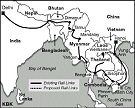
Development of the northeast is thus integral to India’s policy on Myanmar. North East is a corridor and a transit route to Southeast Asia. Infrastructure building tops the priority. A big project already under way is designed to turn the Kaladan River into a shipping route, linking Mizoram to Myanmar’s port of Sittwe, which India is helping develop. India has also agreed to upgrade an extensive network of roads and bridges in Myanmar that would effectively connect the Northeast (and the rest of India) to Thailand as soon as 2016. Both sides are also exploring the possibility of setting up train routes through the country. Facilitating border transit would make the Northeast a gateway to Myanmar --a potential boon for trade as well as tourism.
India's north eastern states and Myanmar should be the main target markets of many products manufactured in the SEZs to once again make India’s north eastern states and northern Myanmar a natural economic zone, which they historically were, providing a sustainable economic life line to the north-eastern states. But this would require enormous fast-paced infrastructure development on the Indian side of the border with Myanmar which is primitive and is hardly geared to handle the traffic that would be generated due to the Kaladan project.
Manipur, shares a 398-km border with Myanmar. But more importantly the border town of Moreh has been a traditional trading hub with Myanmar and therefore has vast potential to become a major export centre from India for the South East Asian region. Here’s why: According to available statistics, bilateral trade between India and Myanmar more than doubled between 2005 and 2010, expanding from US$557 million to $1.2 billion, most of it through Moreh. Disappointingly though, it pales in comparison to the bilateral trade between China and Myanmar which in 2010 amounted to an estimated $3 billion.
In this context, the Trilateral Highway that aims at connecting India’s North-east with Thailand via Myanmar becomes important. It could mitigate the disadvantages of landlocked North-east India. It is a component of the Asian Highway, which is scheduled for completion by 2016. Proposed and implemented by the United Nations Economic and Social Commission for Asia and Pacific (UNESCAP), the Asian Highway Project includes the Asian Highway 1 and 2 that would pass through the North-east, connecting India with its easterner neighbours. Thus, with the coming of the Asian Highway, Myanmar will become the point of convergence as well as the linking route between India and the other South-east Asian countries. That, in turn, will lead to the creation of more secure and safe living spaces for the populace residing on either side of the border.
But there are apprehensions too. Local people in the Northeast fear that the opening of the Asian Highway and absence of inadequate enforceable regulation on immigration, illegal migration into the region may increase manifold.
It is the failure of actualizing intent that rankles in Manipur. That, combined with multiple frustrations emanating from prolonged bouts of economic blockades, a state administration in terminal atrophy and the continued and unchallenged writ of underground armed groups, has left the people despondent. It is this hopelessness that the Centre and State government must work hard to overcome. For that, a solution to long-standing ethnic insurgencies has to be found in double-quick time.
Now is the time to press for peace and security in Manipur since politics in Myanmar are undergoing a dramatic change. With the junta taking tentative steps towards genuine democracy and showing signs of warming towards India, New Delhi must seize this moment to establish lasting trade and cultural ties with its eastern neighbour. But before India can play a larger role in Maynmar, it needs to fix Manipur’s broken socio-political landscape.
Manipur and to a lesser extent Nagaland must take advantage of the liberalisation that is taking place in Myanmar. But that potential can be fully realised only if New Delhi starts looking at Manipur as an important starting point in India’s ‘Look East’ policy instead as a dead end of the country’s road network.