
Showing posts with label ceasefire. Show all posts

Monday, January 21, 2013

India’s Pendulum Policy on Pakistan


Sushant Sareen 
(Senior Fellow, VIF) 

More than anything else, experience should inform Indian policy-makers and the legion of analysts and commentators on Indo-Pak relations about the peril of using words like ‘irreversible’ and ‘uninterruptible’ to describe the extremely accident-prone peace (more likely, engagement) process between the two South Asian neighbours and adversaries. Even when superficially everything seems to be going well between the two countries, the state of bilateral relations remains quite fragile. A relatively minor incident has the potential to get blown out of proportion and unleash an emotional storm that results in a regression of any forward movement or progress that might have preceded it.

There was of course nothing ordinary about the recent events along the Line of Control (LoC) in Jammu and Kashmir. Had it been only a ceasefire violation by Pakistan, it would have been treated as something of a routine nature. Even the death of an Indian soldier as a result of cross-LoC firing would also have probably not been hyped up by the Indian media. The Indian Army would have taken such an incident in its stride, with the proviso that it would return the favour to the Pakistanis in due course. But a raid across the LoC by Pakistan Army regulars, and worse, the medieval barbarism of mutilating corpses of Indian soldiers and beheading one of them, crossed all the red lines. 

Not surprisingly, once such an outrageous and unacceptable action became public knowledge, the incident acquired a life of its own, with the media, politicians, talking-heads and columnists all contributing to the rage in the country, and eventually forcing a very reluctant government of India to toughen its stand against Pakistan. Across the Radcliffe Line, however, the incident didn’t find the same salience. To an extent, the underplaying of the incident by the Pakistani media and their political class is an indication of how much the focus in Pakistan has shifted away from Kashmir. 

A decade or so ago, the Pakistani press would have gone hysterical. But now there are so many other things happening – around the time of the LoC violation, there was a huge bomb blast in Quetta killing over 100 Shias, in Islamabad a cleric who had parachuted in from Canada was on the verge of conducting a Long March to force a complete political overhaul, the provincial government in Balochistan was being dismissed, around 20 soldiers were blown up in North Waziristan, the Pakistani Taliban were proposing a ceasefire, political confabulations and manoeuvres in preparation for the forthcoming general elections were in full swing etc. etc. – that Kashmir, and by extension India, have perforce been put on the backburner. 

This, of course, doesn’t mean that Pakistan has forgotten all about Kashmir; only it is no longer a priority like it was until some time ago. The Pakistani strategy for now seems to be to keep probing India’s defences along the LoC, occasionally try and push in terrorists and infiltrators by giving them covering fire and generally not let things settle down in J&K. It is also important for Pakistan to keep reminding India to not think that Pakistan is a pushover because it is so embroiled in very serious internal crisis. While an increase in tension along the LoC suits Pakistan because this gives it the opportunity to try and once again convince the international community that the road to Kabul runs through Kashmir, it is unlikely if Pakistan would like to provoke an outbreak of hostilities along the LoC and risk a complete breakdown of the ceasefire agreement. 

For its part, India too would like to avoid a resumption of the shooting match and artillery duels across the LoC, partly to avoid unnecessary and undesirable international attention to the Kashmir issue and partly because relative calm along the LoC is helping in normalising the situation in Jammu and Kashmir. Chances, therefore, are that things will settle down on India’s western front after the latest flare-up. The DGMO’s of the two countries seem to have indicated as much. India will make a show of toughness to satisfy public opinion – for instance, the PM’s statement and the Army Chief’s presser – and for a few weeks keep the engagement process with Pakistan on the hold. But it will be back to business as usual after things cool down, that is until the next flare-up when the entire cycle will repeat itself. 

There is a slim possibility that something good might emerge from this incident. The increasing violations of the ceasefire by Pakistan over the last couple of years, which until now have been more or less brushed under the carpet, might receive greater focus in the talks that have been proposed between the two governments. Pakistan would certainly try to push through its proposals for conventional CBM’s along the LoC, which India has so far rejected. At the same time India will get the opportunity to lay down new procedures to ensure that there is peace and tranquillity along the LoC.

On the more substantive issue of the state of relations between the two countries and the principles on which India needs to formulate its Pakistan policy, there are lessons to be learnt from the latest spat between India and Pakistan. The one major take-away of this incident is the fickleness of diplomacy conducted in full public glare and also of diplomacy that seeks to benefit on the backs of greater interaction between the peoples of the two countries. In other words, depending too much on the so-called people-to-people relations to push forward the engagement process with Pakistan is a strategy fraught with consequences which are not in the control of the two States and their establishments. 

The people of the Indian subcontinent are very emotional, something that can be of great advantage when things are all sweet and honey in giving a fillip to the engagement process; but when things go bad, these same emotions can swing things in the other direction by generating pressures that governments find too onerous to bear. When public opinion turns hostile on a foreign policy issue like Pakistan, it is quite natural for any government to get swayed by the emotional outpouring of an outraged public. The point is that when people and their emotions get involved in determining the pace and direction of a foreign policy issue, it results in what can be called a Pendulum Policy in which relations with another country swing from one extreme to another. This is exactly what was on display after the LoC incident.

Just a couple of days before the LoC violation, Pakistanis were being feted in India. The TV networks and newspapers were going overboard in covering the cricket series between the two countries. Trade and travel were the new buzzwords. There was excited anticipation of the new visa regime, including the visa on arrival facility. Businessmen were going to and fro striking deals, holding exhibitions and what have you. Pakistani artistes were being invited for live performances and participating in TV music, game and reality shows. Then suddenly the pendulum swung the other way. Hockey players were sent back. Singers and actors were no longer welcome. The Indian bureaucracy suddenly discovered a lacuna in the visa on arrival facility and put it on hold. The trade along LoC came to a standstill. Visitors to either country started making a bee-line for going back home. Some politicians started baying for blood and demanded breaking off relations and waging war. In short, from the hyperbole of Aman ki Aasha, the two countries swung to the other extreme of Aman ki Ashes! 

This is hardly the way to conduct diplomacy, even less so by a country with ambitions to play a role on the global stage. Surely, for two nuclear weapons states to behave in such an emotional manner is rather strange and unseemly. A large part of the blame for such pendulum swings rests on the government. What some analysts defend as the policy of strategic restraint is perhaps more appropriately described as a policy of strategic fuzziness and strategic irresoluteness, aptly summed up in a recent article by the former RAW chief, Vikram Sood, who asks “why are we talking to them [Pakistan], with whom, about what, to what end and for how long?” It is precisely because of this strategic fuzziness that is guiding India’s Pakistan policy that the government hasn’t been able to convince a substantial section of the public about its approach towards Pakistan. Add to this the glaring inability of the current dispensation to understand the nature of the beast called new media – electronic, social, cyber, even print – and try and manage the information flow so that it always has a handle over the situation, and it is no surprise that the entire edifice of the government’s Pakistan policy has come crashing down. 

Perhaps the time has come for India to reduce if not remove the emotional quotient that underscores its Pakistan policy. India’s Pakistan policy should not be guided by the heart, but by the head. This means that instead of an ad hoc policy based on a hope and a prayer that ultimately good sense will dawn on the Pakistani establishment, India needs to have a well-structured policy which is based on facts and not emotions. Rather than harbouring silly notions of forging friendly ties with Pakistan – relations between States are based on interests and friendship is incidental, at best a by-product of these interests – India should adopt a clinically professional approach towards Pakistan in which emotions are subjected to interests and not interests to emotions. In other words, have a relationship without wanting to get related. 

This means that while India should listen to all the sweet nothings that come its way from Pakistan, the substance of relations should be based on actions and not empty words being cooed into India’s ears by Pakistan's leaders. There are always lessons to be learned, even from an adversary. Pakistanis never tire of saying that only Allah knows about the intentions (or if you will, mindsets) of people. Therefore, instead of falling for or looking for changed mindsets in Pakistan, as some retired diplomats turned politicians exhort India to do, let Pakistan’s actions inform us of their changed mindsets. Until now, Pakistan’s actions on the ground really give no indication of either a changed mindset or even a paradigm shift in its approach towards India. In the meantime, keep your powder dry because you never know when you might need to use it to let the adversary know that it crosses India’s red lines at its own peril.

Wednesday, January 16, 2013

LoC Ceasefire Violation: Talking Peace only to Undercut The Dialogue by Other Means


Sushant Sareen 
(Senior Fellow, VIF) 

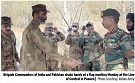
The flag meeting between the local Indian commander and his Pakistani counterpart has concluded in an utterly predictable fashion: India has protested the repeated violation of the LoC ceasefire by Pakistani troops and strongly took up the issue of barbarity displayed by Pakistani soldiers who crossed the LoC, killed two Indian soldiers and mutilated their bodies, carrying away the head of one soldier as a trophy; Pakistan has brazenly denied all the Indian charges and hurled counter-accusations at the Indians. 

Despite this talking at each other, the flag meeting could possibly have achieved the limited purpose for which it was being held viz. cooling down things so that hostilities don’t spiral out of control. Of course, how long the temperature remains lowered is another matter altogether. Sooner or later, efforts will be made from the Indian side to even the scores – the morale of the troops who are seething with rage over the savage actions of Pakistani soldiers depends on this. As far as the Pakistanis are concerned, they could well violate the ceasefire again, either to push in infiltrators and terrorists or in response to an Indian retaliation, or even in pursuit of some larger strategic game-plan which could very well have been the reason why tensions were ratcheted up in the first place. 

Basically, there are two possible explanations for the cross-LoC adventurism by the Pakistani forces at this stage. The benign explanation is that it was a routine ceasefire violation which spiralled out of control. In other words, it wasn’t part of any premeditated plan. Once the firing started, the two sides went up the escalation ladder with no easy way of defusing the situation because of political compulsions of all the main players. The civilian government in Pakistan is already coming under pressure of the Islamists and the military establishment for going soft on India and opening up trade and relaxing travel between the two countries. With general elections round the corner, the civilian government in Islamabad doesn’t want to appear as having backed down from giving a muscular response to an alleged Indian provocation along the LoC. 

The military leadership in Rawalpindi is also facing dissension within its rank and file for re-engaging with the Americans and opening up NATO supply lines post the Salala incident in which 26 Pakistan Army soldiers were killed in bombing by US aircraft in November 2011. For the Pakistan Army chief Gen Ashfaq Kayani to now appear as adopting a pusillanimous approach towards India will be quite disastrous. What is more, the Pakistan Army probably feels that it needs to send out a signal to India to not think that it is on its knees because of the myriad problems within Pakistan. In other words, the Pakistan Army wants to convey that it still has a lot of fight left in it and India shouldn’t think it can trifle with Pakistan just because it is in a tight spot on both the western front and internally. 

The predicament of the Indian political leadership is no less. Already seen as a weak, vacillating and extremely corrupt and incompetent government which is also seen as bending over backwards to appease Pakistan, the UPA-II finds itself in an unenviable position. It doesn’t want hostilities along the LoC to spread and would like to cool things down but without being seen as having thrown in the towel. Adding to its problems is the seething rage in the armed forces which cannot tolerate the thought of letting the extreme provocation by the Pakistan Army go unanswered. The manner in which the Indian government is trying to resolve the matter is by playing good cop – the political leadership playing down the incident and taking a soft approach – and the military leadership talking tough to cool down the soldiery – the air chief talking about ‘other options’ and the army chief warning of an ‘aggressive’ response to future violations of ceasefire and assuring his troops that India will respond to the outrage of mutilation of its soldiers at a time and place of its own choosing.

The bottom-line as far as the benign explanation goes is that neither side wants things to go out of control and the ceasefire to collapse. Despite India taking the issue of the treatment meted out to its soldiers extremely seriously, it doesn’t consider the matter to be of a level over which it is willing to either suspend the dialogue with Pakistan or start a general shooting match along the LoC. Of course, the incident has once again laid bare Pakistan’s treacherous conduct – talking peace and cooing sweet nothings on the one hand and displaying barbarity and indulging in unprovoked firing on Indian soldiers on the other hand. But India has somehow come to expect this sort of treachery from Pakistan and at least the current dispensation is more than happy to live with it. 

Before we touch upon the second and more plausible, if also more sinister, explanation of the entire LoC affair, it is important to disabuse ourselves of the nonsense that the Pakistan army is a professional and modern army which doesn’t engage in the mutilation of corpses of its adversaries. The fact of the matter is that despite all the trappings and traditions of the old British Indian army, the mindset of the Pakistan army is that of a medieval Islamist or Jihadist army. The only difference between the Pakistan army and its illegitimate offspring, the Taliban, is that the former is a uniformed force while the latter is not. None other than the former leader of opposition in Pakistan, Maulana Fazlur Rehman, has revealed that the Pakistan army would hurl living Taliban fighters out of helicopters flying from a height of a 1000 feet and more to instil fear and terror among the Taliban ranks. During the 1990’s, Pakistani Urdu press were full of stories and pictures of beheaded Indian soldiers which were displayed as trophies by the jihadist proxies of the Pakistan army. 

Apart from the mutilation of Limit Saurav Kalia and his men during the Kargil conflict, there is also the incident of Gen Pervez Musharraf felicitating the terrorist commander Ilyas Kashmiri after the latter presented him with the severed head of an Indian soldier. A former Indian general has revealed that during the 1965 operations in Chammb, the Pakistan Army severed the ears and noses and even genitals of dead Indian soldiers. And for anyone to suggest that in this latest incident, it was perhaps some jihadist force which carried out the mutilation is nothing but an apology, if not an alibi, for the Pakistan Army. The simple fact is that given the saturation presence of the Pakistan Army along the LoC, it is inconceivable for a jihadist force to operate without the permission and assistance of the Pakistan army. Therefore, there is no way that the Pakistan Army can be absolved of this dastardly and barbaric act which was carried out as part of a larger game-plan to deliberately increase tension along the LoC and the Eastern front.

This is where the second and more sinister explanation comes in. Ever since 9/11 and the subsequent US-led NATO occupation and operations in Afghanistan, Pakistan has been trying hard to convince the Western bloc and the international community that the road to Kabul goes through Kashmir. But until now, this ploy hasn’t received much traction, partly because India reacted very emphatically against drawing any such linkage and partly because Pakistan’s own double-speak and double-game in Afghanistan lost it all support and sympathy of the West. Now however, with the Afghan endgame unfolding – ISAF troop withdrawals from Afghanistan moving into a high gear, reconciliation moves with the Taliban gathering pace and the US desperate to leave behind some semblance of order before it quits Afghanistan – Pakistan senses another opportunity to draw the attention of the West to solve the Kashmir issue in accordance with Pakistan's wishes and holding out the threat that unless this is done Pakistan would be forced to divert its focus on the eastern front with India leaving the Western forces in the lurch in Afghanistan. The perceptible US tilt in favour of Pakistan is also emboldening the Pakistanis to indulge in some sabre-rattling and indeed adventurism on the eastern front under the belief that if things get heated up on the Indian front, the US and its other Western allies will be left with no choice but to intercede on Pakistan's behalf against India. 

The timing of the latest provocation along the LoC also makes sense because Pakistan is holding the presidency of the UN Security Council in January and tensions in Kashmir allow Pakistan to try and internationalise the Kashmir issue at the UN. The alacrity with which the Pakistani officials proposed involving the UNMOGIP to investigate the entire incident suggests premeditation behind the cross-LoC raid. Not only has the Pakistan foreign office been trying hard to get the UN involved, it has also launched a diplomatic offensive with the American and EU ambassadors to internationalise the issue. 

As far as India is concerned, it needs to operate at two levels to scotch this Pakistani move. India must react strongly to any provocation along the LoC, something that the Army Chief Gen. Bikram Singh has indicated in his press conference. At the diplomatic level, it is important that India convey to the US that while we understand their compulsions in Afghanistan and the fact that the Americans will want to protect their interests in the Af-Pak region by reaching out to Pakistan, India has also its own vital interests to protect and there are certain red-lines the breach of which India will never allow. The US cannot expect India to surrender its vital interests for the sake of the Americans. Once India makes clear to the international community where it gets off, the so-called pressure that is likely to be brought on India will disappear. 

India needs to keep in mind the lesson of Kargil. Once hostilities started, the international community tried to pressure India against responding forcefully to Pakistani aggression, holding out assurances that they will try and resolve the matter. Had India agreed, the Pakistanis would have been still sitting on the heights they occupied with the international community twiddling its thumbs. But once India responded with force and refused to listen to the self-serving advice of the international community, the boot was suddenly on the other foot and Pakistan was seen as the aggressor and all the international pressure was then on Pakistan to vacate its aggression. This then is the reality of international politics and soft-peddling on issues of vital interest will only lead to surrender of these interests.