Showing posts with label Pentagon. Show all posts

Wednesday, April 10, 2013

Mining Concessions in Afghanistan Take Centre-Stage


Monish Gulati

Introduction

Afghan President Karzai during a visit to the Helmand province on 12 March continued, from the week before, his criticism of the US/NATO intentions in Afghanistan. He made a pointed reference to the US, claiming that it was ‘eyeing’ Afghan minerals and warned that Afghan government is aware of their intent. "Americans have asked Afghans to give them Afghanistan's mining contracts … from the start they have been doing their investigations and finishing their photography. But now they understand that we know about them".1

Karzai’s assertion may be high on rhetoric and less on substance as US commercial interests in the Afghan mining sector are, at present, far and few. However, developments in the Afghan mining sector match the hectic pace of events in the country’s surcharged political space. It is not Afghanistan’s immense mineral riches that are causing the excitement, but how the mining sector is being looked at in the present circumstances. An entire range of stakeholders see Afghanistan’s mineral deposits as a panacea for the country’s current problems. Mining, as the prospects of large international aid packages are dim, is the quick fire solution to secure finances to pay for country’s armed forces, draw investors, build infrastructure, create jobs, bring in industrial growth and development and alleviate poverty. The Afghan Ministry of Mines has identified 1,400 mines in different parts of the country and it is expected that the income from the mining sector will reach over US $1.5 billion to cover nearly half of the government’s budget by 2016.

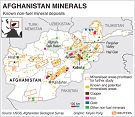
The Afghan government concurs with the joint assessment of the Pentagon, the US Geological Survey (USGS) and USAID, that Afghanistan possess “previously unknown” and untapped mineral reserves including huge veins of iron, copper, cobalt, gold and critical industrial metals like lithium with an estimated worth of one trillion dollars. One estimate details this as Iron: $421bn, Copper: $274bn and Gold: $25bn besides other rare earths and minerals. According to some analysts the likely royalties and taxes that could be generated in Afghanistan could reach $3 trillion.2 The World Bank estimates that if the situation stabilises mining and agriculture together could raise annual growth rates by 3 to 4 percentage points between now and 2025.

It is true that the US, as was the case with the Soviet Union before it, has extensively mapped and estimated Afghanistan’s mineral deposits. Detailed Soviet exploration had produced excellent geological maps and reports that listed more than 1,400 mineral deposits, including about 70 of which are commercially viable. The Soviet Union subsequently committed more than $650 million for resource exploration and development in Afghanistan, and the proposed projects included a smelting complex for the Aynak mines that was to produce 1.5 million tons of copper per year.

Afghanistan has become the first country whose surface minerals have been mapped from the air by "hyper-spectral imaging”, in which reflections of light from the ground are analysed. As different minerals - as well as snow or vegetation - reflect specific colours, a “spectral mineral map" can be created. The Afghan map comprises more than 800 million data points corresponding to an area of 440,000 sq km, about 70% of the country. The USGS public release of the data includes two maps: one of iron and iron-bearing minerals, and other of minerals principally containing carbon, silicon, or sulphur. The survey was jointly funded by the US Department of Defense's Task Force for Business and Stability Operations (TFBSO) and the Afghan government.3

One of the recent developments in the Afghan mining sector is the decision of the UK government on 06 March this year, to put in its bid for Afghanistan’s untapped mineral wealth, through a three-year, $15 million (£10m) plan to support mining and oil and gas projects in the country.4 David Cameron announced the funding programme to aid the Afghan Ministry of Mines at an event at Downing Street where dozens of UK investors and mining contractors were in attendance. British mining companies welcomed the announcement and called for a level playing field to compete.

The award of the 30-year Aynak copper mine contract to a Chinese consortium in 2007 had come under suspicion of bribery and kick-backs. The World Bank had appealed for future Afghan mining concessions to be better regulated and more competitive; UK's support is aimed at improving that process. It was felt that enhancing Afghan technical competence and ensuring transparent processes in the mining sector would provide a more conducive business environment. The decision, coming after the recent Afghanistan-Pakistan-UK trilateral meet in London, is significant for Afghanistan, particularly its mining sector. In an era of fiscal constraints and uncertain Afghan security environment, the move sends a positive signal.

The second important development has been the preliminary approval by the Afghan Council of Ministers of the Mines Law. The approval, which had been previously stalled because the Council of Ministers thought the law gave foreign companies too much space to exploit country’s natural resources, is an important step for Afghanistan to attract large investors in the mining sector. Pending approval of the Mines Law no mining agreements were being signed by the Afghan government even though it had identified ‘preferred bidders’ for a number of projects. Earlier the Mines Law had also called for separate bids for exploration and mining in an area, which it was felt was not favourable to the agency/company carrying out the exploration process.5

There is a view that the huge investment already made by companies from China and India reduces the opportunity for others. The two major mining contracts awarded in Afghanistan have been for the Aynak copper and Hajigak iron mines, given to Chinese and Indian consortiums respectively. Contrary to the common perception the going has not been easy for these consortiums.

Chinese Mining Concession

The Chinese consortium led by the Metallurgical Group Corporation is developing a massive copper mine at Aynak, to which they were awarded the rights in 2007. As per a report by The Wall Street Journal the Chinese are struggling to exploit the untapped mineral resources due to security issues. In December 2012 Afghan Minister of Mines Wahidullah Shahrani told the media that all but about 20 of the 170 Chinese workers who fled the Aynak copper mines have returned due to improved security.

Aynak mines have an added complication with history. Copper mining at Aynak goes back to the Buddhist era, 2,000 years ago, and before any new mining activity can be undertaken archaeologists need to complete the excavation of the site. Officials of the United Nations Educational, Scientific and Cultural Organization (UNESCO) said that historical relics discovered at the Mes Aynak site are of great significance and the site should be included in World’s Historical Heritage list.6 Consequently the Afghan Minister of Mines recently announced that the extraction of copper from Aynak copper mine had been postponed for one year due to discovery of historical relics at the site and existence of land mines in the area.7

Indian Interest

The Afghan Iron and Steel Consortium(AFISCO), is a the SAIL-led consortium of three state-run and four private Indian companies that was selected in November 2011 as the ‘preferred bidder’ for blocks B, C and D of Hajigak mines in Afghanistan’s Bamiyan province. The Hajigak blocks are estimated to have reserves of around 1.28 billion tonnes of high-grade magnetite ore. A MoU was signed in April 2012 for the comprehensive project, which included a 2.6-mtpa steel unit based on the mined ores.

Since then the project has run into tough times. The Afghan mines ministry has said that AFISCO risks losing its mining license for the $10.8-billion integrated Hijigak project if it fails to meet production targets or does not commence exploratory projects within six months of the license being granted. The Ministry has also put a cap on iron ore exports at six million tonne per annum. AFISCO is of the view that a six month project start-up stipulation may not be practical or feasible as investments in large projects, particularly in the mining and steel production facilities, are extremely challenging in the Afghan environment. The Afghan Government on the other hand feels that Indian companies are not particularly reputed for timely project implementation, particularly in the mining sector and hence its insistence on laying down clear timelines for the Hajigak project. 8

During the past one year, the Afghan Government after negotiations has agreed to provide access to 6 million tonnes of coking coal, 5 mtpa thermal coal and around 3 mtpa of flux assets to AFISCO for the project. In December 2012, the Afghanistan Mines Minister had told the Indian media that a comprehensive agreement is expected to be signed in January 2013.9 However the agreement is yet to be signed. A meeting to discuss the important aspects of the project was scheduled to be held in Kabul last month. Earlier, another consortium of Indian companies had failed to successfully bid for the Shaida Copper mines in Herat, which was awarded to Afghan Minerals Group (AMG) .10

According to AFISCO sources, there are apprehensions over viability of the Hajigak project. It is estimated that exploration and mine-development could cost some $2 billion. The Indian consortium will have to manage the Rs 40,000 crore required to explore the mine and set up a steel plant as the Finance Ministry has turned down their demand to part finance the project. The consortium wanted an assistance of about Rs 3,000 crore from the government either through a credit line or in the form of a soft loan (for a 30-40 year period). It had also sought a grant-in-aid of about Rs 8,200 crore for building a 2x400 MW power plant and 200 km road network. Financial assistance of Rs 16,000 crore also sought for building a dedicated rail corridor between Bamiyan and the Iranian port city of Chabahar.11

The Steel Ministry in late December 2012 had asked the consortium to arrive at the viability gap figure for the Hajigak mining project. The consortium has also to consider the details of agreement, yet to be signed with the Afghan authorities. However with the recent rekindling of Indian interest in developing Chabahar port the Hajigak project may receive government support at least for the transport linkages.

In a country that involves high risk, developing a new mining sector is a complicated affair. This is despite the compelling requirement to open up the sector. In times of global economic uncertainties not only is project finance difficult to obtain but also the market potential of the commodity being mined becomes fluid as consumption patterns fluctuate. The uncertain nature of security and political transition in Afghanistan makes planning and investing a tricky affair. At the same time any US decision to enter the Afghan mining sector would not surprise most analysts considering the ‘blood and treasure’ it has invested in the country.



Thursday, July 12, 2012

Indo-US Relations and Balance of Power


Kanwal Sibal
Member Advisory Board, VIF

The direction of our strategic ties with the US has come under renewed focus with US Defense Secretary Leon Panetta’s visit to India on June 5-6 and the third round of the Strategic dialogue between India and the US at the Foreign Minister level at Washington on June 13.

During his visit to Delhi after visiting the US Pacific Command Headquarters in Hawaii, Singapore, Cam Ranh Bay and Hanoi in Vietnam- an itinerary that speaks for itself- Panetta spoke about the new US defense strategy of “rebalancing” toward the Asia-Pacific region by expanding US military partnerships and presence in the arc extending from the Western Pacific and East Asia into the Indian Ocean region and South Asia. A few days earlier at the Shangri-La dialogue in Singapore he announced that the US will shift 60% of its naval fleet, including as many as six aircraft carriers, to the Pacific Ocean by 2020. The Pentagon has also referred to India as a link India between East and West Asia and a net provider of security from the Indian Ocean to Afghanistan and beyond.

The US seems to have concluded that there is no political down-side to identifying India openly as a crucial element in this new defence strategy. In its judgment neither the Indian government nor the majority of public opinion will recoil at being so visibly enlisted as a defence partner of the US in its expanded military role in Asia. The US is aware of the degree of controversy generated in India by the Indo-US nuclear deal, in terms of its ramifications for India’s strategic independence. It is cognizant of Indian sensitivities about unwanted messages going out to Russia and China from the degree of India-US defence engagement. Yet, Panetta has not hesitated in Delhi to describe India, with its size and military capability, as a lynchpin in this US strategy.

General Dempsey, chairman of the US Joint Chiefs of Staff, has subsequently underlined India’s enormously important geostrategic location on the sea lanes of communication from the Mid-east to the Pacific. Noting that India will soon have the second largest fleet of in the world with an expanded reach and ability to rapidly deploy, Panetta sees an India-US partnership in assuring a peaceful Indian Ocean region, besides seeing India’s voice and involvement in Southeast forums such as the ASEAN Defence Ministers Meeting Plus as being critical to prevent and manage regional tensions.
Panetta spoke publicly in Delhi about India-US defence relationship becoming more strategic, practical and collaborative through regular defence policy exchanges, military exercises that cover all functional areas of naval warfare, prospects for advanced R&D, sharing of new technologies and joint production of defence equipment, as well as defence sales and intelligence sharing.

In understanding the import of these statements one needs to sift reality from future possibilities. Military exercises undoubtedly constitute a very substantial element of growing India-US defence ties, but these precede the declaration of a strategic partnership between the two countries. US defence sales to India have grown from virtually nothing to US $ 8 billion in the last five years or so, which is remarkable progress. It is doubtful if the content of defence policy exchanges with the US is substantial, not the least because the integration of defence and foreign policy, unlike in the US, is inadequate in India, which is a big handicap in such discussions with a global power like the US. Collaboration in advanced R&D, sharing of new technologies and joint production will be, in Panetta’s own words, “over the long term”. He has acknowledged that moving ahead will require hard work and breaking down bureaucratic hurdles on both sides.

All these developments signify that space now exists for us to play an enhanced international role, which we seek. We are being wooed by the US, at times quite unabashedly, for political, economic and military reasons. The US has taken a more forward looking position on India’s permanent membership of the Security Council, without, however, taking any practical step so far to push for this at the international level. It has committed itself to support India’s membership of the various non-proliferation and technology denial regimes such as the NSG, MTCR etc, but this agenda too is languishing in terms of effort at accomplishing it. The Joint Statement issued at the end of the Strategic Dialogue did not indicate any new initiative in this regard. The US is exhorting India to invigorate its Look East policy. Already a trilateral India-US-Japan political dialogue has been put in place, apart from trilateral naval exercises, a development welcomed in the Joint Statement issued at the end of the Strategic Dialogue in Washington.

This Joint Statement is all-embracing in scope, covering virtually every aspect of the bilateral relationship- political, strategic, security, defence, intelligence, nuclear cooperation, space, trade and investment, energy, science and technology, higher education and empowerment, as noted by Minister Krishna. For Secretary Clinton closer ties between the people, private collaborations, and public-private partnerships is at the center of the Strategic Dialogue, which would explain why issues that can be hardly classified as “strategic” find place on the agenda. Our strategic dialogue with other key countries is much more restricted in scope, focusing primarily on political, security and defence related issues, of bilateral, regional or global interest.
The announcement by Clinton just before the commencement of the strategic dialogue exempting- for 180 days- India from sanctions on the ground that India had diversified its sources of crude imports and reduced oil purchases from Iran as required by US legislation avoided a potentially major political blow to efforts to build a strategic understanding between the two countries. The avoidance of such a step shows nevertheless the fragility of such understanding, as reduced supplies from Iran is the result not of a political decision by India but practical compulsions, but this gave the US a way out from following the pernicious logic of its unilateralist policies.

The road blocks in the way of forging India-US collaboration in civilian nuclear cooperation continue to be a source of disgruntlement for US companies. The scant progress made in this area has been disguised by exaggerating the import of the announcement made to time with the Strategic Dialogue that a MOU had been signed between Westinghouse and the Nuclear Power Corporation of India (NPCIL) committing both sides to negotiate an Early Works Agreement for the preliminary licensing and site development work associated with construction of the new Westinghouse reactors in Gujarat, and the ongoing progress between General Electric-Hitachi and NPCIL on their MOU. The nuclear liability issue remains a problem for the US, as was mentioned in Washington.

Irrespective of whether the subjects discussed, progress in relations noted and projects of future cooperation envisioned can be veritably called “strategic” in content, some highlights of the dialogue in Washington can be identified. Both sides intend consulting with each other with regard to forums like the East Asia Summit, the ASEAN regional Forum and the ASEAN Defence Ministers Meeting Plus. India will support the US bid to become a dialogue partner with the Indian Ocean Rim Association for Regional Cooperation. Both sides-in an allusion to Chinese claims to the South China Sea-affirmed the importance of maritime security, unimpeded commerce, and freedom of navigation, in accordance with international law, and the peaceful settlement of maritime disputes. Significantly, any direct reference to the South China Sea has been avoided, obviousy with Chinese sensitivities in mind, though it is unclear why if other regions can be mentioned there is squeamishness with regard to these waters.

Noting that both countries have signed Strategic Partnership Agreements with Afghanistan, the intention to intensify their consultation, coordination and cooperation to promote a stable, democratic, united, sovereign and prosperous Afghanistan has been expressed in the Joint Statement. On regional connectivity through South and Central Asia, India seems to have desisted from openly endorsing the New Silk Road project proposed the US, with the two sides discussing only the “vision” of enhanced regional connectivity. The two have “reiterated that success in Afghanistan and regional and global security require elimination of safe havens and infrastructure for terrorism and violent extremism in Afghanistan and Pakistan”, a language that Pakistan is bound to have resented. This is half-satisfaction for us though, as safe-havens and the infrastructure of terrorism are mentioned uniquely in the context of Afghanistan and not India.

Cyber-security is now figuring more prominently on the bilateral agenda, with consultations having already begun between the National Security Councils of the two countries. The first bilateral exercise between the respective Computer Emergency Response Teams will be held later this year.

India has requested the US government to permit LNG exports from the US to India. This would be important in terms of India reducing its reliance on the Gulf countries and benefiting from the expansion of natural gas production in the US that will also give the latter considerable energy autonomy and affect the geopolitics of oil trade globally.

While at the governmental level any anti-China dimension to the India-US strategic relationship is pointedly denied, yet it is widely accepted that US overtures to India in general, and especially the encouragement given to it to intensify its ties with Southeast and East Asia, are part of US’s hedging strategy against an inexorably rising China.

The China issue is very complex as China does not merit being treated as a friend by either the US or India as both countries have serious strategic differences with it, and cannot be treated as an adversary either as both countries have productive ties with it in several spheres. In any case, China’s weight in the international system and the degree of its integration with it makes confrontation with it highly costly and liable to fail.

To attenuate negative perceptions, Panetta underlined in Delhi that as the United States and India deepen their defence partnership, both will also seek to strengthen their relations with China. The US, he said, welcomes the rise of a strong, prosperous and a successful China that plays a greater role in global affairs and “respects and enforces the international norms that have governed this region for six decades”- underlining the core aim of America’s new Asia pivot.

If Panetta chose to speak explicitly about the China context of India-US strategic ties, the China factor was side tracked at the strategic dialogue in Washington, with Clinton avoiding any comment on the subject. The subsequent State Department’s briefing was couched in re-assuring terms to the effect that China was discussed but not focused on, that both India and the United States wanted a good, strong engagement with China, and that their strategic partnership was not in way at China’s expense. It was stated that a zero-sum relationship with Beijing would have negative results. dampening the opportunities for a stronger, more prosperous Asia. To further disarm anti-Chinese interpretations, it was added that a trilateral dialogue with China had been mooted, with the hope expressed that it will be agreed to.

The Chinese would undoubtedly pay less attention to what is stated publicly by US and India about the larger strategic thrust in Asia of their developing partnership and more to its underlying implications for China. It cannot be lost on the Chinese that the US intends to be the central player in Asia to which economic, political and military power is shifting at the expense of the trans-Atlantic alliance. While maintaining a relationship of engagement and competition with China, the US would want to draw India to its side as much as it can, not only to have a combination of the world’s foremost power and an Asian power like India with all the potential attributes of China in terms of demographic, geographic, economic and military strength to balance that country, but also to prevent the development of a potential India-China axis, even if it seems unlikely at present.

The Chinese, even as they remain unyieding on core differences with India, do exhibit some concern through commentators and think tanks about an India-US axis in Asia. According to reports, on the day Panetta was in Delhi, the Chinese vice-premier Le Keqiang, who is expected to replace Chinese Premier Wen Jiabao, pledged to Minister Krishna in Beijing to “work together with India to maintain strategic communication, improve political mutual trust, and appropriately address disputes and safeguard the peace and tranquility in border areas to advance the bilateral relationship to a new phase.”
A Chinese analyst from a government sponsored think tank, commenting on Panetta’s wooing of India, has opined that “India was unlikely to get involved in any such containment policy on somebody’s behalf”, noting that India wants to be independent in making its own foreign policy while maximizing its interests. He also underscored that India’s interests lie in wider economic and cultural cooperation with China and spoke of “China’s opportunity to break up the US intention to contain China”. Chinese specialists are noting with satisfaction that both PM Manmohan Singh and Minister Krishna conveyed their reservations about the US “rebalancing” strategy to Panetta. China is pressing through these messages the sensitive points in Indian foreign policy thinking.

In actual fact, Panetta’s explicit statements on incorporating India into its Asia strategy did not evoke any sharp negative reaction in India at the political level, though some cautious, balancing comments were made and briefings given. A Defence Ministry release referred to the need to set up a security architecture in Asia at a pace that would be comfortable to all countries concerned. This could be construed as cautionary advice to the US not to make precipitatory military moves in the region and unduly alarm China. Unless India has consulted other Asian countries and is reflecting a large consensus amongst them that Chinese sensitivities should be kept in view by the US, proffering such advice may suggest that India is not comfortable with the pace the US is moving. Why we should feel concerned about Chinese reaction to security precautions being taken against an assertive China is not clear, especially as China’s strategic policies in our region damage us enormously.
In response to Le Keqiang’s gesture, Minister Krishna reportedly said that the Sino-Indian relationship is one of the most important bilateral relationships in the world, echoing, oddly, what the US Administration has said in the past about its relationship with China.

The US is now making a more realistic projection of its relationship with India even as its wooing of India appears too ardent at times. A confident US is always inclined to push while a diffident India is by nature cautious. Panetta recognized in Delhi that the two countries “may not agree on the solution to every challenge facing us, and we both face the challenge of political gridlock at home that sometimes prohibits advancing our broader strategic objectives”.

Clinton struck a similar note at Washington in remarking that “there is less need today for the dramatic breakthroughs that marked earlier phases, but more need for steady, focused cooperation” and effort to work “through the inevitable differences”. “This kind of weekly, sometimes daily, collaboration is not always glamorous, but it is strategically significant”, she said, adding that she looks at the totality of the relationship rather than denying the existence of differences. According to her, “the strategic fundamentals of our relationship are pushing our two countries’ interests into closer convergence”.

Minister Krishna introduced a note of caution even while playing up to the rhetoric by remarking that the India-US global partnership “could” be one of the most important or defining relationship of the 21st century. He acknowledged that “sometimes there are questions and doubts about the relationship”, but explained that “they are inevitable in something so unique and new”. That India and the US “should” (hedged language again) work towards a close relationship has been settled as a question, the Minister said while warning against complacency. The sense here is that the strategic partnership is work in progress and should not be considered a fait accompli, which is a signal to the US that it has to do more to meet Indian expectations and to other major powers that India is moving at a measured pace with the US.

Broadly speaking, India’s response to US overtures is crafted as well as it can be, as the diplomatic challenge it faces is very complex. India should not appear to be rushing to embrace the US strategy in Asia, though India’s need to put constraints on Chinese ambitions is greater than that of the US. India has less means to deal with these ambitions than the US has. We should not allow ourselves to be put in a position of having to make concessions in the future to ward off the pressures generated from China’s growing strength.

India has to defend its territorial integrity vis a vis China; the US wants simply to retain the upper hand against China. We should therefore establish a basis of cooperation with the US that neither sends a dampening signal to it nor is an enthusiastic endorsement of its strategy.

We should continue our engagement with China bilaterally and in regional and international forums, without forgetting that our real rival is China not the US. If we want to tactically send reassuring signals to China, even as we become partners with the US, we may do so, but what is important is that it should not be done in the belief that we need to equate our relations with the US with those with China as part of preserving our strategic autonomy.

Most of all, we must not take upon ourselves, as we did at Bandung, to do diplomacy on China’s behalf with others and help China appear less of a threat to the others than it actually is. Which is why, statements by us that the security architecture in Asia should move at a pace comfortable to concerned countries make little sense.

Strategic autonomy yes, strategic confusion no!