The science and business of government is what politics is all about.
In fact the dictionary meaning of politics is “The science or business
of government; moves and manoeuvres concerned with the acquisition of
power”. Politics is played by political parties and in a democracy it
is political parties which contest elections and which, if they are
fortunate enough to be favoured at the polls, form a government.
Therefore, in a democracy any group of people which wants to capture
power and thereby determine the manner in which a country will be
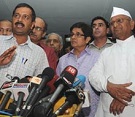
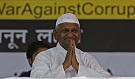
governed has to form a political party. Anna Hazare, who had taken up
the theme of fighting corruption and eliminating it, largely through a
law in this behalf to be enacted by Parliament, finding that the
agitational approach alone was not enough to win success, has now
decided to use the political road to power in order to achieve his
objective.
Before India embarked on its campaign for independence this country
did not have any meaningful political parties because the road to
government and to power lay not through the political process but rested
on the bayonets of an imperial power. One was either British; therefore
a ruler or one was an Indian whose principal task was to be governed by
his imperial masters. Here there was no room for politics or a
political party. No doubt there were movements such as the
revolutionary movement led by the Anushilan Party in Bengal, but this
was a pure campaign of terror whose ultimate objective was nihilism and,
therefore, this group did not really constitute a political party. Its
origin was the partition of Bengal by Lord Curzon, which it hoped to
undo by creating a situation of anarchy through terror. It suffered the
fate of all such movements, which was that the British security
apparatus penetrated its cellular structure and then destroyed it. This
was an excellent example of how a terrorist movement could be broken,
but in my view it did not constitute a political movement.
My contention could be questioned because on 28th December, 1885 the
Congress was born in Bombay through the initiative of Allan Octavian
Hume. This initiative had the blessing of the British Viceroy, Lord
Dufferin. Hume intended this party to be a group which would meet
under the chairmanship of the Governors of the Provinces as a type of
grievance court which could place before government issues relating to
India. However, the Viceroy wanted an Indian to preside over the
Congress so that it could place the Indian point of view before
government without inhibition. Hume was the first General Secretary of
the party and remained so till 1907. Lest it be understood that the
Congress at the time of its origin was a party fighting for
independence, it might be noted that in 1888 the President of the party
was George Yule, an Englishman, in 1894 it was Alfred Webb, in 1904 it
was Sir Henry Cotton, a retired ICS officer and in 1910 it was Sir
William Wedderburn, who had been Secretary to the Government of Bombay.
The early role of the Congress is best described in the words of
Louis Fischer in his book “The Life of Mahatma Gandhi”. I quote, “The
Congress was organised to channel popular protest into legal moderation.
But into the channel flowed the fresh waters of national revivalism…
The world theosophist movement … likewise fed that pride in the past
which constituted the foundation of the movement for national
regeneration.
Thanks in part to the unification and orderly administration of the
country by the British, Indian industrialists, Hindus and Parsees in
particular, grew rich and began to buy out their British partners. The
emergence of Indian capitalism and a new Indian middle class gave a
powerful impetus to the urge for self-government. Under these multiple
influences the Congress outgrew its collaborationist boyhood and became a
demanding youth”. Here it needs to be acknowledged that in the
conversion of the Congress from a group which petitioned the British
into a political party which became a formidable instrument for
organising the whole of India into a freedom movement, the greatest
credit must be given to Gopal Krishna Gokhale and to Bal Gangadhar Tilak
who coined the slogan “Swaraj is my birthright”.
The metamorphosis of Congress from a group representing Indian
interests into a political party whose objective was the same as that of
any modern political party, that is, the ousting of foreign rule and
then gaining power to govern the country, followed a long and tortuous
path. A comparison could be made with the African National Congress in
South Africa which also began as a group of people believing that the
white masters could be petitioned to recognise the existence of the
black population and then gradually turned into a political movement
which combined militancy with genuine politics and then culminated in
the elimination of apartheid from South Africa and its replacement by a
genuinely democratic polity. Because the Congress had a leader of the
stature of Mahatma Gandhi and ANC of the stature of Nelson Mandela the
transition of power from imperial rule in India to independent India and
from white supremacy to genuine democracy in South Africa could take
place without embitterment or hatred for the British in India and the
whites in South Africa. In this lies a lesson for those who want to
constitute new political parties in India, for example, Anna Hazare.
There seems to be a belief in the followers of Anna Hazare that because
theirs’ is a popular movement against corruption and if the movement
converts itself into a political party it will instantaneously be voted
to power. Thereafter it will then be able to use this political power to
abolish corruption. Fortunately politics is not like a packet of
Rasna, a flavoured powder which one dissolves in water to create an
instant cold drink. Politics, even the politics of revolution, is an
evolutionary process in which first there is an idea, then the idea is
converted into a seed, the seed into a seedling, the seedling into a
tree on which grow various branches which together constitute politics.
People who start a political movement need enormous endurance and
staying power if they want their ideas to mature into the tree of which I
have spoken.
Let us take the example of two revolutionary movements, that of Lenin
in Russia and of Mao-Tse-Tung in China. The seed of Marxist philosophy
was sown by Karl Marx in the latter half of the 19th Century. It was
the consequence of the horrors of the industrial revolution which
planted in Karl Marx’s mind an idea that the future belonged to the
proletariat and that could only be achieved through a total egalitarian
dictatorship of the proletariat in which ultimately the State would
wither away. This gave birth to the Communist Party which, after
intense struggle in Russia and in the midst of the total defeat of that
country in the First World War, resulted in the elimination of the
Tsarist regime and the establishment of the Soviet Union under Communist
rule. The objective of this political movement was the destruction of
the existing State in Russia, but it was not an anarchist movement
because its sequential objective was to establish the Soviet Union as a
dictatorship of the proletariat. There was no instant fix in the change
of the political and social order; it came at the end of a long, hard
struggle. Similarly, the Communist triumph in China in 1949 was the
result first of the Sun Yat Sen Movement in China in which the
Kuo-min-tang party established by him overthrew the old imperial order
and established a republic. Despite the interregnum of Chiang Kai-shek,
during whose regime the Kuo-min-tang descended into the depths of
corruption, Mao Tse Tung’s Communist Party struggled against the
government and this ultimately resulted in the Chinese Revolution of
1949. Unlike the Soviet Union, where Lenin and Trotsky heavily depended
on the urban proletariat, the Chinese Revolution was entirely peasant
based because the reality of China was that it was a predominantly
peasant based country. Mao’s genius lay in realising that dogmatic
Marxism which depended on the urban industrial proletariat needed
redefining in the Chinese context and here it is the peasants who
constituted the proletariat.
In India independence saw the Congress in power in the Centre and the
States, just as in Pakistan it was the Muslim League which gained
power. After Jinnah’s death and the assassination of Liaquat Ali Khan
the politics of Pakistan underwent a change. Multi-party democracy
virtually disappeared and despite its sporadic emergence from time to
time in various forms, the fact remains that in Pakistan it is the Army
which calls the shots. India continued in the democratic mould. The
Mahatma realised that the Congress was all powerful in India, it was in
government and could not, therefore, oppose government and, therefore,
Congress rule would degenerate into one party rule. No one-party rule
can be truly democratic. He fully appreciated that the Congress
consisted of many disparate elements which come together in the freedom
movement, including the powerful group of socialists. The cementing
force which held these groups together was power and this is the worst
kind of a bond because it only temporarily binds groups within a larger
whole which can ultimately only be destructive. He recommended that the
Congress should dissolve itself and new parties should be formed
according to their respective ideologies which could help democracy to
function. When this did not immediately happen the Mahatma tried to
create a group of Constructive Workers. They would not go into power
politics but would guide government and the people in the running of
government on truly democratic, nonviolent lines. For Anna Hazare and
his associates I would like to quote the words of the Mahatma who
said, “I do not want to take power into my hands, but abjuring power and
devoting ourselves to pure, selfless services of the voters we can
guide and influence them. It would give us far more real power than we
shall have by going into the government. A stage may come when the
people themselves may feel and say that they want us and no one else to
wield power. The question could then be considered”. Let Anna Hazare
not feel that he is the only crusader against corruption. This is what
the Mahatma had to say “There is so much corruption today that it
frightens me. Everybody wants to carry so many votes in his pocket,
because votes give power… Banish the idea of the capturing of power and
you will be able to guide power and keep it on the right path… There
are other ways of removing the corruption that threatens to strangle our
independence at its very birth”.
To return to the main theme of this paper, a multi-party democracy
needs more than one political party, but does not need and cannot
survive fragmentation of parties into tiny components, each with a
highly selfish agenda of its own. Therefore, before a new player
enters the political scene it must first identify its own ideology and
spell it out, first to its members and then to the people at large. The
Communist Party was born out of a Marxist ideology, the parameters of
which were created by Marx and the body of which was created by Lenin.
Karl Marx was the ideologue and Lenin was the person who gave substance
to the party. Fabian socialism in Britain grew out of an idea and the
originator of this dogma was the London School of Economics. Even the
Nazi party, or the National Socialist Party to give it its full name,
was born out of a somewhat confused amalgam of racist thoughts,
Nietzsche’s philosophy of rejecting the Christian compassion for the
weak and advocating the creation of the Ubermensch, or superhuman,
combined with an ill formed idea which was generally anti capitalist and
ultimately focused onto extreme anti Semitism. The point being made
here is that even the ultimate horror launched on the world by the Nazis
came out of some form of ideology. However, let me hasten to add that
this was an aberration and does not represent what I mean by ideology in
the context of politics.
From the ideology of a party emerge its programmes, aims and
objectives. Whereas these can be flexible to a contextual reality,
ideology must be based on firm foundations. Judged by the criteria of
ideology and ideology-based programmes, no political party in India
lives up to their ideal. Politics is a game of power and ideology is
what lends a direction to the purpose for which power will be utilized.
When Clement Atlee came to power as the head of the Labour Party in
Britain his programme, based on the ideology of socialism, was to make
available universal health care and education to all, to nationalise
major industry and to transfer from private ownership to the public
domain the major utilities and capital goods industries. Atlee’s
government proceeded to achieve its objectives with single minded
purpose and succeeded. That is the power of an ideology based
programme. By contrast in India, especially after 1967, almost all
programmes of all parties are based on expediency because the
objective is no longer to govern but to gain power and to use it for
self-aggrandisement. This means that even the existing parties are no
longer ideology based and, therefore, Indian politics has become
rudderless. That as a result of this India is fast becoming a victim of
non-governance does not seem to cause any worry or concern to any
politician or political party. I can think of nothing more cynical than
L.K. Advani’s recent statement that in 2014 India may face a situation
in which neither the BJP nor the Congress can form a government, that
some third party candidate will become Prime Minister and an extremely
weak coalition will be cobbled together, either with the support of the
Congress or the BJP, which will just not have the capacity to govern
India. As the senior most active leader of the BJP it was Advani’s duty
to suggest steps which could strengthen the major political parties and
thus enable either the BJP or the Congress to be sufficiently strong in
Parliament to form a meaningful government. I am afraid a leader of his
seniority and status cannot enjoy the luxury of making cynical
statements without suggesting a remedy.
In an earlier paper I have referred to what is happening to this
country because of the state of degeneration of our political class.
Now into the fray has jumped Anna Hazare with his motley group of
supporters whom he has now disowned. I myself was approached by a person
who is a former civil servant, whom I personally like, to join this
group and offer my candidature for Parliament. Fortunately I have had
the experience of a parliamentary election in 1984 which I narrowly lost
because the then Chief Minister, Arjun Singh, had heavily manipulated
the votes in two assembly segments where I have not served as an
officer. I am proud of the fact that I carried all six assembly
constituencies of Betul District where I had been DC twenty-five years
before the election. That, however, was a one time phenomenon only,
because I had no organisation, no money, no vehicles and the entire
election was fought by the students of the district and by people at
large who had fond memories of me as their D.C. I certainly do not have
the resources and energy to again fight such an election and I also
acutely realise that I retired from Service twenty-eight years ago and
I cannot expect people to fight an election for me on the basis of old
memories. I mention this because whatever its intentions, the Anna
Hazare group must realise that fighting an election calls for an
organisation, which we call a party. Even after totally eliminating the
corruption factor it should be understood by Anna Hazare that a
parliamentary constituency, especially a rural constituency, covers an
area of about ten thousand square kilometers and embraces at least eight
assembly constituencies. For the candidate and the supporters to
travel around the constituency and place their point of view before the
electorate requires fairly complex logistics, including ten to twelve
off road vehicles, their drivers, POL, maintenance, etc. A
parliamentary constituency has probably about five thousand polling
stations at each of which a candidate would need two polling agents to
look after his interests. These agents would have to be given some
small sum of money, say Rs. 100 each for the day of poll, for
refreshments and food. Taking into account the cost of travel and of
the polling agents’ allowance alone, a parliamentary election campaign
needs a minimum of rupees twenty-five to thirty lakh. Which honest
candidate from an ordinary background would be able to find this large
amount? That is where party funding comes in and this becomes the root
of all corruption. The very process by which Anna Hazare now wants to
eliminate corruption is the genesis of corruption. By all means go into
politics because that is a fundamental right of every Indian citizen,
but do so with eyes open and an acute awareness of what politics
requires.
At present Anna Hazare has no ideology at his command. Neither he
nor his colleagues understand dialectics, they do not have the
capacity to formulate long-term programmes, they have no clearly
enunciated objective other than the elimination of corruption and that,
too, through an Act, the draft of which has been prepared by Prashant
Bhushan and his father, Shanti Bhushan, together with some inputs by
their colleagues. The very act of drafting the Bill and then insisting
on its adoption by Parliament without changing a comma or full-stop is
aimed at completely undermining the democratic process as exercised
through Parliament and does not bode well for the future of any
political party to be set up by Anna Hazare. What will be the stand of
this party on economic organisation in India? Will the economy be based
on free market capitalism, will it be socialism or will it be a
continuation of the present mélange? How will the new party tackle the
problem of unemployment? How will it deal with questions relating to
energy, physical infrastructure, social infrastructure, the future of
education and health services, the policy relating to industry and a
future blueprint for agricultural development? In other words, what
will be the philosophy of government of this new party? I do not think
anyone has applied any thought to these issues. It would be a tragedy
if an anti corruption movement ultimately becomes a farce in which Don
Quixote, Anna Hazare, mounted on a spavined charger and accompanied by
his Sancho Panza, Arvind Kejriwal, goes careening across the plains of
La Mancha tilting at windmills. That is how I see the fate of the Anna
Hazare movement, for which I blame Anna himself. A novice at politics,
totally unable to fathom how complex a political organisation is, led by
the nose by unscrupulous former bureaucrats and half baked activists,
on whose bandwagon has now jumped V.K. Singh , I see Anna Hazare and his
laudable campaign to fight corruption disappearing without a trace in
the dreary desert sands of Indian politics. Gandhi understood politics,
used it to build a national movement for freedom, but then by choice
preferred to stand outside politics. Anna is the exact opposite.