Showing posts with label Kargil conflict. Show all posts

Monday, February 4, 2013

Stop Appeasing Pakistan


Satish Chandra 
(Distinguished Fellow, VIF)

The anger in India at the recent mutilation of its soldiers by Pakistani forces in J&K is natural and understandable. Quite unwarranted, however, are the calls for revenge and of internationalisation of the issue as also our feelings of surprise. The idea of a tit-for-tat response to the mutilations is an obvious non-starter given the Indian ethos which militates against such atrocities. Moreover, unlike the Pakistani Army which is essentially a jihadi outfit in uniform the Indian Army is much more professional with a code of conduct that makes such reprehensible moves unthinkable.

Going by our historical experience calls to haul Pakistan before the bar of international opinion, while more meaningful, do not hold much promise. In this context, one need only recall the manner in which the international community failed to address Pakistan’s aggression in Kashmir, its blatant involvement with nuclear proliferation, and its aiding and abetting several terrorist outfits. Moreover, today when the West needs Pakistan in order to facilitate its disengagement from Afghanistan it is most unlikely that the international community will bestir itself in order to address our concerns about Pakistan’s unacceptable behaviour, particularly when we continue to engage it.

There is no reason for Indians to be surprised at the acts of barbarism committed by the Pakistan Army and its modus operandi when confronted with them. These have been committed by it from time to time most notably in August 2011 and earlier during the Kargil conflict. Its propensity to engage in them arises from its affiliations to terrorist outfits since its very inception. Its standard operating procedure when confronted with its behaviour is to flatly deny the same. Lies, deceit, and subterfuge are second nature to it. This should only be expected of an army and a nation that has engaged in Mumbai like terror attacks on India for decades.

Quite clearly Manmohan Singh’s policy of engagement with Pakistan has failed in reducing the trust deficit with the latter and in securing India from the latter’s inimical designs. This is reflected in Pakistan’s recent acts of barbarism against our soldiers, frequent breaches of the ceasefire, infiltration of terrorists into J&K, repeated terrorist attacks against India even after 26/11, refusal to shut down the infrastructure of terror and to bring to justice the perpetrators of 26/11, efforts to revive the Khalistan movement, the induction of fake Indian currency, etc. This falls into a pattern as over the years all Indian endeavours to establish a meaningful relationship with Pakistan most notably the extraordinarily generous Indus Waters Treaty, the return of over 90,000 Pakistani POWs as well as the over 5,300 square miles of territory captured by India in the 1971 conflict, and the unilateral grant of MFN treatment, did not succeed and must go down as grave errors of judgments.

Engagement and generosity with Pakistan have failed because its armed forces, which have all along called the shots, have had a vested interest in maintaining an inimical relationship with India. An Indian bogey has been critical as a means of keeping their hands on the reins of power. The expectation that civil society could weaken the grip of the Pakistan armed forces on power is totally misplaced as not only is it too weak but has over the decades been brainwashed into an anti-Indian mould and, to an extent, co-opted into the establishment. This is borne out by the insensitive statements coming from Hina Rabbani Khar. Given the fact that anti-Indianism is a part of the Pakistani DNA the latter will continue with trying to bleed us no matter what gestures India makes towards Pakistan.

In view of the foregoing India needs to undertake a paradigm shift in its Pakistan policy. Policies of engagement and unilateral concessions have got us nowhere and, indeed, have proved to be counterproductive as they have only encouraged Pakistan to continue with its efforts to hurt us. Accordingly, we need to evolve a holistic approach designed to bring home to Pakistan that its pursuit of inimical policies vis-a-vis India will not be cost free and, in fact, persistence with the same could jeopardise its very existence.

Some elements of such a policy, which should be short on rhetoric but strong on action, are: the composite dialogue process may be abandoned. It has not succeeded in bridging the trust deficit and only maintained an illusion of improving ties between the two countries. Abandoning it would, moreover, be in keeping with our PM’s initial assurance, which he reneged upon, that it would only be resumed when the perpetrators of 26/11 would be brought to justice; trade liberalisation with Pakistan may be made contingent upon its according us MFN status and providing us overland access to Afghanistan; visa liberalisation should not be entertained till such time as Pakistan addresses our concerns relating to terrorism as it would open us up to all manner of undesirables from that country; India should exercise full rights over the Indus waters as legally permitted under the Indus Waters Treaty. For starters, the release of Indus water to Pakistan should be minimised by maximising the use in India of these waters as permitted under the Indus Waters Treaty. Building of storages as permitted under the treaty should be accelerated in Kashmir. A notice should be served on Pakistan for renegotiation of the treaty under which we get only 20 per cent of the waters while having 40 per cent of the catchment area; Pakistan’s faultlines must be ruthlessly exploited particularly in Balochistan. Since it already accuses us of such activity it would do us no harm to engage in it covertly; covert action, and if need be focused strikes, should be undertaken to take out terrorist elements and their supporters operating from Pakistan. Contingency plans for such action should be developed expeditiously so that following another terrorist attack on us or any unacceptable behaviour these are undertaken within a matter of hours; the armed forces may be given full tactical freedom to militarily address any Pakistani adventurism across our borders; and, at the diplomatic level India should relentlessly expose Pakistan’s involvement with human rights violations, nuclear proliferation, and terrorism. In addition, we should oppose its efforts at securing any office in international bodies.

The pursuit of such a policy alone would lend reality to the PM’s assertion that it cannot any longer be business as usual with Pakistan.

It goes without saying that such a policy must be accompanied by measures designed to tighten up internal security, ensuring that the needs of our armed forces both in the conventional and nuclear sphere are met, and ending alienation in Kashmir through our endeavours.

Wednesday, January 16, 2013

Inhuman Act at LoC: Need for an Appropriate Response


Brig (retd) Gurmeet Kanwal 
(Visiting Fellow, VIF) 

Despicable Act

The Pakistan army's dastardly and utterly irresponsible behaviour in crossing the LoC, killing Indian soldiers and mutilating their bodies in an inhuman manner – including the ruthless beheading of one soldier – is reprehensible and worthy of condemnation in the strongest terms. During the Kargil conflict in 1999 too the Pakistan army had returned badly mutilated bodies of Indian soldiers and had earned for itself the infamous epithet “rogue army”. Such incidents serve to further damage the dubious professional reputation of an army that has repeatedly let down its nation while claiming to be the sole saviour of Pakistan’s identity and its territorial integrity.

However, there is need for a measured Indian response at the diplomatic and military levels as the incident is in all probability a low-level violation of military ethics and conventions. It is unlikely to have been sanctioned by higher military commanders. India should demand the speedy trial of the soldiers involved in the brutal killings. If Pakistan’s response is unsatisfactory, India should suspend further discussion of peace and security and military confidence building measures (CBMs) in the resumed dialogue process. If Pakistan continues to stall on this issue like it has been dragging its feet on bringing to book the perpetrators of the Mumbai terror strikes in November 2008, the entire eight-point dialogue should be suspended. 

The aim of initiating appropriate military measures should be to inflict deterrent punishment so that the Pakistan army learns the right lessons from its repeated violation of the code of conduct of military operations. Several direct and indirect military options can be exercised without unduly escalating the exchanges to dangerous levels. The most suitable response would be to raze to the ground the forward post of 29 Baloch Regiment from which the vicious attack took place. This should be done through the employment of direct firing weapons like bunker busting missiles and rocket launchers as well as devastating artillery and mortar fire. 

As had been amply demonstrated during the Kargil conflict, India has a preponderance of artillery firepower – even if the guns are bordering on obsolescence – and this capability must be put to use. The guns are a custodian of the last resort of the country’s borders and send an unmistakable message when such a message is needed to be sent. The Pakistan army will retaliate but cannot hope to match India in a long-drawn exchange of artillery fire. Simultaneously, Special Forces must be used to degrade the Pakistan army’s logistics infrastructure in the areas behind the rogue post while remaining prepared for all contingencies that might arise.

Over the last three years and particularly in the summer of 2012, infiltration levels from across the LoC have risen sharply. The Pakistan army has been violating the cease-fire with impunity to push through its Jihadis under the cover of fire. It is obvious that protests at the diplomatic level have failed to elicit a positive response. It is now time to act decisively. The message must go home that while India has no grouse against the Pakistani people, its army’s cruelty will no longer be countenanced. 

The people of India expect the government to respond appropriately. The government must convincingly demonstrate that there is a limit to Indian tolerance. The sacrifice made by the soldiers who have been martyred must not go in vain.

Pakistan’s Internal Turmoil

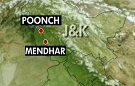
On a larger plane, the incident is likely to have been locally instigated, possibly in response to the killing of a Pakistani soldier during Indian retaliatory firing in the Uri Sector a week before the Mendhar incident. The Pakistan army has much to lose by activating the largely quiet Indian border when it is engaged in fighting major internal security challenges, even as the Pakistan government has been embroiled in countering continuing political turbulence, judicial activism, sectarian clashes and a stagnating economy. 

The Pakistan army is facing, perhaps, its deepest crisis since its strategic blunder in Kargil. Its counter-insurgency policy has been unsuccessful and casualties have been mounting. The use of air strikes and helicopter gunships to attack terrorist hideouts has proved to be counter-productive. The Pakistan army has been forced by the TTP to wage a three-front "war": against the TTP and the Islamic Movement of Uzbekistan (IMU) in South Waziristan; against the anti-Shia Lashkar-e-Jhangvi (LeJ) in the sensitive Darra Adam Khel-Kohat area of NWFP and the Shia-dominated Kurram Agency of FATA; and, against the Tehrik-e-Nifaz-Shariat-e-Mohammadi (TNSM), headed by Maulana Fazlullah, and the Jaish-e-Mohammad (JeM) sheltering across the Durand Line in Afghanistan. 

Though it has flirted with peace deals with the militants, the army finds it impossible to meet the demands of the TTP and the TNSM. According to B. Raman, a noted counter-terrorism expert, these demands include the suspension of all military operations in the tribal areas; the withdrawal of army posts from the FATA; the release of all tribals arrested under the Anti-Terrorism Act; the release of Maulana Abdul Aziz Ghazi and tribal students arrested during the commando action in the Lal Masjid of Islamabad in July 2007; and, enforcement of the Sharia in the tribal areas.

The US and its allies have become increasingly more frustrated by Pakistan’s failure to deal with al Qaeda and Taliban militants launching raids on US and NATO troops across the Durand Line. The Chairman Joint Chiefs of Staff of the US and other officials have been meeting General Kayani frequently to impress on him the need to be more pro-active in counter-insurgency operations. Unilateral trans-border intervention against militants inside Pakistani territory by the US is continuing through drone strikes. President Obama may soon approve trans-border ground action through Special Forces. Under these circumstances, it would be grossly illogical for the Pakistan army to activate the LoC with India.

Pakistan must Reduce Tensions

The Pakistan army must make amends for its grossly unethical conduct and completely stop further violations of the informal cease-fire along the LoC. It must also stop sponsoring terrorism, as promised by Musharraf in January 2003, or else it must be ready to face retaliation. General Bikram Singh, the Indian Army Chief, said during his press conference on the eve of Army Day that India reserved the right to retaliate at a time and point of its choosing. The IAF Chief has also stated that if Pakistan’s response is inadequate, other options will have to be considered. The Indian army has felt for long that the only place where it can gainfully hit back at the Pakistan army is at the LoC and it would make full use of a breakdown in the cease-fire. No one in India wants a complete reversal of the gains of the last ten years during diplomatic negotiations. However, when the need for self respect and national dignity is weighed against the gains of diplomacy, the balance will weigh heavily in favour of national dignity.

Pakistan’s political turmoil, internal instability, a floundering economy and weak institutions make for an explosive mix. It is apparent to even lay observers that the country is in for even greater difficulties ahead. Its leadership would do well to bring down the tension on the LoC.