Monday, November 20, 2017

India’s Search for Big Power Status


Pinaki Bhattacharya

Introduction
Indian elite’s desire for big power status grew out of a belief about the Indic civilizational values that spread in the ages of antiquity to what we call North West, South East, East and even West Asia. Most of this proliferation took place from soft power sources like Hinduism carried through the vehicle of trade to these regions; in other times else through the vehicle of Buddhist proselytisers; only rarely through the sword arm of the rulers in an expression of hard power. This has given the country’s elite a sense of exceptionalism that was India’s very own. Eminent historians like Bipan Chandra noted that the Indian struggle for independence based on mass movements was unique in its nature. He wrote in his famous volume, India’s Struggle for Independence the following:
“The Indian national movement, in fact, provides the only historical example of a semi-democratic or a democratic type of political structure being successfully replaced or transformed. It is the only movement where the broadly (Antonio) Gramscian theoretical perspective of a war of position was successfully practiced, where State power was not seized in a single historic moment of revolution, but through prolonged popular struggle on a moral, political and ideological level….”
This broadly Gandhian freedom movement1 had only added grist to the mill of the ‘exceptionalist’ group. As a result, when the British colonialists left India after denuding of almost all resources, India still was a leader amongst the post-colonial nations, solely based on what Bipan Chandra would have liked to call as Jawaharlal Nehru’s ‘moral’ dispensation. Notwithstanding the likes of John Foster Dulles who found ‘Non Alignment’ to be immoral, in reality it was far bigger than the US armed invasions of Korea and the like.
But with time, as India’s economy improved adding value to the rather chimerical a measure of economic development, the gross domestic product (GDP), the Indian population turned increasingly ‘realist’ in strategic terms, with the profit motive being the primary source of their aspirational desires. 2 This also caused the Indian State to count on the fact of higher and higher appropriation of national resources for the armed forces, including the police forces at both the central and state level. 3
These developments also added to the idea of ‘comprehensive national power’ (CNP) – a Chinese term – that can be deployed in terms of national crises. This CNP was meant to be brought to bear in cases of foreign aggression, both in traditional and non-traditional methods. Having said that most of this is still in the realm of theoretic exploration of a modernising State.
Path of Progress
In 1960, the urban population as a per cent of the total population was about 18 per cent. This steadily rose to 33 per cent in 2015. In other words, 67 per cent of the population is still rural. Compare the figure with China, in the same time-scale, the population of the nation was 16.2 per cent in 1960 while it has risen sharply to almost 57 per cent by 2015. At constant 2010 dollar terms, China’s per capita GDP was in the negative territory to the extent of 26 per cent in 1961, while India’s was 1.7 per cent in black ink. But when in 2016 both, the Chinese economic growth slowed down to about 6 per cent and the Indian story notched up a rate of 5.8 per cent, the graphs converged.
The Chinese ‘Reforms and Opening Up’ under Deng Xiaoping really began to produce results consistently from the mid-1980’s and continued through to the 2000’s on the back of high exports. In the case of India, during the few Rajiv Gandhi years, showed growth of about 7-plus per cent only in one year 1988, but at a high cost of heightened short term loans through market borrowings. The ‘economic reforms’ programme initiated in 1991 showed a lag and began to rise on a moderate growth path of about 7 per cent from the year 2007 of the United Progressive Alliance (UPA)-I rule. This dipped by a couple of points during the 2008 financial melt-down. But India’s economic growth rose again between 2009 till 2015, till it dipped a tad in 2016. Since both the countries were at the similar level of socio-economic development, when a stable domestic leadership took power - in case of India in 1947 or in real terms,1950, and China in 1949 – clearly China has now marched ahead of the country in these terms too. 4
Be that as it may, the policies of both the nation-states still have to be geared towards the rural population since a vast number of them live there. Prime Minister Narendra Modi’s government too have given importance two important aspects: rural roads and electrification.
In terms of the quality of growth, however, China is much ahead of India. This essentially means the factor of redistribution of income to the poorest sections of the people is much higher in China than that of India. The World Bank table on percentage of population below the level of $1.90 per day shows data of the countries till 2013. In China’s case 1.3 per cent of the people earn less than the Bank monitored level. India’s numbers are obviously much higher. But since UPA-II’s mid-term, no reliable poverty data has been generated that can be taken as a measure of distributive justice. 5
Geo-strategic Goals
India’s geo-strategy is evolving still. While it is searching for a handle over the Indian sub-continent as its pre-eminent power, it still appears uncertain whether it can maintain its position untrammeled. All the other smaller nations fear having a ‘big brother’ in the neighbourhood. Hence, they seek an equivalence of sorts, by opening other fronts like Sri Lanka, Nepal, Bangladesh and of course, Pakistan who keep their channels of involvement open to the West – more out of habit as it being former colonial rulers – and now, China.
Unevenness of development in India – economic, social and cultural – is such that a dispassionate observer would barely see the odd islands of modernism in a sea of pre-modern societies. This is the most important cause of India being held back from achieving what its elite believe is its métier.
What are the causes of this situation developing? The first reason devolves upon the ruling class of the country – bureaucratic, political and even military – the same lot who dream ‘big.’ On another plane exists the Constitutional goals of ‘socialist, secular, democratic republic.’ Our delivery systems of public goods and services are so mired in corruption – bureaucratic, political and military (though this still remains the most credible institution of the country) – that China forged passed us by the end of the 1980’s as has been seen in the previous section.6
Beijing’s breath on the neck of the country – in real terms as in Siliguri Corridor, which also is called the eastern Chicken’s Neck – has made New Delhi to get closer to Washington. Understanding the limitations of its own reach into the Asian continent, the USA too is seeking to develop a closer relation with India, as a sort of a local sheriff, who will watch over common interests in what has been dubbed the ‘Indo-Pacific’ region.
Before India can fully take on that role, the country needs to fix the domestic systems. The biggest problem the country faces is corruption that devalues any regime which comes to power in the eye of the people. Besides these rent seekers misappropriate the resources that were to be distributed amongst the people in need. Media attention naturally amplifies the problem, though it must be said that one prime minister who had talked about 10 paisa of the development rupee reaching the people on the ground, had himself flamed out on the issue of commissions drawn for an artillery gun purchase.
Prime Minister Narendra Modi promised ‘clean governance’ and his evocative notion of ‘Swachh Bharat’ could easily have meant to end corruption through transparency and accountability. But how much he is successful in his mission will be known when there is impartial audit of the performance of his government – if at all possible at the end of his five year term. In geo-political terms his efforts translating into action – the approach seems to have been to eradicate most malpractices by systemic changes like demonetisation and tracing the offshored monies – is extremely important. Because from the beginning he has sought to project himself as a strong man, he is being watched closely by not just the nations of the neighbourhood but the faraway friends of India too.
In terms of India’s evolving geo-strategy, the maritime opportunities of limited projection of power has become evidently important. Scenario wise, the strategy of its Big Power engagement cannot be a zero sum game. Hence, its tactic of cooperation and competition with China will need to continue. Even as the US pushes for a quadrilateral relationship tying up with Japan and Australia besides India, the latter should remember the disaster of World War-II Japanese proposal of ‘Asian Co-prosperity Sphere’ or ‘Greater East Asian Co-prosperity Sphere’ – a thinly veiled attempt at extending Japanese imperialism in the continent. Thus the ‘correlation of forces’ or ‘balance of power’ to be maintained in Asia devolves a greater responsibility on India and demands from it to be the fulcrum. It has to firm up its own position by which it becomes the factor that tilts the scale one way or the other. Choosing the sides becomes important in these times of transition when the world is being challenged to bestow itself an order that would define the century.
The last world order that was established following the World War-II survived less than a hundred years; and is up either for renewal, and failing which, replacement. Chinese under Xi Jinping are making a serious effort at creating one, where they will truly be in the middle of a concentric circle of influence.7This is despite the exhortations of their leader who kicked off what is being considered the second Chinese Revolution, Deng Xiaoping. Deng, in his famous 24 character commandment had said, "Observe calmly; secure our position; cope with affairs calmly; hide our capacities and bide our time; be good at maintaining a low profile; and never claim leadership."8 Xi’s China wants not only to claim leadership but proliferate its form of governance as a global model of ‘best practices.’ By the same token Russia’s strongman Vladimir Putin wishes his own sense of a world order where it plays a key role in a post-communist fashion. India needs to be in a position to choose either side of spectrum, and be the decisive leader in either. Indeed it had become a balancing factor with the non-alignment mantra that went deep into the heart of the post-colonial nations as they were being born.
India’s other preference for ‘strategic autonomy’ segues into the model very well. For maintaining that space, its Big Power engagement strategy has to be fine tuned by which none of them can take umbrage. More specifically, Deng’s words coupled with a definite idea of avoiding the Thucydides Trap possibly remains less limiting than the Chanakyan adage of “Enemies enemy is a friend” as a homegrown wisdom.
Roadblocks
When CNP is understood to be a potent mix of economic and political power, social integration and military prowess, it does go beyond the traditional thought of solely instrumentalising international relations on the basis of the military teeth. For example, the problem lies in the processes of industrial development in the country. In that the biggest logjam is in terms of infrastructure. Over the last 70 years we have spent what are scarce resources, to the extent of a few lakh crore of rupees or a few thousand billion dollars, but have not been able to generate electrical power or enough carriage capacity or even roads to bear large volumes of cargo though road transport as the cheapest mode of carriage. Much of this money has vanished as loot into individual pockets lined up for precisely that.
When we launched the economic reform programme, two simultaneous developments took place. The first was the fire sale of public sector units irrespective of their profitability, in a way that Russia witnessed after the fall of the USSR. Second was the desire to create positive results to match the electoral cycles, that the pain of economic reorientation was apportioned to those who were disenfranchised, suffering privation, and also completely voiceless. The pleasure principle worked in favour of the middle classes that had been reared, ironically, on the money of a mixed economy, when most of the State assets created more jobs per unit of capital than the small but favoured private sector. To neutralise the effect of marketisation of the economy, the system needed regulatory mechanisms to be created at the earliest. Contrarily, the public sector shares scam and the stock market scams took place. This eviscerated the small investors who could have been the back-bone of the asset values of the market.
To create a quick pathway for the ‘fruits’ of economic reform available to the marginally advanced middle classes and to bypass the problem of the lack of infrastructure, the service sector was given the choice of being the primary driver of economic growth. Fortuitously, the Y2K problem came up and a minor tweaking of the operating systems of the cyber world was needed. This led to the information technology enabled services (ITES) boom – the call centre story. Simultaneously began the low end software design like keeping attendance records and financial accounting processes. This began the software boom, with concurrent impact on the education sector, and thus an emphasis on the English language training.
Then followed the real estate bubbles which were fuelled by comparatively easy money, i.e. institutional and non-institutional credit. While those satisfied the natural aspirations of the middle classes for dwellings, they became enclaves surrounded by shanty towns of those who were displaced from their rural homesteads as internally displaced people with an economic refugee status. On top of that was the real estate development business, first in mostly the unorganised sector and some of the big corporates who came into the game at the high end of the market. They really gave rise to the inflow of Non-Resident Indian (NRI) money that went into speculation based on the rising market. Post-2008 financial crash, this speculative investments became what is ‘unsold stock,’ and which contributed to the ‘bubble bust’.
An unofficial ‘exit’ strategy was allowed to the technologically obsolescent private sector owned by those captains of capital who had milked it dry in a ‘controlled’ economy, for legitimate and illegitimate wealth generation. The domestic media pundits, most weaned on family incomes earned from the fixed-tenure public sector jobs, became such votaries of market-driven economic development that the symbol of closed economy became the humble ‘Trabant’ car of East Germany, focused upon first by the anti-left, international media. But the domestic pundits here failed to account for the ‘Ambassador’ car that was a classic example of how protected the private industry was by the successive governments. The engine and the mould of the car had not been changed for about four decades till a classic small car of Japanese-make came into the market; that’s another story for another day. But it remains a fact that barring in the exploitation of natural resources sector, industries, either domestic or of foreign origin, did not take root as easily as they did in China for two entirely different reasons. The former failed to be efficient producers despite artificially depressed wages; and the latter because of the absence of infrastructure like electricity generation, poor roads and over-burdened railways.
Manufacturing, thus shared space with agriculture in the lower bottom of the composition of gross domestic product. The results of de-industrialisation that is now felt in the Western economies is not a formula that this country would have had to follow. Western manufacturing jobs were lost to low wage nations like China, and even some of the so-called ‘Asian Tigers.’ But India too was in the same category. While the prized FDI inflow was a trickle, the country even suffered from skills deficits – some of the people required retraining and some others, new skills. The Indian Institutes of Technology (IIT) and Indian Institutes of Management (IIM) though produced technically qualified professionals, who preferred to add to the GDP of the rich West than the home country where they had had subsidised education. This takes us to the issue of solidity of the Indian economic growth. For the key income generator of the rural population, which is still – after 30 years of reform – bigger than the city dwellers, remains agriculture. And there was little or zero reforms in this crucial sector. It also suffered from a lack of fresh investments.
To be clear, the terms of trade between agriculture and industry remained adverse for farm sector right from the beginning of the economic reform programme.9 A major contributor to this is the tapering off the ‘Green Revolution’. Though movement of labour and capital did not flow out of the sector at a similar level as that of China, there was still some movement that had deleterious effect on the middle peasantry, especially even as their small savings were depleted by various Ponzi schemes which proliferated due to absence of any regulatory or advisory mechanism of the State. As a result the pace of industrialisation slowed, the expected concomitant urbanisation was small, and farmer’s suicide rate, that can only remain as blot on the larger society, continued to rise.
These barriers to the growth of CNP thus cried for attention.
Conclusion
Quite to the contrary of the National Democratic Alliance (NDA)-I regime that seemed to be a part of what can be called the ancien regime, the NDA-II came to power with a certain mission-mode readiness. Some of the targets they set were composite in character. However, they were of course not trying to change the class character of the Indian society.
Some illustrations are necessary for one to explicate the NDA-II phenomenon. It focused at the micro level on creating connectivity, roads mostly, from the viewpoint of facilitating trade – both intra-national and international. And it talked about hundred per cent electrification. The resource allocations were connected to the tenure of the regime and the targets were achievable. At the macro level, ironically, despite the nominally right wing coalition, it remains decided to have inspection of especially the urban sector – they also went for fiscal consolidation. Thus despite the issues related to the dominant West undergoing drastic meltdown, the country’s current account deficit remained at a low level; while the foreign exchange reserve remained on a higher plane.
Finally, there was an intense focus on giving fillip to the degraded yet important sectors of the economy – as has been reflected in the previous sections – by re-capitalising Public Sector Undertaking (PSU) Banks after a write-down of the non-performing assets accumulated over decades; directly transferring resources to those at the bottom of the pyramid; and seeking to increase the pace generally of economic reform programme.
This brings to bear the first research question of how to become a Big Power – on an exceptionalist basis. The path is long and tortuous; but the country is readying itself for its place at the global altar for some time now. The time window for achieving its goal is fast shrinking.
Endnotes
1. Broadly Gandhian independence movement essentially implies that the country also had a large groups of revolutionaries who did not ascribe to the non-violent method of MK Gandhi. They equally had an immeasurable impact on the British colonialists.
2. When this aspirational profit motive becomes the driving force of a society, it turns to what Karl Marx called product fetishism. This is quite in contrast of the spiritual abnegation that marked the history of Bharat – from the antiquarian times to a Gandhi to a Sundarlal Bahuguna. While it is debatable whether self abnegation can quite contribute to the material growth of the larger population of a nation-state, but it certainly helps in terms of emancipatory ‘Dharma’ which can dictate life. While ‘dharma’ is not religious but universally social in understanding, the closest Quranic word is the Arabic etymology of ‘ijtihad.’
3. A post-Westphalian modern nation-state needs a ready sword arm; in comparison to the other comparative societies of the West and East the forces are much smaller per capita. Some experts in the country argue that the ratio of the police force with respect to the whole population is too small for maintenance of order and upholding the writ of the law, but the fall-out of the militarisation of civil police is now being witnessed in the USA, for one.
4. All data have been sourced from the World Bank.
5. Dr. Manmohan Singh’s first UPA-I government undertook a solitary intervention in terms of addressing endemic poverty in the country called MGNREGA (Mahatma Gandhi National Rural Employment Guarantee Programme). The issue was born out of a plan by the Left Front that supported the government from outside. For form’s sake the idea was fleshed out by the National Advisory Committee (NAC) chaired by Mrs. Indira Gandhi. The confusion however was on account of the poverty count that created widespread conflict, within and outside. All this is well documented in news publications’ columns, and a few scholarly treatises. Read Suresh Tendulkar, Abhijit Sen, Surjit Bhalla et al.
6. China, like any other country of the world, also suffers from the problem of large degree of corruption. But ever since the demise of the Soviet Union, the unitary Party-State has grown a fear of popular revolt (they call it social instability) that they have had to deliver some of the public assets to the people. That, and what former president of China created a notion of ‘China Dream’, was shared by all, creating equivalence across classes. The concept of ‘class’ in a supposedly communist country creates a problem about the Marxist Thought. But the recent 19th Communist Party of China (CPC) Congress has created the ‘two stage’ development plan which in some way ameliorates the idea of an evident class system.
7. The 19th CPC Congress held extensive discussions on the world order and even pitches for a model of governance that revives memories Beijing Consensus, as reported by Xinhua, South China Morning Post etc.
8. 8 Vogel, Ezra, Deng Xiaoping: Transformation of China
9. World Bank Country Reports, ironically contributed by the likes of Ashok Gulati, Kaushik Basu and Ors.
(Pinaki Bhattacharya is strategic security researcher and analyst.)
(Views expressed are of the author and do not necessarily reflect the views of the VIF)

Friday, November 17, 2017

Analysis of China’s 19th Party Congress


Jayadeva Ranade

Already holding over fourteen formal positions -- more than any other Chinese communist Party (CCP) leader so far – CCP CC General Secretary Xi Jinping has, as anticipated, emerged considerably stronger from this Congress. By skilful use of the sustained anti-corruption campaign he has eliminated opposition in the Party and military and drastically reduced the influence wielded by his predecessor once removed, Jiang Zemin. In September 2017, China’s official media publicised that more than 176 CCP cadres equivalent to the rank of central Vice Minister and above had been dismissed and arrested for corruption and that more than 14,000 officers of the People’s Liberation Army (PLA) had been similarly dismissed. At least 120 officers of the PLA of and above the rank of Major General have been dismissed and retired.
Just weeks before the Congress, Xi Jinping publicly demonstrated his authority by arresting two top Generals (Fang Fengui and Zhang Yang), appointing 20 General Officers to command thirteen new Group Armies and promoting close associates to head the PLA Army (ground forces) and PLA Air Force. In a rare move, the names of thirteen delegates selected by Chongqing Municipality were deleted reducing the total number of delegates to 2287. A couple of days before commencement of the Congress another seven were ‘disqualified’. Politburo (PB) member and Chongqing Party Secretary Sun Zhengcai, viewed a likely candidate for the Politburo Standing Committee (PBSC), was also suddenly dismissed on charges of graft. He had been admonished in February for not doing enough to eliminate the influence of imprisoned former PB member Bo Xilai.
Xi Jinping had also been projecting himself since November 2012. The People’s Daily, for example, during Jiang Zemin’s tenure used to publish approximately 3,000 stories per year mentioning him and during Hu Jintao’s term it published 2,000 each year mentioning Hu Jintao. In stark contrast, the People’s Daily already publishes 5,000 stories each year mentioning Xi Jinping.
A major highlight of the week long (October 18-24, 2017) 19th Congress of the CCP, which was held in Beijing, was its recognition of Xi Jinping’s contribution to Chinese communist ideology. The Congress unanimously approved its incorporation into the Party Constitution as ‘Xi Jinping’s Thought on Socialism with Chinese Characteristics for a New Era’. He is the first CCP leader to have his contribution, attached to his name, enshrined in the Party Constitution while still alive. This places it next in heft to those of Mao Zedong and Deng Xiaoping, especially with the Chinese media already having begun to headline it as “Xi Jinping Thought”!
Xi Jinping’s ambition to be included in the pantheon of Chinese communist revolutionary thinkers was glimpsed early in June 2014 when the Party theoretical fortnightly ‘Qiu Shi’ (Seeking Truth) described him as “one of China’s greatest communist leaders” who had put forward “new thinking, new views and new conclusions”. The public campaign to promote inclusion of Xi Jinping’s thinking in the Party Constitution seriously kicked off in June 2017. The social media account of the overseas edition of the CCP’s official mouthpiece ‘People’s Daily’ had then revealed that the Director of the CCP Central Committee (CC) General Office Li Zhanshu had announced in an internal speech in February that President Xi Jinping’s political philosophy was “basically complete.” This was followed by a series of speeches eulogising Xi Jinping’s political wisdom. In the weeks leading to the 19th Party Congress and between August 7 and September 18, 2017, Party Secretaries of thirty one provinces and autonomous regions wrote signed articles in the official CCP newspaper ‘People’s Daily’.
Approval by the 19th Party Congress to the appointment of many Xi Jinping loyalists, who now constitute the majority of the membership of the PBSC, the PB, CCP CC Secretariat and the Central Military Commission (CMC), underscores the unmistakable -- and anticipated -- enhancement of Xi Jinping’s authority and influence. Pertinent in this context are the revelations by China’s official media, in the weeks before the 19th Party Congress, of the successes achieved by the campaign against corruption, and on the side lines of the Congress on October 20, by Liu Shiyu, Chairman of the China Securities Regulatory Commission, who said “Xi Jinping had saved socialism by bringing down high-ranking officials who intended to “usurp the party leadership and seize state power” describing Xi Jinping as a “saviour of the Communist Party”. Liu Shiyu has since been promoted to the CCP CC!
Interesting are the affiliations of the new leaders appointed to the PBSC, whose number remains at seven. The composition of the new PBSC shows that while Xi Jinping has followed the Party's informal rules and convention regarding retirement age of senior echelon cadres, he has avoided inducting younger cadres who could be potential successors in the PBSC. The field for advancement to the next PBSC and as successors to Xi Jinping and Li Keqiang have, therefore, been left wide open for the younger cadres now in the PB. The field is open too for Xi Jinping to continue in office as, which some of his acolytes have been saying since 2013, China enters a new thirty year era like those of Mao Zedong and Deng Xiaoping earlier!
The new PB, like the previous one, has 25 members. Apart from the seven PBSC members, Xi Jinping has a clear majority among the remaining 17 PB members also. At least 12 of them are long-time Xi Jinping loyalists not including the two Vice Chairmen of the CMC who are very close and long time associates of Xi Jinping. Some of the PB members are poised to take over as heads of Central Party organisations. They all owe their rise to him.
Equally important is the CCP CC Secretariat, which has in the past five years under Xi Jinping become a powerful body. It reports directly to Xi Jinping. Xi Jinping has packed the important new 7-member CCP CC Secretariat with loyalists and Wang Huning is its senior-most member. The previous 18th CCP CC Secretariat was headed by Liu Yunshan who, like Wang Huning is now, was in charge of ideology, the propaganda apparatus and Party organisation. Three of the Secretariat’s members are persons with a background in security or the military namely, Yang Xiaodu, Guo Shengkun and Huang Kunming. The indication is that Party controls on these sectors will continue to become progressively tougher.
At least two members of the new CCP CC Secretariat have a background in Tibet affairs. In addition to Wang Huning, who has in the past been a member of Tibet Autonomous Region (TAR) delegations to the National People’s Congress (NPC), these are Yang Xiaodu, a ‘sent down youth in the Cultural Revolution’ and till recently Minister of Supervision who served in the TAR from 1976-2001, and Guo Shengkun who as the Minister of Public Security (MPS) attended meetings of the Leading Small Work Group on Tibet. Huang Kunming, another member of the Secretariat has served in the PLA. As anticipated, TAR Party Secretary Wu Yingjie has been promoted to the new 19th CC as a Full Member. In addition, this time there are two ethnic Tibetans, Qi Zhala (Choedak) and Luosang Jiangcun (Lobsang Gyaltsen), as Full Members of the CC - one more than in the previous CC - and one, Norbu Dhondup, as an Alternate Member of the CC. Sun Chunlan who heads the CCP CC United Front Work Department (UFWD) and handles Tibet affairs, continues as the solitary woman in the PB despite being 67 years of age which actually puts her in the retirement zone. Interestingly Zhang Qingli, who was born in 1951 and earned a reputation as a hard-line TAR Party Secretary for his derogatory comments about the Dalai Lama, continues as a Full Member of the 19th CC. Zhang Yijiong, present Executive Deputy Head of the UFWD and Vice Minister who on the side lines of the 19th Party Congress outlined China’s new strong policy towards the Dalai Lama, has been promoted from Alternate Member of the 18th CC to Full Member of the 19th CC. All of them will have a strong voice in formulation of Tibet policy.
The new CMC consists of military officials who are all solid supporters of Xi Jinping. The composition and size of the new CMC has also changed. For the present, it comprises only four members and does not include the heads of the different services like the PLA Air Force (PLAAF), PLA Navy (PLAN) etc. The two CMC Vice Chairmen, former PLAAF Commander Xu Qiliang and PLA General Zhang Youxia, are both ‘princelings’ with long-time association with Xi Jinping. The new CMC Vice Chairman, Zhang Youxia’s father Zhang Zongxun fought alongside Xi Jinping’s father and they were called ‘partners in blood’. Zhang Youxia has fought in the Sino-Vietnam war in 1979. The presence of Xu Qiliang, Zhang Youxia and PLA Rocket Force Commander Wei Fenghe in the CMC point to an emphasis on the development and acquisition of modern, advanced defence technology. The induction of General Li Zuocheng, head of the Joint Staff Department under the CMC, and Lt. General Zhang Shengmin, Secretary of the PLA Discipline Inspection Commission, indicate that Xi Jinping will maintain the stress on a ‘clean’ and corruption free armed forces. Zhang Shengmin, incidentally, previously served in the 52th, 55th and 56th Bases of the Second Artillery in the Lanzhou Military Region and was Political Commissar of the Second Artillery Command College between 2012 and 2013. General Miao Hua as head of the Political Work department under the CMC will further Xi Jinping’s agenda of expanding Party control and supervision over China’s armed forces ensuring that the personnel are ‘red and expert’.
The new appointments in the CCP’s top bodies will allow Xi Jinping to pursue his ambitious agenda with few constraints. He will be free of any restraints in pursuing realisation of the “Two Hundreds” namely, the ‘China Dream’ (by 2021 which marks the CCP’s centenary) and making China an advanced developed nation (by 2049, or the hundredth year of the founding of the People’s Republic of China (PRC)). It additionally leaves open the possibility of him extending his term.
There were some important additional highlights of the 19th Party Congress. The Party, China and Army were mentioned often in Xi Jinping’s Work Report along with a specific reference to the Belt and Road Initiative (BRI). Less mentioned were the economy, reform and development. Xi Jinping for the first time made a direct linkage between the completion of China’s second and final stage of development in 2035 and the PLA becoming a world class fighting force. There was emphasis on the PLA with the term ‘Army’ mentioned more than double the number of times than in the Work Reports presented at the 17th and 18th Congresses. It was mentioned 86 times in Xi Jinping’s Work Report to the 19th Party Congress and 49 and 54 times in the Work Reports presented at the 18th and 17th Party Congresses respectively. Xi Jinping announced that the Army’s focus will be on realisation of the ‘Chinese Dream’ for which it must develop “a new military strategy under the new situation” while national defense and military modernization will be promoted. Clarifying that by 2020, mechanization will basically be achieved and that the modernization of national defense and armed forces should be mostly completed by 2035, Xi Jinping said that “it (Army) has come a long way and strategic capabilities have seen a big improvement.” He underscored technology as the PLA’s “core combat capability”. Xi Jinping asserted that the goal is to make the PLA a “world class force” that “can fight and win” by 2050. This timeline coincides with realisation of the BRI and China becoming a nation with “pioneering global influence”. Xi Jinping also pointedly described the PLA as a “people’s army”.
The references to Hongkong, Macau and Taiwan were uncompromising with a strong suggestion of limits imposed on these. With regard to Taiwan, Xi Jinping said “we have the resolve, the confidence and the ability to defeat separatist attempts for Taiwan independence in any form. We will never allow anyone, any organisation or any political party, at any time or in any form, to separate any part of Chinese territory from China”. He asserted that the CCP “stands firm in safeguarding China’s sovereignty and territorial integrity, and will never allow the historical tragedy of national division to repeat itself”.
There was pronounced emphasis in the Work Report on “the Party exercising leadership over all areas of endeavour in every part of the country”, clearly indicating that Party controls will be expanded and ideology will remain predominant. Xi Jinping emphasised that “sweeping efforts” had been made to “strengthen party leadership and party building” while dismissing any notion of copying “western style democracy”. There were 331 references to the ‘Party’ in this Work Report, many more than in the Work Reports at the past eight Congresses.
Finally, Xi Jinping has lost no time in further consolidating his position and concentrating more power in his person. The first meeting of the new PB on October 27, in its notification, formally recognised Xi Jinping as the ruling Communist Party’s lingxiu – a reverential term for “leader” instead of the usual lingdao or lingji. It also stated that henceforth all PB members will not only inspect all organisations and cadres under them and submit annual reports to the concerned central Party organisations and the PB, but also to Party General Secretary Xi Jinping. He has already announced that the anti-corruption campaign will continue to be pursued with vigour and appointed his long-time loyalist and PBSC member Zhao Leji as head of the Central Discipline and Inspection Committee (CDIC).
A clear indication of China’s confidence in founding a modern socialist country by 2050 has already been articulated by the state-owned Global Times on October 25, 2017. Stating that some Westerners find this level of confidence challenging, it said they should actually see this as an opportunity and “it is time for these people to open their hearts to China”. Emphasising that China will not only be a strong nation with a first-class army, but will focus on its continued pursuit of harmony, balancing an ecological environment, and democracy, it said, “This modernized country will serve its people, rather than seek revenge upon the world in efforts to establish global hegemony”. At the same time, it warned that “China will not tolerate disruptions of any kind during this new phase of socialist modernization” adding that “if for whatever reason the nation's peaceful development is thwarted by external influence, China will not hesitate to strike back with sharp strategic force, or if necessary, prepare for a full-scale showdown. Of course, a situation of this nature will lead to consumption, and have a negative impact on the realization the nation's goal for 2050”. It also said that when “China's peaceful ascension is realized, it will be a watershed moment for humanity, a form of development completely removed from the laws of the jungle. The determination to grow into a powerful and peaceful nation will remain intact”. Pertinent to recall in this context is the resolution adopted at the Conference on Peripheral Diplomacy in October 2013, that countries which oppose China will face periods of sustained opposition and pressure!
In conclusion, the 19th Party Congress has sent out the following clear messages:-
(i) The Party will pervade and dominate all sectors in China, i.e. government, military, economy and society;
(ii) China is confident it will achieve the developmental goals set out for the first time by Xi Jinping, i.e. period 2020-2035 to make China a technologically advanced and moderately developed country in the top ranks of the world, and period 2035-2050 to make China a strong developed nation having “pioneering global influence”;
(iii) ‘Xi Jinping Thought on Socialism with Chinese Characteristics for a New Era’ is an alternate to western-style democracy; and
(iv) incorporation of the BRI in the Party Constitution now elevates it to a national development goal with the warning against its obstruction issued on October 25 taking on added significance.
(The author is a former Additional Secretary in the Cabinet Secretariat and is presently the President of the Centre for China Analysis and Strategy)
(Views expressed are of the author and do not necessarily reflect the views of the VIF)

Image Source: http://fortune.com/2017/05/15/china-xi-jinping-belt-road-summit-protecti...

सरदार सरोवर परियोजना: बड़ी उपलब्धि


Rajesh Singh, Visiting Fellow, VIF

प्रधानमंत्री नरेंद्र मोदी ने दक्षिण गुजरात में नर्मदा नदी पर बना सरदार सरोवर बांध 17 सितंबर को राष्ट्र को समर्पित कर दिया। इससे लाखों परिवारों और हजारों हेक्टेयर कृषि भूमि को जल देने वाली विशाल परियोजना ही पूरी नहीं हुई। यह क्षुद्र स्वार्थों के कारण पक्षपाती एजेंडा पर काम करने वाले तमाम व्यक्तियों और संगठनों द्वारा खड़ी की गई बाधाओं पर विकास की राजनीतिक की विजय भी थी। सितंबर के कार्यक्रम के साथ ही 1961 में देखा गया वह सपना भी पूरा हो गया, जो रास्ते में आने वाली अड़चनों से पार पाने की इच्छाशक्ति नहीं होने के कारण अधूरा रह गया था।
गुजरात सरकार द्वारा दिए गए आंकड़ों के अनुसार सरदार सरोवर परियोजना - जिसका नाम उन सरदार वल्लभ भाई पटेल के नाम पर रखा गया था, जो इस परियोजना के पीछे प्रेरक शक्ति थे (उन्होंने देश की स्वतंत्रता से पहले ही इसका सपना देख लिया था) और जिनके संकल्प के कारण प्रधानमंत्री जवाहरलाल नेहरू ने इसका शिलान्यास किया था - से 18 लाख हेक्टेयर से अधिक भूमि को सिंचाई की सुविधा मिलेगी और राज्य के लगभग 72 तालुकों में 3,000 से अधिक गांवों को जिससे लाभ होगा। इससे राजस्थान में 2.46 लाख हेक्टेयर भूमि और महाराष्ट्र में बड़े भूभाग की सिंचाई में भी मदद मिलेगी। केंद्रीय मंत्री नितिन गडकरी ने कहा कि इस परियोजना के कारण “चार करोड़ गुजरातियों को पीने का पानी मिल जाएगा।”
विभिन्न राज्यों को इससे मिलने वाले इतने अधिक फायदों को देखते हुए इसका विरोध हैरत में डालने वाला ही था। पारिस्थितिकी तथा जन विस्थापन आदि से जुड़े जो मुद्दे उठाए गए, वे प्रासंगिक थे किंतु जैसे-जैसे काम आगे बढ़ता गया, उन्हें सुलझा लिया गया। अधिकतर निष्पक्ष पर्यवेक्षकों के सामने यह स्पष्ट हो गया कि आलोचक केवल इसलिए अड़े हैं क्योंकि अलग-अलग कारणों से उन्होंने यह परियोजना पूरी नहीं होने देने की ठान ली है। राजनीतिक जगत के भीतर और बाहर के शक्तिशाली हितधारकों के समर्थन वाले सामाजिक कार्यकर्ता मौके पर पहुंच गए और उन्होंने एक तरह से घेराबंदी ही कर ली, जिससे सरदार सरोवर बांध के काम में देर हो गई। आरंभ में परियोजना की लागत 6,000 करोड़ रुपये होने का अनुमान लगाया गया था, जो बाद में बढ़कर 50,000 करोड़ रुपये तक पहुंच गई। और इससे निर्माण की लागत ही नहीं बढ़ी बल्कि इसके कारण गुजरे दशकों के दौरान हजारों हेक्टेयर जमीन की ठीक से सिंचाई नहीं हो सकी और लाखों घरों को पानी नहीं मिल पाया, जो उन्हें नर्मदा नदी से मिलता। हालांकि पहले दो दशक संबंधित राज्यों द्वारा विभिन्न अध्ययन कराए जाने में ही गुजर गए, जिनके बाद योजना आयोग ने इस पर मुहर लगाई। आरंभिक अध्ययन रिपोर्टों में जल के प्रयोग का जो खाका खींचा गया, उसका महाराष्ट्र, गुजरात और मध्य प्रदेश ने जमकर विरोध किया। साझा सहमति नहीं बन पाने के कारण 1969 में नर्मदा जल विवाद पंचाट का गठन करना पड़ा। मामले का गहन अध्ययन कर रहे पंचाट ने दस वर्ष बाद यह समाधान दियाः लगभग 35 अरब घन मीटर उपलब्ध पानी में से मध्य प्रदेश को 65 प्रतिशत, गुजरात को 32 प्रतिशत और महाराष्ट्र तथा राजस्थान को 3-3 प्रतिशत हिस्सा मिलेगा। उस समय ऐसा लगा कि विवाद निपट गया है और परियोजना पूरी तेजी से आगे बढ़ेगी। लेकिन उसके बाद तथाकथित सामाजिक कार्यकर्ताओं ने इसे निशाना बनाना शुरू कर दिया, जो ख्याति (और धन?) की चाह में उसी तरह चले आए थे, जैसे पतंगा लौ के पास पहुंच जाता है।
इसे खारिज करने वालों में प्रमुख कार्यकर्ता मेधा पाटकर थीं। विभिन्न क्षेत्रों - राजनीति, साहित्य और सिनेमा भी - से अपनी ही तरह सोचने वाले विघ्नकारियों की मदद से उन्होंने जो संसाधन जुटाए थे, उन्हें देखकर उनकी ताकत को कम नहीं आंका जा सकता। उनके साथ मिलकर पाटकर ने सरदार सरोवर बांध परियोजना को रद्द कराने का आंदोलन छेड़ दिया। उनके कारण अलग-अलग थे और उन्होंने बेहद सावधानी के साथ उन सब पर जनता और पर्यावरण की भलाई के मकसद का मुलम्मा चढ़ा दिया; उन्होंने दावा किया कि इसके काण हजारों लोगों को विस्थापित होना पड़ेगा और राज्यों के पास विस्थापितों के लिए उचित राहत एवं पुनर्वास योजना नहीं है। लेकिन उन्हें पता था कि इस मामले में कोई उम्मीद ही नहीं है क्योंकि इसमें शामिल राज्य आगे बढ़ने की ठान चुके थे और उनके दुष्प्रचार की परवाह नहीं करने वाली आम जनता को पता था कि सरदार सरोवर बांध से उसे कितना फायदा होने वाला है। उन्होंने हरेक कोशिश कीः अनशन किया और टेलीविजन कैमरों की चौंध के नीचे जमीन पर लेटी रहीं, बांध बनने पर आने वाली आपदा की भयानक लेकिन मनगढ़ंत कहानियां सुनाईं और परियोजना का समर्थन करने वाले नेताओं के खिलाफ जहर उगला तथा व्यक्तिगत आरोप लगाए। उसके बाद उन्होंने कुछ ऐसा किया, जिसे अधिकतर भारतीय सबसे बड़ा विश्वासघात मानते हैं। उन्होंने परियोजना के लिए मिलने वाली वित्तीय सहायता रुकवाने के इरादे से अपना अभियान तेज कर दिया।
उनके तीखे विरोध ने अंतरराष्ट्रीय मीडिया का ध्यान खींचा, जो भारत में विकास संबंधी योजनाओं में किसी भी तरह के विवाद को लपकने के लिए हमेशा तैयार रहता है। आरंभ में इस योजना के लिए धन देने को राजी हो चुके विश्व बैंक ने वास्तव में उनके विरोध के कारण ही पर्यावरण के मसलों आदि का हवाला देकर बाद में हाथ खींच लिया। पाटकर के नर्मदा बचाओ आंदोलन ने इसकी खुशी मनाई होगी। सबसे पहले 1985 में बांध निर्माण स्थल पर पहुंचने वाली पाटकर को पहली बार लगा होगा कि बांध पर पूरी तरह रोक लगाने में वह सफल रही हैं। किंतु उनकी सफलता कुछ ही समय तक टिकी। प्रधानमंत्री मोदी ने यह परियोजना राष्ट्र को समर्पित करते समय दावा किया कि विश्व बैंक के इनकार के बाद गुजरात के कई मंदिरों ने सरदार सरोवर के लिए धन दिया। धन कहीं से भी आया हो, लटक चुकी परियोजना फिर शुरू हो गई और तत्कालीन सरकार ने विश्व बैंक द्वारा मंजूर किया गया कर्ज मार्च 1993 में ‘रद्द’ कर दिया। हैरत की बात नहीं है कि करीब दो दशक पहले इन्हीं कार्यकर्ताओं के कारण विवाद उच्चतम न्यायालय की देहरी पर भी पहुंच गया और कई वर्ष तक अनसुलझा ही रहा। अंत में सर्वोच्च न्यायालय ने कुछ शर्तों पर पूरी ऊंचाई (138.68 मीटर) तक बांध बनाने की मंजूरी दे दी। शर्तों में एक यह भी थी कि ऊंचाई पहले की तुलना में पांच मीटर अधिक करने के कारण जो लोग विस्थापित होंगे, उनका संतोषजनक पुनर्वास होना चाहिए। सभी पक्ष इस पर फौरन सहमत हो गए और इस तरह परियोजना के विरोध में पाटकर की एक और दलील खारिज हो गई।
इस प्रकार शुरू में परियोजना का ‘पूरी तरह’ विरोध करने वाली पाटकर और उनके साथियों को जब लगा कि अदालत पर भी उनकी हरकतों का असर नहीं पड़ रहा है तो हालात से समझौता करते हुए वे ‘बुराइयां’ दिखाने और उन्हें सुधारने की जरूरत पर उतर आए। अदालत ने यह सुनिश्चित करने के लिए पद्धति तय कर दी थी कि विस्थापितों का समय पर और सही तरीके से पुनर्वास किया जाए। पर्यावरण से जुड़ी चिंताएं भी खत्म हो गई थीं। इस तरह कार्यकर्ताओं के पास शिकायत करने को कुछ रहा नहीं था। 2011 के बाद से सर्वोच्च न्यायालय की निगरानी में बांध की ऊंचाई बढ़ाई जाने लगी। इससे जुड़े कई पक्ष मानते थे कि पानी का घरों तथा सिंचाई में अधिकाधिक इस्तेमाल करने के लिए यह जरूरी है। 2004 तक बांध की ऊंचाई 110.64 मीटर हुई थी; मार्च, 2006 में इसे 121.92 मीटर करने की मंजूरी मिली और अब उसकी ऊंचाई अधिकतम सीमा तक पहुंच चुकी है।
कई दशकों पहले परियोजना पूर्ण होने की राह में कठिनाइयों और दुर्भावना के साथ खड़ी की गई अड़चनों की चुनौती थी। आज सरदार सरोवर बांध बन जाने के बाद इसके फायदे अंतिम व्यक्ति तक पहुंचाने की चुनौती है। लाभार्थियों (कृषि भूमि) तक जल ले जाने के लिए नहरों का जाल तैयार करना होगा। गुजरात सरकार के आंकड़े बताते हैं कि इस नेटवर्क में 532 किलोमीटर लंबी मुख्य नहर होगी और उससे निकले वाली 30 से अधिक शाखा नहरें होंगी। इसके अलावा छोटी और खेतों की नहरें भी होंगी। नहर प्रणाली और उससे लाभ लेने वाले क्षेत्र के आकार के बारे में अब भी अधिक स्पष्टता नहीं है। कुछ आलोचक कहते आ रहे हैं कि लाभ बढ़ा-चढ़ाकर बताए गए हैं। जो भी हो, सरदार सरोवर बांध परियेाजना देश की बड़ी उपलब्धियों में गिनी जाएगी।
(लेखक विवेकानंद इंटरनेशनल फाउंडेशन में विजिटिंग फेलो हैं और वरिष्ठ राजनीतिक टीकाकरण तथा लोक मामलों के विश्लेषक हैं)

Translated by: Shiwanand Dwivedi 
Image Source: 
http://www.sardarsarovardam.org/images/pageimages/3.jpg

Wednesday, November 15, 2017

Commentary - Presidential Elections in Kyrgyzstan: More Continuity than Change


Dr Rashmini Koparkar, Research Associate, VIF

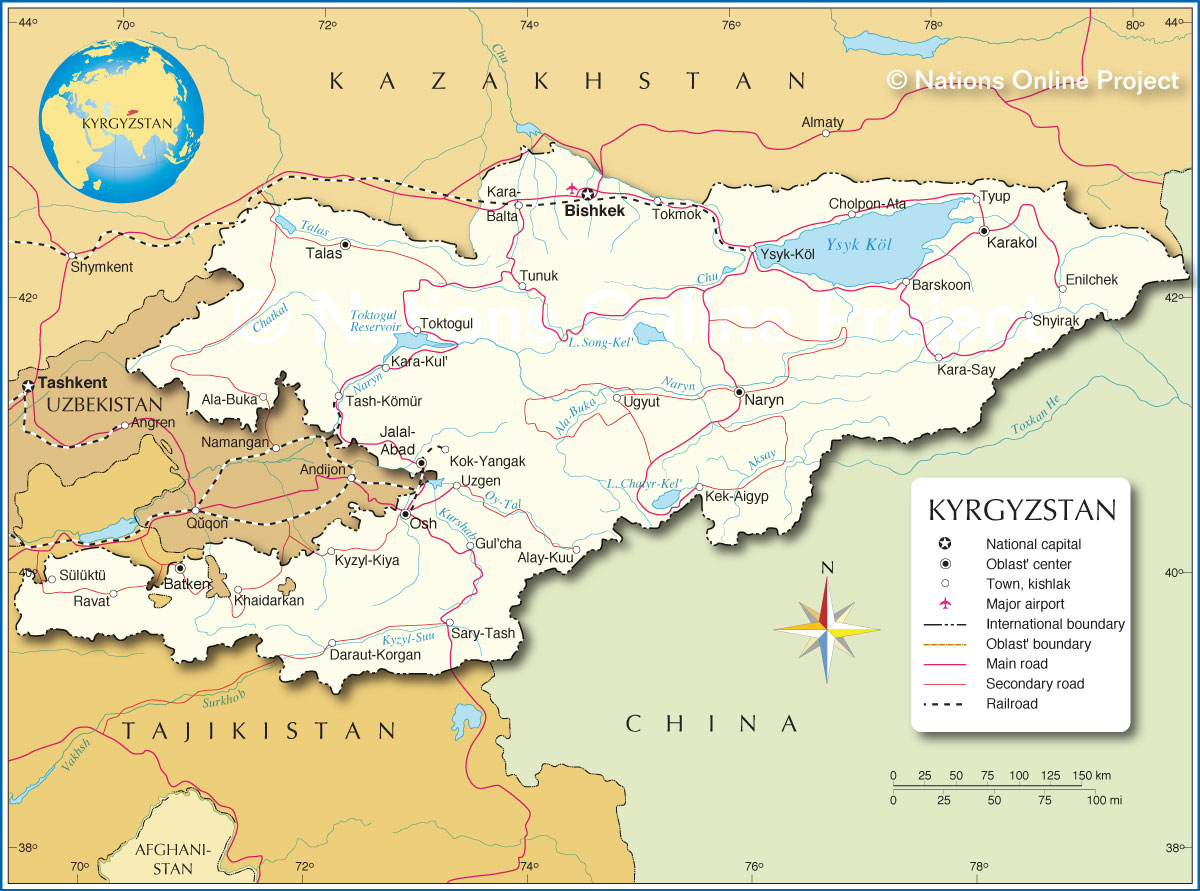
Kyrgyzstan is a small, landlocked and mountainous republic in the heart of Asia. Because of its remote location and tiny population (about 6 million) not much is reported about it. The country borders China on the east and three Central Asian Republics (CARs) on other three sides. It figures prominently in China’s One Belt One Road (OBOR) initiative. It is also the source country of the Central Asia- South Asia (CASA-1000) project that proposes to transmit electricity from Kyrgyzstan and Tajikistan to energy-starving Afghanistan and Pakistan.
Kyrgyzstan has gone through a great degree of political upheaval in last 15 years. Recently conducted Presidential election in Kyrgyzstan is remarkable and worth studying, as it marks republic’s first peaceful transition from one elected leader to the other. In national election on 15 October, the people of Kyrgyzstan have elected former Prime Minister Sooronbai Jeenbekov as the new President. He was the candidate of the ruling Social Democratic Party of Kyrgyzstan (SDPK) and was a pick of outgoing President Almazbek Atambayev. Jeenbekov received 54 percent votes out of total 1.67 million votes cast (56 percent of the total electorate). His most prominent rival, Omurbek Babanov of the Respublika Party received 33 percent votes1.

President-Elect Sooronbai Jeenbekov
Political History of the Kyrgyz Republic
Kyrgyzstan, which became independent in 1991 as a result of the Soviet disintegration, has witnessed considerable political turmoil in recent years. The first Kyrgyz President Askar Akayev was overthrown in 2005 in what is called the “Tulip Revolution”, leading to Kumranbek Bakiyev becoming the new President. In 2010, the country witnessed devastating ethnic riots between Kyrgyz and the Uzbeks in the southern city of Osh. These riots led to political upheaval and ousting of Bakiyev who was facing corruption charges.
Under the interim Presidency of Rosa Otunbayeva2, a new Constitution was adopted that declared Kyrgyzstan a Parliamentary Democracy, making it a standalone case in Central Asia. Some powers were transferred from President to the Parliament; and presidential tenure was restricted to only one term. The constitution was ratified in a National Referendum, and fresh elections were held in 2011, making Almazbek Atambayev the fourth President. In spite of adopting the parliamentary government, which technically makes Presidential post ceremonial, Presidential office still holds considerable power and influence vis-à-vis the Prime Minister. In December 2016, Kyrgyzstan again held a referendum to transfer some more powers from the President to the Prime Minister3. This process of reforming the political system and creating democratic institutions is still going on.
Political volatility of the Republic seems to have inversely affected the economic development as well as foreign investments. Kyrgyzstan is one of the poorest post-Soviet republics that is heavily dependent on precious metals, agriculture, or remittances from workers working in Russia. The gold sector accounted for 25 percent of country’s industrial production, and 42 percent of its exports in 2015. In 2016, GDP received a blow due to falling gold production4. However, in 2017, with smooth conduct of elections, steady increase in gold production and recovery of remittances from Russia, the real GDP is estimated to grow at 5.5 percent, stabilizing the economy5.
Significance of the Current Election
The new Constitution restricts the Kyrgyz President to a single term of six years and prohibits him from re-election. Accordingly, incumbent President Almazbek Atambayev became ineligible for contesting the next election. Unlike many other Central Asian leaders that have extended their terms through constitutional amendments, Atambayev gracefully decided to step down paving the way to President-elect to take over. In 2011, Atambayev took over the country that was full of chaos and confusion. It is to his credit that stability was successfully restored in Kyrgyzstan. Jeenbekov’s victory is in a way a ‘vote for stability’ maintained by Atambayev in last six years6.
Smooth conduct of Presidential election reflects nation’s urge towards democratization and electoral polity. It was a truly competitive contest between 13 candidates from various regions and backgrounds. Most of the international observers have recognized the election as open and democratic. Highlight of these polls was the use of new technology and novel electoral method, where each voter was given a biometric identification7.
President-elect Jeenbekov has served the nation as the Prime Minister since April 2016. Before that, he had served as country’s Agriculture Minister and the Governor of his native region of Osh8. This long-standing experience of governance will help Jeenbekov in delivering as the President. He has announced that he will continue the policies of the incumbent President, including the reforms9.
Jeenbekov comes from the Osh region, situated in Fergana Valley in southern Kyrgyzstan. In elections, he has received massive support from the southern regions. However, after coming to power, he has to tackle the differences between the south and the north. Mostly the northerners had supported opposition leader Babanov; and the north-south tension will linger for the time to come.
Small and economically underdeveloped country like Kyrgyzstan cannot afford another political blow. Therefore, President has a challenge to maintain unity and stability. His other challenges include anti-corruption laws, and reforms in health, education and the judicial systems10. Threats of terrorism and violent extremism also have been surfacing inside the country, and to tackle these menaces is a huge task.
Impact on International Relations
During elections, Kyrgyzstan’s relations with neighboring Kazakhstan had soured, as President Atambayev accused the Kazakh President for interfering in the electoral process by meeting opposition candidate Babanov. Though the Kazakhs have dismissed these allegations, the incidence led to a degree of uneasiness. Kyrgyzstan went on to denounce the agreement on economic cooperation with Kazakhstan within the Eurasian Economic Union (EEU) 11. Relations between the two will take some time to normalize. Newly elected President of Kyrgyzstan has a larger role to play in this.
Kyrgyzstan’s relations with its western neighbor Uzbekistan have witnessed upper trajectory in last one year. Credit for this goes to Atambayev as well as the newly-elected President of Uzbekistan Shavkat Mirziyoyev, who together resolved certain irritants in fields like border cross points, immigration, connectivity and trade. It now depends on Jeenbekov to take this positive relationship forward.
China, with whom Kyrgyzstan shares long border, has made deep economic inroads based on investments, infrastructure and trade. It is vital in China’s connectivity projects in the west. China is currently constructing the China-Kyrgyzstan-Uzbekistan railway line, which will integrate the Kyrgyz Republic with the regional economies. Similarly, Kyrgyzstan hosts Russian military base at Kant, near capital Bishkek. It is also part of the Russia-led regional groupings, namely EEU and Collective Security Treaty Organization (CSTO). Therefore, it will be crucial to balance the influence of Russia and China, and still maintaining sovereignty of the small republic. Kyrgyzstan is heavily dependent on Russia for trade and remittances and gets affected by up-downs in the Russian economic situation. President Atambayev had maintained sound relations with Russia, especially because of his excellent personal rapport with Russian President Putin. President-elect Jeenbekov is also likely to continue that relationship.
India and Kyrgyzstan have recently completed 25 years of establishment of diplomatic relationship. President Atambayev paid a state visit to New Delhi in December 2016, and Modi had visited Bishkek in July 2015. The two countries have developed cooperation in the areas of defense, security, elections, IT, human resource development, culture, agriculture and tourism. India has offered Kyrgyzstan training and cooperation in electoral and parliamentary matters. Indo-Kyrgyz joint military exercises called ‘Khanjar’ have become an annual event. On the other hand, Kyrgyzstan had supported India’s membership of the Shanghai Cooperation Organization (SCO) and also backs its bid for permanent membership of the UN Security Council12. India has to take the opportunity to establish close cooperation with the newly elected President of Kyrgyzstan.
End Notes:
1. “New President of Kyrgyzstan Elected in the First Round”, Kabar- Kyrgyz National News Agency, 15 October 2017, URL: http://kabar.kg/eng/news/new-president-of-kyrgyzstan-elected-in-the-firs...
2. Gizitdinov, Nariman, “Jeenbekov Wins Kyrgyzstan’s Presidential Elections”, Bloomberg, 15 October 2017, URL: https://www.bloomberg.com/news/articles/2017-10-15/jeenbekov-on-course-t...
3. “Referendum in Kyrgyzstan: 79% Voted for Constitutional Changes”, Trend News Agency, 11 December 2016, URL: https://en.trend.az/casia/kyrgyzstan/2696547.html.
4. Economic Intelligence Unit, Country Report on the Kyrgyz Republic, December 2016.
5. Economic Intelligence Unit, Country Report on the Kyrgyz Republic, October 2017, URL: http://country.eiu.com/kyrgyz-republic.
6. Mallinson, Kate, “Kyrgyz Election Shows There is Another Way Forward in Central Asia, Chatham House, 17 October 2017, URL: https://www.chathamhouse.org/expert/comment/kyrgyz-election-shows-there-...
7. “SCO Observers Recognized the Elections in Kyrgyzstan as Open and Democratic”, Kabar- Kyrgyz National News Agency, 16 October 2017, URL: http://kabar.kg/eng/news/sco-observers-recognized-the-elections-in-kyrgy...
8. “New President of Kyrgyzstan Elected in the First Round”, News Headlines, Official Website of the Kyrgyzstan Embassy in India, 18 October 2017, URL: http://www.kgzembind.in/?p=1118.
9. “First Interview of Kyrgyz President-elect”, Kabar- Kyrgyz National News Agency, 30 October 2017, URL: http://kabar.kg/eng/news/first-interview-of-kyrgyz-president-elect-i-wil....
10. Malinson, Ibid.
11. Mustafayev, Ali, “Kyrgyzstan Denounces Agreement Concluded with Kazakhstan within EEU”, Trend News Agency, 20 October 2017, URL: https://en.trend.az/casia/kyrgyzstan/2810815.html.
12. Indi- Kyrgyzstan Joint Statement during the state visit of President of Kyrgyzstan to India, Official Website of Ministry of External Affairs, 20 December 2016, URL: http://mea.gov.in/bilateral-documents.htm?dtl/27870/IndiaKyrgyzstan+Join...
(Views expressed are of the author and do not necessarily reflect the views of the VIF)

Image Source: http://www.nationsonline.org/maps/kyrgyzstan-political-map.jpg